
Artificial Turf Grass: A Prescott Homeowner Guide
A full-size synthetic sports field can save approximately 1.9–3.8 million liters of water per year compared with a comparable irrigated natural-grass field, but artificial turf isn't automatically the best choice for every Prescott yard. The right decision depends on heat exposure, foot traffic, drainage, maintenance expectations, and how you plan to use the space.
You may be looking at a tired lawn that turns brown during dry stretches, demands regular irrigation, or becomes muddy and difficult to maintain. R.E. and Sons Landscaping serves Prescott, Prescott Valley, and Northern Arizona homeowners by transforming high-maintenance, water-guzzling lawns into beautiful, durable, drought-friendly outdoor spaces using quality artificial turf and custom design-build solutions. The team also works with homeowners in Chino Valley and nearby communities on complete outdoor environments, from turf and putting greens to patios, fire features, kitchens, and stonework.
Artificial turf grass can give you a consistently usable surface in a high-desert climate, but a good result takes more than rolling out synthetic carpet. The base, drainage, infill, shade, surface temperature, and daily use all affect whether the installation still feels right years later.
What Artificial Turf Is and Why Prescott Homeowners Choose It
Artificial turf grass is a manufactured outdoor surface designed to resemble living grass without routine mowing, fertilizing, or regular irrigation. Synthetic fibers are attached to a backing, then installed over a prepared base that supports the surface and allows water to move away. The finished yard can look green and orderly through dry weather, heavy use, and seasonal changes.
Artificial turf became a major commercial technology through sports. The first prominent installation was at Houston's Astrodome in 1966, where synthetic grass addressed the enclosed stadium's lack of adequate sunlight. The product became widely known as AstroTurf, and its use helped establish synthetic grass as a durable option for heavily used spaces. The sports-field life-cycle comparison also shows why utilization matters. Some synthetic athletic fields can support more than 2,000 hours of annual use, while the environmental and economic case changes substantially at lower use levels.
For a Prescott homeowner, the question isn't just whether artificial turf works. It's whether your yard needs a durable, green surface often enough to justify the materials and installation. A small play area, dog run, side yard, or outdoor living zone may be a better application than covering every planted area.
R.E. and Sons Landscaping uses a straightforward process:
Consultation: Review sun, slope, soil, access, drainage, and how your household uses the yard.
Design approval: Confirm the layout, turf type, planting areas, edges, hardscape, and drainage plan.
Transformation: Prepare the site, build the base, install the system, and finish the details.
Enjoyment: Use the completed outdoor space with clear expectations for care and seasonal conditions.
Understanding How Synthetic Turf Systems Are Built
A dependable installation is a layered drainage and stabilization system, not just plastic blades. Each layer has a job, and skipping one can create problems that won't be visible until the yard receives rain, traffic, or prolonged sun.
The visible surface
The top layer contains synthetic fibers selected for appearance, softness, resilience, and intended use. Turf for outdoor spaces usually combines blade shapes and color tones to avoid the uniform look of inexpensive products. Infill settles between the fibers, helping them stand upright while adding ballast and some cushioning.
Pet areas need particular attention to drainage and cleaning. A permeable backing and suitable infill help liquid move through the surface, but they don't eliminate the need to remove waste promptly and rinse the area.
The base does the heavy work
Beneath the turf is a prepared aggregate foundation, usually made from compacted crushed stone or similar material. Crews grade this layer to establish the finished slope, compact it to limit movement, and keep fines from blocking drainage paths. Edge restraints hold the system in place, while seams need careful preparation so they don't become visible or separate.
The surface you see is only as good as the ground underneath it. If you're replacing living grass, resources such as this guide to prepare soil for new grass can help explain why soil preparation matters before a new surface is installed.
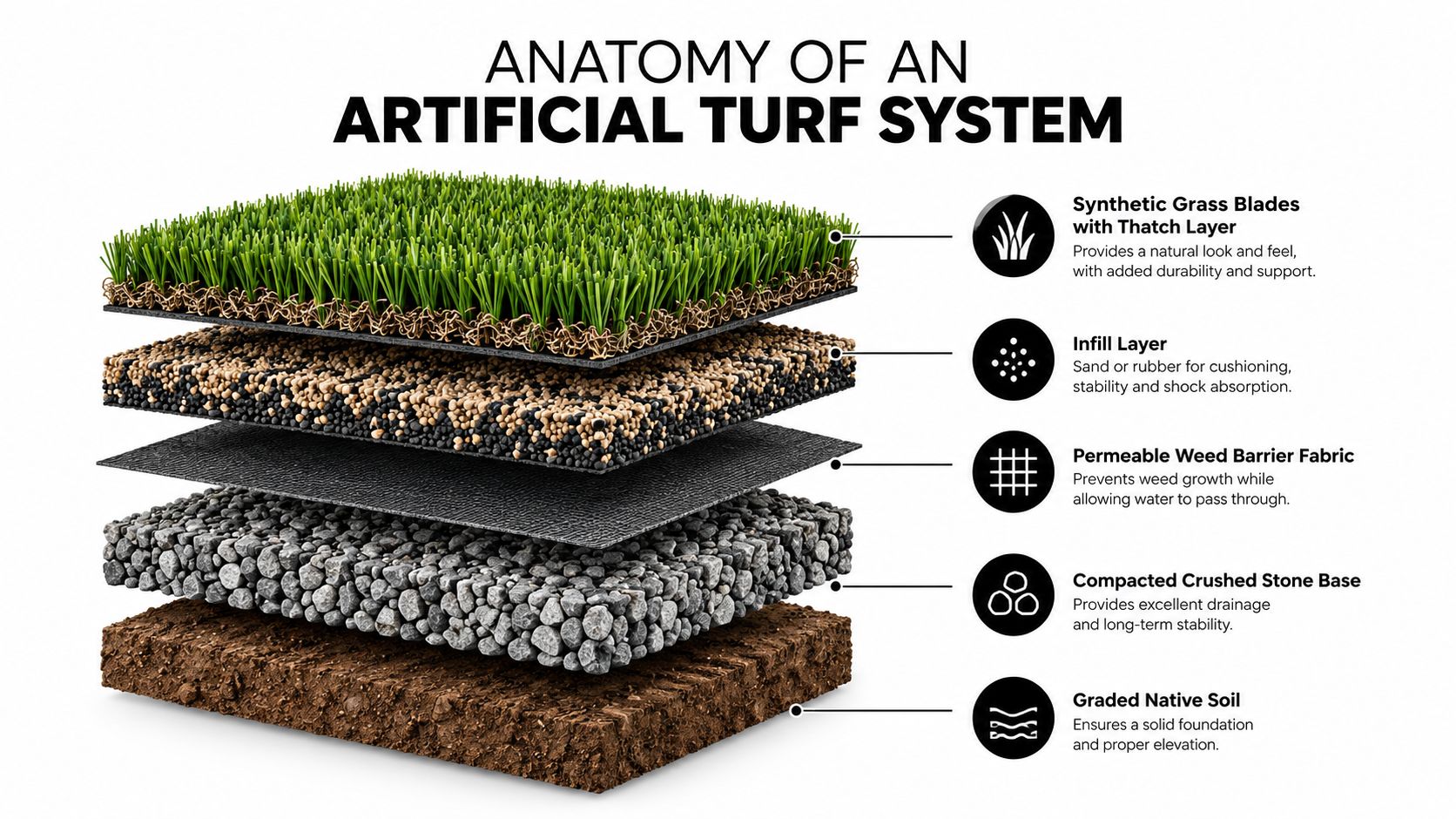
A complete Prescott artificial grass installation process should document excavation, grading, aggregate selection, compaction, edging, seams, and final drainage. Those details matter more than a product sample held in a showroom.
Here's a visual explanation of how the layers work together:
Comparing Common Types of Artificial Turf for Residential Yards
The right turf category depends on what happens on the surface. A putting green, a dog run, and a front-yard lawn have different performance requirements, so choosing by color alone usually leads to disappointment.
Turf type | Where it fits | What to examine |
|---|---|---|
Landscape turf | Front yards, backyards, side yards, and entertaining areas | Natural color variation, blade softness, density, and resilience |
Putting-green turf | Practice greens and recreation areas | Ball roll, firmness, contours, cup placement, and edging |
Pet turf | Dog runs, fenced yards, and relief areas | Drainage backing, cleanability, infill, odor management, and seam placement |
Play-area turf | Children's play zones and active family spaces | Cushioning, softness, shade, heat management, and surrounding materials |
Premium outdoor turf generally uses varied blade textures and color tones to look less artificial. A very dense, tall product can appear luxurious, but density isn't the only measure of quality. The material should match the traffic level, exposure, cleaning routine, and visual style of the property.
Putting-green turf is intentionally different. It's built for a consistent ball roll rather than the soft, slightly irregular feel most homeowners want in a lawn. A backyard can combine a putting surface with lawn turf, but the transition needs careful design so the two areas look intentional.
Pet systems deserve a site-specific discussion. A dog run should have a practical route for liquids, accessible rinse points, durable edges, and a surface that can be cleaned without trapping odors. Antimicrobial infills may help with odor management, but they don't replace regular waste removal or proper drainage.
Practical rule: Choose the system based on the activity first, then choose the color and texture. A beautiful product that doesn't suit your pets, children, or traffic pattern won't remain beautiful for long.
Pros and Cons of Installing Artificial Grass in Prescott
A Prescott yard can look finished after installation, yet the daily experience depends on more than appearance. Artificial turf can reduce routine irrigation, eliminate mowing, and provide a stable surface where natural grass struggles with dry weather, heavy use, or inconsistent care. It works well around patios, pools, play areas, and outdoor gathering spaces, provided the system is designed for local heat and drainage.
The water benefit needs practical context. A 2025 review reported that a full-size synthetic sports field in the United States can save approximately 1.9–3.8 million liters of water per year, or about 500,000–1,000,000 gallons, compared with a comparable irrigated natural-grass field. The savings mainly come from avoiding regular irrigation, mowing, fertilization, and herbicide applications. The review also explains the lifecycle trade-offs, including manufacturing, transportation, installation, replacement, and disposal.
A residential yard will not use water exactly like a sports field. Treat that figure as context, not a personal savings guarantee. Your results depend on the lawn being replaced, local irrigation habits, Prescott's climate, and the amount of turf installed.
What homeowners gain
Less routine lawn work: You will not need to mow, fertilize, or manage the surface like living grass.
A dependable appearance: The yard can remain visually consistent through dry periods.
Better use of difficult areas: Side yards, play zones, and compacted spaces can become cleaner and more functional.
More predictable planning: The surface does not depend on germination, seasonal recovery, or uneven grass growth.
What homeowners give up
The upfront installation cost is higher than spreading seed or installing basic sod. A professional project also includes excavation, grading, aggregate, compaction, edging, seams, infill, and labor. Artificial turf may make financial sense over time, but the payback depends on current water and lawn-care costs.
Heat is the trade-off Prescott homeowners should assess before approving a design. Artificial turf absorbs solar radiation and lacks the evaporative cooling provided by living plants. A UNLV and Desert Research Institute study recorded artificial-turf surface temperatures as high as 169°F, approximately 69°F hotter than irrigated natural grass and 62°F above ambient air temperature. The study's findings support checking the surface before barefoot use, pet activity, or children's play. Shade, irrigation for occasional cooling, and thoughtful placement can improve comfort, but they do not make turf behave like living grass.
Maintenance, Lifespan, and Cost Expectations
Artificial turf is low maintenance, not maintenance-free. Leaves, pine needles, dust, pet waste, and spills still land on the surface, and debris can work down into the backing if it isn't removed.
A practical routine includes:
Rinse the surface: Use water to clear dust, pollen, and residue, especially in pet areas.
Remove debris: A leaf blower, plastic rake, or suitable broom can keep organic material from accumulating.
Brush high-traffic zones: Brushing against the grain helps restore flattened fibers around gates, play areas, and walkways.
Clean promptly: Pet waste should be removed quickly, followed by rinsing and an appropriate turf cleaner when needed.
Watch the edges: Separation, settlement, or loose edging should be addressed before a small repair becomes a larger one.
A professionally installed residential system commonly has a service life of approximately 10–20 years, according to the New Jersey synthetic-turf report. Actual longevity depends on sunlight, traffic, pets, infill, product construction, base preparation, and maintenance. A quiet side yard and a busy dog run won't age at the same rate.
Cost should be discussed as a project scope, not a generic square-foot promise. Yard size, demolition, access, grading, drainage, curves, seams, retaining conditions, turf selection, and infill all affect the proposal. A useful outside reference is this turf cost breakdown from Vistancia, but local site conditions still determine the actual work required.
The artificial grass durability guide is also useful when comparing products. Ask what the installation includes, how the base is prepared, what maintenance is recommended, and what happens if a seam or edge needs attention.
Environmental Considerations for Northern Arizona Installations
The environmental case for artificial turf has two sides. It can reduce ongoing irrigation and remove the need for routine fertilizers and herbicides, but it replaces living soil and vegetation with a manufactured system that requires materials, transport, eventual replacement, and responsible disposal.
Heat management should be part of the environmental and usability discussion. Penn State researchers report that traditional synthetic turf has measured 35–60°C above natural-turf surface temperatures, and one evaluation found that all tested systems exceeded 150°F. Their research on temperature and color also shows why a single product sample doesn't tell you how an installed yard will perform. Fiber, infill, backing, shade, orientation, and surrounding hardscape all matter.
Drainage is a design responsibility
Artificial turf doesn't automatically solve stormwater problems. The surface may be porous, but the full assembly must include an appropriately prepared base, unobstructed drainage paths, edge containment, and a discharge route that suits the property.
For a Prescott installation, the design should account for soil permeability, slope, rainfall intensity, groundwater conditions, and monsoon runoff. The New Jersey drainage memorandum explains that porous layers can allow water to penetrate with minimal runoff, while subsurface storage capacity is important for managing peak flow.
A careful installer should document aggregate specifications, compaction, cross-slope, outlets, and the final water test. If water pools at an edge or moves toward a foundation, the problem is usually in the system design, not the visible turf fibers.
Cooler fibers, different infill materials, shade structures, trees, and hose access can improve usability, but no product should be presented as permanently cool in direct Prescott sun. Designing smaller turf zones beside native plants, gravel, shade, and permeable planting beds often creates a more comfortable and ecologically balanced yard than covering everything with one material. The environmentally friendly turf planning guide can help homeowners frame that decision around the complete yard.
Is Artificial Turf the Right Choice for Your Prescott Home?
Artificial turf is a strong fit when you need a durable, consistently usable surface and understand how it behaves in direct sun. It can work well for busy families, pet areas, side yards, play spaces, pool surrounds, and homeowners who want to reduce routine irrigation.
Start with four questions:
How much direct sun reaches the proposed area? Full afternoon exposure requires a heat plan.
Who will use the surface? Bare feet, pets, children, guests, and sports all create different requirements.
Where will water go? Confirm the slope, base, drainage paths, and discharge route before approving the surface.
What should remain alive? Trees, native plants, pollinator areas, and shaded planting beds may contribute more to the grounds than additional turf.
A hybrid yard often makes more sense than an all-turf yard. Artificial turf can define a play or seating area, while xeric plants, rock, shade trees, and permeable groundcover handle the rest. That approach reduces the amount of synthetic material and gives the property more texture and habitat.
Homeowners in Prescott, Prescott Valley, Chino Valley, and nearby Northern Arizona communities should ask a local design-build team to evaluate sun exposure, soil, drainage, access, and usage before selecting a product. The right recommendation may be turf, a hybrid outdoor setup, or living and low-water planting used in strategic zones. A trustworthy contractor should be willing to tell you when artificial turf isn't the right answer.
Frequently Asked Questions About Artificial Turf
Does artificial grass get too hot for pets?
Yes, direct summer sun can make the surface too hot for paws. The UNLV study cited earlier measured artificial-turf surfaces as high as 169°F. Provide shade, keep water nearby, and test the turf with your hand before letting pets use it. The UNLV findings also support planning active play for cooler periods and including shaded relief in the yard.
How is artificial turf drained during heavy rain?
Rain passes through the backing into the aggregate base, then follows the planned slope toward its outlet. That system depends on a permeable, properly compacted base and a clear discharge route. Ask the installer to test the finished surface with controlled water before the project is closed out.
Can artificial grass handle snow in Prescott winters?
A correctly installed system can remain in place through Prescott winters. Snow, ice, debris, and freeze-related movement still put pressure on the base, edges, and drainage. Keep paths clear, avoid sharp tools, and repair settlement or edge movement before it spreads.
What is the difference between residential and commercial turf?
Residential products generally prioritize comfort, appearance, pets, children, and backyard use. Commercial and sports systems are built around heavier traffic, specialized performance, and different maintenance routines. Choose based on the activities and sun exposure in your yard, rather than the label alone.
Can weeds grow through artificial turf?
Weeds may appear at edges, seams, or places where organic debris collects. Thorough excavation, a suitable barrier, clean edging, and regular debris removal reduce the problem. Artificial turf still requires occasional upkeep.
R.E. and Sons Landscaping installs artificial turf, custom putting greens, drainage-conscious site preparation, and complete outdoor designs in Prescott, Prescott Valley, Chino Valley, and Northern Arizona. Visit R.E. and Sons Landscaping to discuss turf, a hybrid yard, or another option suited to your property.
Comments