
8 Paver Patio Border Ideas for Prescott Homes
Does a patio border keep pavers in place, or finish the edge? A well-designed border frames the paving and helps contain the field when paired with proper restraints. It also sets the patio's style.
In Prescott, border choices include soldier courses, herringbone accents, contrasting color bands, stone headers, curves, inset frames, gravel strips, and planted edges. Each must suit local conditions: freeze-thaw movement, intense sun, monsoon runoff, and the yard's grade.
R.E. and Sons Landscaping provides design and installation, including paver patios and walkways, with layouts developed for the yard's grade, natural stone placement, and existing hardscape. Those details help the perimeter fit the property rather than copy a photograph.
A decorative paver row does not replace structural restraint. A rock strip alone does not guarantee drainage.
Prescott patio edges need to account for winter exposure and site drainage. Homeowners researching poolside layouts elsewhere might find Kern County pool contractors, but border materials and construction still need to suit local conditions.
1. 1. Soldier Course Border
A soldier course gives a patio a crisp, orderly perimeter. Rectangular pavers lie flat, with their long dimension running perpendicular to the edge and their narrow ends facing the paving field. They aren't stood upright on their ends.
This border suits formal courtyards, transitional homes, and patios where the interior pattern already provides enough detail. For example, a warm-gray soldier course around a buff running-bond field can define a Prescott Valley dining patio without adding another competing pattern.
The important distinction is between the visible border and the restraint behind it. The Concrete Masonry & Hardscapes Association's edge-restraint guidance explains that restraints maintain interlock, prevent horizontal spreading, and must remain stable through installation impacts, loading, and freeze-thaw cycles.
How do you keep a soldier course straight?
Establish the finished perimeter with string lines before cutting the field. Dry-lay corners early, then adjust the layout so the outer edge doesn't end in fragile slivers.
Support the perimeter. Detail a concrete or steel restraint behind the soldier row, matched to the paving system.
Match thickness. Compatible paver thicknesses make it easier to maintain a level walking surface.
Resolve corners first. Use substantial cut pieces and consistent joints rather than squeezing leftovers into the last corner.
In Prescott's winter conditions, a straight-looking border won't compensate for a poorly compacted base. Keep the restraint supported, provide a route for water to leave, and avoid burying the finished edge beneath soil that can wash across the joints.
2. 2. Herringbone Accent Border
Choose a herringbone accent border when a plain patio needs a stronger architectural frame. Its repeating angled arrangement adds movement around a quiet field, especially beside simple stucco walls or a long outdoor dining area.
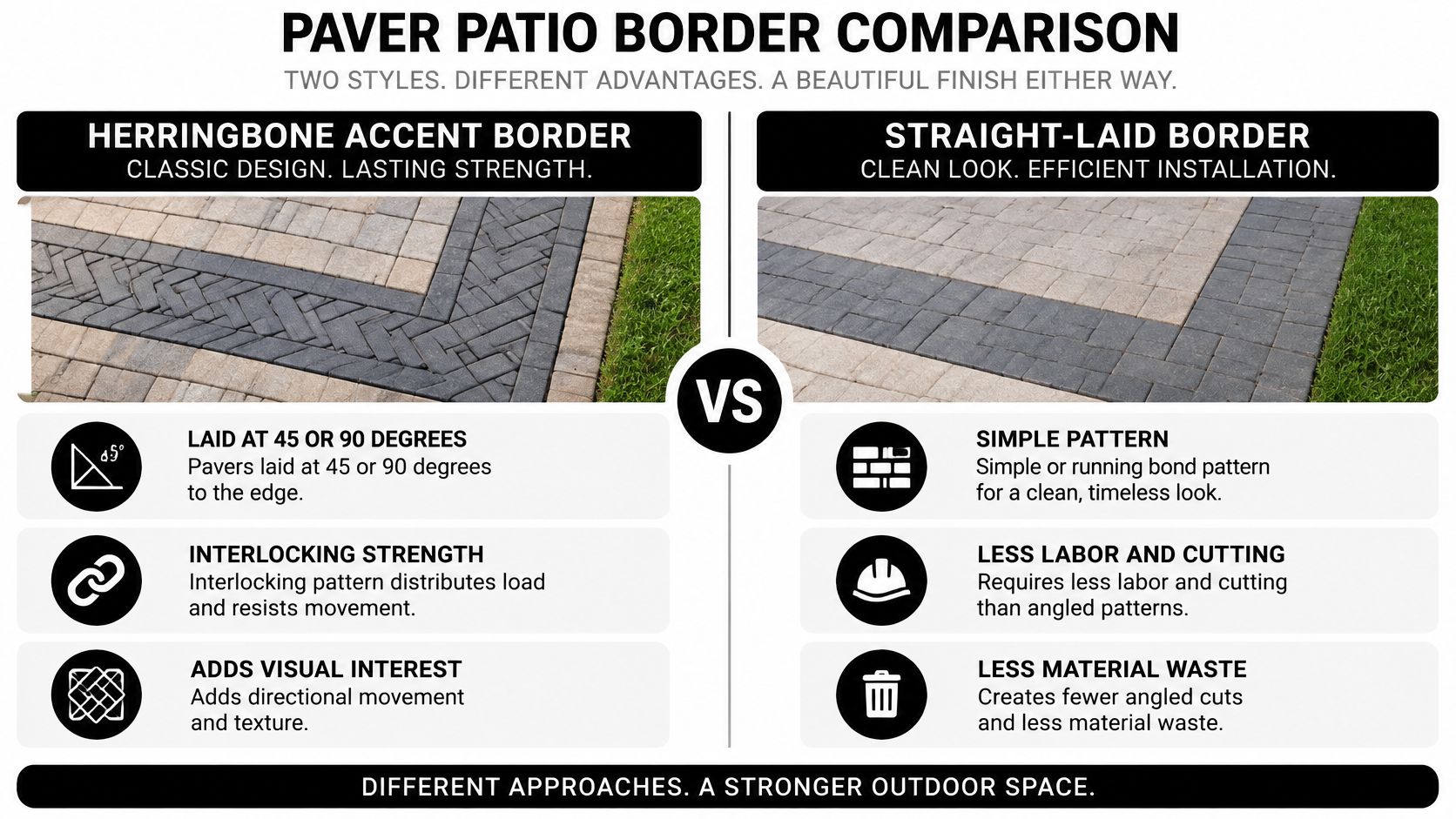
A written design should show the pattern's angle, direction, surrounding bands, and corner treatment. Comparing paver patio patterns helps establish whether the accent complements the field or makes the whole surface too busy.
The trade-off is cutting and layout complexity. A narrow herringbone strip can produce awkward fragments, so give the pattern enough room to read clearly and surround it with straight-laid courses where needed.
Does herringbone eliminate the need for edging?
No. The angled arrangement doesn't replace lateral confinement. The EP Henry edge-restraint specification states that soil backfill isn't a suitable restraint and that edging shouldn't sit on bedding sand.
For a Chino Valley patio beside a driveway, separate pedestrian design assumptions from possible vehicle loading. Base preparation and paver selection must accommodate how that edge will be used, not just the furniture shown on the plan.
A complicated pattern needs a simple, dependable perimeter. Don't use decorative interlock as an excuse to omit structural edging.
Under strong high-desert sunlight, herringbone already produces pronounced joint lines. A restrained color palette usually keeps that texture attractive without turning the border into the patio's only noticeable feature.
3. 3. Contrasting Color Band Border
A charcoal band around light pavers creates a clear outline without changing the basic paving geometry. Contrasting color borders are a practical choice when you want definition but don't want the extra cutting associated with a patterned accent.
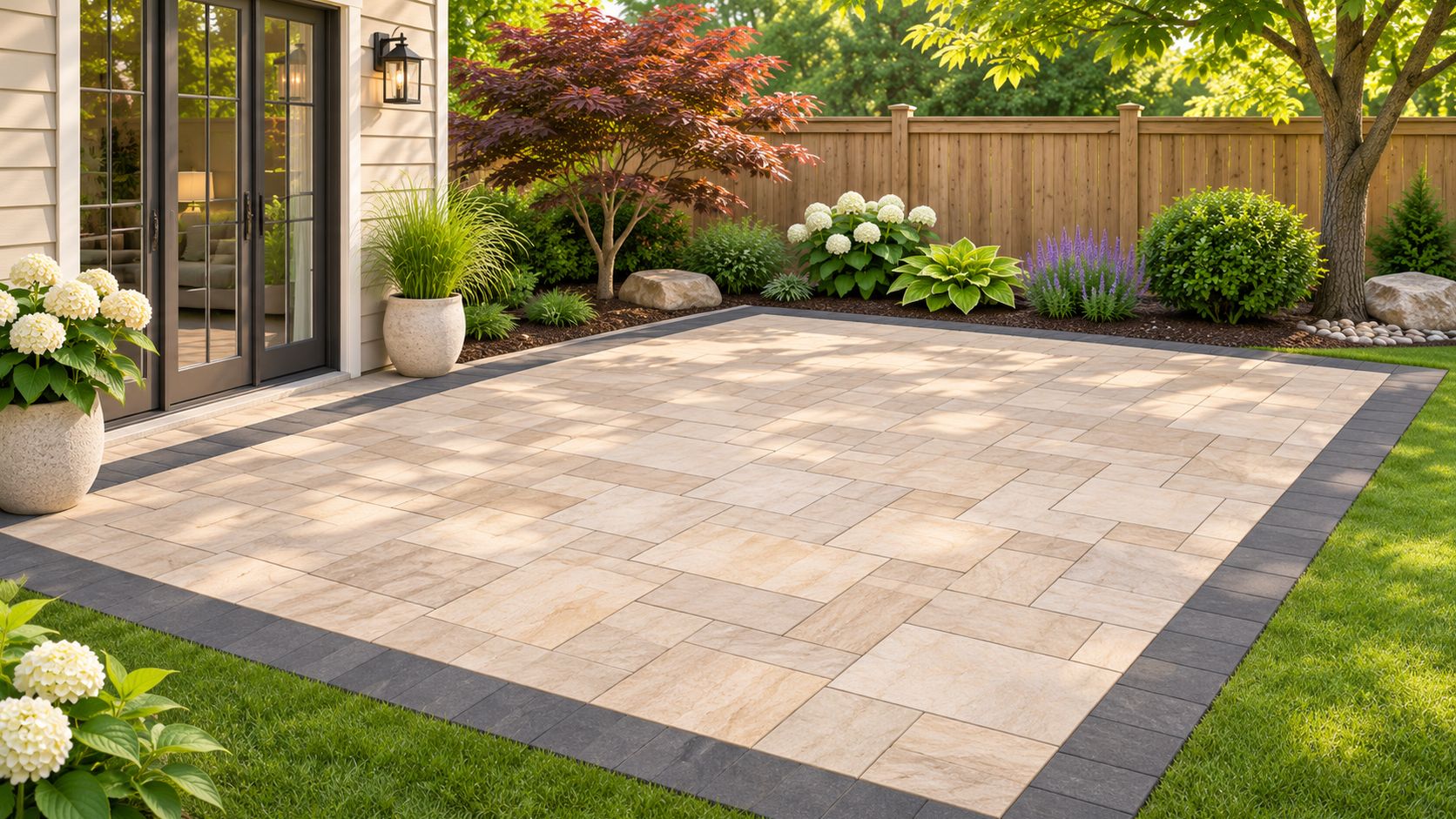
For a Prescott home with warm stone veneer, consider buff paving with a rust-colored band. For a more contemporary exterior, a muted charcoal perimeter can connect the patio to dark window frames without introducing another material.
Judge samples outdoors, beside the house and existing rock. Morning shade and afternoon sun can make the same blend look quite different, and a small showroom sample won't reveal every variation in a blended product.
Should the border be lighter or darker?
Either works. Darker bands emphasize shape, while lighter bands can soften a dark field and are worth considering for exposed south- or west-facing seating areas.
Approve the intended contrast. Lay field and border samples together rather than selecting them separately.
Control batch variation. Coordinate deliveries and production lots within each selected color; different colors won't necessarily share a lot.
Blend during installation. Pull compatible units from multiple pallets to avoid abrupt patches.
Color contrast can help people recognize the patio edge, but it doesn't correct an uneven transition. U.S. Access Board walking-surface guidance limits cross slope on accessible routes to 1:48, a useful reminder to measure the surface rather than judge it by eye.
For private residential projects, determine which accessibility requirements apply. Regardless, keep the band smooth enough for dining chairs, walkers, and rolling grills.
4. 4. Stone or Concrete Header Border
A stone or concrete header works especially well where a patio meets native boulders, flagstone paths, or rustic masonry. Cut stone provides texture and natural variation; concrete provides a more uniform line and can form a durable, clearly defined perimeter.
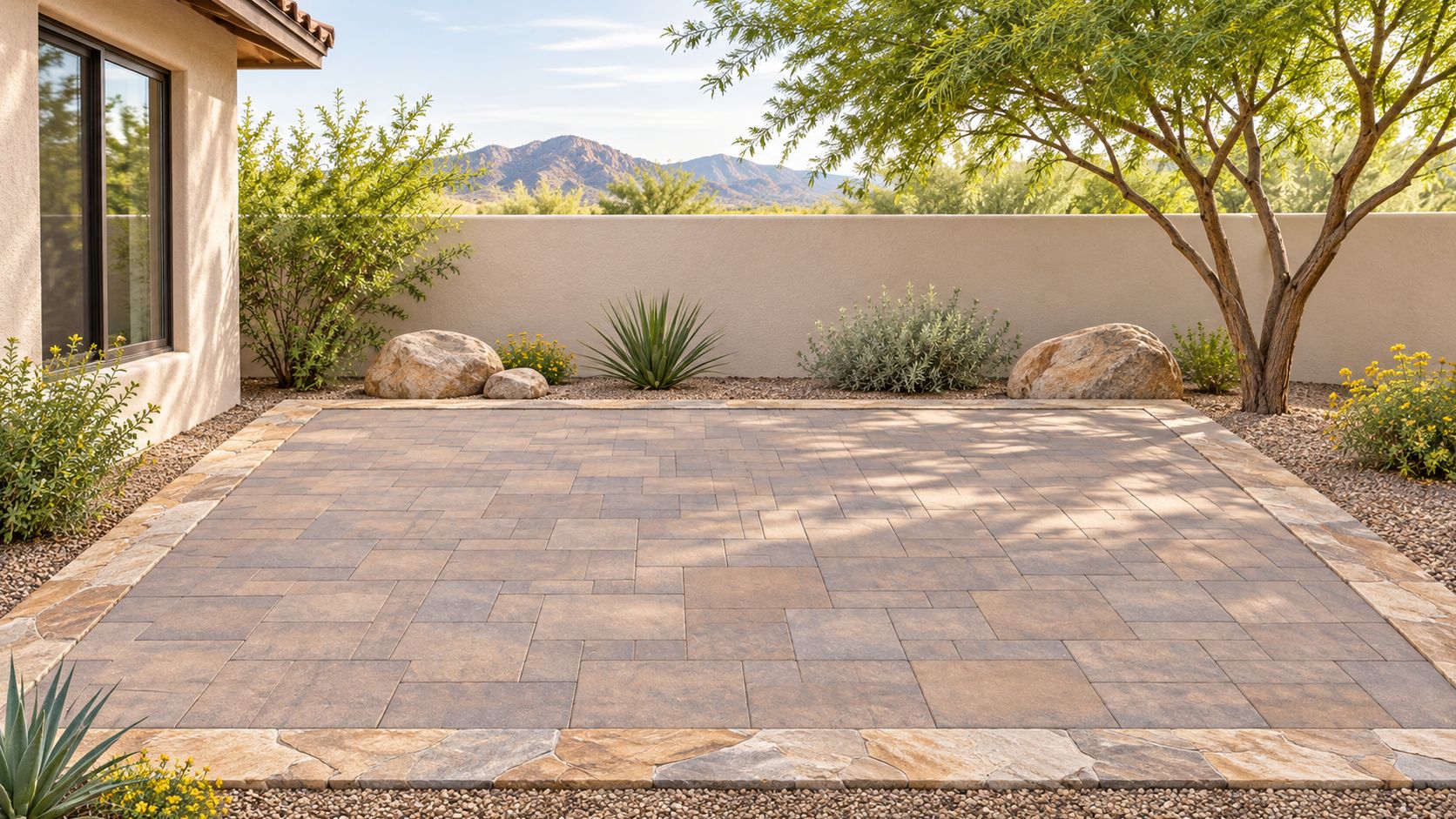
Consider a Prescott courtyard with existing granite features. A stone header that echoes their undertones can connect the patio to its surroundings more naturally than an unrelated decorative color.
The structural detail matters as much as the material. A stone strip laid loosely beside pavers isn't automatically capable of restraining them, while a continuous concrete curb can interfere with drainage if its elevations aren't planned.
Will a solid header trap water?
It can. The Halifax interlocking-concrete-paver specification identifies drainage concerns where water becomes trapped against concrete edges or stabilized bases and describes low-elevation weep provisions.
The practical response isn't to avoid concrete. It's to show where water leaves the assembly before building a continuous curb.
Detail joints. Include appropriate movement and control joints in concrete headers rather than expecting an uninterrupted strip to remain crack-free.
Coordinate elevations. Keep walking transitions flush while accommodating the paving system's installation tolerances.
Select suitable stone. Use exterior paving material appropriate for freeze-thaw exposure, not decorative veneer.
Concrete is less convenient to alter than removable pavers. If future utility access or patio expansion is likely, weigh that repairability trade-off before committing to a rigid perimeter.
5. 5. Curved Freeform Border
A broad curve can make a patio sit more comfortably among high-desert planting beds and exposed rock. Freeform borders work best when they respond to something real, such as a boulder grouping, an established planting area, or the route between a door and a seating space.
A curve shouldn't be added just to make a rectangular yard look less rectangular. Tight, repeated bends create more cuts, reduce usable furniture space, and make restraint installation harder.
How do you lay out a natural-looking curve?
Mark the proposed edge with a garden hose, then walk around it and place chairs inside the outline. Check the view from the house as well as from the yard before transferring the line with marking paint.
Use broad arcs. Generous curves are easier to pave cleanly than abrupt scallops.
Choose compatible units. Smaller pavers can follow tighter radii, but avoid excessive wedge-shaped joints.
Support every turn. A flexible restraint must follow the arc closely and remain anchored to a prepared base.
For a sloping Prescott lot, remember that a curved outline doesn't solve an elevation problem. Where the patio must hold back soil or create a level terrace, resolve that structural requirement separately.
The video provides another visual reference while comparing curved patio layouts.
During monsoon planning, check the outside of each bend for concentrated runoff. Don't place a decorative planting pocket where water leaving the patio will repeatedly scour its soil onto the paving.
A simple curve with clean cuts usually looks more intentional than a complicated edge assembled from small offcuts.
6. 6. Inset Frame Border
An inset frame introduces a decorative band inside the patio rather than at its outermost edge. It's useful when you want to define a dining area, connect a fire-feature zone to the main terrace, or add detail without making the exterior perimeter visually heavy.
For example, a subdued charcoal frame can outline a gathering area while the surrounding paving continues toward the house. That arrangement creates visual organization without a raised divider that guests must step over.
Keep the frame at least a full paver width where practical. A very thin inlay can look accidental, require fragile cuts, and disappear beneath furniture.
Can an inset border change the patio slope?
It shouldn't introduce a ridge, trough, or abrupt change in grade. Carry the intended drainage plane through the frame, and confirm how water moves away from the house before setting the accent.
The U.S. Access Board's ramp guidance explains that accessible walking-surface portions steeper than 5% must meet ramp requirements. A decorative transition shouldn't become an improvised steep connection between patio levels.
Keep the detail visual, not vertical. A frame should define where people gather without becoming something they trip over.
For Northern Arizona patios, the outer structural restraint still matters even when the main design feature sits farther inside. The inset band does nothing to confine an unsupported exterior edge.
Coordinate the frame with fixed features, but don't let it squeeze circulation around them. Mark furniture footprints and pull chairs back during layout so the finished pattern supports everyday use rather than only looking balanced on paper.
7. 7. Decorative Gravel or River Rock Border
A gravel or river rock strip creates a softer transition between pavers and xeriscape planting. It suits Prescott yards where loose stone already connects boulders, shrubs, and open areas.
The distinction is important: decorative rock isn't the paver restraint. Install a suitable steel or concrete edge between the paving and loose material so the patio doesn't spread and stones don't continually migrate into its joints.
For a side-yard patio, a rock strip can separate seating from a planting bed and make accumulated leaves easier to spot. Explore river pebble landscaping to compare the visual effect of rounded pebbles with other border materials.
Does a gravel border improve drainage?
It can provide a drainage transition, but only if water has somewhere to go. The EPA's permeable-pavement guidance explains that infiltration depends on water moving through a suitable surface into underlying soil and gravel layers.
Rock placed over compacted, poorly draining soil may conceal standing water rather than solve it. Plan the subgrade, outlet, and overflow route before selecting the decorative stone.
Choose stone for the location. Rounded river rock gives a softer appearance, but angular gravel generally resists displacement better.
Use fabric selectively. Permeable fabric can separate soil and decorative aggregate; it won't prevent weeds growing in deposited dust.
Protect travel routes. Keep loose stone away from door landings and regular walking paths.
Monsoon flow can move decorative aggregate. Don't treat a narrow rock band as a substitute for a properly designed swale or drain where runoff concentrates.
8. 8. Planted Border with Native Desert Plants
A planted border softens the patio edge and helps the hardscape feel connected to its surroundings. The strongest designs use plants selected for Prescott's winter cold, summer dryness, exposure, and mature size, rather than anything labeled desert-friendly.
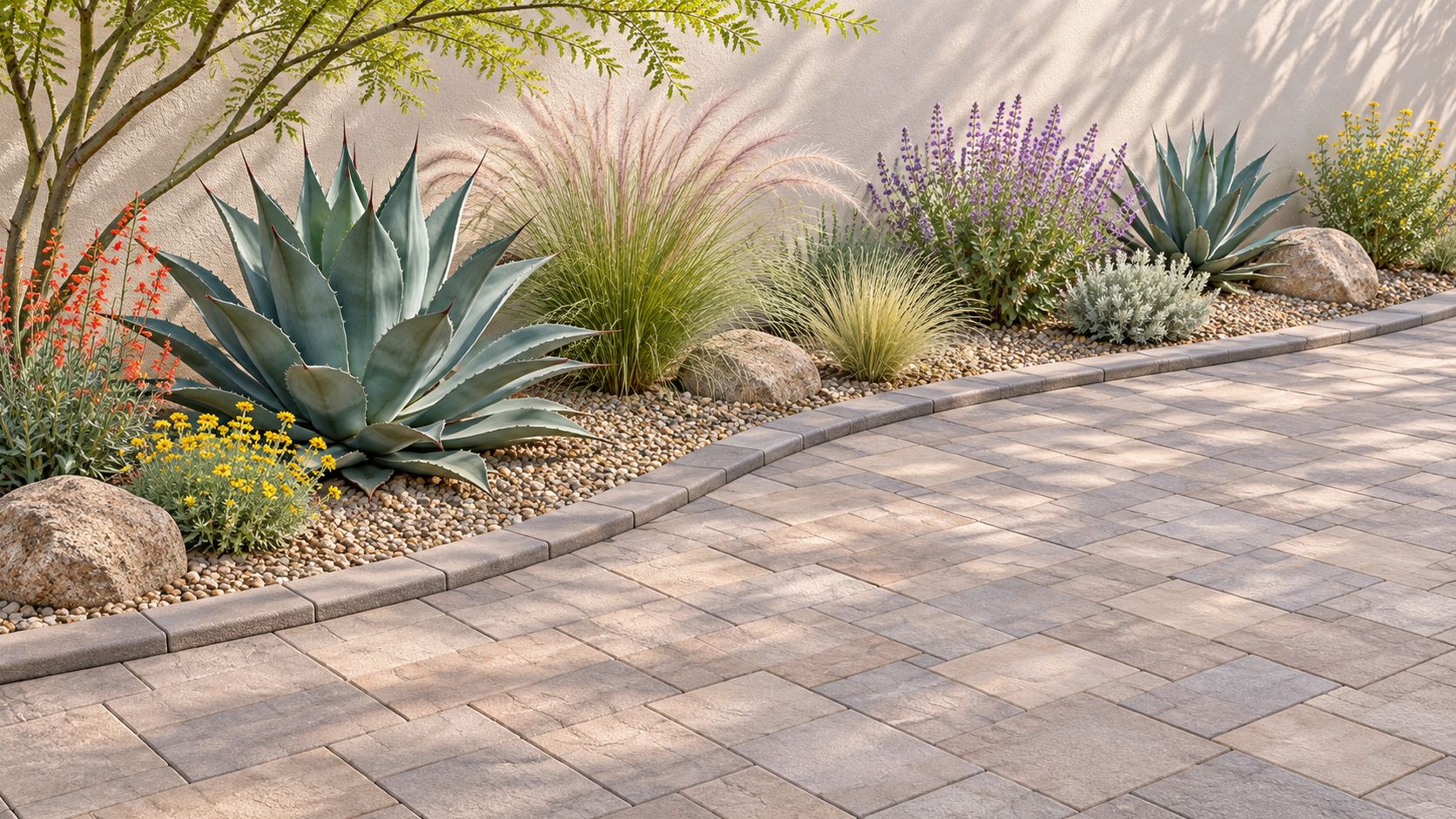
For a sunny seating patio, consider locally appropriate penstemon or low-growing native grasses, with species selection matched to the site. Keep spiny plants away from chair backs, children's routes, and places where guests step off the paving.
The guide to Arizona desert landscape plants can help narrow the palette, but elevation and cold tolerance still need checking for each plant.
How close should plants sit to the pavers?
Allow room for their mature spread rather than arranging nursery containers tightly against the edge. Leave access to inspect the restraint, remove debris, and maintain irrigation without dismantling the border.
Keep soil contained. Set bed elevations so monsoon runoff doesn't wash soil and mulch across the patio.
Separate irrigation. Position drip emitters for the plants rather than repeatedly wetting the paving base.
Maintain visibility. Trim growth before it conceals transitions or narrows circulation.
A planted edge can also accompany a deliberately engineered permeable band. The EPA's permeable-pavement review reports stormwater-discharge reductions ranging from 25% to 100%, depending on system design and site conditions, not the presence of plants.
For a Prescott home beside a slope, keep planting beds graded away from the foundation and preserve an overflow path. Attractive planting shouldn't obscure drainage problems or substitute for structural edging.
Comparing the 8 Paver Patio Border Ideas
Border Style | Material/Pattern | Maintenance Level | Best For |
|---|---|---|---|
Soldier Course Border | Single row of flat pavers laid perpendicular to the edge | Low. Occasional cleaning and joint maintenance | A crisp, tailored edge for formal, modern, or traditional patios |
Herringbone Accent Border | Pavers arranged at a 45- or 90-degree angle in a V pattern | Moderate. Keep the pattern square at corners | Adding movement and an interlocking edge |
Contrasting Color Band Border | One or two rows of pavers in a contrasting color | Low. Occasional cleaning | Creating a custom visual frame around the patio |
Stone or Concrete Header Border | Continuous strip of solid stone or concrete | Low. Occasional cleaning | A durable, natural-looking edge that complements existing stone features |
Curved Freeform Border | Flowing arcs made with flexible or cut pavers | Moderate. Cut and reset units for repairs | Softening patio lines and blending the edge into planting beds |
Inset Frame Border | Narrow paver frame set just inside the patio edge | Low. Occasional cleaning | Adding subtle detail or defining outdoor living zones |
Decorative Gravel or River Rock Border | Band of decorative gravel or river rock | Low. Rake and replenish displaced stone | A drainage-friendly, low-upkeep edge for desert and xeriscape yards |
Planted Border with Native Desert Plants | Low-water plants, often with gravel mulch or boulders | Ongoing care. Prune plants and manage irrigation | Softening hard edges and adding color, habitat, and greenery |
Choose the Right Border and Build It to Last
The best border matches both the home and the way the patio will be used. Soldier courses suit clean, traditional layouts; herringbone accents add pattern; and contrasting bands define the perimeter without changing materials.
Choose stone or concrete headers for a substantial architectural edge, or freeform curves where the site calls for softer geometry. Inset frames organize gathering areas, while gravel strips and planted borders connect paving to a high-desert yard.
In Prescott, appearance is only part of the decision. Confirm the base, restraint, finished elevations, drainage route, and repair access before approving the color.
What makes a paver patio border cost more?
Complex curves, extensive saw cutting, difficult excavation, concrete forming, drainage work, and mixed material thicknesses all add work. A straightforward band using compatible pavers generally requires less detailing than a custom stone header or narrow patterned inlay.
Compare proposals by their construction scope, not just the visible border. Missing base preparation or restraint work isn't a meaningful saving.
Do paver patios really need edge restraints?
Yes, flexible interlocking paving needs dependable lateral confinement. A decorative paver row, planting bed, or soil backfill doesn't replace a properly supported restraint.
For ongoing care, homeowners can compare paver joint cleaning methods before choosing tools that might disturb joint material. Cleaning should preserve the paving assembly, not strip away the material helping stabilize it.
What's the best border for Prescott's freeze-thaw conditions?
A compatible paver border over a properly prepared base, backed by suitable restraint and effective drainage, is a practical choice. Exterior-rated stone and correctly detailed concrete can also work; no material compensates for trapped water or inadequate support.
Can you add a border to an existing patio?
Often, yes, but first inspect settlement, loose joints, drainage, and available base support. Adding a decorative band won't repair a moving patio, and matching older pavers may require a deliberate contrast rather than an imperfect color match.
R.E. and Sons Landscaping serves Prescott, Prescott Valley, Chino Valley, and Northern Arizona as a licensed, bonded, and insured design-build company, Arizona ROC #300642. Consultations can be scheduled online or by phone, Monday–Friday, 8am–4pm.
R.E. and Sons Landscaping offers paver patio design and installation that coordinates the border with your yard's grade, existing hardscape, and outdoor living layout. Visit R.E. and Sons Landscaping to schedule a consultation and discuss border materials, edge support, and drainage for your Prescott-area home.
Comments