
River Pebble Landscaping: Sizes, Uses and Installation
The downspout has cut a groove through your side yard, mulch keeps drifting onto the patio, and you're considering river pebble instead. River pebble landscaping works best when you choose the stone for its job, then design the grade, base, edging, and outlet around it. A good-looking surface alone won't solve a water problem.
R.E. and Sons Landscaping helps homeowners in Prescott, Prescott Valley, Chino Valley, and nearby Northern Arizona communities plan rock features that fit their property's drainage and planting needs. Our design and installation services combine rock and gravel with paver walkways and drought-tolerant plants suited to the high desert.
Pebble Sizes and What Each Size Is Built For
River pebble is rounded stone shaped over time by flowing water, but the trade name covers several size classes. Ask suppliers for a diameter and a sample, not just a load of river rock.
The U.S. Geological Survey classifies gravel as approximately 2–64 millimeters in diameter and cobbles as 64–256 millimeters. Those geological categories explain why products sold under the same landscaping name can look and behave very differently.
Which size should I ask the supplier for?
Use this table as a buying framework, not a universal quarry specification. Medium and large river rock are supplier-defined grades, so have the yard write the actual diameter range on your quote.
River pebble size classes for landscaping
Size class | Diameter | Common product name | Best first use |
|---|---|---|---|
Small gravel | 2–16 mm | Pea gravel | Pathways and light groundcover |
Medium river rock | Supplier's screened medium diameter range | Medium river rock | Groundcover and drainage bands |
Large river rock | Supplier's screened large diameter range | Large river rock | Edging and dry creek beds |
Cobble | 64–256 mm | Cobble and boulder | Accent stones and stream features |
The small-gravel row is a practical landscaping grouping, not a promise that every pea-gravel product covers that entire range. Likewise, a supplier may group cobble and boulders together commercially even though geologists distinguish them.
Why does diameter matter in Prescott?
Small rounded stones can move during concentrated monsoon runoff. Larger stones resist casual displacement better, but they create an uneven walking surface that's awkward in heels or with a stroller.
Roundness matters, too. Rounded gravel doesn't interlock like angular crushed aggregate, so even a neatly raked path can shift underfoot. For a primary route to the front door, stable pavers with pebble borders are often the more comfortable choice.
At R.E. and Sons Landscaping, our service area spans Prescott, Prescott Valley, Chino Valley, and surrounding Northern Arizona communities. Local homeowners should compare physical samples side by side before approving a size, especially where a decorative bed meets a walking route.
Before choosing: identify the main job, walking, holding an edge, or suggesting a dry creek. Match that job to the table, then confirm the supplier's actual medium and large diameter ranges.
Design Uses for River Pebble in a Northern Arizona Yard
River pebble does its best work as groundcover, dry-creek lining, placed accents, and pathway borders. Each use needs a different arrangement, even when the stone comes from the same pile.
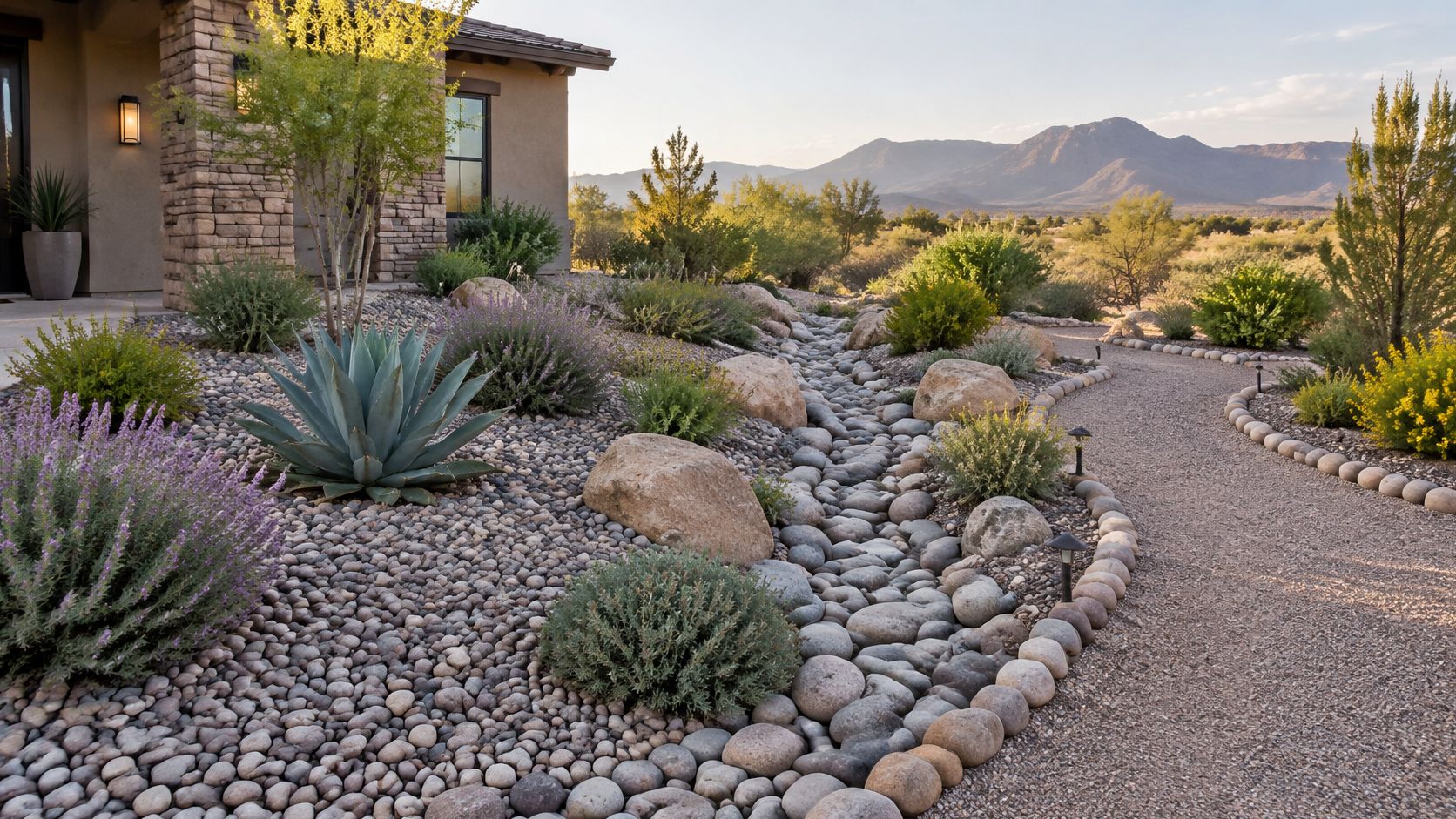
This desert-style layout shows how planting can soften a defined stone channel.
What would work in a sloped side yard?
Say your Prescott side yard slopes toward the back fence and runoff has exposed the soil. A shallow, curving dry creek can turn that strip into a deliberate design feature, provided its route reaches an appropriate discharge area rather than merely ending at the fence.
Cobble establishes the channel, while larger placed stones give the bends visual weight. Keep the curves broad enough to look natural and leave room to inspect the channel after storms. Our dry creek bed landscaping ideas offer ways to coordinate the channel with adjacent planting and hardscape.
Elsewhere in the yard, the same palette can serve different purposes:
Groundcover between shrubs: Medium rock covers open soil without requiring irrigation of its own. Keep planting pockets accessible for irrigation repairs.
Accents near gathering spaces: A cobble cluster beside a gate or patio corner provides contrast without filling the whole yard with stone.
Paths and borders: Pebble can frame a walking route around an outdoor kitchen, while flatter stepping surfaces carry regular foot traffic.
For a path that needs both drainage gaps and dependable footing, Shopifarm's guide to designing paths with gravel and pavers is a useful layout reference.
The video offers another visual reference for considering stone arrangements.
Which colors suit a high-desert yard?
Tan, gray, and rust-toned stone generally sit comfortably beside local soils, granite outcrops, and warm stucco. Bright white creates a stronger contrast, but broad white beds can look glaring in summer sunlight.
Choose the landscape's purpose before choosing its stone color.
Before settling on a layout: mark the groundcover, drainage, accent, and walking areas separately. Then view stone samples beside your house in full sun, not just under the supplier's shade canopy.
Choosing Sources and Budgeting for River Rock
River rock is sold by weight or by volume, and the unit matters as much as the quoted number. According to Hello Gravel's 2025 river rock pricing guide, river rock materials were priced at $45–$130 per ton or $50–$160 per cubic yard. Treat that as a dated material benchmark, not a current Prescott installed quote.
How can I compare supplier quotes fairly?
Ask suppliers to price the same stone grade using the same unit. A ton measures weight; a cubic yard measures volume, so don't convert between them without the supplier's bulk-density information for that product.
River rock pricing by unit of sale
Unit of sale | 2025 price range | Confirm with the supplier |
|---|---|---|
Per ton | $45–$130 | Washed, screened to the size ordered, and the delivered weight |
Per cubic yard | $50–$160 | Actual volume delivered and whether it covers your planned depth |
Installed cost | Project-specific written quote | Excavation, fabric, edging and site access, quoted separately |
Inspect the material as well as the paperwork. Washed stone with consistent screening is preferable to a dusty load containing unexpected small particles or oversized pieces.
For drainage applications, the NRCS aggregate specification calls for clean, hard, durable mineral particles free of contaminants that impair drainage. Fines can occupy the spaces you intended water to move through, so attractive color doesn't compensate for unsuitable material.
What belongs in the delivered and installed price?
A delivered load isn't a finished bed. Include excavation, disposal, geotextile where appropriate, aggregate, edging, equipment access, and final cleanup in the comparison.
Delivery placement also matters. A driveway drop may be straightforward, while moving stone through a narrow gate requires a separate handling plan. Routelink's a delivery playbook for builders merchants provides useful context for coordinating access and unloading instructions.
For a hypothetical 100-square-foot bed at 3 inches deep, multiplying area by depth in feet and dividing by 27 gives about 0.9 cubic yard. This is calculated volume, not a universal coverage rate; ask the supplier about a modest allowance for settling, and correct any washout problem rather than budgeting for repeated losses.
Before placing an order: request two written quotes with identical stone size, unit, delivered quantity, and planned depth. Check the line items, not just the total.
How to Install River Pebble Over Soil and Fabric
The visible stone is only the top layer of a system. Preparation should reflect whether you're building decorative groundcover, a walking border, or a channel that carries runoff.
The EPA's guidance on permeable assemblies describes surfaces working with underlying storage or infiltration layers. A decorative pebble bed isn't automatically permeable pavement, but the same practical distinction matters: the surface can't compensate for an unsuitable base.
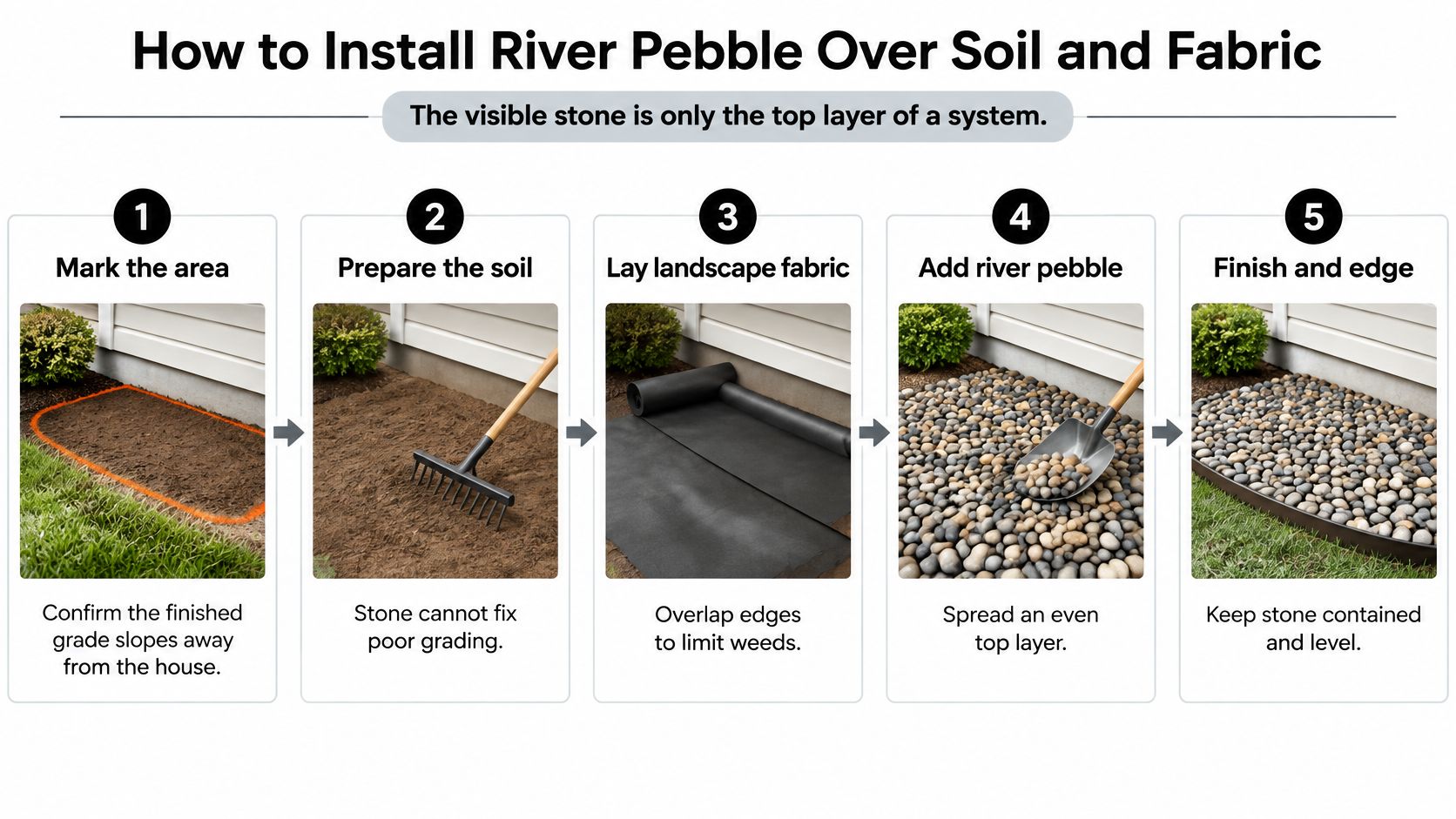
This installation overview shows the sequence from layout to containment.
What order should the work follow?
Mark the bed and establish elevations. Use marking paint, stakes, and a string line to locate the edges and check the finished grade away from the house. Don't use the existing soil surface as your only reference if it already sends water the wrong way.
Strip sod, roots, and loose organic debris. Remove material that will decompose beneath the installation, leaving a sound working surface. Avoid burying turf under fabric and expecting it to become a stable base.
Excavate for the complete assembly. As a preliminary groundcover allowance, about 3 to 4 inches may accommodate a shallow decorative installation, but a channel or aggregate base needs a separately designed excavation depth. Don't let the finished stone bury irrigation fittings, plant crowns, or hardscape edges.
Stabilize the subgrade selectively. Compact disturbed supporting soil where settlement would undermine the installation. Don't blanket-compact an infiltration area, since its purpose is to accept water rather than shed it.
Install nonwoven geotextile where separation is needed. Overlap seams according to the product specification, secure them with fabric staples, and turn the fabric up at contained edges. Torn fabric and open seams allow soil to mix into the stone; fabric isn't a substitute for removing established weeds.
Build the specified aggregate layer. A dry creek may need a stable crushed-aggregate support layer, while an infiltration feature needs a compatible open-graded profile. If the soil holds water, adding compacted aggregate alone isn't the fix; resolve the outlet or underdrain requirement.
Place pebble gently and evenly. For a shallow decorative example, a planned 2-to-3-inch layer may be appropriate, subject to stone diameter and intended use. Spread manageable loads with a garden rake instead of dumping sharply onto exposed fabric.
Secure edging before the final spread. Set the restraint firmly enough to withstand displaced stone and routine maintenance. Keep it aligned with the intended water route rather than creating an accidental dam.
Check depth and clean transitions. Probe the finished layer at three spots, including an edge, then sweep stones off adjacent walks. Thin patches expose fabric and invite displacement during cleanup.
Which details need a site-specific decision?
Excavation and stone depth are starting allowances, not drainage-engineering specifications. Larger cobble, concentrated runoff, and soft soils all require a different assembly.
Our landscape rock installation guide provides additional planning context for rock beds and adjacent hardscape.
Before covering the base: verify elevations, fabric condition, irrigation access, and the intended outlet. Corrections are easier before the stone arrives.
Edging, Weed Control and Drainage Limits
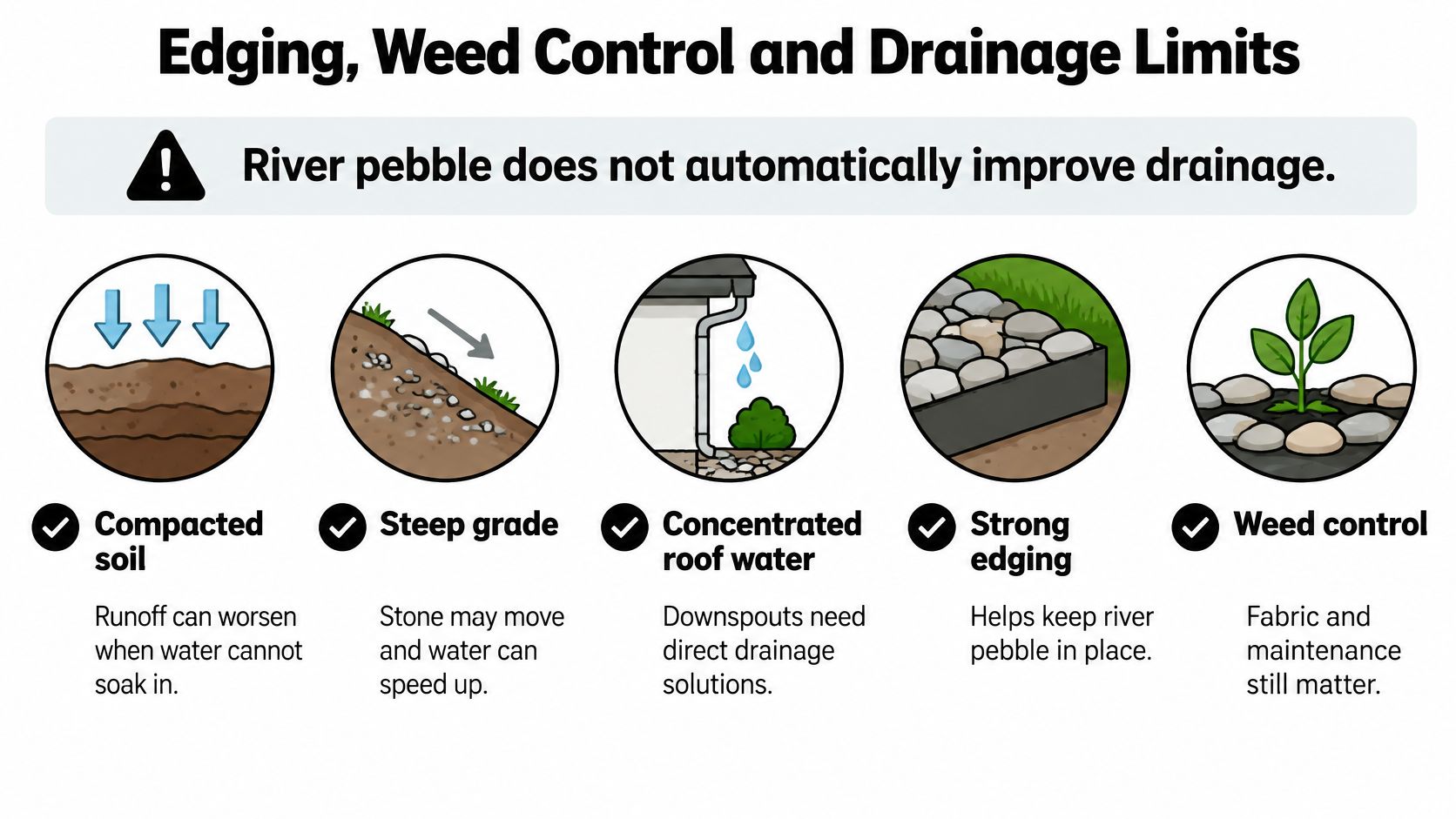
River pebble doesn't automatically improve drainage. It can leave runoff unchanged or worsen the practical problem when it covers compacted soil, rolls down a steep grade, or receives concentrated roof water without a controlled outlet.
Mississippi State University Extension's water-conservation guidance distinguishes permeable materials from the additional drainage measures needed when underlying soil drains slowly. What lies beneath the stone matters more than its color.
These are the conditions to assess before treating decorative coverage as a drainage solution.
Which edging will actually hold the pebble?
Steel or aluminum strips suit clean curves and restrained borders. Poured concrete curbs provide a more substantial separation beside driveways, while firmly set stone creates a less formal transition.
The restraint needs anchorage, not just height. Loose edging can lean under accumulated stone, and a continuous curb across a drainage route can impound water where you didn't intend it.
On steeper grades, rounded pebbles can migrate despite a tidy perimeter. Use larger, embedded key stones where flow concentrates, or reconsider the material and channel design rather than relying on edging alone.
Drainage check: Water needs a safe destination, not simply a stone-covered place to collect.
Will fabric stop weeds permanently?
No. Fabric separates soil from rock, but windblown dust and decomposing leaves can form a seedbed above it. Hand-pull young weeds before roots become established through the fabric, and inspect displaced material after monsoon storms.
Don't automatically add another layer of stone wherever a bed looks thin. First determine whether runoff, inadequate restraint, or settling caused the loss.
Where should overflow go?
A dry creek or basin needs a route for water beyond its normal capacity. EPA bioretention guidance describes underdrains for poorly infiltrating soils and overflow structures for flows exceeding system capacity.
For a Prescott property, that means checking the whole route to discharge. Water shouldn't unexpectedly cross a walkway, collect against a foundation, or leave the project as an erosion problem on a neighboring lot.
A simple soil infiltration check can reveal slow drainage, but it doesn't replace professional assessment where structures or concentrated flows are involved. Downspout outlets deserve particular attention because a small receiving area may serve a much larger roof.
Before ordering stone, complete these checks:
Grade: Confirm the bed falls toward its intended outlet.
Infiltration: Test how the underlying soil accepts water.
Overflow: Identify and stabilize the route water will take when the bed can't absorb more.
Pairing Pebble With Plants and Keeping It Clean
Rock mulch runs hotter than wood mulch. Colorado State University Extension's mulch guidance notes greater heat transfer into soil beneath gravel than beneath wood chips, and gravel surfaces run noticeably hotter than wood-based mulches through summer. For a Prescott yard, that makes stone a plant decision as much as a look: roots that dislike heat belong under a cooler surface, and the pebble belongs where the planting can use it.
Stone can still help conserve the moisture already in the ground. The University of Arizona Cooperative Extension explains that mulch reduces evaporation and slows droplet impact, allowing water to soak in more freely. Inorganic mulch adds no organic matter, so monitor plant growth and nutrient condition rather than assuming a low-water bed is self-sustaining.
Which surface belongs around each planting zone?
Surface choice by planting zone
Planting zone | Best surface | Why it works |
|---|---|---|
Drought-tolerant shrubs in open sun | River pebble, kept a few inches back from the stems | Protects moisture after irrigation without burying stems |
Heat-tolerant perennials and groundcovers | River pebble over a fabric-lined base where appropriate | Limits evaporation; allow room for mature growth and heat exposure |
Young trees and sensitive root zones | Wood-chip or organic mulch | Provides a cooler root environment and adds organic matter |
Walkways and high-traffic edges | Medium or large river rock beside a stable walking surface | Keeps decorative stone at the edge rather than beneath regular foot traffic |
Rain garden or swale | Pebble over a compatible gravel bed with an overflow route | Supports a designed water-management assembly |
Medium or large loose river rock is not stable underfoot. Keep it beside the traffic line, using pavers or another firm surface where people regularly walk.
Spreading groundcovers raise a separate question: fabric can interfere with rooting and expansion. A fabric-lined decorative bed suits isolated plants but works against a planting intended to knit together.
How do I keep the bed clean without disturbing it?
Use a leaf blower on a low setting or a flexible leaf rake with light pressure. Remove leaves before they break down, check for windblown dust, and return displaced stones only after correcting whatever moved them.
Inspect the bed annually after summer rains. Check irrigation emitters, exposed roots, thinning coverage, and sediment accumulation around plant crowns.
Our guide to drought-resistant plants for local landscapes can help narrow the planting palette. Choose for heat tolerance and mature size as well as water demand.
Before approving the planting layout: give heat-tolerant shrubs room, keep crowns clear, and reserve cooler organic mulch for sensitive roots. Then run the irrigation and confirm water reaches the root zones beneath the stone. A mixed pebble-and-native-plant design is often a better practical choice than an uninterrupted rock yard.
Pebble Landscaping Questions Prescott Homeowners Ask
Can a Prescott homeowner install river pebble without help?
A small patio-side bed on level, well-drained ground is a reasonable weekend project if you can safely handle the material. A dry creek or bed receiving roof or slope runoff needs a professional grade and outlet plan before excavation.
What happens at a free consultation?
R.E. and Sons Landscaping offers a free, no-obligation consultation for homeowners in Prescott, Prescott Valley, and Chino Valley, including discussion of drainage before stone is ordered. We're a licensed contractor, ROC #300642, and our process follows Consultation, Design, Transformation, and Enjoy.
How do I book a consultation?
You can schedule online or by phone, and the team can meet you on your property. An on-site discussion helps connect your preferred appearance with access, grade, existing hardscape, and the proposed water route.
What should I bring?
Bring the planned bed dimensions, notes about the slope, and photos showing where water runs during storms. Mark the areas where you want to walk or plant, and have that information ready so grade and outlet decisions can be addressed during the first visit.
R.E. and Sons offers river-pebble garden design and installation that coordinates stone selection with planting, hardscape, and the yard's grade. Visit R.E. and Sons Landscaping to book a free, no-obligation consultation and discuss a practical plan for your Prescott-area property.
Comments