
8 Backyard Putting Greens Ideas for Prescott Homes
Saturday evening in Prescott, the grill is going, the kids are playing outside, and the scruffy patch beside the patio still isn't doing much for the yard. A compact putting green could make that space useful, giving you somewhere to practice after work without turning the whole backyard into a golf facility.
The best backyard putting greens ideas fit the property first. A single-hole synthetic green suits a small, relatively level yard. A terraced layout can make sense on a slope, while a larger practice green needs enough room for safe circulation, varied putts, and drainage that works during monsoon rain.
R.E. and Sons Landscaping helps homeowners in Prescott, Prescott Valley, Chino Valley, and nearby Northern Arizona communities plan around those practical constraints. Our design process considers the yard's grade, natural stone placement, and existing hardscape before the layout is approved.
A green that drains properly and fits your daily routine is more useful than a larger, more complicated design you rarely play.
Summer sun, freeze-thaw winters, and runoff all affect the choice. Start with the layout that suits your yard, then decide which extras will improve how you use it.
1. Classic Single-Hole Artificial Turf Putting Green
Best for small backyards, side yards, and homeowners who mainly want short-putt practice. A simple synthetic green gives you a usable practice lane without taking over the patio, planting beds, or family play space.
Consider a Prescott backyard with an unused strip beside a paver patio. A gently curved green with a primary cup and an optional capped cup position can follow the patio edge while leaving a clear route to the back gate. In a Prescott Valley side yard, natural stone edging can connect the putting surface visually to the house.
Artificial turf doesn't need mowing or fertilizing, but low maintenance doesn't mean no maintenance. Leaves, windblown grit, and displaced infill still need attention, and the base must remain stable beneath the playing surface.
What makes a small green work well?
Protect the putting lane. Leave comfortable room to stand and swing the putter without backing into shrubs or furniture.
Check afternoon glare. Test the main putting direction when you're most likely to play.
Specify putting turf. Decorative grass isn't a substitute for a surface designed for ball roll.
Plan the outlet. Water needs somewhere to go beyond the edge of the green.
The comparison below highlights the everyday differences between synthetic and natural surfaces.
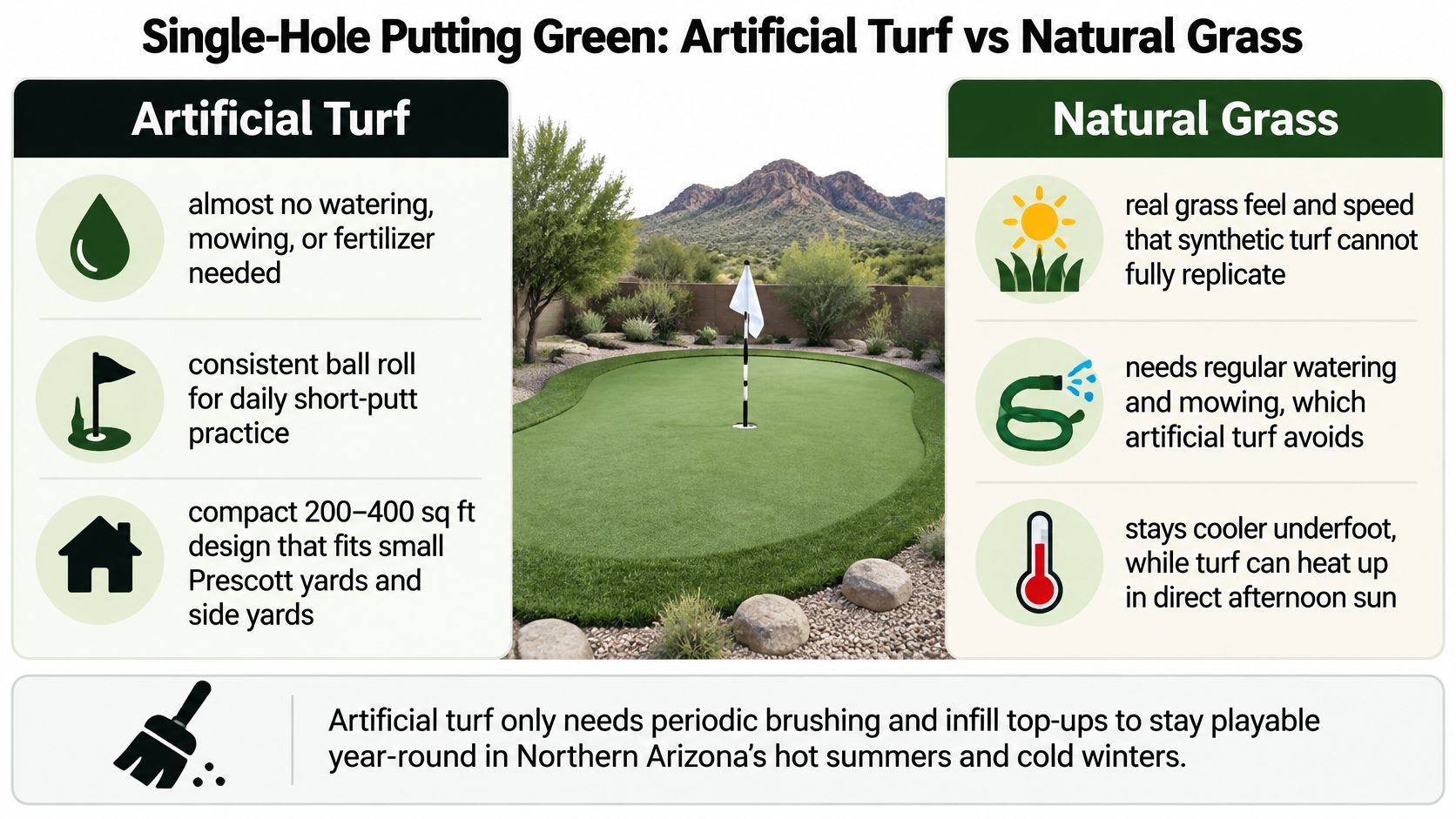
Don't choose turf or infill on a promise that it'll stay cool in direct Arizona sun. Evaluate samples outdoors and plan shade where practical.
For a golfer receiving a new practice space, you could also give a golf coaching session to help turn casual putting into a focused routine.
2. Multi-Hole Practice Green with Fringe and Varied Pin Positions
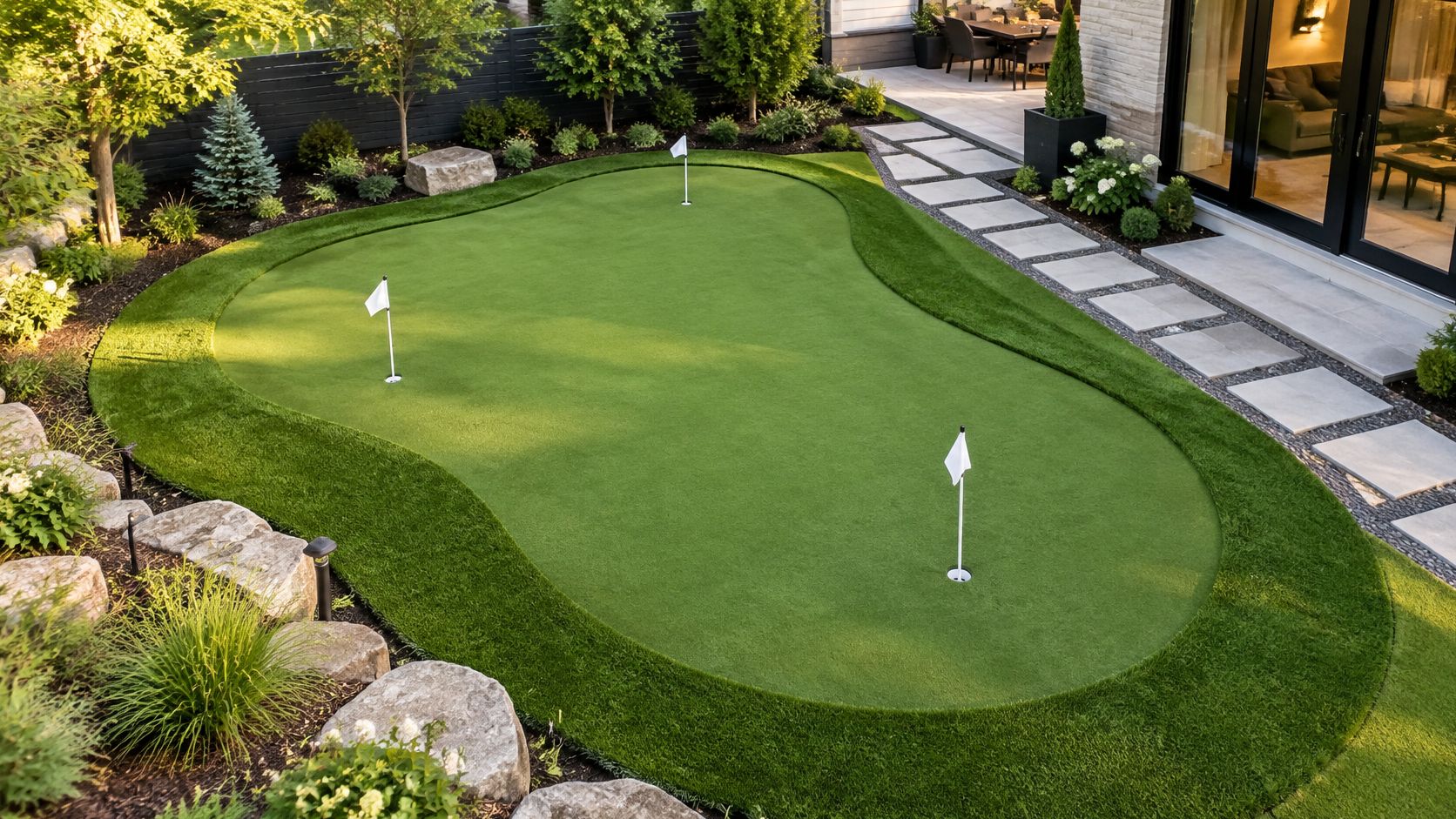
A larger Chino Valley yard can accommodate something a compact side yard can't: meaningfully different putting lines. Multiple cups, gentle breaks, and a fringe make sense when household members want different practice challenges.
For example, an open area between a patio and garden could feature a longer distance-control lane, a flatter practice lane, and a gently breaking putt. The fringe offers a transition to the surrounding area and a spot for controlled bump-and-run practice.
This image illustrates how separate targets can share a connected playing surface.
How do you keep multiple holes from feeling repetitive?
Change the angle, distance, and break, not just the cup location. Placing cups close together on the same slope adds hardware without adding much useful practice.
Agree on an achievable speed before installation, then test the finished surface rather than judging it by appearance. The USGA Stimpmeter booklet describes testing with three balls in each direction and advises that opposing-direction averages shouldn't differ by more than 18 inches when checking whether slope is distorting the measurement.
That's a useful quality-control principle for a residential green: consistent roll matters more than maximum speed. An overly fast surface with strong contours can frustrate children and occasional players.
Provide a separate walking route around the green, particularly between the house and seating area. A bench or shaded resting spot belongs outside the putting lanes, where someone can watch without becoming an obstacle. On exposed Northern Arizona properties, that comfortable pause can be as important as another cup.
3. Tiered Multi-Level Putting Green with Built-In Contours
A tiered green suits a sloped lot when the grading and retaining work create usable terraces. It's not a reason to cover an entire hillside with turf.
Natural stone can help the terraces sit comfortably within a Prescott setting, as this design illustrates.
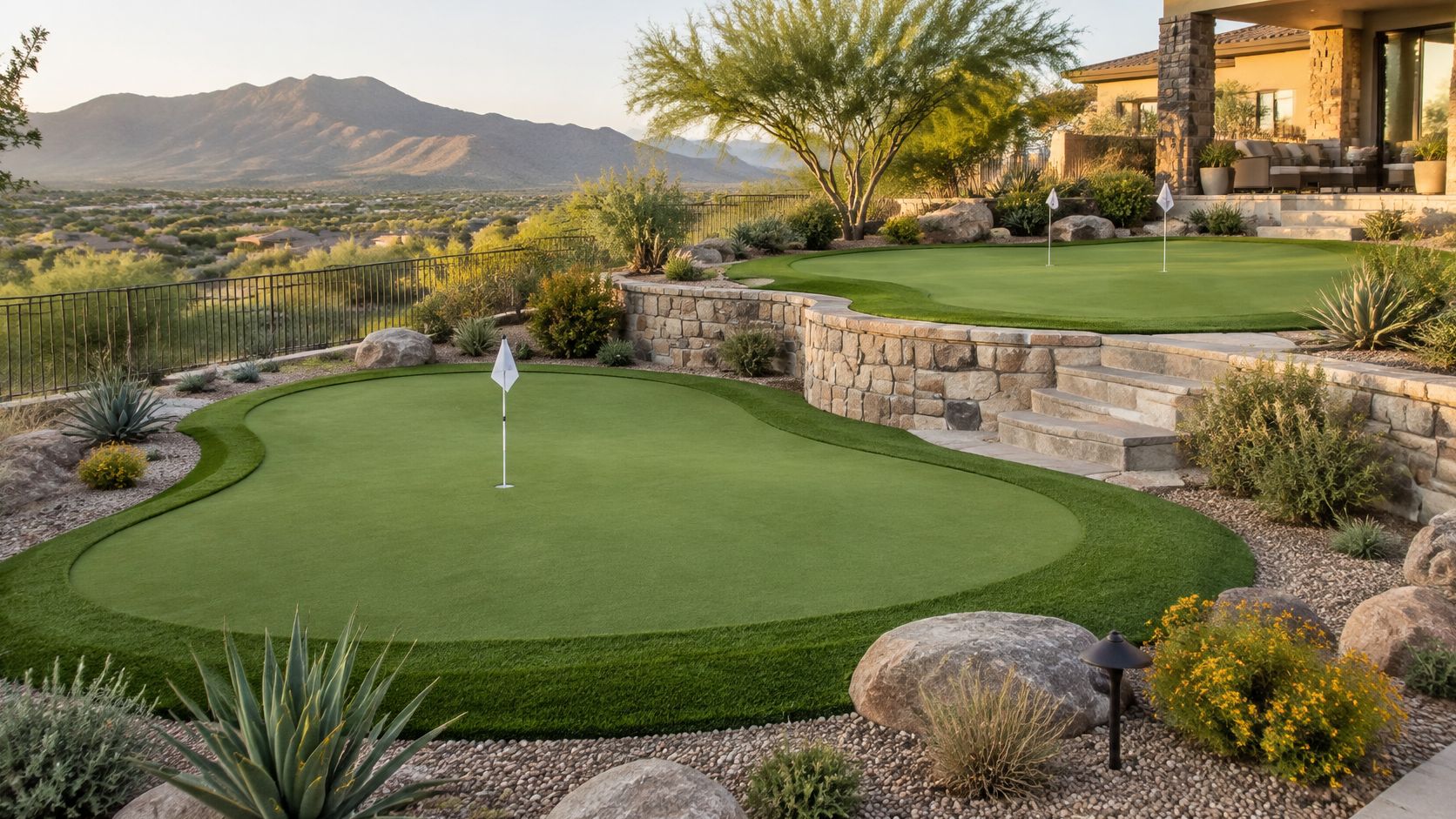
Say your backyard drops away from the patio toward a lower gathering area. Instead of forcing a continuous, steep putting surface down the slope, create comfortable playing terraces with defined walking access. Connect playable areas with gentle contours only where the ball can travel predictably.
Can a putting green replace a steep slope?
Sometimes, but retaining walls, access, and drainage determine feasibility. Confirm local grading and wall requirements before committing to the finished appearance, and keep steps outside the ball-roll zone.
The USGA's putting-green construction guidance calls for a smooth, compacted subgrade without water-holding depressions and drainage pipes with a minimum continuous slope of 0.5 percent. Those are natural-green construction specifications, not a universal synthetic-turf recipe, but they demonstrate why the hidden work matters.
On a Prescott hillside, intercept runoff arriving from above rather than expecting the green to handle the entire slope's drainage. Keep retaining-wall drainage distinct from surface runoff, and avoid creating a low pocket at the bottom terrace.
Design priority: Stabilize the slope and establish the drainage route before shaping decorative breaks.
The video offers another visual reference for a contoured putting-green setting.
A simpler terrace often provides better practice than dramatic undulations. It also leaves more room for safe walking when winter conditions make outdoor surfaces slippery.
4. Natural Bermudagrass Putting Green for Arizona Climates
Choose natural grass because you want to care for a living putting surface, not because you expect an easier lawn. Bermudagrass is a warm-season option to evaluate, but Prescott's winter conditions make local suitability and seasonal expectations important.
A sunny Chino Valley property with dedicated irrigation and an owner committed to turf care is a better candidate than a shaded courtyard used only occasionally. Don't assume that a grass successful in a hotter Arizona city will deliver the same season of play at your property.
Natural turf offers living texture and a course-like maintenance experience. It doesn't automatically produce a truer roll than a properly installed synthetic surface; mowing quality, moisture, grain, and surface condition all affect play.
What care does a natural green need?
Plan for reel mowing, irrigation adjustment, fertility management, aeration, and topdressing. A monthly maintenance visit alone won't cover every task required to maintain a closely cut putting surface.
Choose the grass deliberately. Use a putting-green cultivar suited to the site, not general-purpose lawn sod.
Separate irrigation control. The green's watering needs shouldn't dictate the schedule for surrounding shrubs.
Design for uniform moisture. Don't assume a conventional planting-bed drip layout will irrigate the putting surface evenly.
Budget attention as well as materials. Equipment access and clipping management belong in the design.
The USGA's history of putting-green construction explains the development of a layered drainage and sand-based root-zone system to support more consistent growing conditions. That foundation is why mowing an existing lawn shorter rarely creates a satisfactory green.
Review this putting green maintenance guide before choosing between natural turf and synthetic surfacing. The right choice depends on the care you're willing to provide throughout the year.
5. Putting Green with Chipping Collar and Bunker
Before adding a bunker, stand where you'd hit from and look beyond the intended landing area. If a mishit could reach a neighbor's patio, a window, or a busy walkway, the layout needs to change.
A chipping collar and bunker fit an open Prescott Valley backyard better than a narrow enclosed courtyard. For example, a green facing an interior planting area could support controlled chips, while the same green facing an outdoor bar would create an avoidable conflict.
The collar should provide a useful hitting position and transition into the green. A thin decorative strip may look finished without offering enough room to set up a shot.
Is a backyard bunker worth the upkeep?
It is if you'll practice sand shots regularly and accept the cleanup. It's less useful when the goal is a nearly maintenance-free backyard.
Specify appropriate bunker sand. Choose material for shot performance and drainage, not just color.
Manage surrounding runoff. Don't let monsoon water carry soil and mulch into the bunker.
Contain escaping sand. Shape the edge to limit migration without placing a hard obstruction in the swing path.
Keep equipment nearby. Provide a discreet storage point for a rake and practice balls.
The first design test for a chipping area is where the missed shot goes.
Don't treat an arbitrary gap between bunker and green as a safety guarantee. Shot direction, swing clearance, landing space, and separation from people matter more.
Sand splashed onto synthetic turf also becomes a maintenance task. If you mainly want putting practice, a wider fringe without a bunker is usually the simpler compromise. It offers more shot variety without introducing sand management, bunker drainage, and another area to repair after storms.
6. Putting Green Integrated with a Fire Pit and Outdoor Living Area
This layout works best when golf is part of gathering, rather than the yard's only purpose. Connect the green visually to the patio while keeping cooking, seating, and walking routes outside play.
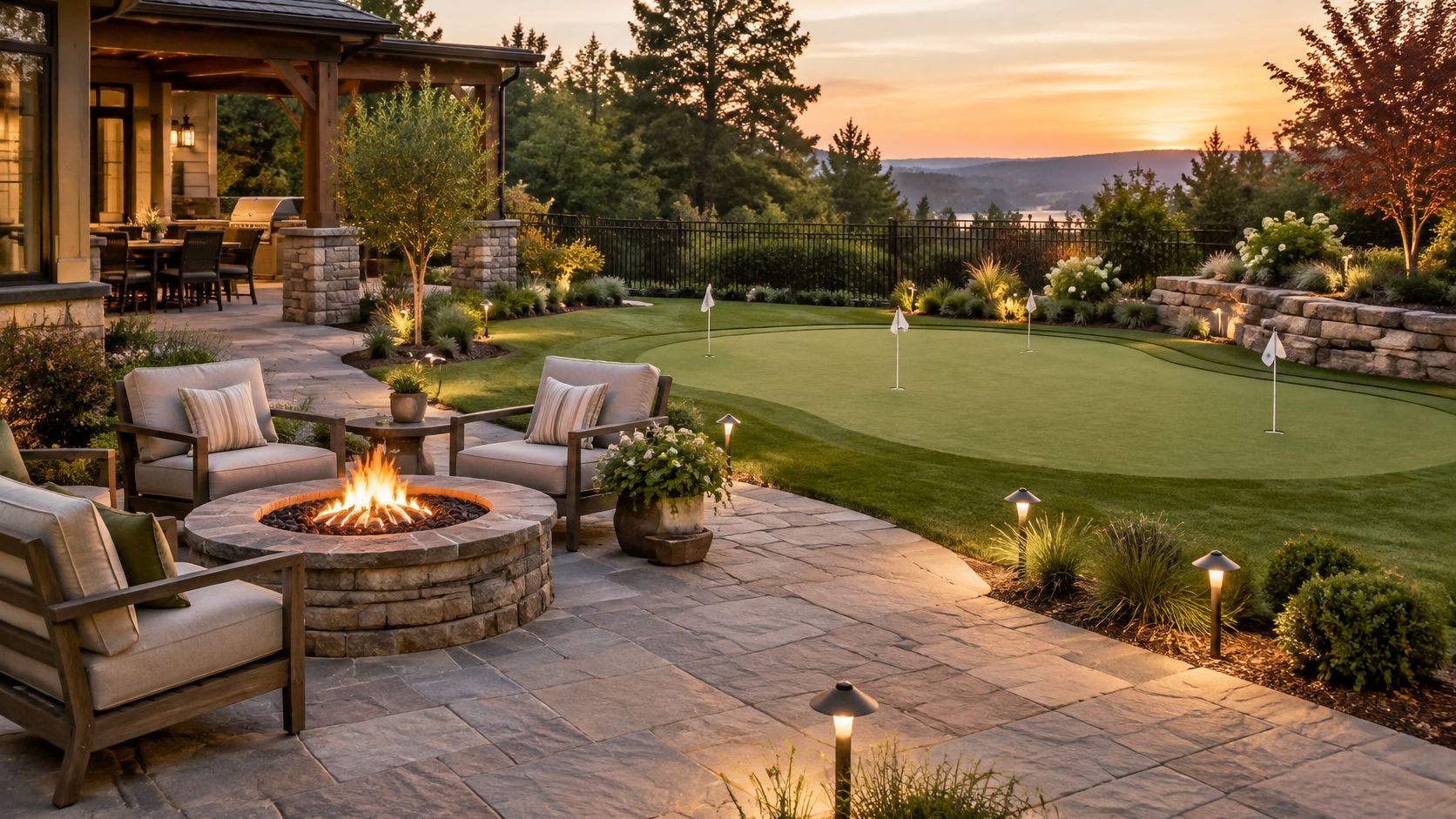
In a Prescott backyard, that might mean a green beside a stone seating area with a clear path from the kitchen door to the grill. Guests can watch putting without crossing behind someone's stroke or standing near a chipping target.
The arrangement below illustrates the relationship between seating, fire, and a nearby green.
How do you make the green comfortable in summer?
Plan shade and evening use before maximizing turf coverage. The National Collaborating Centre for Environmental Health's artificial-turf review reports surface-temperature differences between artificial and natural turf ranging from 9.4°C to 33.7°C across reviewed studies.
Those findings aren't a temperature forecast for your yard, but they're a clear reason not to equate low-water landscaping with a cool surface. Provide a shaded resting area, check surface conditions before children or pets enter, and don't rely on occasional rinsing as a permanent cooling solution.
Keep fire features on suitable noncombustible hardscape, with separation based on the appliance instructions and applicable requirements. Synthetic turf shouldn't sit where sparks, embers, or radiant heat can damage it.
Use shielded lighting to illuminate paths and the playing surface without shining into a golfer's eyes or neighboring homes. In Prescott Valley, a modest green that's comfortable after dinner may be more useful than an expansive surface exposed throughout the afternoon.
7. Paver-Bordered Putting Green Patio Design
A paver border is useful when you want a defined edge, clean access, and a visual connection to the patio. It's especially effective where a green meets an established outdoor seating area.
For a Chino Valley yard, consider a curved synthetic green framed with pavers that match the main patio. Alternatively, a natural green can meet a paved walking route, provided the edge detail accommodates turf care and keeps irrigation from creating a persistently wet transition.
The weak point is usually the junction between materials. A raised paver can catch a shoe or deflect a ball, while an unsupported turf edge can loosen under repeated traffic.
What prevents the border from shifting?
Prepare the paver and turf foundations as a coordinated assembly. Compact the aggregate appropriately, provide edge restraint, and establish finished elevations before either surface is installed.
The USGA's explanation of drainage specifications emphasizes how slope affects drainage performance. For a residential border, the practical lesson is straightforward: don't create a decorative rim that traps water around the green.
Keep transitions comfortable. Avoid abrupt lips along normal walking routes.
Consider lighter colors. Evaluate samples in direct sun rather than choosing from indoor photographs alone.
Protect the outlet. Leave a designed route for runoff instead of enclosing the green like a basin.
Coordinate restraint details. Pavers and turf need secure edges without conflicting fasteners or exposed hardware.
This guide to how to install paver patios explains the preparation behind a durable paved surface. For seating placement, use patio furniture layout inspiration to organize gathering space outside the putting lanes.
A wide decorative border isn't automatically better. Preserve room for actual play and access before spending the available footprint on edging.
8. Low-Maintenance Putting Green for HOA Communities and Multi-Family Properties
Shared greens need straightforward layouts, durable detailing, and a named maintenance responsibility. The design should remain understandable to a first-time user without supervision.
Consider a Prescott Valley common area with a simple putting surface, shaded bench, and direct connection to the existing walkway. Residents can enter without crossing planting beds, and the maintenance crew can reach the surface without driving equipment over the edge.
A community green doesn't need elaborate contours to be engaging. Predictable roll, comfortable access, and clear sightlines usually matter more than tournament-style difficulty.
What should an HOA include in the maintenance plan?
Surface inspections. Check seams, cup surrounds, edging, and signs of settlement.
Debris removal. Clear leaves, litter, and grit before they affect use.
Drainage checks. Inspect outlets and low areas after significant storms.
Use rules. State hours, footwear expectations, and whether chipping is permitted.
Responsible ownership. Identify who handles routine care and who authorizes repairs.
Water savings should be evaluated against the irrigated area being replaced, not treated as a guaranteed property-wide reduction. A synthetic-turf sustainability review discusses water conservation alongside lifecycle issues, including maintenance and material management.
For a shared property, account for occasional cleaning, infill containment, surrounding irrigation, and eventual surface replacement. These responsibilities don't disappear because the grass is synthetic.
Our process begins with a guided consultation and design approval before transformation. For managed properties, that makes early agreement on access, use, and maintenance especially important.
Include the green in the property's broader HOA landscape maintenance plan, rather than treating it as an amenity with no ongoing owner. In Northern Arizona, post-storm inspections and attention to winter movement help identify small problems before they become trip hazards.
How the Eight Backyard Putting Green Designs Compare
Item | Best For | Space Needed | Maintenance Level |
|---|---|---|---|
Classic Single-Hole Artificial Turf Putting Green | Compact daily putting practice | About 200–400 sq ft | Low; periodic brushing and infill checks |
Multi-Hole Practice Green with Fringe and Varied Pin Positions | Families and golfers seeking varied practice | Usually 500 sq ft or more | Moderate; routine turf care |
Tiered Multi-Level Putting Green with Built-In Contours | Sloped yards and challenging play | A sloped area large enough for multiple levels | Moderate; upkeep plus drainage and wall checks |
Natural Bermudagrass Putting Green for Arizona Climates | Golfers seeking a realistic grass surface | A dedicated area for a natural green | High; regular mowing, watering, and fertilizing |
Putting Green with Chipping Collar and Bunker | Full short-game practice | Large area; requires room for a green, collar, and bunker | High; regular turf care and bunker raking |
Putting Green Integrated with a Fire Pit and Outdoor Living Area | Entertaining alongside recreational play | Space for a green, seating, and outdoor features | Moderate; turf and outdoor feature upkeep |
Paver-Bordered Putting Green Patio Design | A polished green with easy walking access | Space for a green and surrounding paver border | Low to moderate; routine care and occasional paver checks |
Low-Maintenance Putting Green for HOA Communities and Multi-Family Properties | Shared community recreation areas | Common-area space suited to shared use | Low; periodic brushing, debris removal, and inspections |
Choosing the Right Putting Green for Your Yard
Start with the space you have, then weigh how often you'll use the green and how much care you want to give it. A single-hole artificial turf green is a sensible starting point for many Prescott yards, while sloped properties may justify terraces and larger lots can support varied practice lanes.
Don't remove the lawn before settling the layout and irrigation changes. The University of Arizona Cooperative Extension's landscape-conversion guidance places replacement design before turf removal and installation, a sequence that helps avoid unnecessary rework.
What should I compare in putting-green proposals?
Compare the site preparation, drainage route, surface specification, edging, and finish details, not just the shape on the drawing. Confirm how settlement concerns and drainage problems will be handled, and distinguish those responsibilities from the turf manufacturer's material warranty.
Estimating tools such as Exayard landscaping estimating software can help organize project scope, but software doesn't replace measuring the property and checking grades. A useful proposal explains what will be built beneath the visible surface.
R.E. and Sons Landscaping is a licensed, bonded, and insured design-build company serving Prescott, Prescott Valley, and Northern Arizona, with Arizona ROC #300642 available for verification. The Arizona Registrar of Contractors advises homeowners to confirm that a contractor's license classification covers the work in the contract, an important distinction when a project includes grading, drainage, or retaining walls.
Can I install a putting green on a sloped Prescott lot?
Yes, when the design provides stable playing areas, appropriate retaining structures where needed, and a controlled drainage route. A steep existing slope shouldn't be covered with putting turf.
Is artificial turf completely maintenance-free?
No. It eliminates mowing and fertilizing, but debris removal, occasional cleaning, infill attention, and inspections still matter.
Will a backyard putting green stay usable all winter?
Usability depends on weather, exposure, and surface conditions. Don't play on ice or force use when the base or surface is compromised, and don't expect synthetic turf to prevent frost.
For homeowners ready to evaluate their yard, R.E. and Sons Landscaping offers a free turf consultation to discuss the space, grade, drainage, and a suitable layout. Bring photographs, note where water travels during storms, and identify when you expect to practice. Those details help produce a green that fits your property rather than a design that merely looks attractive on paper.
R.E. and Sons offers custom putting greens and coordinated design-build services for Prescott-area yards. Visit R.E. and Sons Landscaping to schedule a free turf consultation and discuss a layout that fits your grade, outdoor living space, and maintenance preferences.
Comments