
HOA Landscape Maintenance: The Complete Northern Arizona
Maintenance can consume 30% to 50% of an HOA's annual budget, according to industry guidance on HOA landscaping management. In Northern Arizona, that money pays for more than mowing. It supports irrigation, tree safety, weed control, common-area appearance, water management, and the consistent standards residents expect from a planned community.
R.E. and Sons Landscaping helps HOA boards, property managers, and homeowners in Prescott, Prescott Valley, Chino Valley, and surrounding Northern Arizona communities manage those responsibilities with practical maintenance, improvements, irrigation oversight, and outdoor-space planning. The central problem is rarely a lack of ideas. It's unclear scope, weak contract language, poor vendor follow-through, and maintenance standards that ignore the high-desert climate.
Why HOA Grounds Maintenance Demands Board-Level Attention
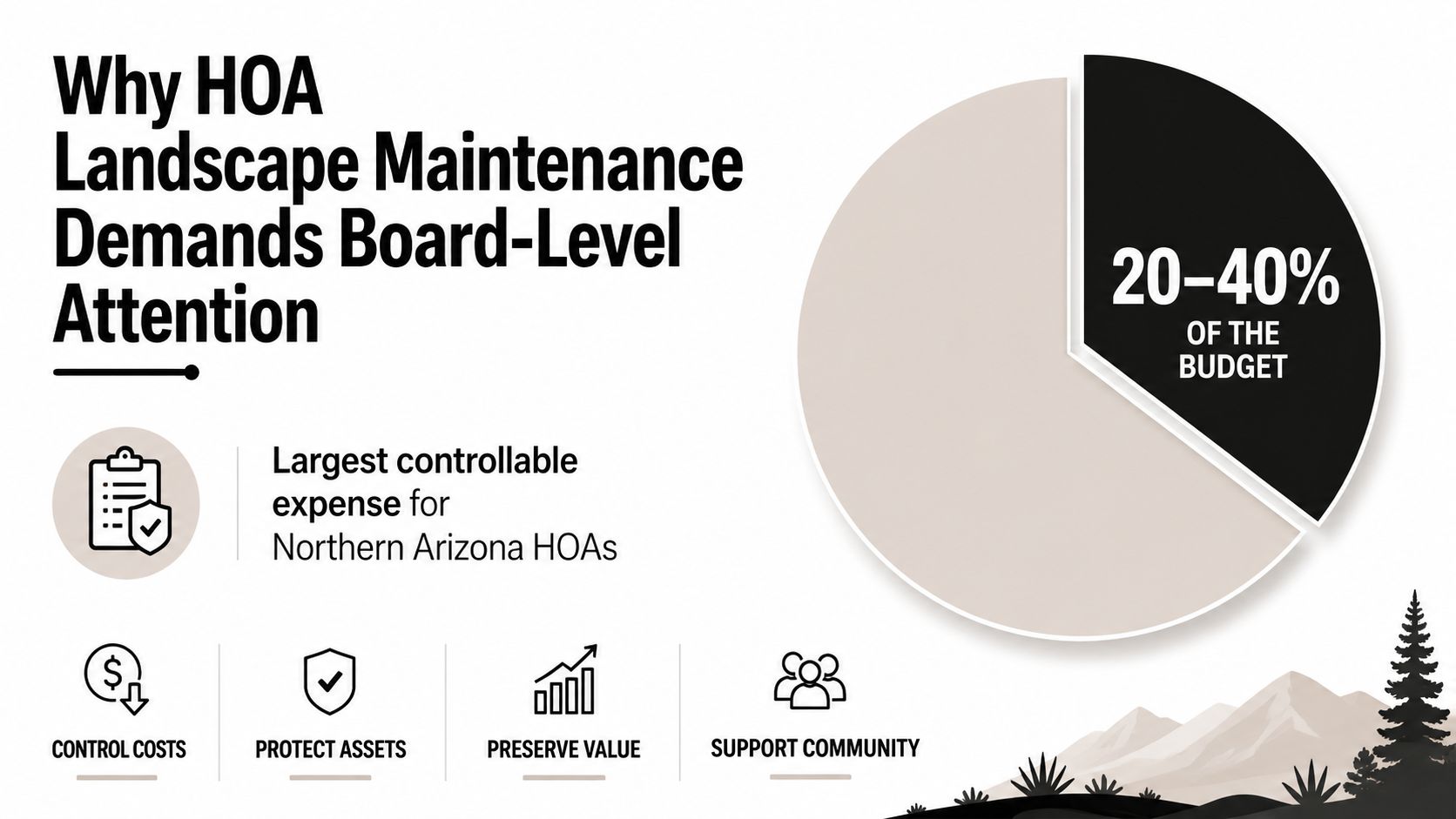
For a community with $500,000 in annual assessments, maintenance may represent $150,000 to $250,000 per year, based on the HOA landscaping budget guide. That makes common-area maintenance a governance issue, not a minor groundskeeping line item. The board decides how shared funds protect property, control water use, reduce liability, and maintain the appearance residents see every day.
In communities with medians, parks, trails, retention basins, entrance monuments, and perimeter plantings, grounds work can account for 40% to 55% of operating costs, according to that guide. Northern Arizona conditions make generic service plans unreliable. Dry soil, intense sun, monsoon runoff, winter freezes, mature trees, and aging irrigation equipment all create costs that a basic weekly mowing agreement will not address.
What boards should monitor
Mowing and edging commonly represent 25% to 35% of the grounds budget, while irrigation and water account for another 15% to 25%, according to the same industry breakdown. These costs respond to different operating conditions. Labor rises when turf grows quickly, while water charges and irrigation repairs increase when controllers, valves, pressure, or distribution are poorly managed.
A board that approves one annual contract and rarely verifies the work creates predictable gaps:
Unclear service standards: “Maintain grounds” does not define pruning height, weed tolerance, irrigation response time, or cleanup expectations.
Hidden asset deterioration: Leaking valves, clogged emitters, damaged sidewalks, and declining trees become more expensive when no one records them.
Resident conflict: Homeowners see uneven mowing, dead plants, or neglected entrances and conclude that the board is not managing the vendor.
Budget surprises: Emergency tree work, irrigation failures, and seasonal additions appear as unplanned charges.
Practical rule: If the board cannot inspect it, document it, and connect it to a contract requirement, it is not being managed consistently.
Effective HOA maintenance turns appearance into measurable service. The board should know which zones receive service, when the vendor visits, how quickly irrigation failures are addressed, what water use looks like, and which repairs require separate approval. In Prescott and Prescott Valley, those records support enforceable standards, climate-adapted contract language, and clear vendor accountability. They also give directors a defensible way to explain maintenance decisions to residents.
Defining Scope and Responsibility Boundaries
A boundary dispute in a Prescott community can start with one weed-filled parkway. The vendor assumes the city maintains it, the homeowner expects the HOA to handle it, and the board discovers that the CC&Rs say neither clearly. Before assigning work or approving a charge, identify the parcel, easement, improvement, and party responsible for it. The sample CCR language shows why written documents should control these decisions instead of informal assumptions.
Common-area duties may cover entrance monuments, medians, parks, retention basins, trails, drainage areas, shared turf, perimeter plantings, and vegetation visible from public rights-of-way. Owners may be responsible for private patios, enclosed yards, owner-installed beds, decorative features, or areas expressly excluded by the CC&Rs. A map attached to the agreement should label each zone and identify whether the HOA, homeowner, municipality, or another party maintains it.
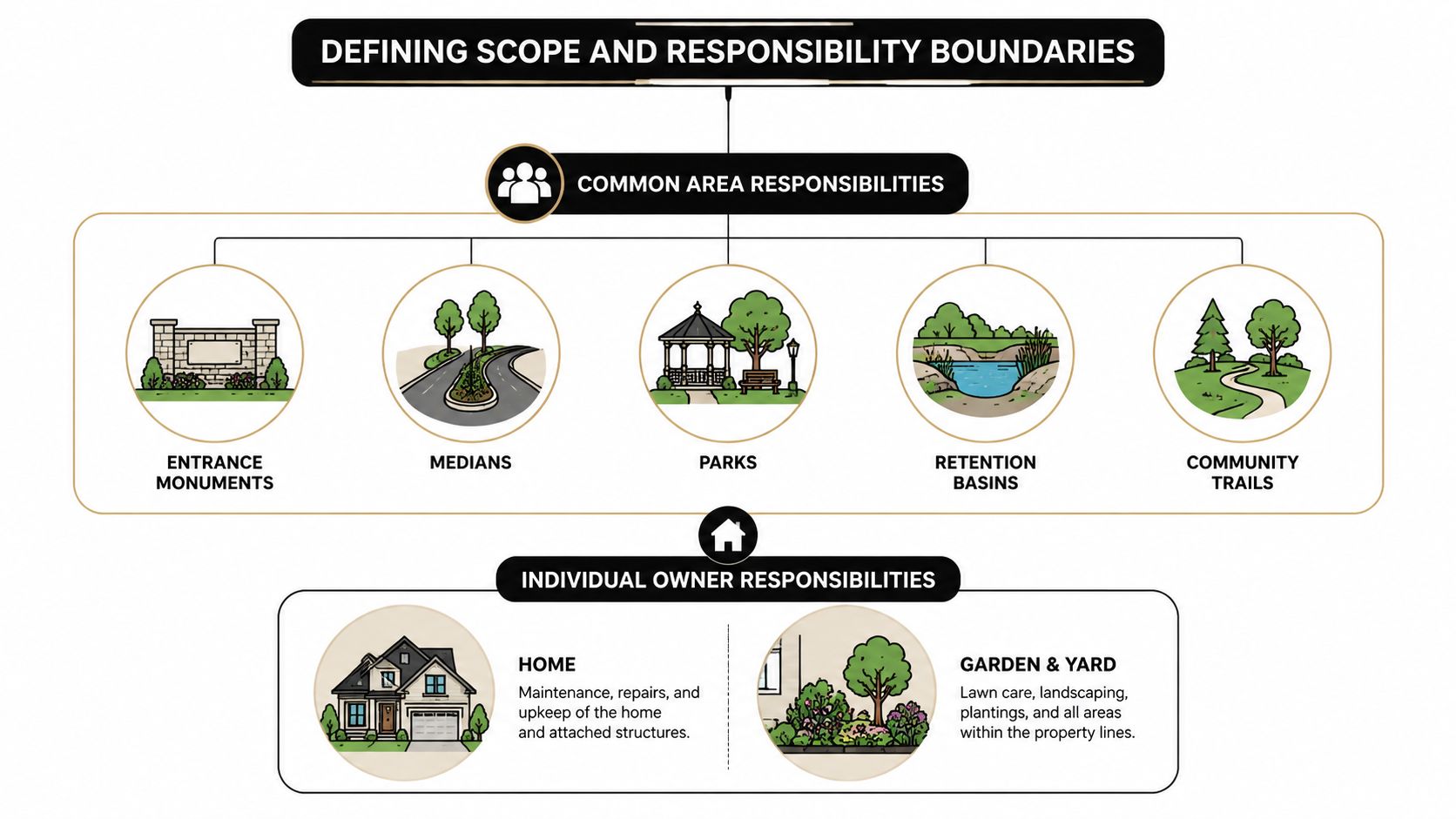
What a complete scope should identify
The exhibit should pair service areas with frequencies, exclusions, response expectations, and approval limits. Specify whether the vendor handles:
Routine care: Mowing, edging, blowing, pruning, weed control, fertilization, and seasonal cleanup.
Irrigation: Controller programming, inspections, pressure checks, valve repairs, leak response, and winterization.
Trees: Clearance pruning, storm inspections, removal recommendations, stump work, and certified arborist assessments.
Planting and color: Seasonal color rotations, mulch, plant replacements, and warranty responsibilities.
Hardscape: Cleaning, weed removal from joints, drainage observations, and reports on cracked or unsafe surfaces.
The contract should also define documentation. Require dated photographs, zone references, and board notification when work falls outside routine service. A maintenance contract planning guide can help directors organize those service categories before requesting bids.
Tree roots from common areas may affect private irrigation, walls, or paving. The board should review ownership, easements, root conditions, and governing documents before promising a remedy. Require the vendor to photograph the condition, identify the likely source, and submit a repair recommendation. No unapproved removal or alteration should follow from a field assumption.
Access belongs in the scope as well. For gated communities, boards can review HOA gate access system options and specify approved entry procedures, resident notices, and emergency access rules. That detail prevents a maintenance visit from becoming an avoidable security or scheduling dispute.
Cost Drivers That Shape Your Annual Grounds Budget
Northern Arizona HOA budgets change for understandable reasons. Turf, irrigation, trees, labor, amenities, and contract risk each create different cost patterns, so boards should not compare bids by total price alone. A low bid may exclude irrigation repairs, seasonal cleanup, tree work, or plant replacement, leaving the association to pay later. The practical test is whether each line item has a defined service standard, inspection method, and approval path.
Irrigation deserves close attention because water demand and equipment condition are connected. Guidance for HOA properties recommends irrigating thoroughly and infrequently at about 1 inch per week when rainfall is insufficient (Virginia Cooperative Extension HOA manual), while verifying that water enters the soil instead of running off. The same manual emphasizes early-morning irrigation, system inspections, and pressure checks. In Northern Arizona, contract language should also require reporting for broken lines, stuck valves, runoff, and controller faults, rather than treating wasted water as an unexplained utility overage.
A dedicated irrigation meter or submeter helps the board distinguish irrigation demand from other community use. EPA WaterSense materials describe a dedicated irrigation meter or submeter as the most effective way to determine outdoor water use (source: EPA WaterSense for Multifamily Irrigation). Boards evaluating get submetering for multifamily properties can use that information to identify leaks, compare seasons, and verify whether schedule or planting changes are working.
Northern Arizona HOA Grounds Cost Drivers Comparison
Cost Category | Annual Cost Range | Key Variables | Budget Impact |
|---|---|---|---|
Irrigation and water | Varies by site and use | Water rates, leaks, pressure, controller age, zone design | Can create recurring overages when failures go undetected |
Turf maintenance | Varies by turf area and service level | Mowing, edging, fertilization, aeration, overseeding | Requires consistent labor and often higher seasonal attention |
Xeriscape and native planting | Varies by design and replacement needs | Plant palette, mulch, drip irrigation, weed control | Reduces turf demand but still needs specialized oversight |
Tree care | Varies by canopy, access, and risk | Mature size, proximity to roofs or infrastructure, storm damage | Irregular expenses can be substantial when deferred |
Seasonal labor | Varies by community calendar | Spring cleanup, summer growth, fall leaves, winter preparation | Creates predictable peaks that should be scheduled in advance |
Amenities and site extent | Varies by maintained acreage and features | Monuments, trails, basins, parks, perimeter areas | Broad scope increases labor, travel, equipment, and inspection time |
Mowing and edging typically consume 25% to 35% of the grounds budget, while irrigation and water account for 15% to 25%, according to the HOA landscaping cost breakdown. The turf-versus-xeriscape decision therefore changes more than appearance. Turf creates recurring mowing and water obligations, while lower-water areas shift attention toward irrigation precision, mulch, weed control, plant establishment, and replacement planning.
Boards should budget by mapped area and service category, not by an unsupported per-acre or per-unit assumption. Ask vendors to separate base maintenance, irrigation repairs, tree work, seasonal color, enhancements, and emergency response. Track missed visits, irrigation deficiencies, water-use anomalies, and unresolved corrective work at board meetings. That format shows whether the association is underfunding a necessary category or paying for an unclear scope.
Selecting and Managing the Right Vendor
Vendor performance depends on more than an attractive proposal. For a Northern Arizona HOA, the contractor must understand high-desert planting, irrigation distribution, monsoon exposure, frost risk, local restrictions, and the difference between keeping plants alive and maintaining a presentable community.
Begin with qualification documents. Require general liability insurance, workers' compensation coverage, and commercial auto insurance appropriate to the work. Confirm licensing and verify that subcontractors carry their own coverage. Ask who supervises crews, who responds to irrigation emergencies, and who may approve extra work. These answers define accountability before a service failure becomes a board dispute.
Build the contract around observable work
The scope should describe work a resident could verify during a walkthrough:
Pruning: Identify shrubs that are shaped or selectively thinned, along with clearance and visibility requirements.
Weed control: Specify treated areas, inspection frequency, and resident notification before applications.
Irrigation response: Require reporting for broken lines, stuck valves, runoff, and controller faults, with a stated response process.
Tree care: Define routine pruning and the conditions requiring a certified arborist.
Documentation: List the photos, service notes, water readings, and deficiency reports delivered to the board.
Use a mapped vendor evaluation scope so proposals can be compared by task, frequency, response requirement, and reporting duty. R.E. and Sons Landscaping can be evaluated alongside other qualified providers against the same written scope, rather than through name recognition or a low headline price.
Monthly walkthroughs with the board liaison create a consistent record. Photograph the same entrance monuments, turf zones, basins, trails, and high-visibility beds so conditions can be compared over time. Document missed visits formally, assign a correction deadline, and connect repeated failures to contract remedies where appropriate.
Vendor access also affects community security. Boards should establish approved arrival windows, gate procedures, emergency contacts, and resident communication using practical HOA visitor management best practices.
Board accountability: Assign one liaison for routine communication, but keep approvals and contract changes with the board or its authorized manager.
Review the contract annually using measurable records: missed visits, unresolved deficiencies, irrigation incidents, plant losses, complaint patterns, emergency charges, and available water records. The board should require the vendor to explain what happened, what was corrected, and how recurrence will be prevented. If those answers are missing, the association lacks meaningful vendor accountability.
Climate-Adapted Standards for Northern Arizona Communities
Northern Arizona grounds standards should not copy requirements written for Phoenix or Tucson. Prescott and Prescott Valley communities face high-desert conditions, monsoon storms, seasonal freezes, dry soil, intense sunlight, and sharp exposure differences between open and sheltered sites. Contract language must account for those conditions instead of relying on a generic recurring service list.
A climate-adapted standard does not require identical front yards. It defines the uniform elements the HOA can enforce: clear bed edges, controlled plant height, healthy coverage, maintained mulch, working irrigation components, and approved materials suited to the region. Native and drought-tolerant plants can look intentional when beds have consistent structure, orderly spacing, compatible rock or mulch, and dependable weed control.
Lower-water plantings are not automatically maintenance-free. They may reduce mowing and irrigation demand, but they still require replacement decisions, drip-system inspections, seasonal pruning, mulch management, and careful weed control. If the board approves xeriscaping without revising the service scope, savings in one category can produce neglected work in another.
Climate-Adapted Grounds Standards Comparison
Standard Category | Traditional Turf Approach | Climate-Adapted Approach |
|---|---|---|
Plant selection | Broad lawn areas with ornamental borders | Approved native, drought-tolerant, and site-appropriate plants |
Irrigation | Fixed schedules that may ignore rainfall or soil conditions | Early-morning cycles, zone inspections, pressure checks, and water tracking |
Soil and mulch | Limited attention between planting events | Annual mulch planning and soil aeration in trafficked areas |
Appearance | Uniform green coverage as the main visual standard | Defined edges, managed heights, healthy plants, and consistent bed condition |
Turf conversion | Replacement decisions handled case by case | Written approval path, drainage requirements, and maintenance obligations |
Artificial turf | Appearance-focused approval | Product, infill, drainage, heat, edging, and cleaning standards |
EPA-inspired contract language commonly recommends about 3 inches of mulch annually and soil aeration in trafficked areas. The same EPA contract guidance identifies seasonal irrigation pressure ranges of 30 to 45 psi, depending on emitter type, and supports water-budget alerts at 80%, 90%, and 100% of monthly use.
Boards should turn water-saving goals into enforceable operating requirements. Require weekly water-budget tracking, documented controller adjustments, pressure checks, leak reports, and a separate approval process for turf removal. Assign accountability to a board liaison or manager, then review records for missed inspections, unresolved irrigation issues, plant losses, water-use exceptions, and corrective completion.
Where state law protects low-water planting, appearance rules must remain reasonable. California's Davis-Stirling framework, for example, addresses restrictions involving low-water plants and artificial turf, as summarized in this California water-conservation HOA overview. Northern Arizona boards should still write clear standards for design approval, drainage, heat exposure, upkeep, and responsibility boundaries.
Seasonal Maintenance Schedule and Inspection Checklist
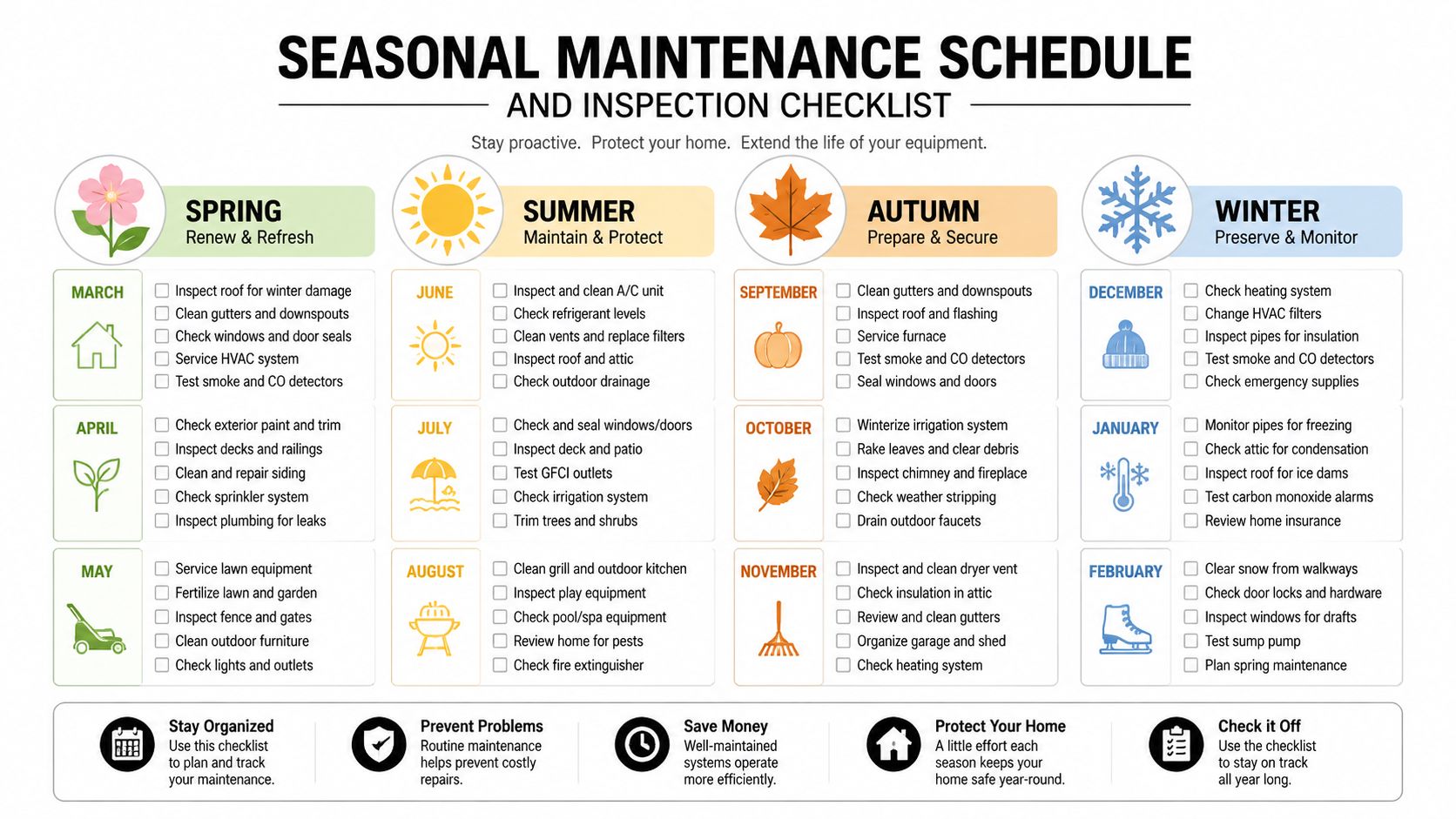
Northern Arizona's maintenance calendar should follow plant stress, storm exposure, and irrigation demand, not a generic mowing route. The vendor completes contracted work, the HOA liaison verifies it, and homeowners remain responsible for private areas assigned under the governing documents. The contract should define observable standards, inspection cadence, photo records, correction deadlines, and approval rules for work outside the base scope.
Spring and early summer
In March, inspect frost damage, activate irrigation gradually, test controllers, check valves and backflow components, and confirm water reaches the soil. Record dead limbs, broken emitters, erosion, and winter debris before regular growth begins.
April is the time for bed cleanup, edging, mulch review, weed control, and selective pruning. If permitted and appropriate, pre-emergent applications should be documented, with resident notices issued when required.
During May and June, inspect turf growth, irrigation coverage, plant stress, and sightlines near sidewalks and streets. Active turf and high-use amenities may need weekly visits, but the agreement should set frequency by zone, risk, and service requirement rather than relying on a blanket schedule.
Monsoon season and fall
Monsoon timing has become less predictable in recent years, so boards should not treat July and August as fixed inspection windows. Increase checks when storms arrive late or in clusters, especially after high winds. Inspect tree risks, drainage, erosion, runoff, and storm-damaged limbs, and require prompt reporting of irrigation breaks. Crews should verify that water is not stripping mulch or carrying soil onto walks and streets.
September and October suit fall cleanup, selective pruning, soil preparation, aeration in trafficked areas, mulch correction, and irrigation adjustments as temperatures change. Compare controller records with visible plant health. A schedule alone does not prove proper watering.
In November and December, remove leaves, prepare plants for dormancy, protect exposed pipes, and winterize irrigation where site conditions require it. State which lines will be blown out or isolated, who approves the work, and how completion is documented.
Winter review
January and February support suitable dormant pruning, tree health assessments, equipment review, contract renewal planning, and map updates. Use a qualified arborist when canopy size, infrastructure proximity, or storm exposure exceeds routine crew observation.
Boards can adapt this annual maintenance schedule template into a contract exhibit. Track the responsible party, inspection result, photo evidence, correction status, and board review. Useful board metrics include missed inspections, unresolved irrigation defects, plant losses, water-use exceptions, and overdue corrections.
The video below offers another visual reference for organizing recurring property-care tasks.
Frequently Asked Questions About HOA Landscape Maintenance
How often should an HOA landscape vendor visit?
The answer depends on the mix, not a universal calendar. Turf, entrances, parks, trails, basins, and xeriscape beds should each have defined service frequencies. The board should require enough visits to maintain appearance and identify irrigation or safety problems before they become emergencies.
Who pays for tree removal in a common area?
The HOA generally handles trees located in areas assigned to the association, subject to the governing documents and any required approval. A homeowner typically handles a tree on a private lot, but boundary trees, roots, easements, and damage claims require document review before responsibility is assigned.
Can an HOA fine a homeowner for poor landscaping?
An HOA may enforce valid maintenance standards through the process authorized by its CC&Rs and applicable law. The board should document the condition, provide notice and an opportunity to correct it, and apply rules consistently. Arizona-specific questions should go to qualified HOA counsel.
What is the average HOA landscape budget per unit in Northern Arizona?
There isn't a reliable universal average for every Prescott-area community. The budget depends on maintained acreage, turf, irrigation condition, tree maturity, amenity count, water use, and whether private lots are included. California planning guidance illustrates that some associations use per-unit budgeting norms, but boards should benchmark their own mapped scope rather than copy another market's figure. See the California HOA operating-cost reference for that broader context.
How can a community transition from turf to xeriscaping?
Start with a pilot area, update the approved plant and material list, define appearance standards, confirm drainage, and revise the maintenance contract before removing turf. Use a dedicated irrigation meter or submeter where possible so the board can measure the effect instead of relying on estimates.
How should a board handle vendor accountability?
Assign a liaison, schedule documented walkthroughs, require correction deadlines, and review photos, service notes, irrigation incidents, and extra-work invoices. If deficiencies continue, follow the contract's cure and rebidding provisions rather than relying on informal complaints.
How should drought conditions change the budget?
Shift money toward irrigation inspection, leak response, soil and mulch management, plant establishment, and replacement planning. Water-saving design can reduce demand, but it still needs specialized maintenance and clear enforcement standards.
R.E. and Sons Landscaping provides ongoing lawn maintenance, mowing, edging, fertilization, irrigation support, and improvement services for properties in Prescott, Prescott Valley, Chino Valley, and nearby Northern Arizona communities. Visit R.E. and Sons Landscaping to discuss a clearly scoped HOA maintenance plan, irrigation priorities, or a climate-adapted project.
Comments