
Outdoor Kitchen Oven Guide for Prescott Homes
You're halfway through a backyard gathering in Prescott, and you're back inside again. The grill is hot, guests are on the patio, but the bread, roasted vegetables, or pizza still needs your indoor stove. An outdoor kitchen oven solves that split, but only if your patio, roof, fuel supply, and clearances can support it safely. That's the decision this guide walks through, in the order that prevents expensive rework.
Why Prescott Homeowners Are Adding Outdoor Kitchen Ovens
A Prescott family we see often starts the same way. They've got a good grill and a patio they love, yet every gathering turns into a relay between the backyard and the kitchen door. Someone misses the conversation, food arrives in waves, and the person cooking never really joins the group.
R.E. and Sons Landscaping designs and builds complete outdoor kitchens for homeowners in Prescott, Prescott Valley, Chino Valley, and across Northern Arizona. The problem we solve isn't just adding an appliance. It's building one connected cooking space with prep counters, storage, refrigeration, seating, and heat-safe surfaces so the cook stays outside with everyone else.
What problem does an outdoor kitchen oven actually solve
An oven adds what a grill can't do well. It bakes, roasts, and finishes dishes at controlled heat while the grill handles searing. Pizza is the obvious draw, but homeowners also use these ovens for crusty bread, sheet pan vegetables, casseroles, and desserts that would otherwise heat up the house.
That range matters for weeknights, not just parties. If you're looking for ideas that pair well with an existing grill setup, these grill recipes for weeknights show how much of a normal dinner can move outside once you stop treating the patio as a weekend-only space.
Why the oven can't be an afterthought here
In Northern Arizona, an oven isn't a standalone purchase you drop on a finished patio. It's the centerpiece of a larger outdoor living investment. Its weight, heat, fuel, and exhaust shape the masonry, counter material, and circulation around it.
Pick the structure first, the oven second. A beautiful oven that fights your roofline or gas line will cost you twice.
By the end of this guide, you'll know how to choose a fuel type, decide between built-in and freestanding, plan ventilation and clearances, budget, and match the oven to high-desert weather. You'll also know which questions to ask before anyone pours a footing or runs a gas line.
The Outdoor Oven Market and What It Means for Your Build
Outdoor ovens used to be a specialty item for serious pizza hobbyists. That has changed. The Freedonia Group reported U.S. demand for outdoor grills, smokers, fryers, ovens, and related accessories reached approximately $5.3 billion in 2021, with consumer purchases representing about 90% of total demand, according to Grand View Research outdoor kitchen market analysis. Its forecast expected a decline from that unusually strong base to roughly $4.4 billion in 2026. Even after that cooling, this remains a multibillion-dollar residential category driven by homeowners, not restaurants.
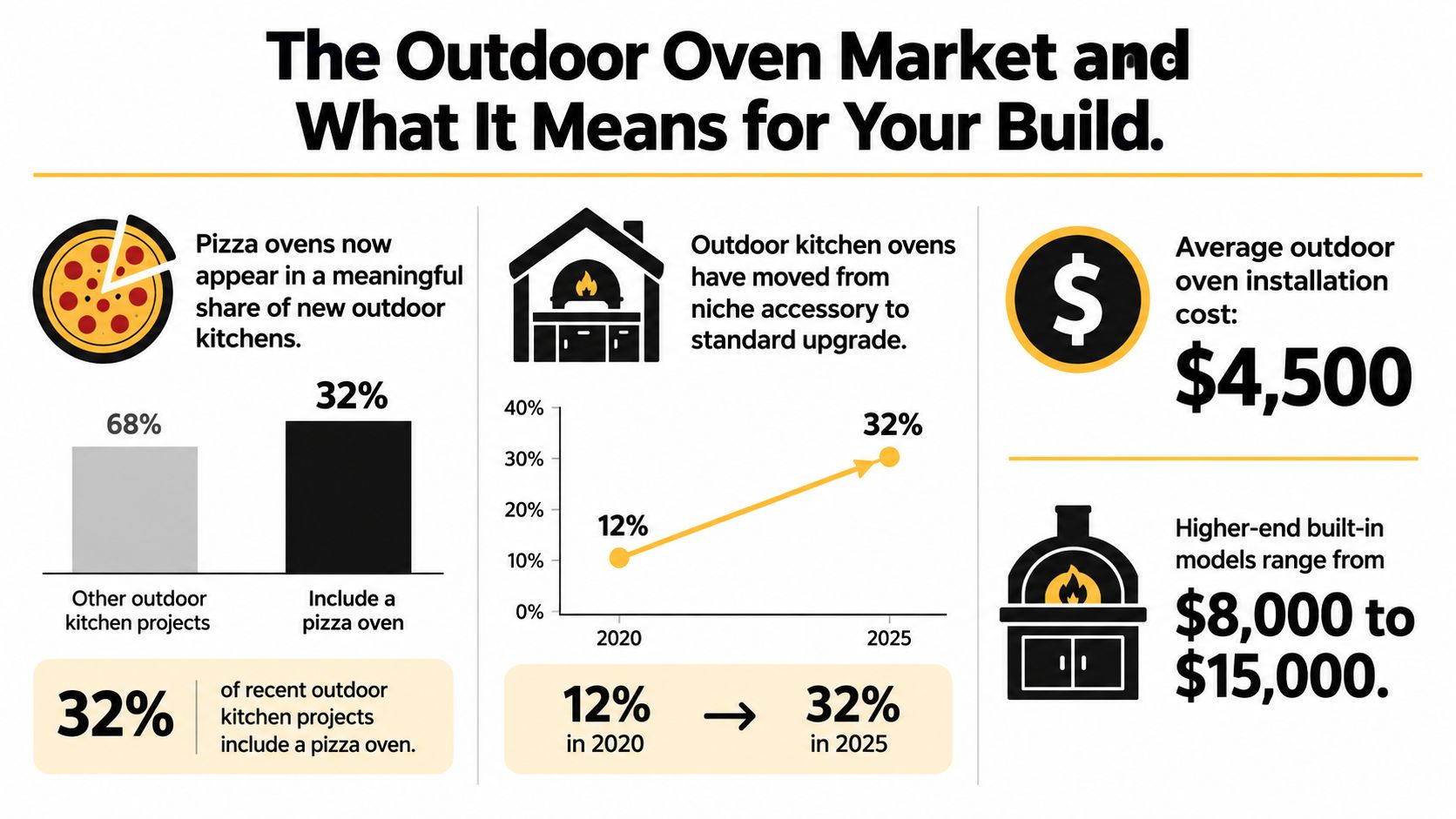
Remodeling data tells the same story at the project level. Houzz surveyed 1,106 homeowners for its 2024 U.S. Outdoor Trends Study, and among those adding or upgrading outdoor kitchens, grills appeared in 88% of projects, cooktops in 46%, and pizza ovens in 33%, as summarized in Mordor Intelligence outdoor cooking appliances market research. One in three new outdoor kitchens now includes a pizza oven. That's mainstream, not niche.
What does this trend mean for your Prescott build
It means manufacturers, masons, and inspectors now expect ovens in outdoor kitchen plans, but it also means the oven pulls other systems with it. That same Houzz data shows most outdoor kitchen projects involve plumbing, electrical, or heating work alongside appliances and countertops. An oven can require coordinated masonry or cabinetry, fuel or electrical connections, heat-resistant construction, and real prep space next to it.
Utilities move to day one. Gas, electrical, and water rough-ins happen before counters and stone, not after.
Scope drives timeline. Adding an oven affects footings, ventilation, and inspections, so it belongs in the first design conversation.
Budget follows integration. You're not buying one appliance. You're funding the assembly around it.
Plan the oven as part of the kitchen from the start, and the rest of the build gets simpler. Add it late, and you're retrofitting around finished work.
Wood-Fired vs Gas vs Hybrid Outdoor Kitchen Ovens
Don't compare ovens by BTU alone. Compare usable temperature, preheat time, insulation, and cooking-surface size, and confirm whether an advertised temperature means chamber heat or stone heat. Published comparison data for current outdoor models reports roughly 800 to 1,500°F maximum temperatures, including a 16-inch infrared gas model listed at 19,000 BTU reaching about 1,500°F in roughly 15 minutes, as detailed in the Bighorn Outdoor oven buying guide comparison. A 12-inch multi-fuel model in that same comparison sits near 950°F with a longer preheat, while a larger 304-stainless wood-fired cabinet model reaches 800°F or higher but needs more time to get there.
Outdoor Kitchen Oven Types at a Glance
Oven Type | Max Temperature | Preheat Time | Flavor | Best For |
|---|---|---|---|---|
Wood-fired | 800°F or higher on larger cabinet models | Longest, around 35 minutes on the cited model | Smoky, live-fire character | Pizza nights, bread, slow entertaining |
Gas | Up to about 1,500°F on the cited infrared model | Fastest, about 15 minutes | Clean, neutral | Weeknight cooking, repeatable results |
Hybrid or multi-fuel | Near 950°F on the cited 12-inch model | Moderate, about 20 minutes | Choice of smoke or clean heat | Cooks who want flexibility |
Electric | Varies by model, confirm stone temperature | Depends on insulation and power | Clean, no combustion | Covered spaces where fuel storage is limited |
Which fuel fits how you actually cook
Wood gives you flavor and ritual. It also asks for dry fuel storage, ash management, and active fire tending. Gas gives you push-button control and fast recoveries between pizzas, which is why busy families use it more often. If you're weighing that flavor versus convenience trade-off, the Smokey Rebel flavour fuel comparison is a useful read on how fuel choice changes taste and effort across outdoor cooking generally.
The honest split: Wood gives character and high heat, gas gives convenience and control, and hybrid splits the difference at the cost of more parts to manage.
Electric models remove combustion and fuel storage, but they depend entirely on your outdoor power supply and still need weather protection for controls. Before you narrow this down, look at how an oven works alongside the rest of your appliance lineup in our guide to the best outdoor kitchen appliances for a complete Prescott build, because the right oven depends on what your grill and burners already cover.
Built-In vs Freestanding Ovens in a Full Outdoor Kitchen
Start with where you are in the build, not where you hope to be someday. A built-in oven and a freestanding oven can cook the same pizza. They create very different projects.
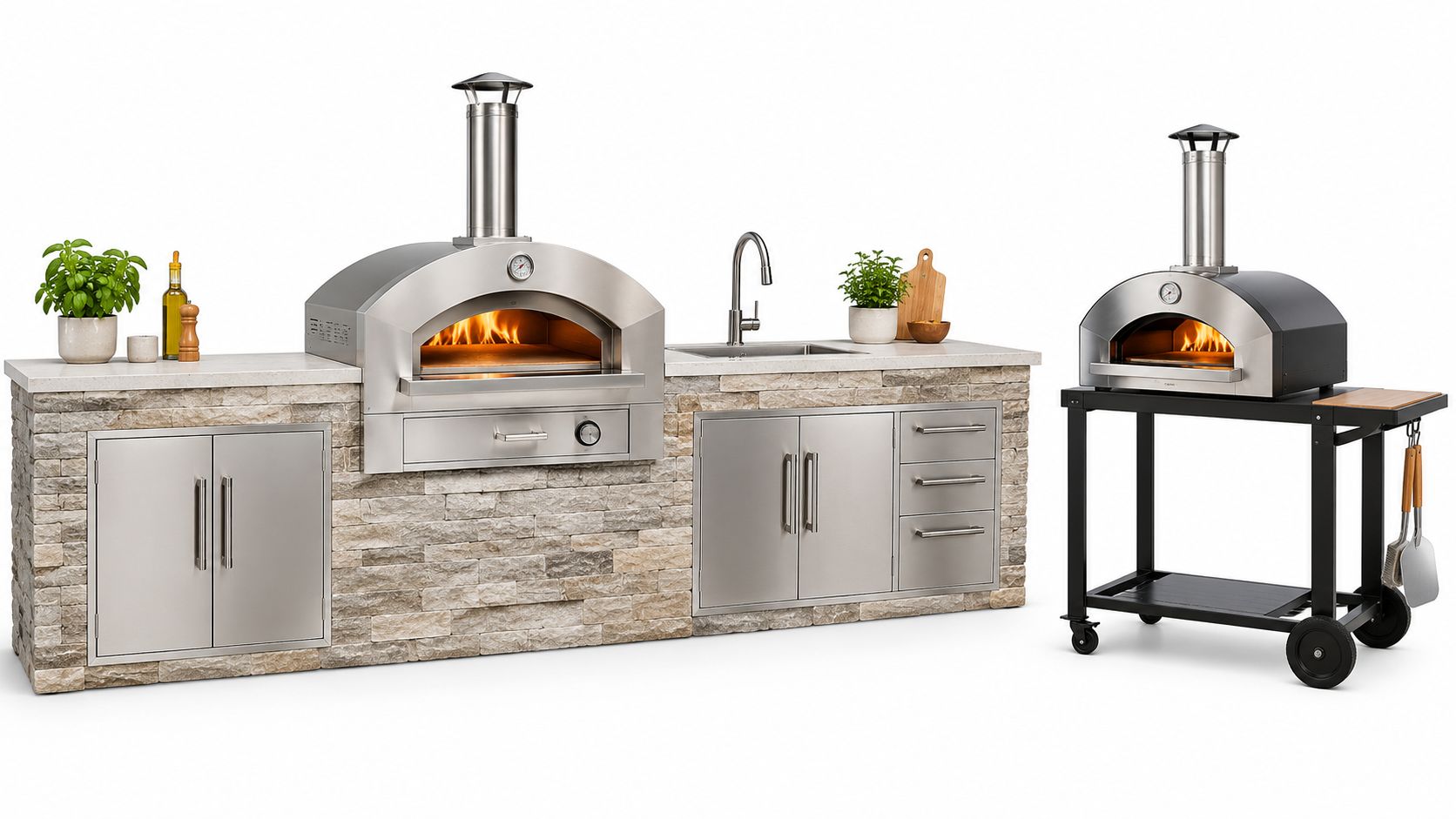
Here's how a finished built-in run looks when the oven, sink, and storage were planned as one island.
When built-in makes sense
A built-in oven becomes part of a masonry or cabinetry run. It anchors the layout, usually alongside a grill, with counter space on at least one side for launching and landing food. Because it's permanent, everything around it gets designed to match, including storage below, refrigeration nearby, and a dining zone within a short, clear path.
That permanence is the trade-off. You gain a unified kitchen and protected utility connections. You lose the ability to move the oven if your layout changes, and service access has to be planned before stone and counters close everything in.
When freestanding is the smarter first step
A freestanding unit on a cart or stand lets you cook now and build later. It's the right call if your patio isn't ready, your budget is phased, or you're not yet sure how often you'll use an oven. You can reposition it for wind, store it under cover, and learn your cooking habits before committing to masonry.
Watch how oven placement and workflow come together in a real outdoor kitchen layout before you lock in a form factor.
One caution applies to both. Counter space is what outdoor kitchens run short on most often, and an oven without a landing zone beside it frustrates every cook. Whether the oven is built in or on a cart, protect generous prep surface next to it and keep the path to seating short and downwind.
Ventilation, Clearances, and Fire Safety for Outdoor Ovens
This is the section that decides whether your installation is safe, legal, and pleasant to use. Most buying guides compare fuel and capacity, then skip combustion air, exhaust routing, and what happens when an oven sits under a patio roof. Don't skip it.
The stakes are real. The National Fire Protection Association reports gas grills were involved in an average of 9,235 U.S. home fires annually in 2020 to 2024, including 4,662 structure fires, according to NFPA grilling fire safety data. The same source notes the grill hadn't been cleaned in approximately 20% of grill fires, and leaks or breaks caused a meaningful share as well. An oven wrapped in cabinetry and roofing makes heat or a gas leak more consequential than a portable grill in open air.
What clearances and ventilation does an outdoor oven need
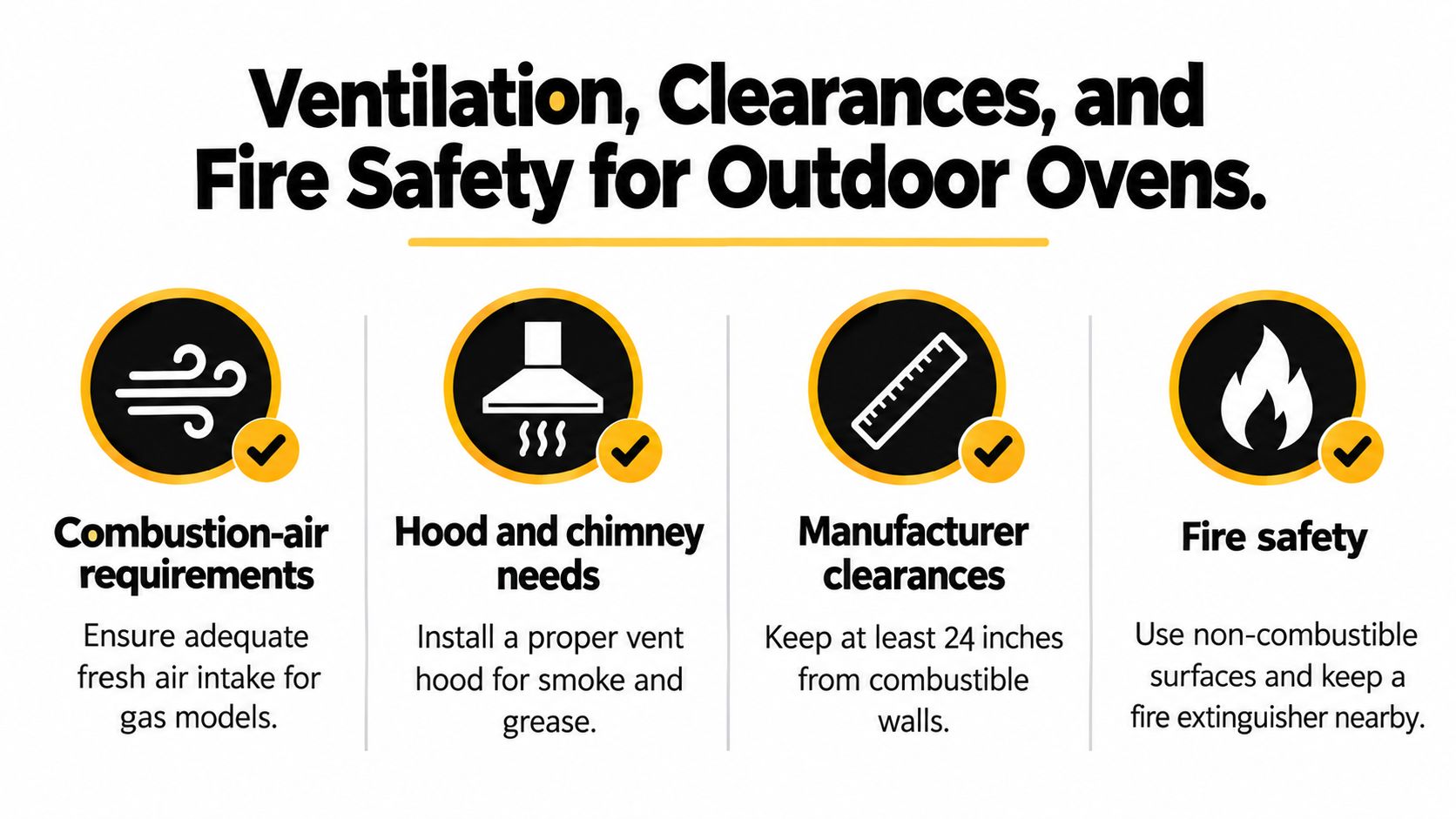
Follow the manufacturer's listed clearances to combustible materials first, then confirm local requirements. Place the oven away from the home, deck railings, eaves, and overhanging branches, and keep children, pets, and combustible items at least 3 feet from the grilling area, consistent with the NFPA guidance cited above. Preserve access for cleaning and inspection, because skipped cleaning is a leading fire factor.
For covered patios and enclosed outdoor rooms, ventilation becomes a design requirement, not a preference. U.S. Department of Energy guidance says combustion appliances require outside-vented kitchen exhaust, recommends operating the fan whenever cooking, and advises carbon-monoxide detection near the kitchen, as outlined in Department of Energy Building America guidance on combustion appliance ventilation. Arizona guidance also indicates ventilation and fire-protection approval may be required for outdoor cooking installations, so confirm permit needs in the Prescott area before construction.
Gas certification and line sizing
For a permanently installed gas oven, specify a unit certified to ANSI Z21.58/CSA 1.6 or ANSI Z21.89/CSA 1.18, installed to the manufacturer's instructions and applicable fuel-gas and building codes, as described in UL gas appliance testing solutions guidance. That guidance identifies carbon-monoxide performance of no more than 0.08% and rated gas input accuracy within ±5% as key benchmarks. Confirm whether the unit is listed for LP or natural gas, verify regulator and inlet-pressure requirements, and size the line for everything it will feed.
Home bakers chasing better crust sometimes ask about steam and moisture control outdoors. These home baker's steam oven tips cover the baking side well, but remember that moisture techniques never override ventilation and clearance requirements in a covered structure.
Preconstruction rule: Evaluate the oven, enclosure, roof, fuel source, and ventilation as one assembly. If one piece changes, recheck the rest.
What an Outdoor Kitchen Oven Actually Costs in 2026
The appliance price is the smallest part of this conversation. Homeowners get surprised not by the oven itself, but by everything the oven requires around it. A freestanding countertop unit and a masonry built-in can both be reasonable answers. They're buying different things.
Where the money actually goes
Think in layers rather than one number.
The appliance. Fuel type, size, insulation, and materials drive this layer. Larger cooking surfaces and heavier refractory construction cost more and weigh more.
The surround. Masonry, cabinetry, and countertops built to handle sustained heat, plus structural support for a heavy oven.
The utilities. Gas-line runs and possible upsizing, electrical for ignition and lighting, and water if a prep sink joins the layout.
Ventilation. A hood or chimney under a covered patio is construction, not an accessory.
Labor and approvals. Licensed gas and electrical work, inspections, and the coordination that keeps trades in sequence.
The line items most homeowners underestimate are gas-line upsizing when the oven shares supply with a grill and burners, structural reinforcement under masonry, and exhaust construction through an existing roof. None of these show up on an appliance product page. All of them show up in a real bid.
How do you match budget to the experience you want
Decide what you're paying for. A freestanding gas oven buys speed and flexibility with minimal construction. A built-in wood-fired oven buys permanence, capacity, and a visual centerpiece, and it commits you to fuel storage and longer preheats. Neither is wrong. Problems start when someone budgets for the first and expects the second.
For a fuller breakdown of how these layers stack up across an entire project, our outdoor kitchen installation cost guide for Northern Arizona homeowners walks through the same categories at the whole-kitchen level. Use it to sanity-check any quote that lists an oven price without utilities, ventilation, or structural work.
Why Northern Arizona Climate Changes the Right Oven Choice
Here's the contrarian point we make on almost every Prescott consultation. Peak temperature and app features matter less than how an oven survives intense ultraviolet exposure, large temperature swings, wind, dust, and freezing conditions at elevation. Market reporting notes specialty cooking appliances in the U.S. premium outdoor-appliance market were estimated at $142 million in 2025 and forecast to grow at an 8.0% CAGR through 2035, according to Global Market Insights outdoor kitchen appliances market analysis. That growth proves interest in premium and smart models. It doesn't prove your site benefits from one, and the same reporting flags installation complexity and climate-driven seasonality as real constraints.
How high-desert weather treats each fuel type
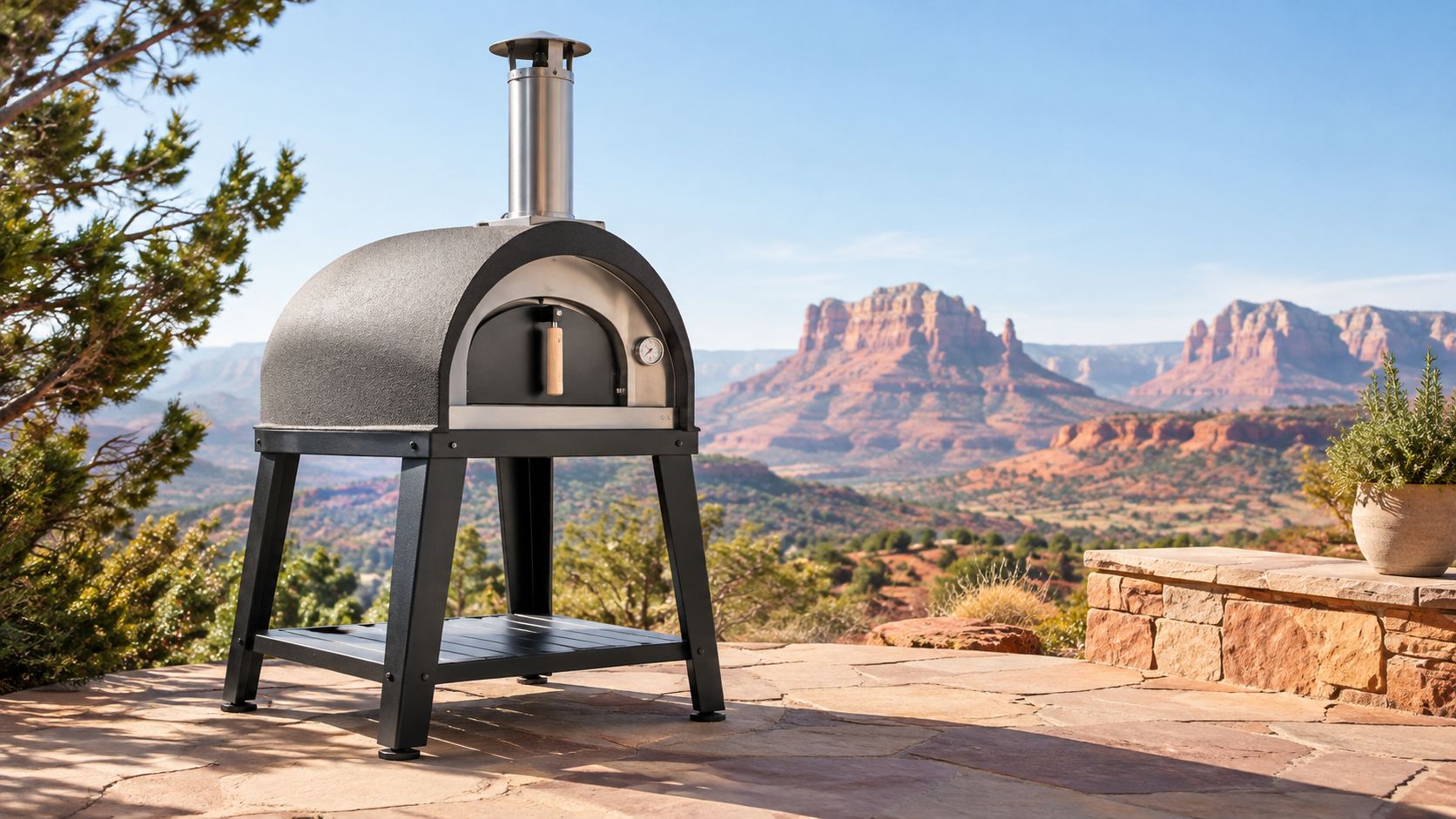
Wood ovens have few electronics to fail, but fuel must stay dry, ash needs regular removal, and refractory materials dislike repeated freeze and thaw cycles when moisture gets in. Gas ovens start reliably, yet regulators, seals, and igniters take a beating from dust and cold snaps. Electric and smart models put digital controls in intense sun, where screens and sensors age faster.
Wind sensitivity. Exposed burners and open wood chambers lose heat and behave unpredictably on gusty Prescott Valley afternoons. Placement and wind screening matter.
Winterization. Drain and protect water lines, cover the oven or house it in a permanent enclosure, and confirm replacement parts stay available and serviceable.
Repairability. A simpler oven a local technician can service beats a connected model nobody nearby stocks parts for.
A well-matched mid-tier oven often outlasts a premium model that fights the climate. Prioritize sealed construction, quality stainless, protected controls, and a cover or enclosure you'll use.
Choosing Your Oven and Working With R.E. and Sons Landscaping
Match the oven to your profile, not to a showroom.
The entertainer. A built-in wood-fired oven as the showpiece, with deep counters and seating oriented toward the fire.
The weeknight cook. A gas oven for fast preheats and predictable results, integrated with the grill so dinner moves outside three or four nights a week.
The phased builder. A freestanding oven now, on a patio layout already roughed in for a future built-in kitchen.
The full transformation. A complete design-build kitchen where oven, grill, bar, and fireplace are planned as one project.
R.E. and Sons Landscaping handles that work through a four-step process of consultation, design approval, transformation, and enjoyment. The team is licensed, bonded, and insured under Arizona ROC #300642, offers complimentary outdoor design, and coordinates appliance installation, gas-line and plumbing rough-ins, electrical rough-ins, and masonry and countertop work. If you're still mapping the sequence, our step-by-step resource on how to build an outdoor kitchen from layout to final install shows where oven decisions fall in the build order. When you search for a local builder, Google notes local results rest primarily on relevance, distance, and prominence, per Google Business Profile guidance on local ranking factors, which is why clear service descriptions and genuine local reviews help you evaluate who's nearby and established.
Frequently asked questions
Can my existing patio host a built-in oven? Often yes, but weight, footings, clearances, and utility routes decide it. We verify the slab and structure before design is finalized.
Do I need a permit for an outdoor kitchen oven in the Prescott area? Gas, electrical, and covered-structure work commonly triggers permits and inspections. Confirm requirements before ordering equipment.
Which fuel is easiest to live with year-round? Gas, for most households. It starts fast in cold weather and needs no fuel storage, provided the line and regulator are sized and protected correctly.
Ready to stop running between your indoor stove and your patio? R.E. and Sons Landscaping designs and builds complete outdoor kitchens with properly integrated ovens across Prescott, Prescott Valley, Chino Valley, and Northern Arizona, handling everything from clearances and gas lines to masonry and finishes. Schedule a consultation and complimentary design, and we'll help you choose an oven your structure, climate, and cooking style can support for years.
Comments