
Outdoor Kitchen Metal Frame Guide for Prescott Homes
A Prescott homeowner comparing outdoor-kitchen quotes may see one builder specify galvanized steel and another recommend stainless. The choice isn't "good" versus "better": the right outdoor kitchen metal frame depends on the lot, the weight it must carry, the appliances it surrounds, and how the whole installation is detailed.
R.E. and Sons Landscaping is a licensed, bonded, and insured Prescott design-build company serving Prescott, Prescott Valley, Chino Valley, and nearby Northern Arizona communities. The team builds custom outdoor kitchens and coordinates the frame with appliances, finishes, utilities, and the surrounding yard, helping homeowners solve the practical question behind competing quotes: which frame makes sense for this site and this design?
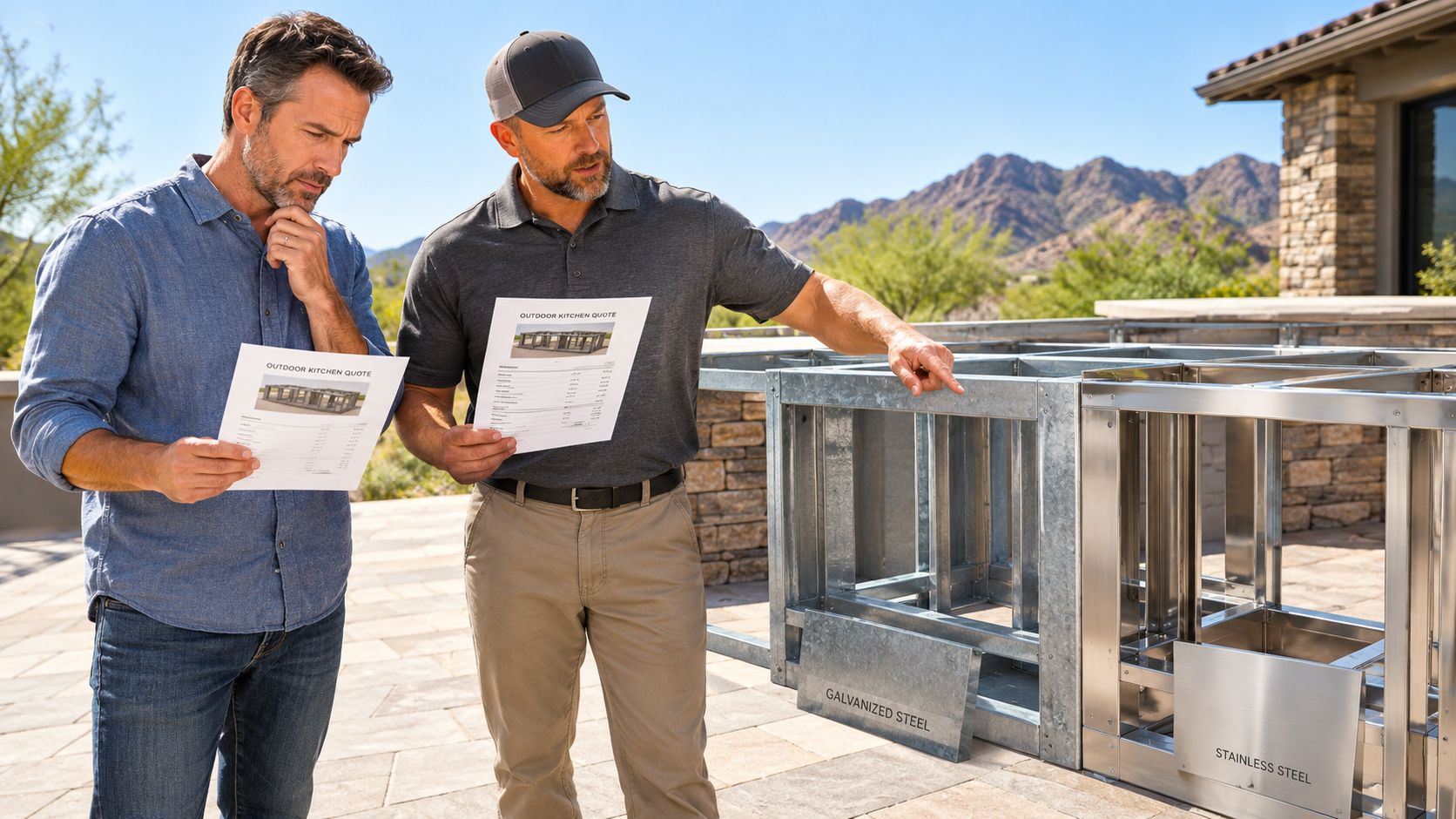
Once stone, cladding, and appliances are installed, the frame mostly disappears. Yet it carries the countertop, supports the grill island, and helps determine whether the kitchen stays stable and serviceable. Material choice matters, but so do the load paths, drainage details, protective coatings, and code review.
Why the Metal Frame Matters for a Prescott Outdoor Kitchen
At elevation, a stone countertop and a loaded grill island put real demands on the frame beneath them. The frame must transfer those loads through supported rails and posts to the patio, while leaving room for appliances, cladding, and access panels. A weakly supported opening or trapped water can undermine the finished kitchen.
Prescott's dry climate can make protected galvanized steel a practical choice, but local conditions still shape how well a frame holds up. Strong sun and UV exposure affect exposed finishes, while irrigation overspray, snowmelt, pool chemicals, cooking grease, and trapped moisture can challenge joints and cut edges. Wildfire exposure also belongs in the design discussion, alongside the applicable fire-code requirements. (R.E. and Sons Landscaping's outdoor kitchen construction overview)
The better question: which specified frame, with these supports and protections, fits this kitchen and this site?
That question helps explain differences between quotes. One may specify galvanized steel, a coating class, and protected cuts. Another may name a stainless alloy without identifying its grade or explaining how water drains. Ask what supports the countertop, how the appliance openings are reinforced, where water goes, and how damaged finishes or field cuts are protected.
R.E. and Sons Landscaping plans frames around site exposure, appliance weight, and Northern Arizona conditions. A useful quote should show the load path, the support around the grill opening, and the locations of utilities and access panels. It should also explain how the structure meets the patio and nearby features, so homeowners can assess the design before the frame disappears behind its finish.
The Four Metal Frame Families Homeowners Should Know
Frame materials suit different combinations of exposure, finish expectations, structural demands, and upkeep. In Prescott, a high-elevation, dry climate with intense UV and wildfire exposure makes the frame specification part of the site design, not just a finish choice.
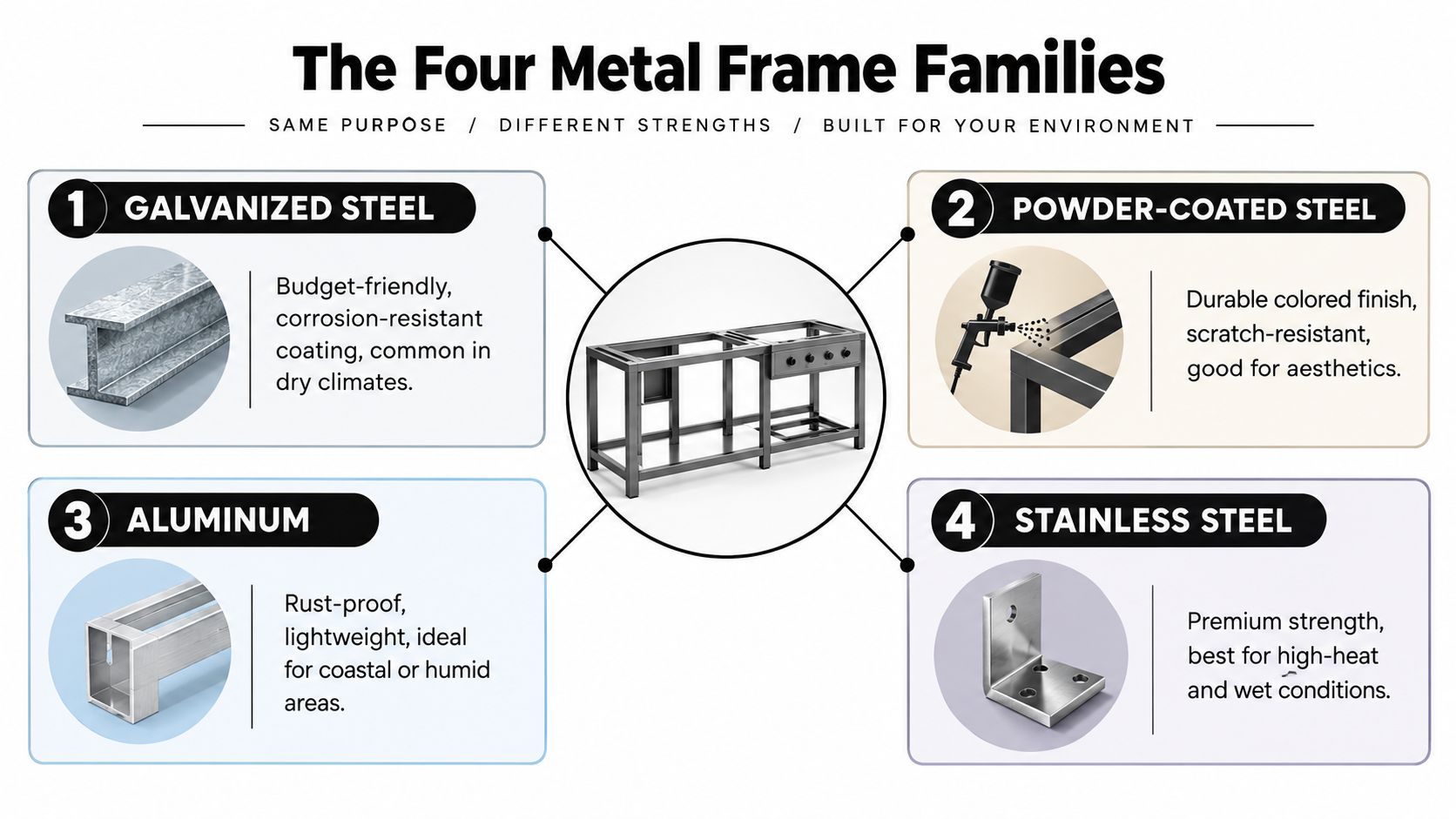
Galvanized steel is carbon steel protected by zinc. The coating helps protect the base metal, and its designation gives a more specific basis for comparing products. G90 has a heavier zinc coating than G60, a difference worth checking when choosing a frame for site exposure and expected service conditions.
Powder-coated steel has a protective finish over a steel frame. It provides a finished appearance and can be selected to suit the kitchen design. The powder coat does not replace protection for the underlying steel: scratches, exposed edges, and penetrations still need proper treatment.
Aluminum is lighter than steel, which can ease handling and installation. That lower weight does not establish whether a frame is suitable for the job. Confirm that the frame system and its connections can support the countertop, cladding, and appliances.
Stainless steel is a family of alloys, not a single grade. Chromium helps form a passive protective film, while molybdenum improves resistance to chloride exposure. Nickel can help stabilize the film in some acidic conditions. For an inland project, 304 may be a practical baseline. Where salt, pool chemicals, deicing products, or persistent wetting are credible concerns, 316 may be a more suitable choice. (Stainless steel design guidance for outdoor exposure)
The material choice also needs to work with the frame's structural role and the project's fire-safety design, including applicable Arizona code requirements. Ask for the exact material and grade or coating designation in the quote. “Metal frame” or “stainless” alone is not enough to compare specifications.
How Corrosion Resistance Really Works in a Dry, High-Elevation Climate
Prescott's dry air does not keep an outdoor kitchen frame dry year-round. Irrigation overspray, snowmelt, monsoon rain, pool splash, dust, and grease can all reach joints and cavities. The practical concern is where moisture sits: water that drains away poses less risk than water trapped inside a tube, at a tight seam, or on a level surface.
Stainless steel can develop localized pitting when moisture and contaminants remain in crevices. Even a grade suited to an inland setting can suffer around a fastener or seam if wetting recurs and drainage is poor. Keep joints accessible for inspection, avoid tight water-trapping overlaps, and give water a clear path out. Those detailing choices matter in Prescott, where brief wet periods can still leave moisture sitting in an enclosed connection.
Galvanized steel relies on its zinc coating to protect the steel beneath it. At a cut edge or scratch, zinc can corrode sacrificially before the underlying steel, but that protection is limited if the exposed area is left untreated or repeatedly wetted. Specify suitable treatment for field cuts, welds, penetrations, and fasteners. A powder-coated galvanized frame also needs attention to damage in the finish, since a deep scratch can expose the coating and steel below.
Site exposure | Recommended frame | Why |
|---|---|---|
Dry, inland yard with limited chemical exposure | G60 or G90 galvanized steel, or 304 stainless | Either may suit inland conditions when selected and installed appropriately. |
Pool splash, deicing chemicals, or persistent wetting | 316 stainless steel | Better suited to chloride exposure than 304. |
Irrigation overspray or snowmelt near joints | Properly protected galvanized steel or specified stainless | Drainage, protected edges, and compatible fasteners affect service life. |
Enclosed cavities or horizontal areas that can hold water | Redesign for drainage before choosing a finish | Standing water can undermine coatings or contribute to localized corrosion. |
Build the frame to shed water. Slope horizontal members, provide drainage openings in enclosed cavities, and seal countertop transitions without trapping moisture. Protect drilled and cut edges, use compatible fasteners, and isolate dissimilar metals where needed. In a dry, high-elevation yard, these details are often more useful than choosing a more corrosion-resistant material while leaving water pockets in the assembly. A quote should identify the frame material and explain how exposed edges, joints, and drainage will be handled.
Structural Load Paths Beneath Stone, Steel, and Appliances
Weight concentrated at a grill or along a stone counter needs direct support beneath it. Treat the frame as a structural system first: countertop and appliance loads must travel through its members and connections to the base. Stone or porcelain tops, masonry-like cladding, built-in grills, refrigerators, and drawers all add demands, while people leaning on the counter add pressure during daily use.
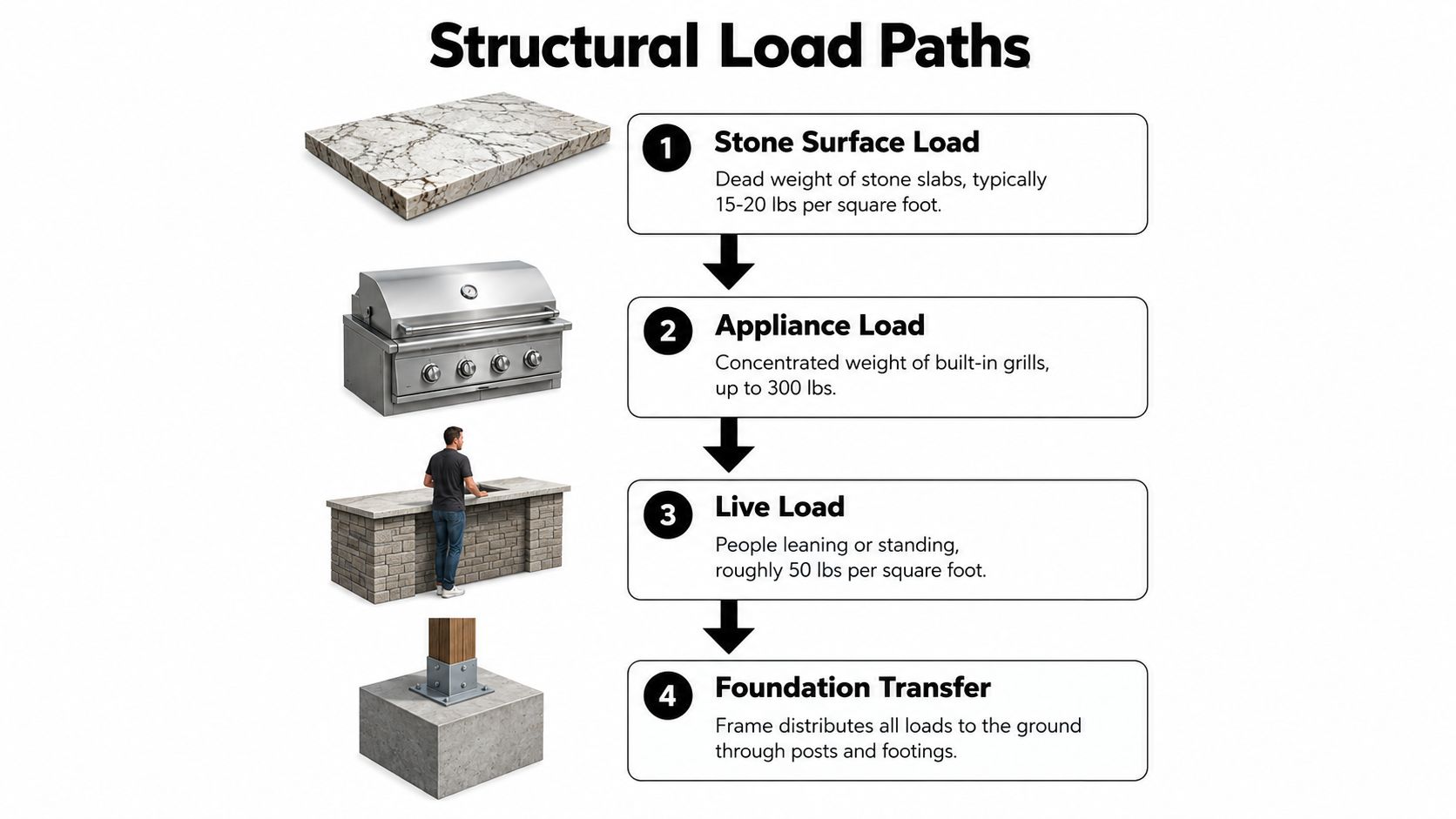
Closely spaced vertical supports, continuous bearing, and reinforcement around openings limit unsupported spans and flex. That matters beneath brittle stone, where movement can cause damage, and around doors and drawers, where a shifting opening can affect alignment. In Prescott, account for these load paths while planning a frame for the site, rather than relying on the finish material to compensate for weak support.
Set each heavy appliance on a dedicated frame rail or equivalent support. A grill should not hang across an opening framed only for access. Reinforce the cutout continuously around its perimeter, and follow the manufacturer's separation and ventilation requirements for heat-producing equipment. For refrigerators and drawers, confirm appliance dimensions and opening support before closing in the frame. (Outdoor kitchen framing guidance on structural load paths)
Practical rule: Ask the builder to show where each major load lands. “The frame holds it” is not a support plan.
The foundation completes the load path. Match anchoring and support to the patio or slab, and avoid placing the frame where irrigation water collects. A pergola or covered gathering area adds a separate planning question; the Modern Lyfe gazebo buying guide can help with overhead shade structures. For countertop choices, review these considerations for outdoor concrete countertops, then make sure the frame supports the selected surface as designed.
Arizona Fire Code, Permits, and Wildfire Planning for the Frame
A metal frame doesn't make an outdoor kitchen fire-safe by itself. The grill, side burners, roof, nearby walls, fences, and combustible finishes all affect the installation. The 2018 Arizona Fire Code states that charcoal burners and other open-flame cooking devices may not be operated on combustible balconies or within 10 feet (3,048 millimeters) of combustible construction. Homeowners should confirm how the responsible local jurisdiction applies the rule to their specific design. (2018 Arizona Fire Code provisions for open-flame cooking devices)
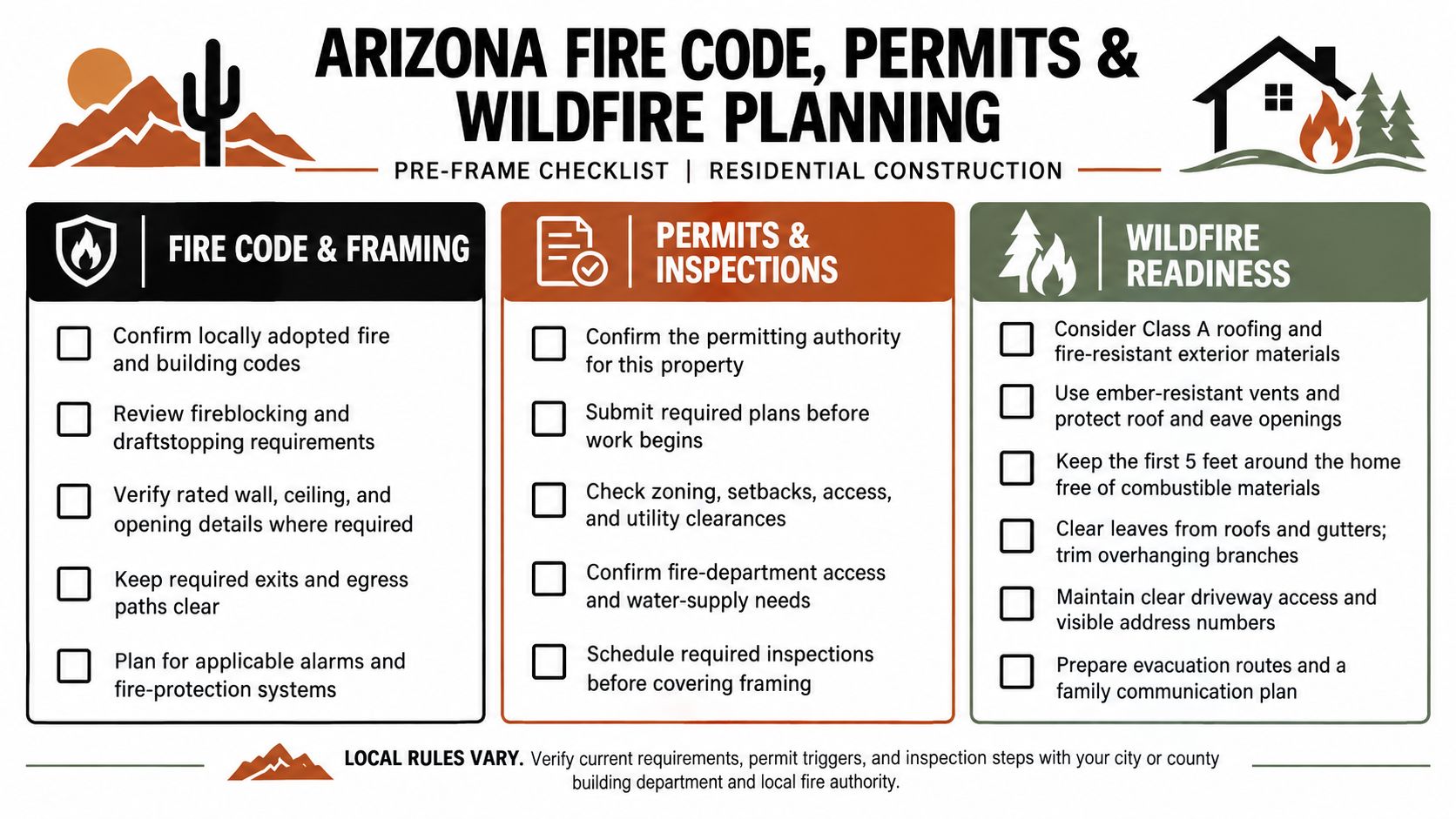
Before fabrication, homeowners in Prescott, Prescott Valley, and nearby communities should ask the applicable city or county building and fire offices which permits and inspections apply. The answer depends on the project location and scope. Plans may need to show clearances, utility routing, access to shutoffs, anchoring, and how the kitchen relates to nearby structures. Arizona's fire-code guidance explains that construction review is tied to adopted fire-code requirements and relevant standards, so project-specific review is more reliable than assuming a frame material settles the question. (Arizona Department of Forestry and Fire Management fire-code guidance)
R.E. and Sons Landscaping brings those decisions into the design-build process before the frame is fabricated. That timing matters because moving a grill, gas line, or access panel after cladding and counters are installed can mean reworking finished construction. On lots near wildland areas, homeowners should also consider how surrounding combustible materials and the placement of heat sources fit into the broader property design. Powder coating and stainless steel address finish and corrosion concerns; neither automatically resolves flame spread, radiant heat, or ember exposure.
Classify each proposed flame feature correctly. Arizona rules distinguish fires used only for cooking, warmth, or recreation from other open outdoor fires, so a cooking appliance may be treated differently from a fire pit, fireplace, or brush burn. (Arizona open-burning rules and exemptions) A permit or inspection question is worth raising early, not after installation.
Pros and Cons of Galvanized, Powder-Coated, Aluminum, and Stainless Frames
No material wins every category. For a Prescott-area project, compare the frame's cost relative to the alternatives, the exposure it will face, and the work required to keep it in service. The appropriate trade-off is often more useful than chasing a label that sounds premium.
Galvanized steel: A value-oriented option for many dry inland sites. Its zinc coating protects carbon steel, and G60 and G90 designations make the coating more specific. It still needs protected cuts, compatible fasteners, drainage, and inspection. Coating damage should be repaired, not hidden.
Powder-coated steel: Useful when the finished appearance matters and the coating system is documented. It can protect the frame, but powder coating doesn't replace sound corrosion protection underneath. Scratches and field damage require touch-up.
Aluminum: Its lighter weight can be helpful for handling or a project where reducing the frame's weight is important. Don't assume that lightness makes it suitable for every retrofit on a paver patio. Verify the system, connections, anchoring, and support capacity for the planned appliances and countertop.
Stainless steel: A durable choice when the specified grade matches exposure. For a fully inland Prescott yard, 304 may be adequate in many applications; 316 is harder to justify unless salt, pool chemicals, deicing products, or persistent wetting are credible. Stainless still needs drainage and inspection.
A coating is not a substitute for specifying the base material and protecting fabrication details. The frame should have a clear finish specification, and anyone assessing coating options can use this overview of powder coating work and contractor considerations as additional background. That resource isn't a substitute for confirming the coating system's suitability for an outdoor kitchen.
For all four families, maintenance is practical rather than optional: inspect seams, fasteners, drainage paths, and finish damage, and clear debris that can hold moisture. A frame that can be checked and repaired is easier to manage than one concealed behind cladding with no access plan.
Integrating the Frame With Cabinetry, Appliances, and Finishes
The frame dictates what can be attached, where appliances fit, and whether service points remain reachable. Cement board can provide a substrate for finishes such as stone veneer, stucco, tile, or porcelain cladding, but the cladding system needs to suit the frame and the exposure. Around grills and pizza ovens, noncombustible separation and ventilation should be designed into the enclosure, not improvised after the frame is complete.
Appliance openings need the same advance planning. Confirm the cutout dimensions, door swing, vent locations, drawer-slide mounting, and access required for service. Gas and electrical routes should be coordinated with the frame so shutoffs and connections remain accessible. If a refrigerator's ventilation path is blocked by a cabinet face or adjacent finish, the problem is built into the layout, not fixed by a nicer cladding choice. (Outdoor kitchen appliance selection and planning)
The exterior finish affects both appearance and maintenance. Homeowners comparing painted cabinet surfaces can review these cabinet painting and finish tips from Alex Trend Painters for general finish considerations, then verify that their chosen material and coating are appropriate for outdoor exposure.
R.E. and Sons Landscaping coordinates custom outdoor kitchens with features such as paver patios, pergolas, fireplaces, and fire pits. That sequencing lets the frame, utilities, counter, and surrounding hardscape work as one installation rather than as separate upgrades that happen to share a yard. The aim is straightforward: appliances should fit, finishes should attach securely, and maintenance or service shouldn't require dismantling the kitchen.
Frequently Asked Questions About Outdoor Kitchen Metal Frames
How long should a galvanized frame last in Northern Arizona?
The coating and site details determine service life. A properly selected galvanized coating can provide a long service life in Prescott's dry climate, but cuts and welds, drainage, compatible fasteners, and regular upkeep still matter. Protect exposed areas and prevent water from collecting around the frame.
Is stainless steel overkill for an inland Prescott yard?
It depends on the exposure and the frame design. A properly detailed galvanized frame often suits a dry inland site without the added cost of stainless steel. 304 stainless is another option; consider 316 when chloride exposure or persistent wetting is a genuine concern. Prescott's intense sun and wildfire exposure also make the full assembly and its clearances part of the decision, not just corrosion resistance.
What inspections or permits might a Prescott outdoor kitchen need?
Requirements depend on location and project scope. Before construction, check with the responsible city or county building and fire officials, particularly if the design includes built-in cooking equipment, gas, electrical work, a roof, or a fire feature. Bring proposed clearances, utility routes, and service access details for review, and account for applicable fire-code requirements early in the design.
Can a metal frame go beneath an existing paver patio?
Possibly. Pavers alone do not confirm that the base can carry the kitchen or provide suitable anchoring. Have the installer assess the supporting base and drainage, then decide whether the frame needs a separate foundation or another anchoring method before adding appliances or stone.
For a Prescott, Prescott Valley, Chino Valley, or nearby Northern Arizona project, R.E. and Sons Landscaping can review the site, frame options, appliance layout, and project requirements.
R.E. and Sons Landscaping designs and builds custom outdoor kitchens, coordinating metal framing with appliances, utilities, finishes, and the surrounding environment. Visit R.E. and Sons Landscaping to request a consultation and discuss a frame specification suited to your Northern Arizona property.
Comments