
8 Dry Creek Bed Landscaping Ideas for Prescott Yards
A Prescott monsoon can turn a quiet yard into a drainage test in minutes. Water sheets off the roof, cuts across decomposed granite, and heads straight for the patio edge or foundation corner. A dry creek bed is the practical fix when it's designed to move, slow, and spread runoff, not just decorate the yard with a strip of rock.
That's why the best dry creek bed landscaping ideas in Prescott start with drainage first and appearance second. The EPA's stormwater guidance explains that rain gardens and bioretention areas work by capturing runoff from roofs, driveways, sidewalks, parking areas, and compacted lawns, then slowing flow, encouraging infiltration, and reducing downstream erosion, which is the same basic job a well-designed dry creek bed can do when it's sized from the drainage area and given a stable overflow route for larger storms (EPA stormwater guidance on runoff capture and sizing).
R.E. and Sons Landscaping helps homeowners in Prescott, Prescott Valley, Chino Valley, and nearby Northern Arizona communities solve exactly that problem. As a licensed, bonded, and insured design-build company, the team builds dry creek beds as part of a complete yard plan, with complimentary design so drainage, planting, hardscape, and even details like outdoor lighting ideas from DLG Electrical work together instead of fighting each other.
1. Meandering Cobble Dry Creek Bed
A meandering cobble dry creek bed works best when you want the yard to look natural but still stay controlled during summer storms. The winding shape softens a straight drainage route, fits older Prescott lots well, and gives you room to blend stone sizes so the bed looks settled instead of dumped in one pass.
In practice, this style works well in front yards where a steep bank keeps washing out, or in side yards where you need to separate lawn from native planting without making the transition look abrupt. I've seen the same idea make sense in Prescott Valley backyards where a curve creates a visual break between artificial turf and lower-water plantings, but the curve still has to follow the lot's real fall. If the bend ignores grade, water will show you the mistake the first time it runs.
What makes the meandering look hold up
A winding bed still needs structure. Common residential drainage guidance says the channel should keep a continuous positive grade of roughly 1% to 2%, and it shouldn't rise in the middle or water can back up instead of reaching the outlet (dry creek bed slope guidance for residential grading).
That's why the prettiest curves are the ones that also respect gravity. Before digging, mark the route with stakes and check it with a string line, line level, or laser level. Then build the look in layers, not in a pile.
Use edging where turf meets stone: Steel or aluminum edging helps keep cobble from creeping into lawn areas over time.
Lay weed barrier with intent: Commercial-grade ground-cover fabric under the rock can help suppress weeds, but it needs full coverage and proper pinning so exposed edges don't show later.
Build from large to small: Set bigger anchor stones first, then lock the gaps with smaller rock so the bed reads like a stream course, not loose fill.
Call before digging: Always contact utility locating before excavation so buried lines are marked.
If you want to see how river rock and hardscape can be combined cleanly, this look pairs well with ideas similar to pavers and river rock combinations and careful leveling and spacing stone walkways.
Practical rule: Curves are for appearance. Grade is for performance. You need both.
2. Functional Stormwater Dry Creek
A functional stormwater dry creek is the right answer when runoff is already threatening the house, patio, side yard, or a low spot that stays soft after storms. This is the version that behaves more like a small rock-lined swale than a decorative ribbon.
Here's the visual comparison that helps most homeowners decide whether they want a drainage feature or just a look.
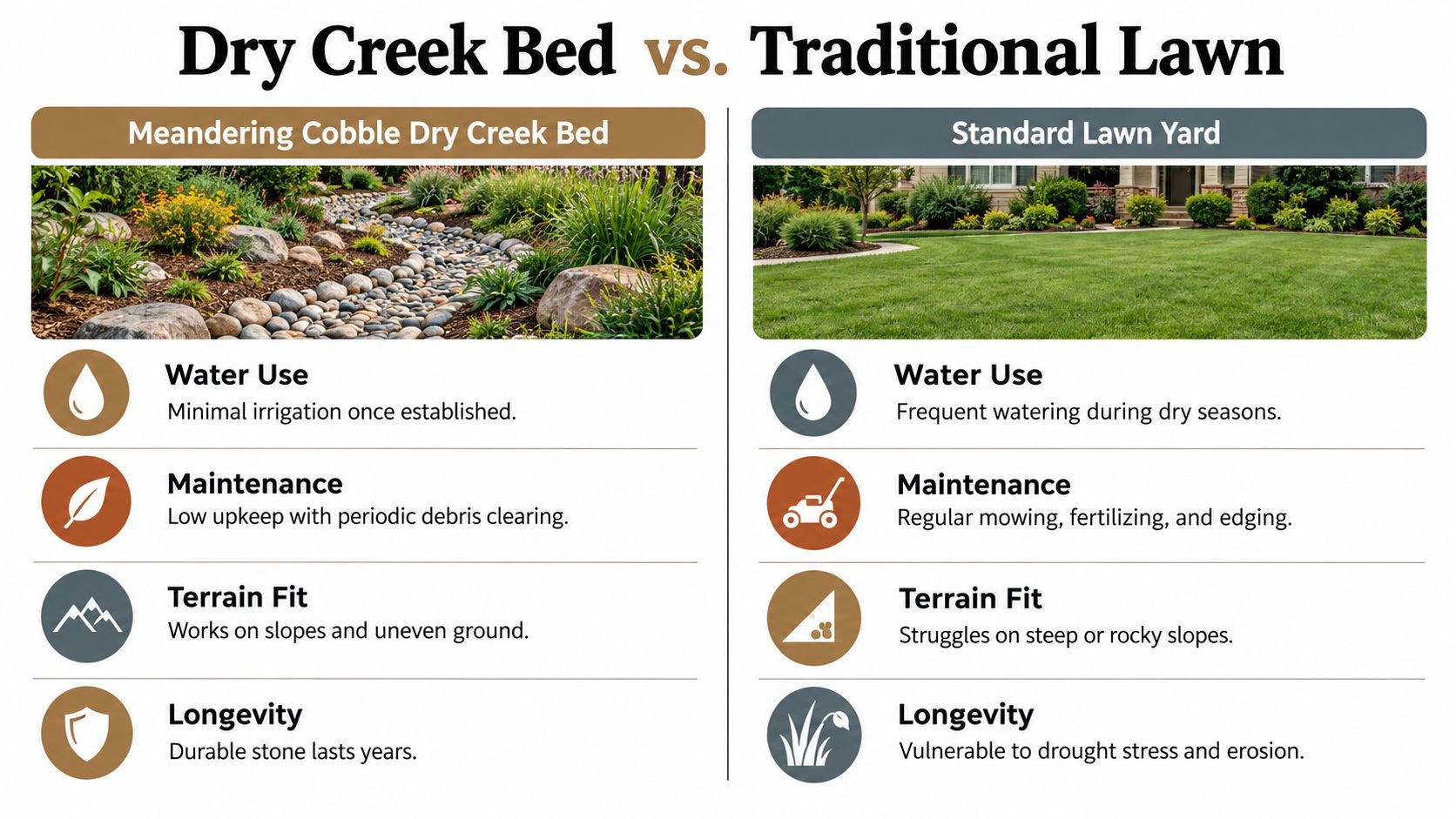
For this kind of project, route matters more than style. On a Chino Valley property, that may mean catching roof and side-yard runoff and carrying it to a planted infiltration basin. On a Prescott hillside lot, it may mean stepped reaches that slow water before it starts cutting gullies.
How to make it actually drain
University of Arizona guidance recommends treating a rainwater-harvesting channel as a shallow, continuously graded feature with sloped basin sides and rocks at least 4 inches in diameter to help maintain slope integrity and limit erosion, plus periodic inspection for erosion, overflow, and sediment buildup (University of Arizona rainwater harvesting guidance for rock-lined basins). That's a useful baseline in Northern Arizona, where short monsoon bursts can move more water than a decorative bed is ready to handle.
Place larger stone at inlets, bends, and outlet transitions where velocity rises. Keep the outlet headed toward a stable infiltration area, not a sidewalk, foundation, or neighboring parcel. If you're solving active washout, a project like this often overlaps with rock erosion control methods.
This video gives a good visual sense of how a channel shape guides flow through a yard.
Water always chooses the easiest path. A good dry creek bed makes that path safe on purpose.
What doesn't work is guessing. Watch where water runs during a hard rain, especially where downspouts discharge and where granite soils shed water fast. Then test the bed after the first monsoon storm and reset stone where flow proves stronger than expected.
3. Dry Creek with Boulder Clusters and a Stone Bridge
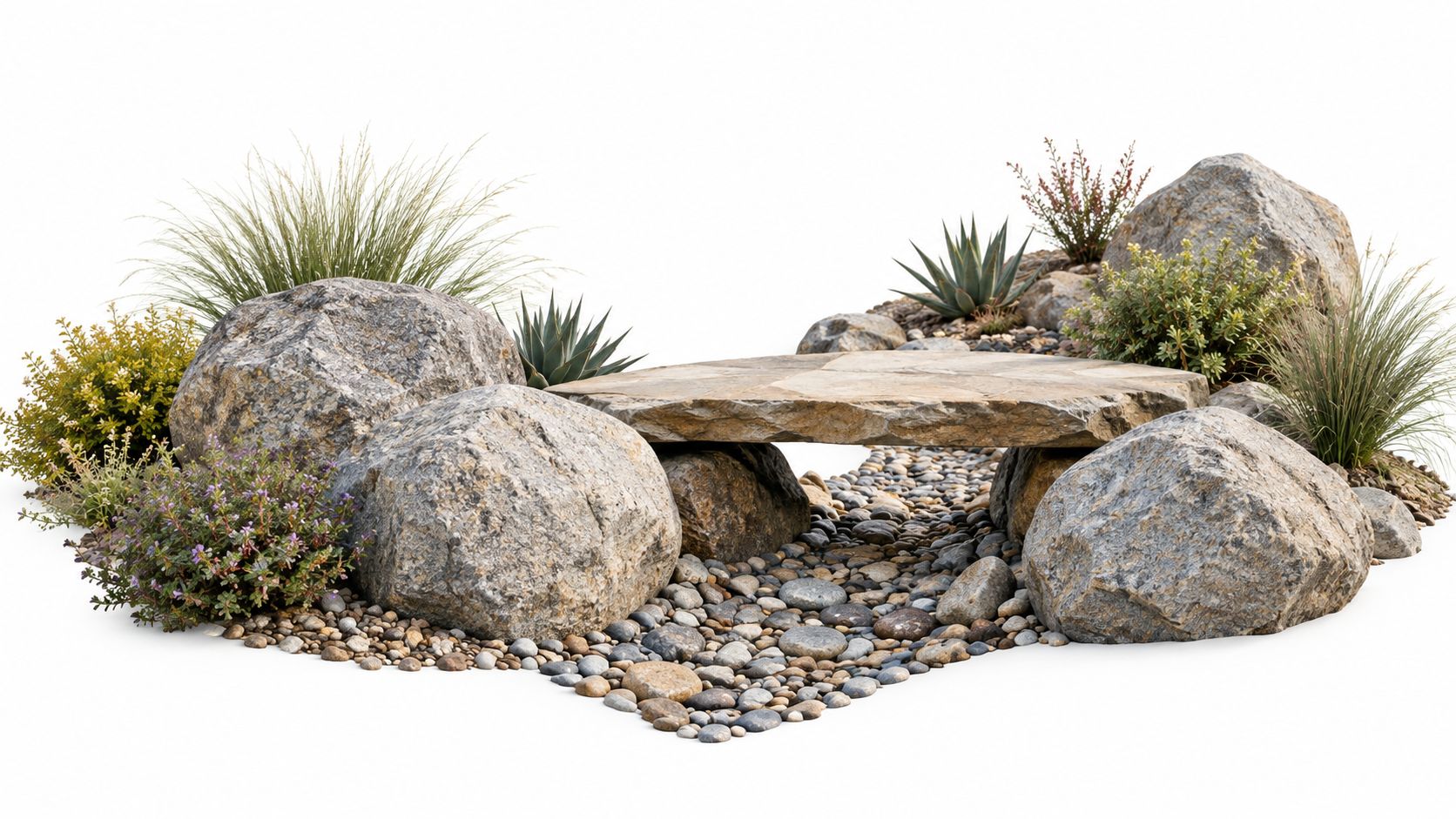
A dry creek with boulder clusters and a stone bridge works when the yard is large enough to carry a stronger visual feature and you want the creek bed to do more than drain. It can divide a patio from a native planting zone, link a fire pit to a seating area, or give a broad backyard the kind of weight that matches Prescott's granite character.
This style often fits best on bigger Prescott and Prescott Valley lots where a plain rock channel would disappear. A bridge makes sense when people need to cross it daily. Boulder groupings make sense where the channel changes direction, where the patio needs a focal point, or where one end of the creek bed feels visually unfinished.
Where the drama can go wrong
A lot of decorative dry creek bed landscaping ideas fail here. Homeowners focus on bridge style and boulder placement, but forget that the channel still has to behave like drainage. A conservation-district guide for dry streambeds describes typical swale depths of about 6 to 24 inches, a minimum bottom width of about 2 feet, and gently sloped banks rather than vertical edges, with larger boulders concentrated at grade changes and outlets (dry streambed construction guidance with swale dimensions and bank shaping).
That matters because a bridge narrows your tolerance for error. If the bed is too tight, too shallow, or perched with steep banks, stormwater can jump the channel and undermine the crossing. Boulders also have to be set like they belong there. Partially burying them helps them look natural and keeps them from reading as surface decoration.
A few trade-offs are worth keeping in mind:
Bridges need real footing: If people will cross it every day, don't wing the support details.
Big stone needs room: Tight side yards rarely benefit from oversized boulders because they make maintenance harder.
Sightlines matter: Place the focal cluster where you'll see it from the house or patio, not where it hides behind shrubs.
A bridge is worth adding when it solves movement and adds character. It isn't worth adding just because a photo online looked good.
4. Dry Creek as a Turf Border for Artificial Grass or Putting Greens
Use a dry creek as a turf border when artificial grass or a putting green needs a defined edge that can also receive minor runoff. The stone strip separates turf from planting beds and patio paving, softens the artificial look, and gives leaves, pine needles, and loose infill a place to collect before cleanup.
In Prescott and Prescott Valley, this pairing suits yards built around usable outdoor space rather than traditional lawn. A putting green may meet gravel and shrubs, while a family yard may place artificial grass beside a patio. The creek provides a deliberate change in texture between those surfaces, but it still needs to handle monsoon water, hard freezes, and granite soil.
Set the border for drainage first
Keep the rock channel out of the fastest flow path from roofs, slopes, or downspouts. Granite soil can shed intense stormwater instead of absorbing it quickly, so shape the border with a stable grade and an outlet that will not wash across the turf edge. Compact the native soil before adding rock, and check the line after a storm for settlement or exposed edging.
A narrow channel works beside a putting green when the green has a firm, accurately finished edge. Choose rounded stone near play areas, where sharp fragments can create problems for bare feet, pets, and maintenance equipment. Larger rock may look stronger, but it reduces clearance and makes leaf removal harder.
Arizona has experienced some stage of drought since 1994, according to the Arizona Department of Water Resources' statewide precipitation context (Arizona drought context and arid-climate water loss guidance). That history supports reducing thirsty lawn areas, while artificial turf still requires careful grading and drainage rather than being treated as a substitute for stormwater design.
Use this border where the edge serves a clear purpose:
Putting green transitions: A slim stone channel frames the green without adding a rigid paved band.
Family yards with pets: Smooth, stable stone is easier to live with beside play areas.
Patio-to-turf edges: A visible break keeps the yard from reading as one flat surface.
Install the turf edge and edging before placing the creek rock. Leave enough width for a leaf blower or soft brush, and avoid trapping stone tightly against the turf where infill and organic debris will be difficult to remove.
5. Xeric Planted Dry Creek Bed
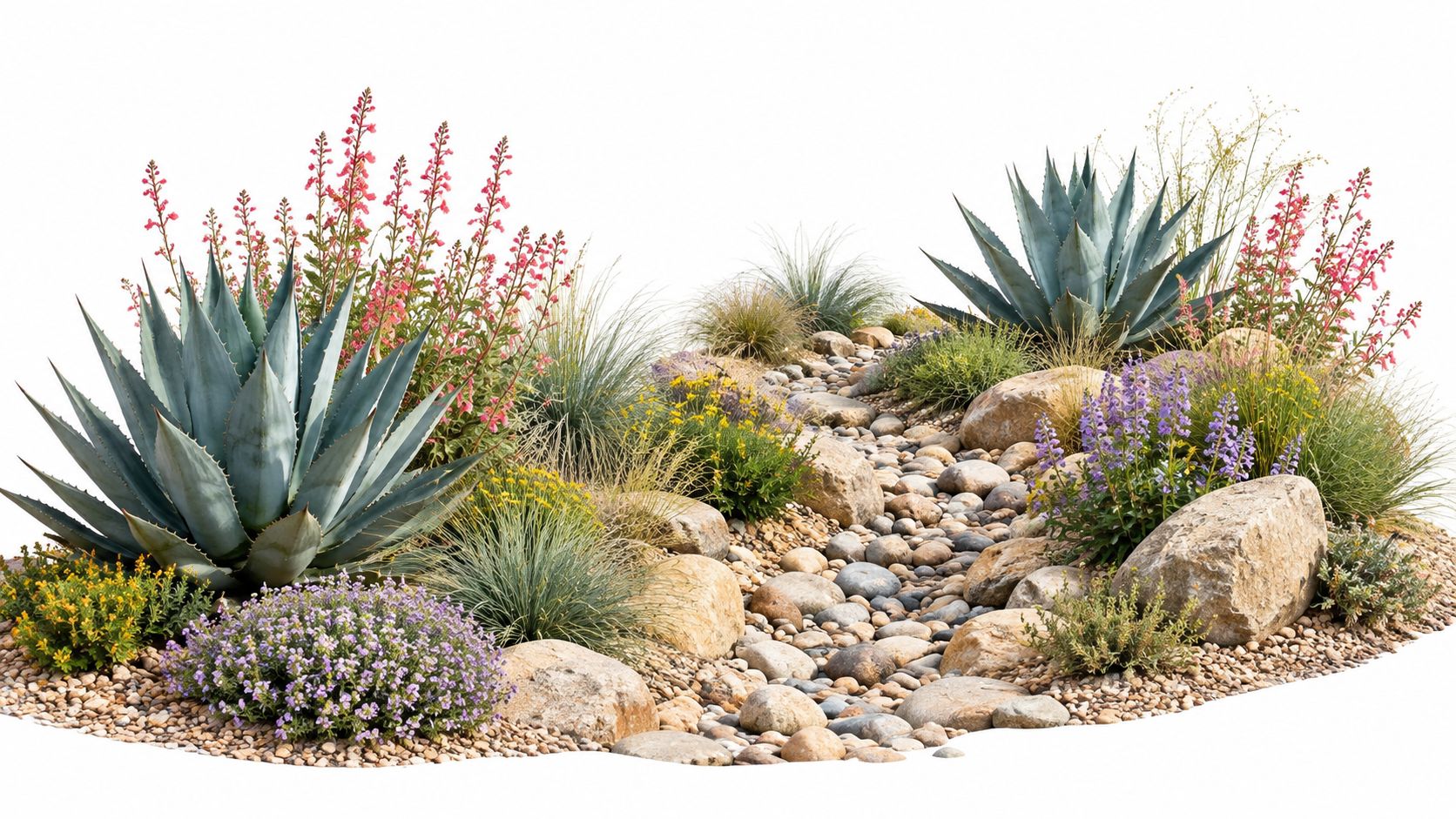
Choose a xeric planted dry creek bed when the goal is a settled, water-wise feature that still looks intentional through Prescott's winter. Place drought-adapted plants along the shoulders and keep the fastest flow path open. That arrangement handles monsoon runoff more reliably than a fully planted channel, while granite soil and hard freezes make stable grading and well-drained planting pockets important.
Agave and penstemon can mark the upper edges, with durable grasses connecting the creek to the rest of the yard. On a Chino Valley lot, this approach helps the bed fit an open setting instead of reading as a separate decorative island. Keep tender plants away from low spots where cold air, runoff, and sediment collect.
Plant beside the flow, not in it
Water woody plants slowly and thoroughly, then group species according to their irrigation needs. University of Arizona Cooperative Extension guidance recommends prioritizing trees and shrubs when water is limited and wetting the established root zone to about 2 to 3 feet. It also gives summer intervals of 4 to 7 days and winter intervals of 4 to 10 weeks, depending on conditions. Use those figures as a starting point, then adjust for exposure, soil, plant maturity, and weather.
A xeric planting still needs room for water and maintenance. Plants in the channel can bend under storm flow, trap granite sediment, and make post-monsoon cleanup harder. Plants packed along the edges can also hide settlement or loosened rock.
Field note: Planted creek beds look relaxed after they mature, but the initial spacing should be deliberate.
Use this layout:
Group by water need: Keep plants with similar irrigation requirements together.
Use rock mulch outside the main flow line: A 2 to 3 inch layer can reduce evaporation and weeds along the shoulders.
Save the center for flow: Leave the middle open enough to carry runoff and sediment.
Compact native granite soil where needed, but do not create a sealed basin around plant roots. Build planting pockets with drainage, set stones firmly before planting, and inspect the channel after the first heavy storm. More plant mass softens the view, while an open center protects flow capacity and simplifies cleanup.
6. Illuminated Dry Creek Bed for Evening Living
After sunset, a dry creek beside a Prescott patio can disappear into the yard unless its shape is lit with restraint. Low lighting keeps the channel visible, brings out granite and boulder texture, and helps people cross it safely without washing the whole property in glare.
Start with the route people already use. A creek beside an outdoor dining area may need a few low path lights, while a boulder cluster visible from the kitchen or great room can take one or two warm uplights. Keep the fixtures subordinate to the drainage feature. The channel still has to carry monsoon runoff, shed water through granite soil, and tolerate winter freezes.
Lighting also changes maintenance. Fixtures placed after ornamental grasses fill in can become buried, exposed, or difficult to reach. Set conduit while the bed is being built, secure wiring away from likely erosion paths, and leave access for stone replacement after storms. Avoid placing fixtures where rakes, shovels, or seasonal gravel work will strike them.
Balance wildfire awareness with a darker night sky
University of Arizona guidance identifies rock-covered areas, riprap, boulders, and dry streambeds as potentially useful parts of defensible space. It also recommends reducing connected fuels, spacing plants carefully near structures, and using noncombustible hardscape or low-growing irrigated groundcovers near homes. Dry grass and highly flammable plants such as juniper should not sit close to structures (University of Arizona firewise landscape guidance for defensible space).
That guidance supports a clean, open creek edge, but rock alone does not make every installation fire-safe. Keep vegetation maintained, inspect wiring, and prevent dry plant material from collecting around fixtures or against the house.
Use these installation choices:
Choose fully shielded fixtures: They control glare and reduce light spilling into neighboring yards.
Select warm-white LEDs: Around 2700 to 3000 Kelvin generally sits comfortably against stone.
Keep lights outside work zones: Leave room for cleanup, inspection, and post-monsoon repairs.
Aim light downward or at stone: This reveals crossings and texture while preserving a calm view of the night sky.
The common mistake is overlighting. A dry creek already supplies form and contrast. Light only the crossings, key stones, and route through the yard.
7. Dry Creek Leading to a Fire Pit or Gathering Space
A dry creek leading to a fire pit or gathering space gives an open backyard a clear route. Guests can follow it from the house or planting beds toward a fire pit, outdoor kitchen, or seating area, while the stone channel separates activity zones without adding a wall.
That arrangement suits Prescott yards where several outdoor features share one space. In Prescott Valley, a longer creek can give a broad yard direction and make the gathering area feel connected to the rest of the property. Set the channel beside the main walking route rather than directly through the seating area, so runoff and foot traffic do not compete for the same ground.
Build the approach for people, runoff, and heat
Place stable crossings wherever guests need to move between the house, seating, and fire feature. Broad, level stepping stones or a secure bridge should sit firmly on compacted material, with enough separation that visitors are not forced to walk on loose cobble. Check the route after a monsoon storm. Water should pass beneath or beside the crossing without washing out its edges.
The material around the gathering space also needs careful selection. Bare soil can erode and invite weeds, while gravel, rock, and decomposed granite can help control erosion and conserve moisture, according to University of Arizona guidance on erosion control materials and landscaping. Foot traffic makes this especially important near seating and cooking areas, where soft surfaces wear quickly.
Use granite or another durable stone close to the fire feature. Keep dry mulch, dead leaves, resinous plants, and tall dry grasses away from the heat source and creek edge. Rock can interrupt fuel continuity, but it does not remove the need for maintenance. Clear debris after storms, trim nearby vegetation, and inspect the area before using the fire feature.
Confirm required clearances and local fire rules before construction. Fire pit placement, fuel type, and seasonal restrictions can affect the layout, even when the surrounding creek is made from noncombustible stone.
The practical test is straightforward: people should reach their seats without unstable footing, and stormwater should still have a defined route through or around the bed. If either condition fails, adjust the grade, crossing, or stone before adding decorative planting.
8. Minimalist Dry Stream with Decomposed Granite and Gravel
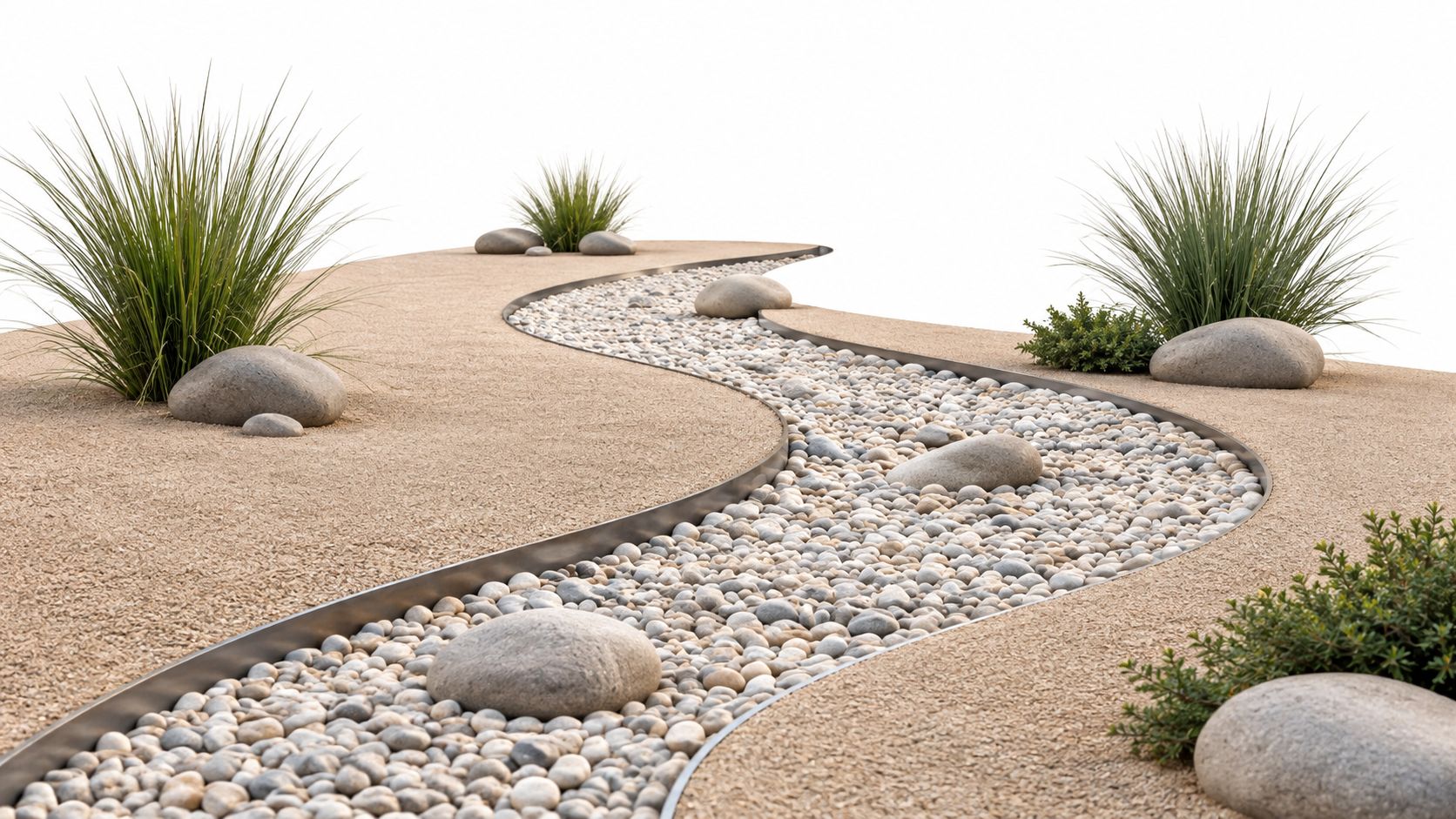
A minimalist dry stream with decomposed granite and gravel fits modern homes, smaller courtyards, and yards where you want the drainage feature to stay quiet instead of becoming the main focal point. This style can look sharp in Prescott because the neutral tones tie naturally into native soils, masonry, and contemporary architecture.
It's a good fit for a modern home where a broad cobble bed would feel too rustic. It also works in Chino Valley courtyard spaces where a restrained channel connects two garden rooms and keeps the design from feeling busy.
Minimal doesn't mean fragile
This is the style most likely to get built too lightly for Northern Arizona weather. A practical residential reference notes that typical dry creek bed dimensions are often about 3 to 6 feet wide, while a narrower 18 to 24 inch channel may work for limited roof runoff, and another common benchmark places bed bottoms at roughly 2 to 4 feet wide and 6 inches to 1 foot or more deep, with gentler side slopes around 2:1 or 3:1 helping banks stay stable (practical dry creek bed width, depth, and side-slope guidance).
That's the caution with decomposed granite. It looks refined, but if the base isn't compacted, the edging isn't firm, and the low point of the channel lacks heavier stone, monsoon runoff can erase the clean lines fast. A layer of larger rock in the lowest part of the stream helps slow water movement and protect the finer finish.
If you're comparing materials, it helps to understand what decomposed granite is used for in landscape construction before you lock in the final look.
For this style, maintenance is part of the design. Rake the surface now and then. Refresh the edge line. Match the DG color to the house so the feature reads as intentional architecture, not leftover fill with a few river stones dropped in.
8 Dry Creek Bed Design Comparison
Design | 🔄 Implementation Complexity | ⚡ Resource Requirements / Cost | 📊 Expected Outcomes | Ideal Use Cases | ⭐ Key Advantages |
|---|---|---|---|---|---|
Meandering Cobble Dry Creek Bed | Moderate, excavation, fabric, layered stone placement | Cobble (3–6"), river rock, landscape fabric, edging; moderate labor | Durable, low-maintenance stream aesthetic; stable in storms | Front/side yards, uneven lots, visual drainage feature | Natural look, low water use, long-lasting |
Functional Stormwater Dry Creek | High, precise grading and hydraulic planning required | Large stones, deeper channel, equipment and skilled labor; higher cost | Effective runoff control, reduced erosion, foundation protection | Properties needing stormwater management, monsoon-prone sites | Turns drainage into an asset; erosion control |
Dry Creek with Boulder Clusters & Stone Bridge | High, heavy equipment, structural footings for bridge | Very large boulders, bridge materials, specialized installers; high cost | Strong focal point, circulation via bridge, permanent feature | Large lots, estates, vistas seen from house/patio | Dramatic focal element; durable and sculptural |
Dry Creek as a Turf Border for Artificial Grass | Low–Moderate, precise edging and coordination with turf install | Edging, smooth cobble/gravel, coordination with turf contractor; low–moderate cost | Crisp separation, prevents material mixing, neat transitions | Artificial turf, putting greens, narrow lawn edges | Professional edge, tidy appearance, protects turf |
Xeric Planted Dry Creek Bed | Moderate, planting design and establishment irrigation | Drought-tolerant plants, rock mulch, temporary irrigation; moderate cost | Water-wise blend of stone + vegetation; seasonal interest; wildlife value | High-desert gardens, water-conserving yards, pollinator plantings | Softens hardscape, ecological benefits, water savings |
Illuminated Dry Creek Bed for Evening Living | Moderate, electrical planning, concealed wiring and fixture placement | Low-voltage LED fixtures, wiring, transformer, controls; added cost | Extended evening use, improved safety, night-time focal points | Entertaining yards, paths, features visible from indoors | Enhances ambiance, highlights textures, improves safety |
Dry Creek Leading to a Fire Pit or Gathering Space | Moderate, integration with fire features, safe material selection | Heat-rated stones, stepping crossings, coordination with fire installer | Defines circulation, frames gathering areas, smooth arrival sequence | Outdoor living spaces, fire pits, outdoor kitchens | Guides movement, creates transitions, blends features |
Minimalist Dry Stream with Decomposed Granite & Gravel | Low–Moderate, compacted base and firm edging essential | DG, fine gravel, metal edging; lower material cost but needs prep | Clean, modern look; economical but may need topping after storms | Contemporary homes, courtyards, budget-conscious modern designs | Minimal aesthetic, affordable, integrates with native soils |
Plan Your Dry Creek Bed Before Monsoon Season
If you're deciding between dry creek bed landscaping ideas, start with the plain question that matters most in Prescott, Prescott Valley, and the rest of Northern Arizona. Where does the water go when a real storm hits your lot? If you don't know that first, you're choosing materials before you've chosen the job the creek bed needs to do.
A dry creek bed should be treated like a small drainage system with a garden finish, not a maintenance-free strip of decorative stone. Arizona drainage guidance recommends clearing channels, swales, and dry creek beds of overgrown vegetation and sediment before flash-flood conditions, and checking after major storms for displaced stone, eroded banks, blocked outlets, standing water, and exposed soil or fabric, especially at inlets, bends, and outlets where debris tends to collect (Arizona dry creek bed maintenance and inspection guidance). That's especially true in this region, where monsoon runoff, winter freeze-thaw, and native soils can expose weak grading quickly.
The next practical step is simple. Watch your yard during the next heavy rain. Sketch the route water takes from roof lines, driveways, and compacted areas. Mark where it pools near the house, where it jumps existing edging, and where it naturally wants to exit.
Then look at the bigger site constraints before anybody digs. EPA guidance notes that infiltration should be verified because clay, compacted fill, or shallow bedrock can reduce performance, and the dry creek bed should be sized from the contributing drainage area instead of chosen only by appearance (EPA guidance on infiltration limits and drainage-area-based sizing). On many Prescott-area properties, granite soils drain differently from one part of the lot to another, so the bed that looks right on paper may still need a wider basin, stabilized entry point, or safer overflow route in the field.
R.E. and Sons Landscaping is one local option for homeowners who want the drainage, planting, and outdoor-living side of the project handled together. The company serves Prescott, Prescott Valley, Chino Valley, and nearby communities, offers complimentary design, and has a dedicated maintenance department, which matters because a creek bed only stays effective if someone plans for inspections, sediment cleanup, and seasonal touch-ups. For broader backyard planning ideas around features that complete an outdoor space, this kind of integrated approach fits the same thinking found in the Pinnacle Property Media landscape guide.
If you want a creek bed that still looks good after the first monsoon, don't shop by rock color first. Start with runoff, grade, outlet, and maintenance. The appearance gets easier once the function is right.
If water is crossing your Prescott yard and you want a dry creek bed that looks natural and works through monsoon season, R.E. and Sons Landscaping can design and build it as part of a complete yard plan. Visit R.E. and Sons Landscaping to schedule a consultation and see how drainage, stonework, planting, turf, and outdoor living features can be planned together.
Comments