
What Is Decomposed Granite Used for in Landscaping
Decomposed granite is a finely crushed granite used as a low-cost, permeable surface for paths, patios, driveways, and xeriscape ground cover, and one major landscaping reference puts typical pricing at about $40 to $50 per cubic yard (Gardenista). If you're staring at bare dirt, washed-out gravel, or a yard that needs to look finished without pouring concrete everywhere, DG is often the material people in Prescott end up considering for good reason.
Around Prescott, Prescott Valley, Chino Valley, and the rest of Northern Arizona, homeowners usually want three things at once. They want a yard that looks intentional, handles monsoon runoff, and doesn't demand constant irrigation. That combination is exactly why decomposed granite shows up so often in desert-style and mountain-desert settings.
For homeowners, builders, and property managers trying to decide whether DG is the right fit, the answer isn't just “yes” or “no.” It depends on where it's going, how it's installed, and whether it's being treated like a layered surface system or just loose rock spread over soil.
What Decomposed Granite Is and Why Prescott Homeowners Choose It
You see the need for DG after the first hard monsoon rain. Bare soil cuts ruts, loose gravel migrates into the driveway, and the side yard turns into a dusty shortcut that never really feels finished. In Prescott, a material has to handle dry spells, sudden runoff, and plenty of foot traffic without demanding constant water or constant cleanup.
Decomposed granite, usually called DG, is weathered or crushed granite made up of fines and small aggregate. Those fines are what make it useful. When the material is installed over the right base and compacted in lifts, it knits together into a firmer surface than loose decorative rock, so it works well for walking areas, sitting areas, and utility paths.
That is why so many Prescott homeowners choose it. DG gives a yard a natural look, drains better than solid concrete in many applications, and fits the colors and textures already common in Northern Arizona.
R.E. and Sons Landscaping works with homeowners and properties across Prescott, Prescott Valley, Chino Valley, and nearby Northern Arizona communities, where dry conditions, sloped lots, and summer stormwater shape every material choice. Here, DG makes sense because it pairs well with low-water planting beds while also creating usable space between patios, driveways, and side-yard access routes.
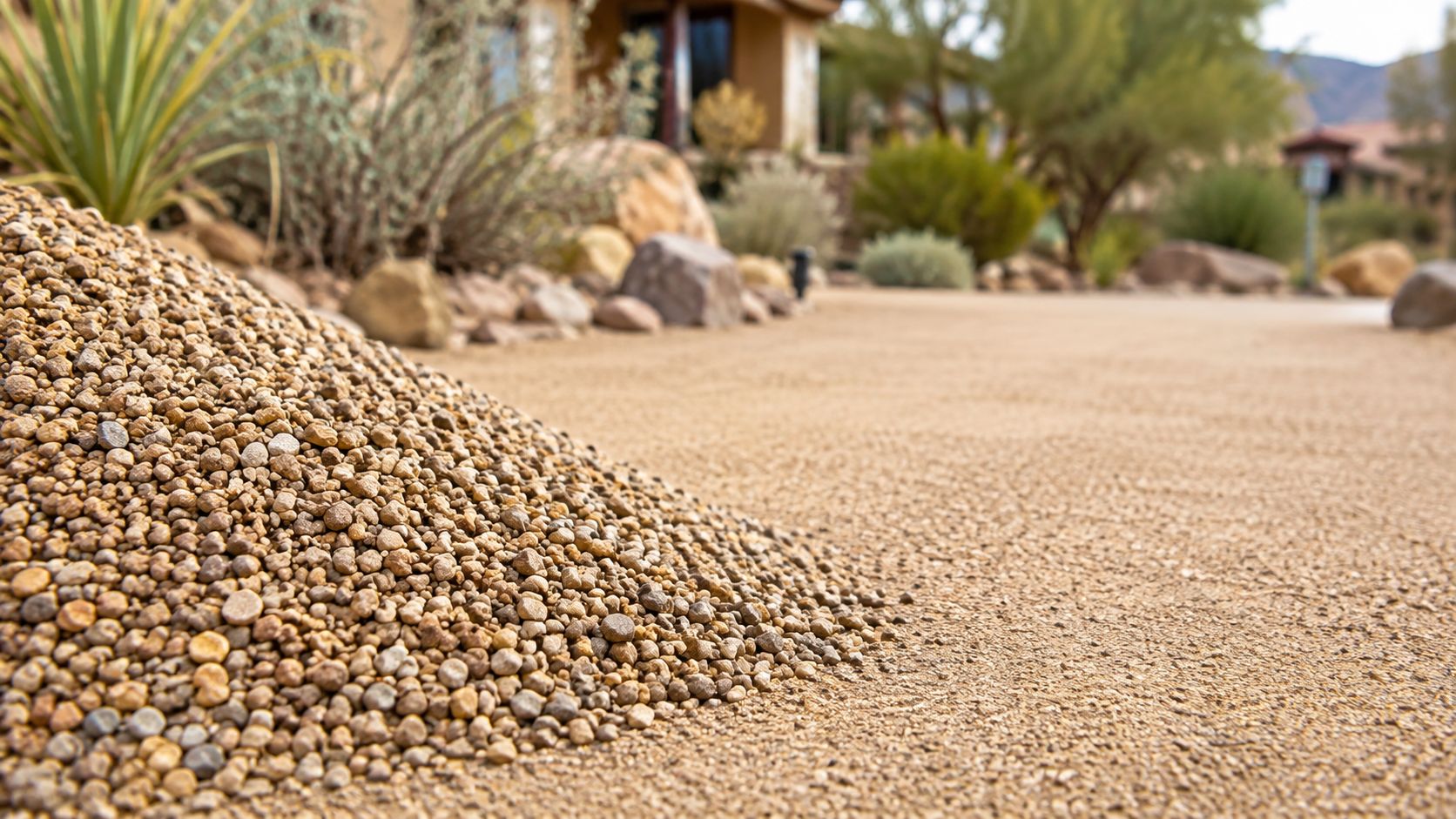
Why it appeals to Northern Arizona homeowners
Prescott-area yards often need to do more with less water. DG fits that job well because it can cover exposed soil, reduce mud, and create clean transitions through the yard without turning everything into poured hard surface.
The color helps too. Warm gold, tan, and brown DG usually sits naturally beside granite boulders, juniper, pinyon, manzanita, and other drought-tolerant plantings common in this part of Arizona. It tends to look settled into the site instead of dropped on top of it.
The practical advantage is not just appearance. DG works best here as a layered system. In real installs, the top DG layer is only part of the result. What keeps it usable is the combination of grade control, compacted base, edge restraint, and a finished depth that matches the traffic the area will get. Skip those pieces and the surface loosens up fast, especially on slope or where runoff crosses the area.
Practical rule: DG performs best as a built surface with base, compaction, edges, and drainage. It does not perform best as loose fines scattered over native soil.
What DG is not
DG is not the right answer for every yard. It can wash on steep grades, track indoors if it is left too loose, and break down faster in spots that take concentrated runoff or repeated tire turning. Homeowners usually get the best results when they use it in the right location and build it to the right depth.
Two distinctions matter:
Natural DG works better as a looser ground cover or in lower-demand areas.
Stabilized DG is better for paths and patios where a firmer, tighter finish is the goal.
That distinction matters in Prescott because climate exposes weak installs quickly. Freeze-thaw cycles, wind, and monsoon water all test the surface. A good-looking DG path did not come from the top layer alone. It came from the full system underneath.
Common Landscaping Uses for Decomposed Granite
A Prescott yard usually shows you fast whether DG was used in the right place. After a summer storm, a well-built path stays firm underfoot, a patio drains instead of holding puddles, and a side yard stays cleaner than bare soil. A loose layer dumped over native ground does not hold up the same way.
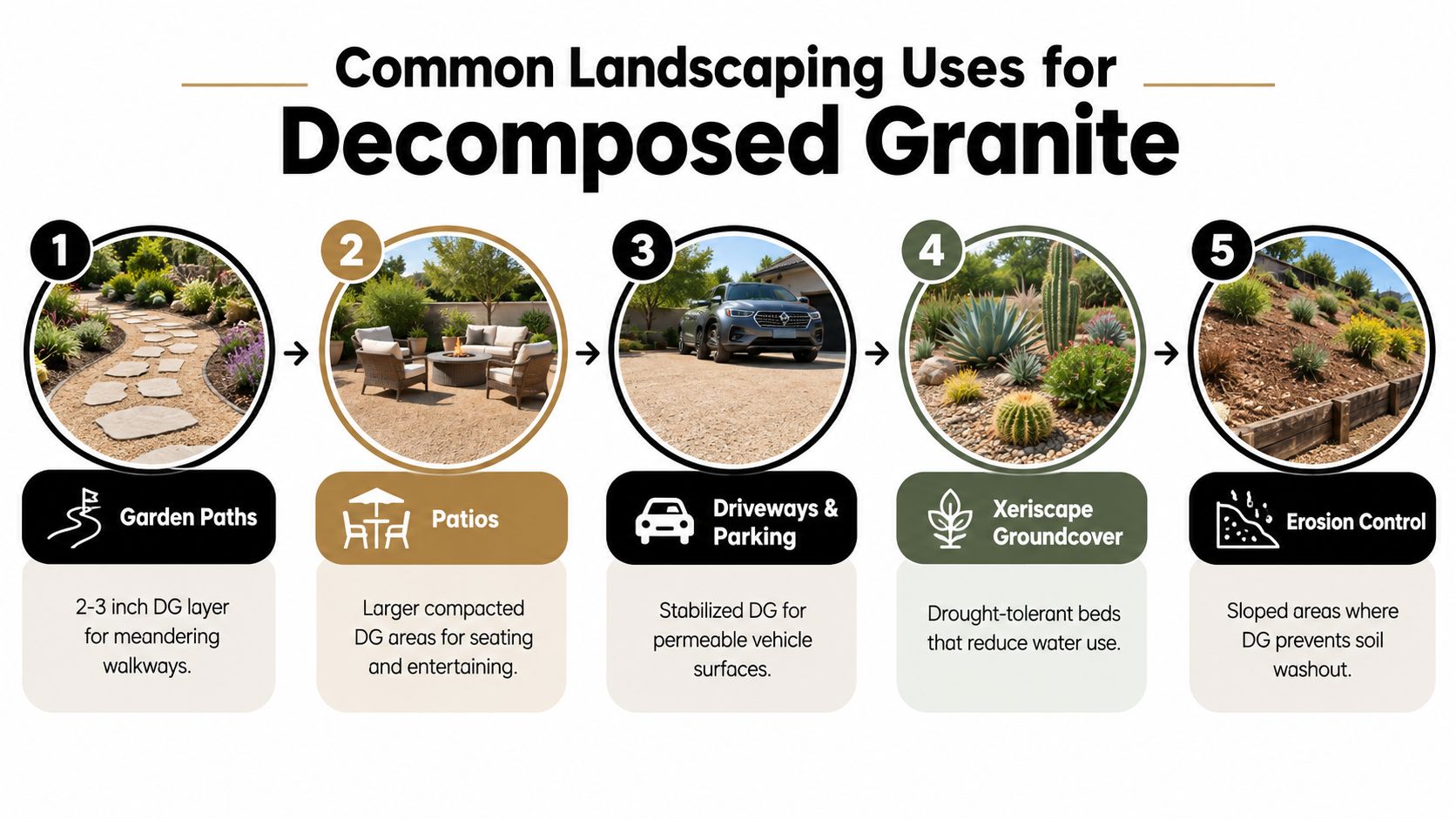
Where DG works best on a property
The most common use is still the walkway. DG fits curved garden paths, connections between front and back yard areas, and informal routes where poured concrete would look too hard or cost more than the space justifies. In Prescott, it also works well around flagstone steppers and boulder edging because the color and texture sit naturally with high-desert materials.
Patio seating areas are another good fit. A compacted DG surface gives homeowners a place for chairs, a small table, or a fire pit zone without building a full paver patio. The trade-off is firmness. For frequent furniture movement or perfectly level dining setups, pavers usually perform better. For a lower-formality sitting area that drains well during monsoon season, DG often makes sense.
Driveways and parking pull-offs can work too, but only in the right conditions. Straight runs and lighter vehicle use are usually fine. Tight turning areas, garage aprons, and spots where tires scrub in place tend to break down faster, so those zones often need a different surface or a stronger build.
DG also earns its keep in the spaces between bigger features:
Side yards and utility runs: cleaner than bare dirt and easier to walk on
Around trees and planting beds: a mineral finish that fits drought-tolerant planting plans
Border zones next to flagstone or concrete: helps transition between hard surfaces and planted areas
Low-water ground cover areas: useful where homeowners want less organic mulch and a more settled appearance
For homeowners comparing materials across different parts of the yard, this breakdown of ground cover options helps clarify where DG fits and where another material may serve the area better.
Functional uses beyond appearance
DG also solves practical site problems. On Northern Arizona lots, runoff rarely spreads out evenly. It concentrates, finds slope, and tests weak spots. That is why DG often shows up in dry drainage routes, shallow swales, and dry stream bed edges where a compactable surface is more useful than exposed soil.
It also works well as infill around larger stone. I use it in projects where flagstone, steppers, or boulder placement need a tighter-looking finish between pieces without pouring concrete everywhere. The key is matching the use to the build. Foot traffic areas can perform well with a compacted surface layer over base. Drainage channels and decorative zones usually call for a different approach and should not be treated like a patio.
On hauling and staging jobs, material volume matters more than many homeowners expect. If you are moving aggregate yourself for a larger yard project, this heavy duty landscape trailer guide gives a straightforward overview of trailer setups for bulk loads.
Before you commit, it helps to see a DG install in motion rather than just in photos.
DG holds up best where the use, depth, base, and drainage plan all match the traffic the surface will actually get.
Pros and Cons of Using Decomposed Granite
A Prescott yard can make DG look great for years, or expose every shortcut in one monsoon season. That is why I judge it less by the sample color and more by where it is going, how much traffic it will take, and whether the build below it is strong enough to hold together.
For the right job, DG gives homeowners a clean, natural-looking surface without the price tag or visual weight of a full paver or concrete install. It works especially well in Northern Arizona because it does not fight the setting. The color range fits high-desert homes, and the surface can handle everyday foot traffic well when it is installed over compacted base instead of dumped as loose rock.
What homeowners usually like about it
Cost is usually the first reason people ask about DG. The material itself is often less expensive than a formal paved surface, which makes it attractive for larger paths, utility side yards, seating areas, and filler zones between stone features. The trade-off is that low material cost does not mean low project cost once excavation, base prep, edging, and compaction are included.
Drainage is another reason DG gets used so often here. Water can move through a DG surface more naturally than it can through concrete, which helps on lots where homeowners want less runoff and a less sealed finish. That only helps if the grade is right. A permeable top layer over poor drainage still fails.
It also solves a design problem many Prescott properties have. Homes need hard surfaces that feel finished, but too much concrete can look harsh against native stone, pines, and open soil tones. DG softens that look.
Here are the advantages that hold up in real yards:
Natural appearance: fits Northern Arizona homes better than many bright or uniform manufactured finishes.
Flexible use: works for paths, patios, side yards, pad areas, and joints around flagstone.
Better footing than loose gravel: compacted fines usually feel more stable underfoot than round or chunky decorative rock.
Easier spot repairs: small damaged areas can often be loosened, regraded, and topped off without tearing out the whole surface.
Where DG falls short
DG is not a fix-all material.
It moves. It tracks. It needs upkeep.
Those issues show up fastest where the installation is thin, the edges are weak, or water concentrates in one spot. On steeper grades, especially on sites that get hard summer runoff, DG can wash, rut, or separate if it is expected to act like pavement. It is also a poor choice for homeowners who want a perfectly crisp, dust-free surface year-round.
Traffic matters too. Repeated tire turning, heavy rolling loads, dragging patio furniture, and dogs running the same path every day can all loosen the finish layer. In shaded spots or low areas, weeds can also become a maintenance issue if the surface is not kept tight and clean.
Decomposed Granite Pros and Cons at a Glance
Factor | Pro | Con |
|---|---|---|
Cost | Lower material cost than many formal hardscapes | Installed cost rises with base prep, edging, and grading |
Drainage | Permeable surface for water-wise yards | Poor slope or concentrated runoff can still cause washouts or pooling |
Appearance | Natural fit for Prescott and Northern Arizona yards | Fines can spread onto adjacent surfaces and look messy |
Walkability | More stable than loose decorative gravel when compacted | Not as rigid or clean-edged as concrete or pavers |
Maintenance | Easier to refresh than a full tear-out | Needs periodic touch-ups, weed control, and occasional regrading |
The best results come from treating DG as a layered surface system. In practical terms, that means a prepared subgrade, compacted base, controlled depth, and edge restraint sized to the use. Skip those pieces, and the material usually gets blamed for an installation problem.
How Decomposed Granite Is Installed the Right Way
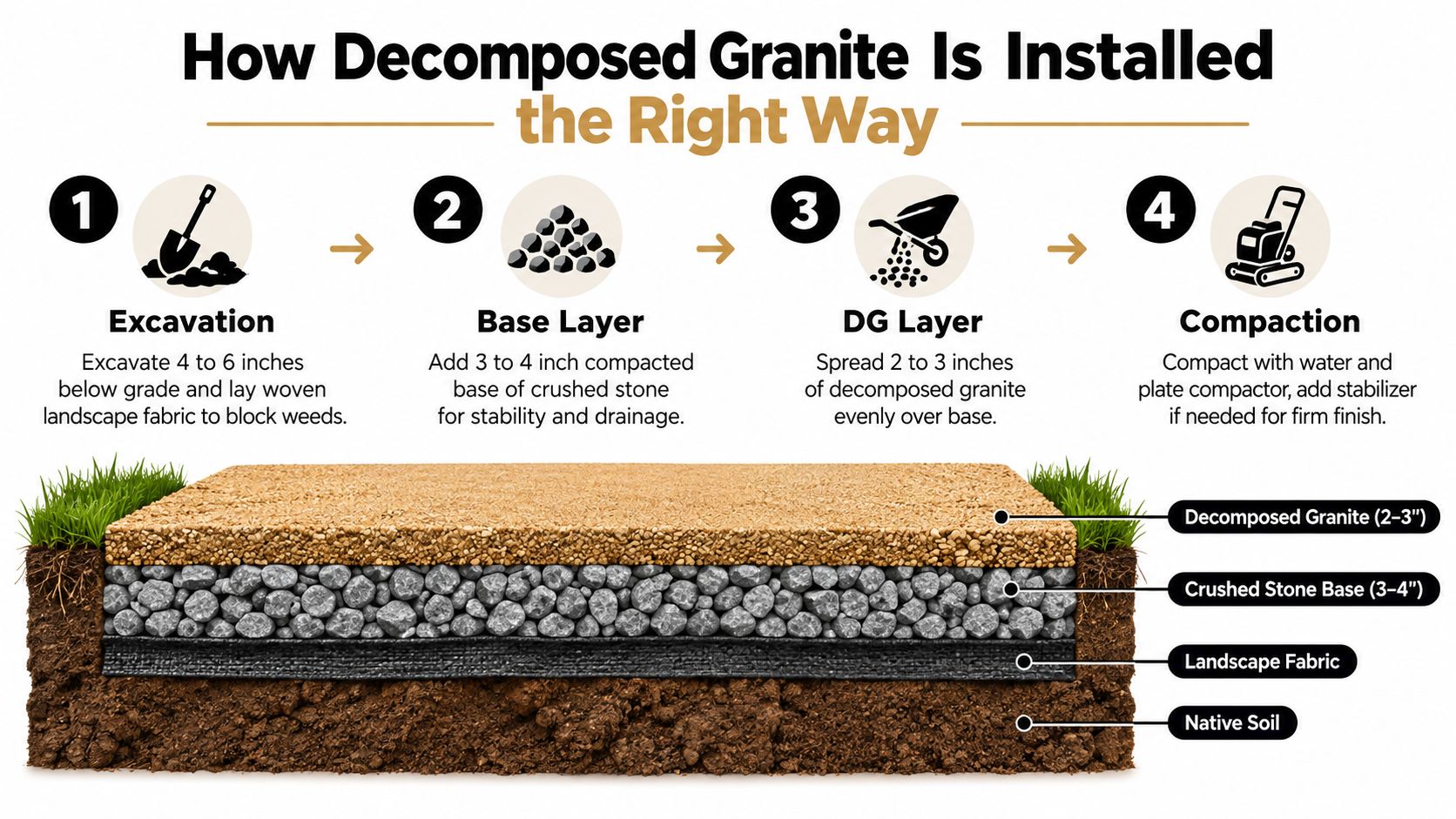
A DG path in Prescott can look solid in May and start raveling out by August if the base is thin, the edges are weak, or runoff has nowhere to go. The material usually gets blamed, but the failure starts underneath.
The Layered Approach That Holds Up
DG performs best as a built surface, not a loose topdressing. That means excavation, grade control, a compacted base, and a finish layer installed in lifts instead of dumping several inches at once.
One installation guide notes that the subgrade commonly sits under an aggregate base about 4 to 6 inches deep, depending on use, and that vehicular areas may need 5 to 6 inches of DG above for traffic demands (Sunco Lawns). On Prescott-area jobs, the exact section changes with the soil, slope, and how the surface will be used, but the rule stays the same. Foot traffic can tolerate a lighter build than a driveway. A side yard with monsoon sheet flow needs more attention than a sheltered garden path.
How compaction and slope affect performance
Compaction decides whether DG feels firm underfoot or loosens up after the first season. Guides commonly recommend placing DG in controlled lifts, often around 2 to 3 inches, then compacting each layer before the next one goes down. A separate pathway and driveway reference also says the aggregate base should be compacted to 92% to 95% before the DG is installed over it (Gravelshop).
That step matters more in Northern Arizona than many homeowners expect.
Our soils and grades vary a lot from one property to the next. Add freeze-thaw cycles, dry spells, and sudden summer storms, and a loose install starts to separate fast. If the crew skips proper moisture during compaction, leaves soft spots in the subgrade, or installs the finish too thick, the surface can pump, rut, or migrate downhill.
Slope has to be set on purpose. The Landscape Library recommends a consistent slope of about 1% to 2% so water moves off the surface instead of sitting in low spots. On flatter patios and walkways, that small pitch is often the difference between a clean finish and puddling that breaks down the fines.
Field note: Thick loose DG is just aggregate that has not been built to stay put.
The finishing details that keep DG contained
Edge restraint is part of the installation, not trim. Steel, bender board, stone, or concrete containment keeps the DG from spreading into planting areas, walkways, and drive edges. Once the perimeter starts giving way, the surface width shrinks and the center loosens.
For homeowners planning the detail work, this guide to installing edging for DG paths and borders shows why containment matters.
Stabilizer can also make sense, but not on every job. I usually reserve it for tighter paths, patios, and places where people want a firmer finish with less tracking. For informal trails, utility side yards, or low-use areas, loose compacted DG often performs well without the added cost.
Why Decomposed Granite Works So Well in Northern Arizona
A Prescott yard can stay dry for weeks, then take a hard monsoon storm that sends water across drive approaches, side yards, and decomposed granite paths all at once. That is where DG either performs well or starts moving. In this climate, the material works best when it is installed as a compacted system with depth, base, and containment sized for the site.
Northern Arizona puts real stress on surface materials. Long dry periods loosen untreated top layers. Summer storms hit fast. Many lots also have enough slope to move fines downhill if the section is too thin or the edges are weak. A loose decorative spread may look good at first, but it usually does not hold up the same way a properly built DG surface does.
The jobs that last here are usually built with climate and grade in mind. On a flat, low-traffic path, a standard compacted section often performs well. On sloped access paths, drive edges, and areas that catch runoff from roofs or uphill hardscape, crews often need more base depth, tighter compaction, and stronger edge restraint than a basic install. That is the difference homeowners feel after the first storm season.
Why the material fits this region
DG solves a very specific Northern Arizona problem. Homeowners want a surface that looks at home with granite boulders, juniper, pinyon, steel edging, and flagstone, but they also need something that can handle weather swings without the cost and rigidity of paving every transition area.
It also works well on properties with mixed-use spaces. A backyard may need a walkable route from the driveway to the gate, a stable pad near raised beds, and a clean transition around native planting. DG handles those in-between zones well because it can be shaped to the lot instead of forcing the lot to fit a rigid pattern.
Where climate and installation meet
In this region, the climate rewards good section depth and exposes shortcuts quickly.
A thin layer of loose DG over native soil tends to scatter, rut, or wash to the low side. A compacted layered install holds together much better because the surface fines knit into the top course while the base underneath carries the load. That matters more in Prescott than in milder climates because freeze-thaw cycles, dry soil movement, and monsoon runoff all test the surface over time.
On many Northern Arizona properties, the question is not whether DG looks right. It usually does. The question is whether the area has the right slope, drainage pattern, and construction depth for DG to stay where it belongs.
In Prescott, DG succeeds when it is treated as a built surface, not as loose rock spread for color.
That is why DG often works so well here, and why it sometimes fails here. The material matches the region. The installation has to match it too.
Decomposed Granite Compared to Gravel, Mulch, and Pavers
DG sits in the middle of several categories. It isn't as loose as pea gravel, isn't organic like mulch, and isn't as formal or rigid as pavers. That's exactly why it solves so many in-between problems.
How the materials differ in practical use
Pea gravel and river rock drain well, but they stay loose. That makes them better for decorative beds than for primary walking surfaces. Mulch helps in planting areas, but it breaks down and doesn't create the same compacted walking surface. Pavers create a more finished patio or walkway, but they come with more excavation, more labor, and a different look.
If you want a broader patio-material perspective from outside the Southwest, this piece on stamped overlay for metro Atlanta patios is useful because it shows how decorative concrete gets evaluated against other hardscape choices in a different market.
For a more local material decision, this comparison of rock vs decomposed granite vs gravel which low-maintenance ground cover is best for Northern Ariz helps sort out where each one tends to fit in Northern Arizona yards.
Side by side comparison
Because installed pricing varies so much by prep, access, grade, and material selection, it makes more sense to compare these surfaces qualitatively unless you're pricing a real site.
Decomposed Granite vs. Common Surfaces
Material | Installed Cost / sq ft | Permeability | Maintenance | Best Use |
|---|---|---|---|---|
Decomposed granite | Moderate relative to decorative gravel, lower than formal pavers in many projects | High when installed correctly | Light seasonal upkeep, occasional top-offs | Paths, casual patios, side yards, low-water groundcover |
Pea gravel | Often lower to moderate | High | Ongoing raking and migration control | Decorative beds, informal drainage zones |
River rock | Moderate | High | Low reshaping need, but can shift and collect debris | Dry creek beds, accents, drainage features |
Wood mulch | Moderate but recurring because it decomposes | Moderate | Regular refreshing and cleanup | Planting beds and tree areas |
Pavers | Higher | Varies by system | Joint maintenance and occasional reset | Formal patios, entries, high-use entertaining areas |
The short version
Choose DG when you want a surface you can walk on comfortably, that still drains, and that visually fits a Prescott-area yard. Choose pavers when you need a more formal outdoor room. Choose mulch for planting health. Choose river rock when the main job is drainage or accent, not foot comfort.
Maintaining a Decomposed Granite Surface Over Time
DG is low maintenance, not zero maintenance. That's the honest version. If you expect it to stay perfect for years with no touch-up, you'll be disappointed. If you treat it like a mineral surface that needs periodic tuning, it holds up well.
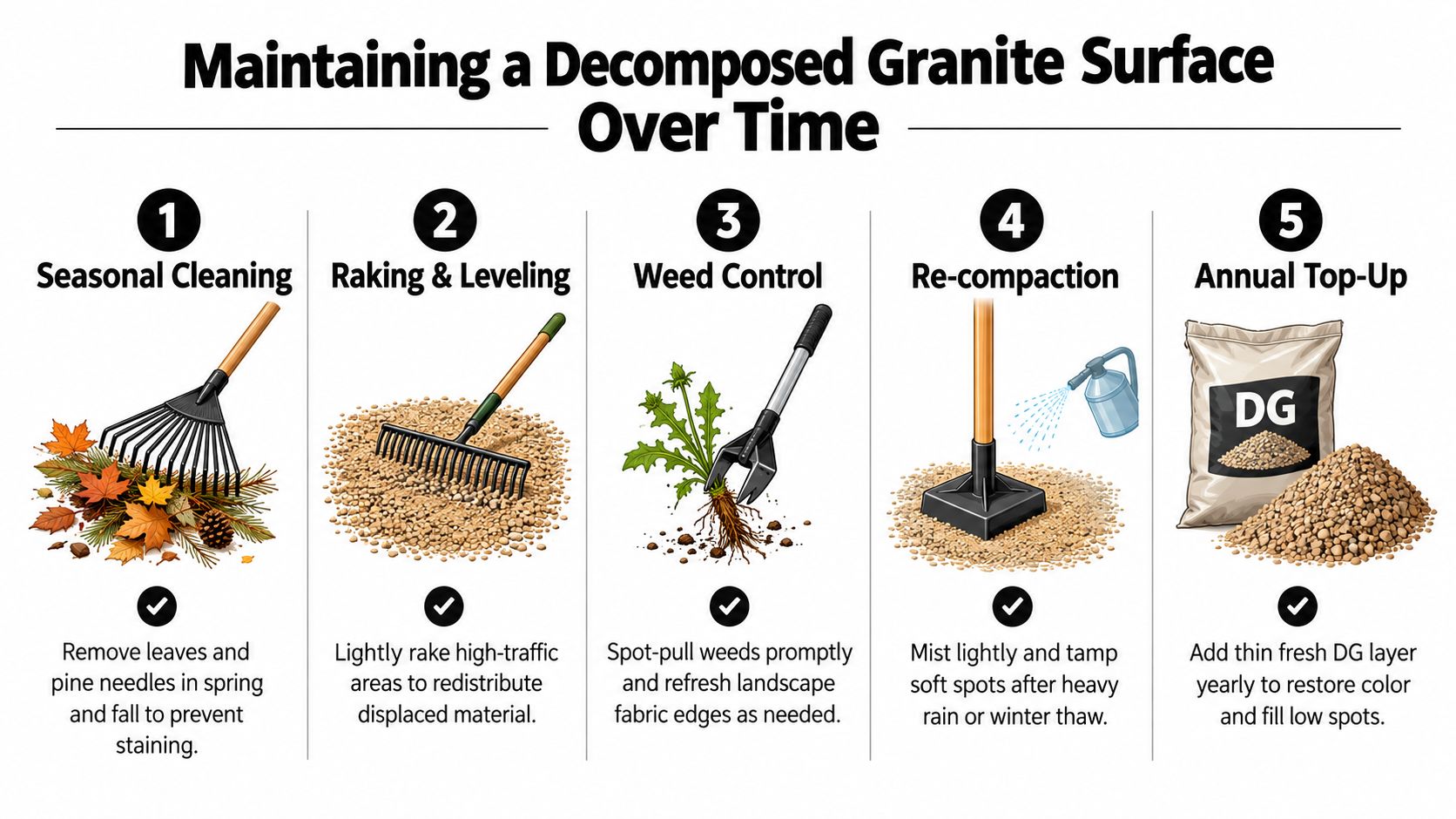
The maintenance rhythm that makes sense
Most of the work is simple. You clear organic debris, watch for low spots, and deal with small issues before they become washouts.
A good annual rhythm looks like this:
Spring cleanup: remove leaves, pine needles, and debris that hold moisture or stain the surface.
Early summer check: inspect before monsoon season for edge failure, thin spots, and runoff channels.
Post-storm touch-up: rake displaced areas back into place and re-compact soft sections.
Fall cleanup: keep tree litter from building up and breaking down into the top layer.
What usually needs fixing
Weeds are the most common frustration. Fabric below can help reduce growth, but it won't make weeds impossible forever. Prompt pulling and routine prevention work better than expecting a permanent fix.
The next issue is surface thinning. Traffic patterns show up first at turns, entries, furniture zones, and pet routes. When material starts disappearing in those spots, top it off lightly and recompact before the base starts telegraphing through.
Fresh DG survives storms better than neglected DG. The first monsoon after installation is when weak spots usually reveal themselves.
A simple homeowner checklist
Use this once or twice a year:
Check drainage flow after a rain. Look for pooling or channels.
Inspect the edges where migration usually starts first.
Re-level worn spots before they become potholes or ruts.
Pull weeds early while root systems are still shallow.
Re-compact soft patches after wet weather or winter movement.
If that list sounds manageable, DG can be a practical long-term material. If it sounds annoying, a more rigid hardscape surface may be a better fit.
Is Decomposed Granite Right for Your Yard and How R.E. and Sons Can Help
DG is a strong fit when the goal is a natural-looking, permeable, lower-cost surface that works with a water-wise Northern Arizona setting. It tends to make the most sense for xeriscape paths, casual patios, tree rings, dog runs, side yards, and budget-conscious driveways or parking pads where the owner wants function without the expense or visual weight of more formal hardscape.
It is not the right call for every space. If you need a crisp front entry with constant heavy traffic, a fully rigid outdoor dining surface, or a slope that already carries concentrated runoff, another material may serve you better. The same goes for homeowners who don't want any seasonal upkeep. DG rewards light maintenance. It doesn't reward neglect.
When to say yes to DG
DG is usually worth serious consideration when:
You want permeability: especially on properties that need better rain handling.
You prefer a softer Southwestern look: instead of a fully paved appearance.
You need to control budget: while still creating usable outdoor surfaces.
You're building around xeriscape planting: and want the hardscape to match that logic.
When to choose something else
Look at alternatives if:
The area gets heavy commercial-style traffic
The slope sheds fast water directly across the surface
You want a cleaner, harder, more furniture-stable finish
The space stays shaded and tends to stay damp or weedy
For homeowners in Prescott, Prescott Valley, Chino Valley, and nearby Northern Arizona communities, the best DG projects usually come from reading the site. Soil, slope, traffic, drainage path, and intended use all matter more than whether the sample looks good in a bucket.
If you're evaluating a path, patio, driveway edge, or low-water yard conversion, R.E. and Sons Landscaping is one local option for design-build work that includes DG pathways, permeable surface planning, and coordination with edging, stone, and planting systems so the material functions as part of the whole yard.
If you're deciding whether decomposed granite makes sense for your Prescott-area property, R.E. and Sons Landscaping can help evaluate the grade, drainage, and intended use before you spend money on the wrong surface. They handle full design-build work across Northern Arizona, including DG paths, groundcover transitions, edging, stonework, and other low-water outdoor upgrades. To see project examples or schedule a consultation, visit R.E. and Sons Landscaping.
Comments