
Rock Landscaping Ideas for Northern Arizona Yards
Wondering how to build a yard that looks intentional in the middle of a Prescott July without a lawn that eats your water budget?
Rock landscaping answers that. It replaces water-hungry turf with boulders, crushed stone, decomposed granite, and drought-tolerant plants chosen for high-desert sun and elevation, and it holds its shape through monsoon runoff instead of turning into mud.
The math supports the shift. The average American family uses about 320 gallons of water a day, and roughly 30% of it, around 96 gallons, goes outdoors, according to the EPA's outdoor water use guidance. Converting to a water-smart design can reduce outdoor use by 20% to 50%, and stone is the structure that makes those savings hold.
R.E. and Sons is the locally owned, licensed design-build firm behind a lot of these yards. With Arizona ROC #300642 and crews building in Prescott since 1999, we solve one problem for homeowners across Prescott, Prescott Valley, Chino Valley, Williamson Valley, and the surrounding communities: a property that demands too much water and too much weekend labor for the yard it delivers.
The ten rock landscaping ideas below are evaluated for Northern Arizona specifically, not translated from Phoenix or Tucson. Intense sun, caliche and decomposed granite soils, slope, winter cold, and water restrictions change how each one should be built, so each entry covers where it works, where it fails, and what it asks of you afterward.
1. Naturalistic Rock and Boulder Groupings
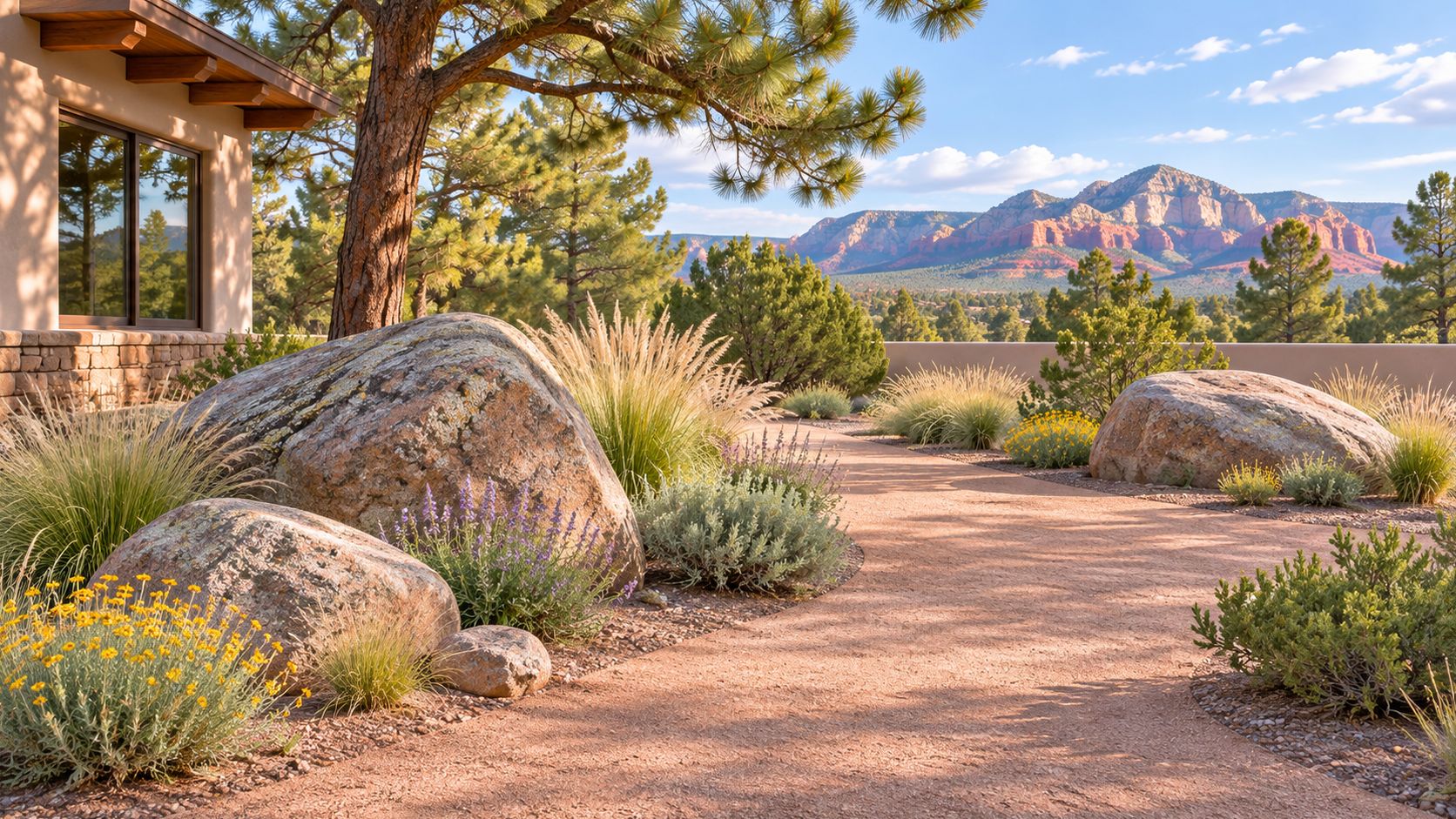
A boulder grouping works when it reads as geology rather than delivery. Set three stones of different sizes in an odd-numbered cluster, bury each one about a third below grade, and let the largest sit slightly uphill of the others. Boulders perched on the surface look temporary, and they usually are.
How Do You Choose Boulders That Belong in Northern Arizona?
Color and hardness come from the quarry, not the catalog. USGS crushed-stone data show limestone and dolomite at about 70% of 2025 U.S. output and granite at 14%, which explains why pale limestone boulders dominate what's sold locally while granite reads as the accent stone. In a Prescott front yard, three staggered granite-toned boulders framing a low-water native bed do more for curb appeal than a full pallet of small rock, because they give the eye one place to land and shade their own root zone.
Place heavy stone first. Once a two-ton boulder is set, paths, drip lines, and plantings get organized around it.
Keep stone out of the drip line. Roof runoff carving through a boulder bed undermines the setting and stains the faces.
Leave the utility easement clear. A rock grouping over a sewer lateral turns into an expensive afternoon during the next repair.
Match the stone to the house. Warm tan stone settles against brick and cedar; cool gray sits better with stucco and metal.
A boulder bed that blocks a swale will flood a foundation faster than the lawn it replaced.
For anything over about 300 pounds, plan on equipment. A skid steer and an operator who sets stone for a living will place a boulder in twenty minutes and leave the surrounding soil undisturbed, which is not true of four friends and a pry bar.
2. Xeriscape Rock Gardens
A xeriscape rock garden is gravel, decomposed granite, or coarse sand planted with drought-tolerant species and anchored by a few stones. It gives a property a finished surface without a full irrigation grid, which matters at Prescott's elevation where July sun and August storms both arrive hard.
The water case is already settled. In a five-year Southern Nevada Water Authority study cited in an EPA report on water-efficient landscaping, water-efficient yards used 76% less water per unit area than turfgrass. The same report cites an Arizona estimate where a 3,000-square-meter lawn, roughly 32,292 square feet, needed 9,000 to 15,000 gallons a month, against 800 to 1,300 gallons for the same area planted in shrubs and trees.
What Separates a Xeriscape From a Pile of Gravel?
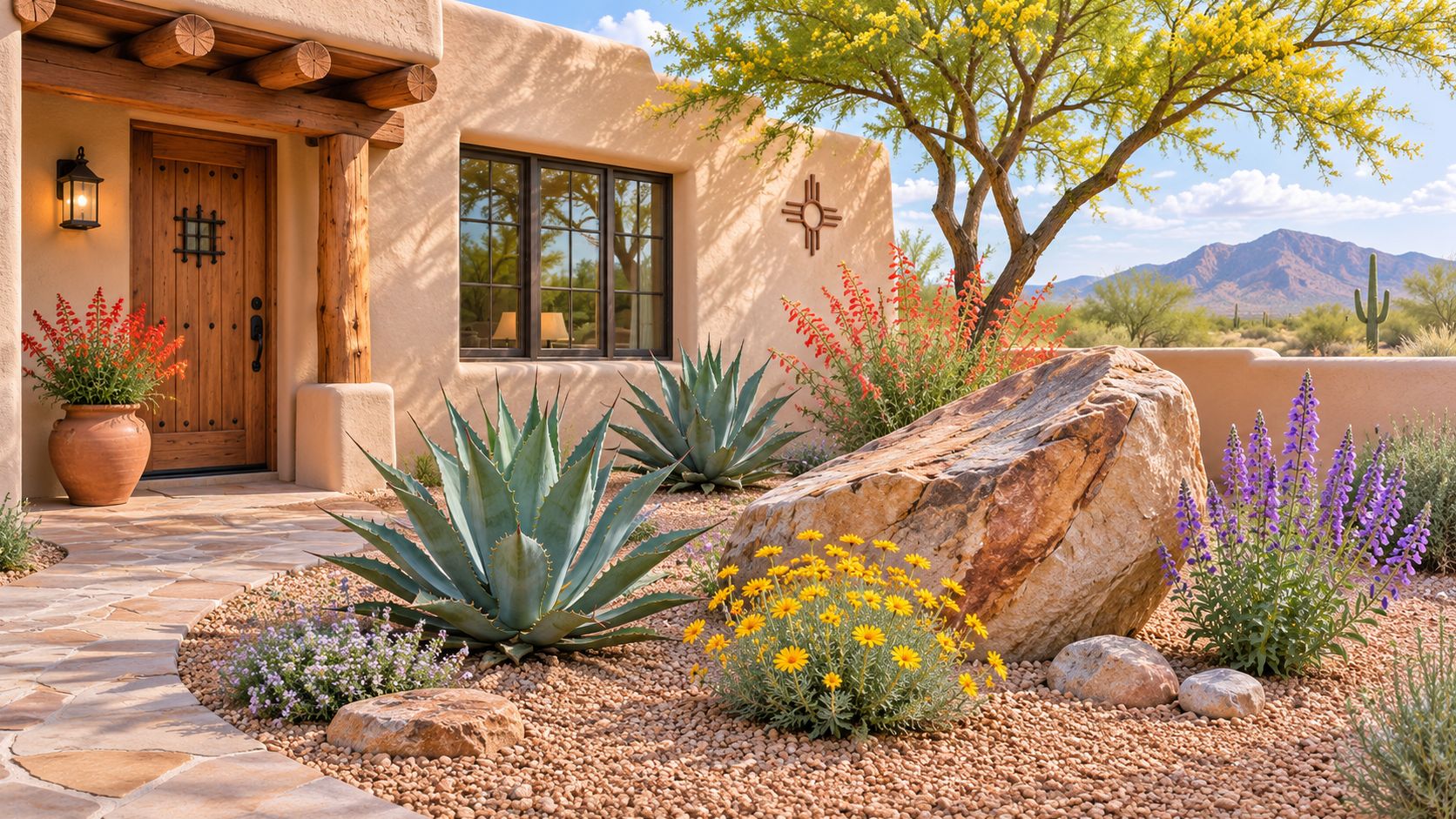
Layering. Most disappointing rock gardens are one stone size and three plants, all the same height, all spaced the same distance apart.
Build in three heights. Upright accents at the back, mounding mid-ground shrubs, and a groundcover that spills over the rock edge.
Repeat, don't scatter. Five agave in one drift read as design. One agave every four feet reads as leftovers.
Pick plants that shrug off reflected heat. Penstemon, Apache plume, blue fescue, and artemisia handle stone under them far better than plants that want cool roots.
Edge the bed. A crisp steel or stone edge keeps gravel off the sidewalk and out of the adjacent planting.
A Prescott Valley side yard that was once bluegrass becomes exactly this: one boulder, a decomposed granite field, and a run of penstemon and grasses on drip only where the plants sit, not across the whole surface.
3. Rock Retaining Walls and Boulder Retaining Borders
Could a rock wall hold a slope and still leave room for a usable yard? In Prescott, Prescott Valley, and Chino Valley, the answer depends on the grade and how water moves through the site. A retaining wall has to manage drainage as well as hold soil. If water builds up behind the stone, pressure can shift the wall.
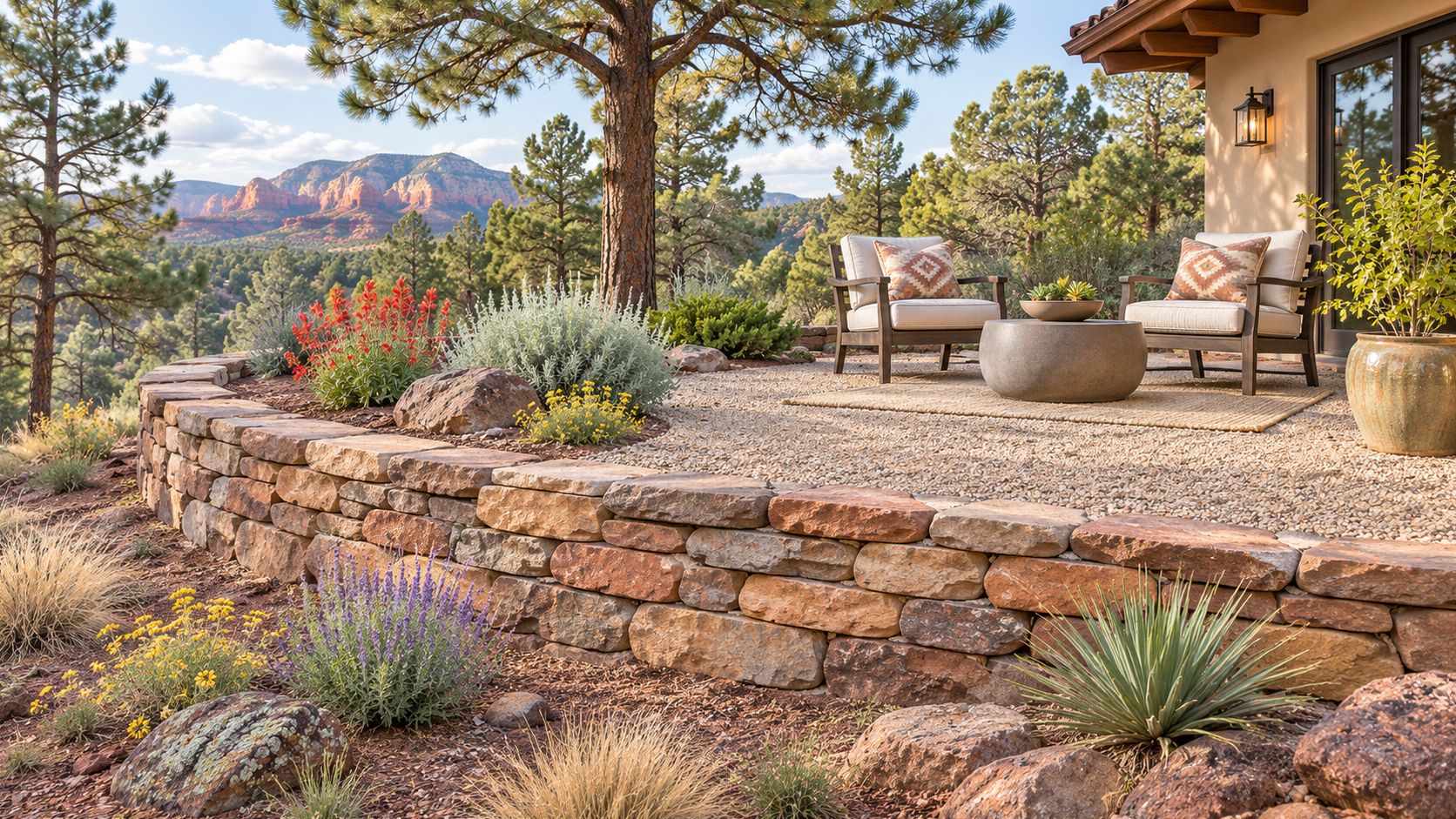
On a Prescott hillside, plan a compacted base, a free-draining gravel zone behind the wall, and a clear outlet for runoff. Intense sun and dry periods can make soil hard, while monsoon rain can send water quickly downhill. In Chino Valley, terracing a steep yard with two shorter retaining walls can create usable space without relying on one tall wall. A boulder border suits a gentler grade, where it can define a bed without holding back a large volume of soil.
The Round Rock water conservation office notes that large amounts of rock can increase stormwater flow, and smaller rock or decomposed granite can migrate into drains. Rock alone also provides no roots to hold soil during heavy rain. Direct runoff to a planned outlet rather than letting it wash across a slope.
Is Your Wall Structural or Decorative?
Under about two feet, a dry-stacked border can hold a modest amount of soil and define a planting bed.
Above that, plan for a footing and drainage, and check with the building department.
Set drainage before the first course. Place filter fabric, washed gravel, and a perforated outlet behind the wall.
Cap the top course. A level cap gives the wall a finished edge and helps limit water running down its face.
Local stone can help a wall feel at home in the yard. A U.S. stone-industry compilation citing USGS data reports that domestic dimension-stone producers sold or used about 2.3 million tons valued at $460 million in 2025. Choose stone suited to the wall's shape and the site's grade, then make drainage the first priority.
4. Decomposed Granite Pathways
Decomposed granite is the least formal path surface available and the one most likely to fail in its first monsoon when it's spread straight onto native soil. The material is only as good as what's underneath it.
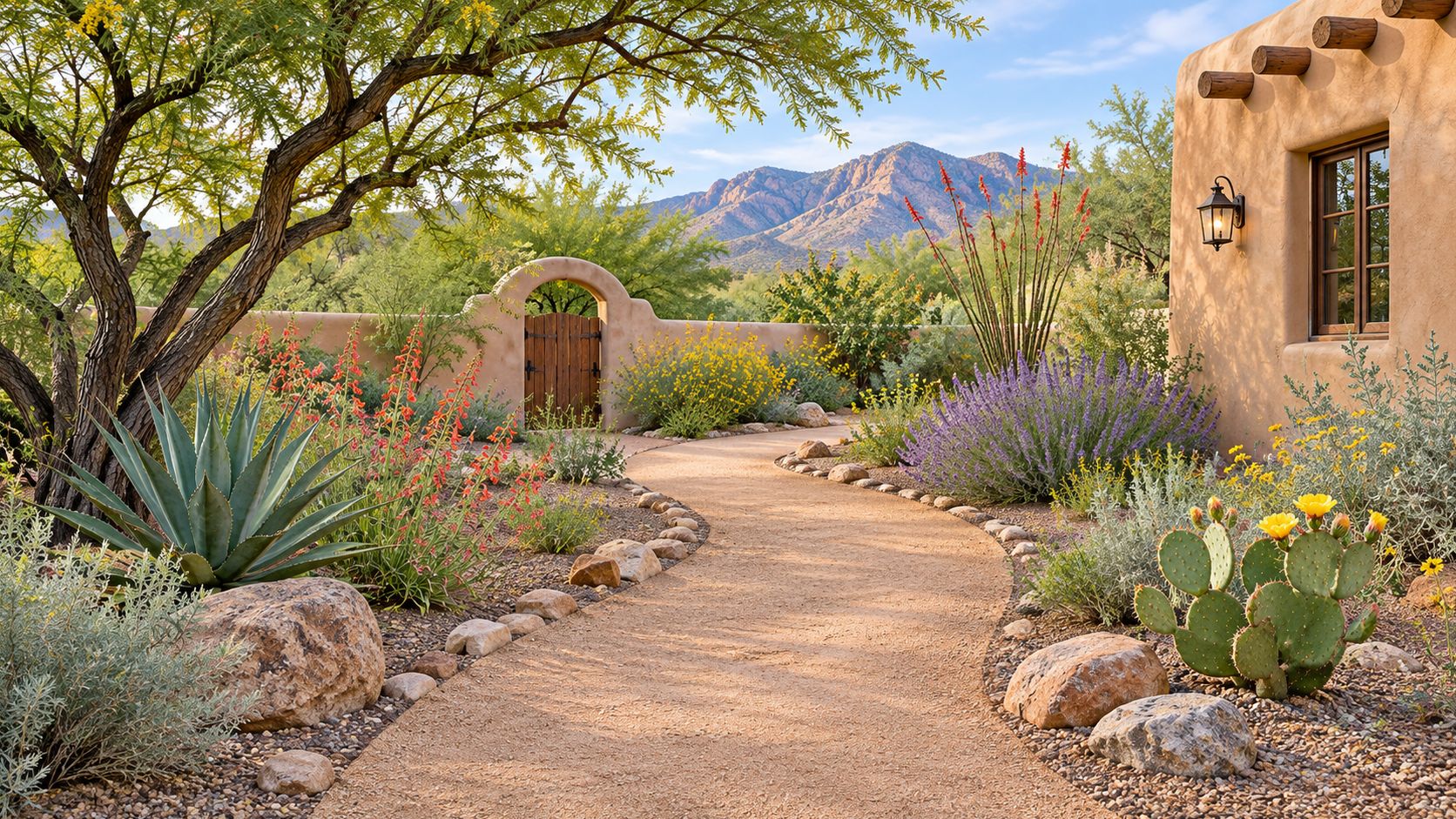
EPA research on permeable pavement frames the design goal as preserving or restoring infiltration, and the same logic governs a DG walk. Separate surface stone from the load-bearing layer: a stable compacted aggregate base where feet and wheels travel, clean uniformly graded stone where water needs to move, and geotextile between soil and aggregate so fines don't migrate upward and choke the section.
What Goes Under a Decomposed Granite Path?
Excavate 4 inches and compact the subgrade before anything else lands.
Lay 2 to 3 inches of angular base and compact it in two passes, not one.
Spread about 1 inch of DG over the base and compact again while it's slightly damp.
Edge both sides with steel, stone, or a planted border, because loose aggregate always travels.
Grade it about 2% away from the house and plan where the water exits before you start.
If you're still weighing surfaces, this explanation of what decomposed granite is used for covers where it belongs and where pavers win. A typical use: a 40-foot, 3-foot-wide walk from a Prescott back door out to a fire-pit patio, bordered by boulders, with a slight crown so monsoon rain sheds off the surface and into the planting beds instead of puddling at the door.
5. River Rock, Dry Creek Beds, and Stone Water Features
A dry creek bed is drainage disguised as a garden feature, which is why it's the most useful idea on this list. Stone laid along the path water already wants to take solves a wet spot and gives a flat yard a line that moves.
University of Arizona rainwater harvesting guidance treats larger rock as the material that stabilizes the contours used to harvest rainwater, and notes that rock mulch helps prevent erosion. It also draws the depth distinction that matters at planting time: inorganic mulch such as rock or gravel goes on at about 2 inches, while organic mulch goes on at 3 to 6.
Here's how a rock channel and a small water feature come together on a real grade.
Where Does a Dry Creek Bed Belong?
Along the low line of the yard, not across it. Follow the grade water already uses.
Below a downspout or a wall outlet, where runoff concentrates during a storm.
Between planted areas, so the channel doubles as a path for wildlife and a visual connector.
Away from primary walking routes, especially when the feature holds water.
Our guide to dry creek bed landscaping ideas covers how to shape the run and size the stone. Fountain construction details, from waterproofing to pump plumbing, are covered in these fountain construction tips.
Build the pump access before you build the waterfall. Nobody wants to disassemble a boulder wall in July.
Good fits here include a Prescott backyard with a winding river-rock channel descending toward a patio, a Prescott Valley dry creek filled with agave and ornamental grass, and a Chino Valley courtyard where a compact recirculating waterfall drops into a stone runnel beside a paver kitchen.
6. Modern Linear Rock Planting Beds
Linear beds are the fastest way to make a small Northern Arizona lot look designed. One long band of stone, repeated planting, and a hard edge give a contemporary house the geometry it's already asking for.
Arizona Cooperative Extension recommends a 2- to 4-inch layer of crushed rock or another mulch over exposed soil, which is the depth that suppresses weeds and slows evaporation. The same guidance favors breathable garden fabric over black plastic, since fabric lets air and water pass while plastic traps heat and moisture against the soil.
How Wide Should a Linear Bed Be?
Scale the band to the wall it hugs. A 10-foot wall wants an 18- to 24-inch bed, not a 6-inch strip.
Repeat a limited palette. Two stone colors and three plant types beat seven of each.
Use crisp edging where the design calls for a modern finish, and buried edging where you want the stone to meet soil directly.
Keep sightlines clear at driveways and steps, since tall grasses in a narrow bed block what you need to see.
A Prescott Valley backyard shows the pattern well: an 18-inch charcoal gravel band dividing artificial turf from pavers, planted with upright grasses that stay narrow. We set the same detail around pools and putting greens in Prescott, where a straight line does more work than any amount of decoration.
7. Japanese-Inspired Rock and Gravel Gardens
Restraint is the whole idea. A handful of stones, raked gravel, a clipped shrub, and open space read calmer than any densely planted bed, and they use almost no water once established.
The tradeoff is heat, and it's real. USDA Forest Service research from a semi-arid Colorado residential setting found xeriscaped yards about 1.5°C warmer in morning air temperature than grass lawns, and another residential study recorded rock surface temperatures reaching 45°C, up to 14°C warmer than adjacent tuff surfaces. A University of Florida summary of that work notes rock-heavy xeriscapes ran hotter than yards with more plant cover, while cautioning that the study couldn't isolate rock from the other xeriscape elements.
Gravel is a design material, not a default. Put the shade over the bench, not over the stones.
Can a Gravel Garden Stay Comfortable in July?
Site the gravel plane away from seating. A raked field is beautiful to look at and hot to stand in.
Choose pale stone where sun hits all day and save dark stone for shaded courtyards, since dark material holds more heat.
Add one small tree or a shade structure over the spot where you'll sit.
Keep the plant palette simple. Three boulders, one maple, and a clipped evergreen outperform a crowded composition.
A Prescott courtyard with three focal boulders, raked gravel, and a single Japanese maple on the east side stays usable through August. The same composition in full afternoon sun looks better than it feels.
8. Rock Borders for Lawn and Turf Transitions
A border is the cheapest upgrade in rock landscaping when the geometry is right. Where lawn meets gravel, pavers, or artificial turf, a real stone edge makes both materials look intentional instead of unfinished.
Cost is modest. HomeGuide's December 2025 pricing research put 1-to-4-inch river rock at $45 to $130 per ton, or $50 to $160 per cubic yard, so a 60-foot border built from medium stone is a materials decision rather than a project.
What Stone Works Best as a Lawn Border?
Medium boulders anchor a corner where the bed turns and give the border visual weight.
Stacked stone builds a low curb where you want separation with height.
Buried edging under the stone stops lateral creep into the turf.
Mowing clearance decides everything. A border that stands proud of the soil gets struck by the deck every week.
Set the tops flush with the soil line and let the grass meet stone cleanly. A border you have to trim around has already failed.
A Prescott front lawn edged in tan boulders beneath desert shrubs, a Prescott Valley artificial-turf project finished with a low natural-stone border, and a Chino Valley side yard where stacked stone separates grass from a gravel path all follow the same rule: the border should look like the yard's structure, not an afterthought added at the end.
9. Rock and Stone Fire-Pit Surrounds
A stone surround extends the fire pit's footprint and anchors the seating area, but its real value in Northern Arizona is what it does for defensible space.
University of Arizona Firewise guidance divides the defensible area into an immediate zone of 0 to 5 feet from a structure, an intermediate zone of 5 to 30 feet, and an extended zone of 30 to 100 feet and beyond. It specifies decomposed granite, gravel, or stone in the immediate zone, limits mulch or compost to watered areas around plantings in the intermediate zone, and allows bark mulch in islands and around individual trees further out.
That framework settles the design question. Hard, noncombustible surfaces belong closest to the house, and planting moves outward as distance increases.
How Close Can Stone Seating Sit to a Fire Pit?
Follow the manufacturer's clearances for the bowl or burner, then add a margin.
Keep everything in the heat zone noncombustible. Stone, concrete, and metal only.
Drain under the surround. Water trapped beneath a stone ring heaves in winter.
Leave circulation space so chairs don't crowd the flame or the walkway behind them.
Our team walks through the full sequence in this guide to outdoor fire pit installation. A Prescott backyard centered on a round pit framed in stacked Arizona stone, or a Prescott Valley paver patio with a linear raised-stone feature, both start with that clearance and drainage plan before a single stone is set.
10. Rock Gardens Around Outdoor Kitchens and Bars
Rock grounds an outdoor kitchen in a way pavers alone can't. A stone bed wrapping the island ties the structure to the yard instead of leaving it as a hardscape barge parked on the patio.
The caution is plant placement. The Arizona Cooperative Extension mulches guide explains that rock and gravel reduce evaporation but also collect heat, which can raise soil temperatures, household cooling costs, and irrigation demand in summer. It also notes that weed seeds blow into gravel even where fabric is installed, so a gravel border near a kitchen needs a blower pass now and then, not a weeding marathon.
Where Should Plants Go Around an Outdoor Kitchen?
Keep the stone band narrow on the cooking side, wide enough to look deliberate and narrow enough to stay cool underfoot.
Cut real planting pockets deep enough for roots to find soil moisture, not saucers of gravel.
Protect service access. Leave the panel, shutoff, and plumbing reachable without moving stone.
Match the bed to the masonry, so the island base and the surrounding rock read as one material family.
If the kitchen is part of a larger build, these backyard deck ideas show how decking, stone, and seating layers work together. A Prescott covered kitchen with a stacked-stone island base and boulder beds, or a Chino Valley patio where stone columns visually connect the kitchen, fireplace, and fire pit, both work because the rock was planned before the utilities went in, not after.
Comparing the 10 Rock Landscaping Ideas at a Glance
Idea | Best For | Water Needs | Maintenance Level |
|---|---|---|---|
Naturalistic Rock and Boulder Groupings | Natural-looking yards, slopes, and planting-bed borders | Low; minimal irrigation | Low; occasional plant care |
Xeriscape Rock Gardens | Water-wise, low-turf landscapes | Low; limited irrigation | Low to moderate; occasional weeding and pruning |
Rock Retaining Walls and Boulder Retaining Borders | Slopes, terraces, and elevation changes | Low; depends on planting | Moderate; inspect drainage and wall condition |
Decomposed Granite Pathways | Informal paths through Southwestern yards | None for the path | Moderate; replenish and recompact as needed |
River Rock, Dry Creek Beds, and Stone Water Features | Decorative drainage channels or water-feature focal points | Low for dry beds; ongoing replenishment for water features | Low for dry beds; high for water features |
Modern Linear Rock Planting Beds | Contemporary yards and clean transitions | Low; depends on plant selection | Low to moderate; occasional plant care |
Japanese-Inspired Rock and Gravel Gardens | Courtyards, meditation areas, and quiet focal spaces | Low; depends on plant selection | Moderate; maintain gravel patterns and plants |
Rock Borders for Lawn and Turf Transitions | Defining edges between lawns, turf, paths, and planting beds | Low; depends on adjacent plants | Low to moderate; reset shifting stones as needed |
Rock and Stone Fire-Pit Surrounds | Outdoor gathering areas and fire-pit patios | None for the surround | Moderate; clean regularly and follow fire-safety requirements |
Rock Gardens Around Outdoor Kitchens and Bars | Integrating outdoor kitchens and bars with the landscape | Low; depends on plant selection | Moderate; keep appliances and service areas accessible |
Bringing Your Rock Landscaping Ideas to Life in Prescott
Walk the yard before you buy anything. Note where the sun sits at 10 a.m. and 4 p.m., where water pools after a monsoon, how the grade falls away from the foundation, and where you spend time outdoors. Those four observations eliminate half of any idea gallery on their own.
Then pick two or three ideas that fit your property instead of treating this list as a package. A slope solves itself with terraces and a dry channel. A flat lot with a bad downspout solves itself with a splash apron, a creek bed, and a decomposed granite path. A courtyard with no lawn to speak of solves itself with boulders, a gravel plane, and one shade tree.
Talk to someone local before you order stone. Aggregate that looks right in a photo can be the wrong gradation for a base, the wrong color under our light, or the wrong scale for the house, and returns on a delivered pallet are nobody's idea of a good week.
R.E. and Sons has been crafting outdoor living spaces in Prescott since 1999. We're locally owned, licensed under Arizona ROC #300642, and we build rock work, retaining walls, water features, and full planting installations across Prescott, Prescott Valley, Chino Valley, and the surrounding communities. Homeowners get a free, no-obligation consultation with a complimentary garden design, so you can see the plan on paper before any work begins. Schedule online or by phone, Monday through Friday, 8am to 4pm.
What Type of Rock Works Best in Prescott Yards?
Locally quarried granite, basalt, and the tan-to-gray crushed stone sold around Prescott hold their color under our sun, while bright white rock shows every leaf and mud splash. For paths, decomposed granite; for beds, a 2- to 4-inch crushed rock; for focal points, one large boulder beats a dozen small ones. Buy the stone that matches the ground and the architecture, then let plants supply the color.
Is Rock Landscaping Cheaper Than Grass Long-Term?
Almost always, once you count water, mowing, fertilizer, and replacement sod. The upfront material and installation cost is higher than seeding a lawn, but the ongoing cost drops sharply and stays predictable. The bigger saving is time, since a well-built rock garden doesn't need weekly attention through July.
Does Rock Landscaping Increase Home Value?
A finished, low-water yard photographs well and reads as maintained, and buyers in this market ask about irrigation bills before they ask about square footage. Rock work that includes shade trees, retained planting beds, and a usable patio tends to appraise better than bare gravel alone. Curb appeal comes from the composition, not the tonnage.
How Do I Keep a Rock Yard From Getting Too Hot?
Use pale stone in full sun, keep large gravel planes away from seating, and put canopy or a shade structure over the places people gather. Leave planting pockets big enough that shrubs shade their own root zones. Rock for structure and paths, plants for comfort, is the combination that holds up in August.
Do I Need a Permit for a Rock Retaining Wall?
It depends on height and what the wall is holding back, and your building department sets the threshold. Ask before you dig, especially on a slope where the wall supports a patio or a driveway. A short decorative border is a different conversation from a structural wall, and the permit question usually answers which one you're building.
If you want rock work that fits the grade of your property instead of fighting it, R.E. and Sons designs and installs boulder groupings, decomposed granite paths, retaining walls, dry creek beds, and the outdoor living spaces that connect them across Prescott, Prescott Valley, and Chino Valley. Every project starts with a free consultation and a complimentary design, so you can see the layout before the first ton of stone arrives. Visit R.E. and Sons Landscaping to schedule a consultation online or call Monday through Friday, 8am to 4pm.
Comments