
Polymeric Sand for Pavers: What It Is and How It Works
Why does a patio that looked tight in spring start shedding sand by the first monsoon?
Polymeric sand is joint sand with a water-activated polymer binder. Once it is swept into the gaps between pavers and wetted, it hardens in those gaps so the surface can carry load as a unit instead of as loose stones sitting in grit. The sand has to be graded fine enough to enter the joint and fill it through its full depth. A bag label that promises fewer weeds does not change that job.
The joint is a load path. Underfill, contamination, or flooding during activation strips the friction that keeps pavers from rocking. Sand that leaves after the first hard rain is usually that kind of installation failure. Ordinary wear looks different: a joint that set through its depth may lighten or take a little surface scuff and still hold. In Northern Arizona, monsoon runoff changes the call. Sheet flow across a patio can wash a weak joint clean, and a gap that is already saturated may never let the binder set.
R.E. and Sons Landscaping is based in Prescott, serves Prescott Valley and Northern Arizona, and includes paver patios and walkways in its work. I would check joint depth and how the patio sheds water before blaming the pavers.
What Polymeric Sand Is in Plain Terms
Think of the bag as dry ingredients, not a finished joint. Plain joint sand is flour sitting loose in a bowl. Polymeric sand is flour worked into dough: the polymer is already blended through the sand, and water turns it into something that sets.
A published review of interlocking concrete pavement design describes the activated binder as stiffening and stabilizing the joint through its full depth, which is what preserves vertical interlock and shear transfer between pavers. The same review notes that joint sand is commonly checked against ASTM C144 or CSA A179 because oversized grains leave voids while too many fines reduce drainage and complicate installation.
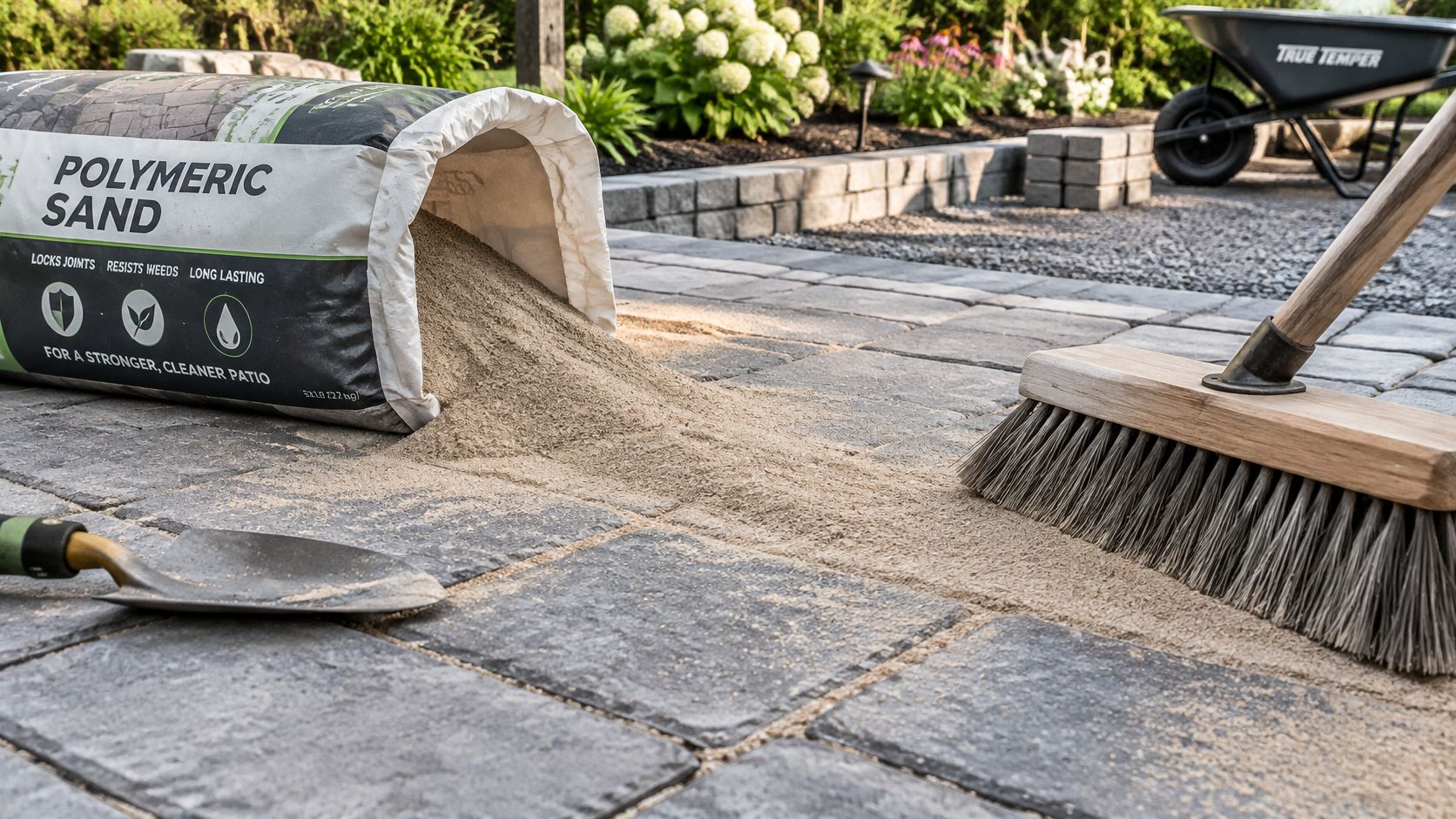
That full-depth behavior is the difference between a joint that works and a crust that looks finished for a season. If the binder only skins over the top, traffic and water find the void underneath. If the sand is too coarse for the gap, the joint never fills. If it's too fine, water struggles to move and the surface can stay damp.
Three plain points to take away
What it is: A graded joint sand with a water-activated polymer binder, not a tube of glue.
What it isn't: Decorative filler or a permanent weed barrier.
What to check next: Whether your joints are full to the bottom of the chamfer, whether sand is soft or missing, and whether water drains away from the house.
For homeowners in Prescott, Prescott Valley and Chino Valley, the practical question isn't whether the bag says polymeric. It's whether the gradation fits the joint in front of you.
Joint Widths, Depth and Sand Sizes That Matter
Will the sand fit the joint from top to bottom? Measure the narrowest opening before choosing a product. Joint width, depth, fill level, bedding thickness and grain size determine whether the material can form a sound joint.
Specification | Typical value | Why it matters |
|---|---|---|
Joint width | About 1.6 to 25 mm (1/16 to 1 inch); about 3 mm as a common design average | Sand must enter and fill the joint |
Joint depth | Minimum about 38 to 40 mm (1.5 inches) | Shallow joints hold less material |
Fill level | To the bottom of the paver chamfer or slightly below the surface | Protects the paver edge and keeps the surface clean |
Compacted bedding sand | Maximum 25 mm (1 inch); layers under about 20 mm may not push sand into joints | Thicker layers add no stability; thin layers starve the joints |
Sieve: passing No. 16 (1.18 mm) | 100% | Grains must fit narrow joints |
Sieve: passing No. 200 (0.075 mm) | 5% or less | Too many fines reduce drainage and complicate installation |
Treat these figures as guidance, not a substitute for the product label. The manufacturer's stated joint-width range controls. If a joint exceeds that range, sand may bridge near the top and leave a void below, even when the surface appears full. The width, depth, fill and sieve guidance in the published polymeric joint-sand specification helps match grain size to the opening.
A Prescott walkway with 2 mm joints needs a product whose grains can enter that narrow gap. Wider joints may need a coarser blend. Fine sand in an oversized joint can leave it underfilled after curing, while excessive fines can restrict drainage and make the material harder to activate. In Northern Arizona, poor drainage and monsoon runoff make a fully filled joint and a suitable product range especially important. Water that cannot move through or away from the paving can contribute to joint deterioration; a product choice cannot compensate for runoff directed across the surface.
The controlling number: The product's own joint-width range takes precedence over a general rule.
For the installation sequence, see this guide to how to install paver patios.
A three-point check before you buy
Measure the joint width at its narrowest point, not by averaging wider and tighter gaps.
Measure the joint depth and compare it with the product's minimum.
Confirm the manufacturer's range for your paver type, joint width and surface texture before opening the bag.
How Polymeric Sand Locks Pavers Together
An interlocking paver field is closer to a brick wall than a tile floor. The pavers are the bricks, and the joint is the mortar. The difference is that a paver joint has to stay firm enough to transfer load while letting the units settle slightly under traffic.
A joint is a load path, not a gap filler.
Stability develops as traffic loads the surface and sand works into the joints. Guidance from the Concrete Masonry and Hardscape Association reports that the combined paver-and-sand layers generally reach a stiffened lock-up condition before 10,000 equivalent single-axle loads. For a representative system using 80-millimeter-thick pavers, the reported resilient modulus after lock-up is about 450,000 psi, or 3,100 MPa. That stiffness comes from the paver and sand layers working together, not from the paver alone.
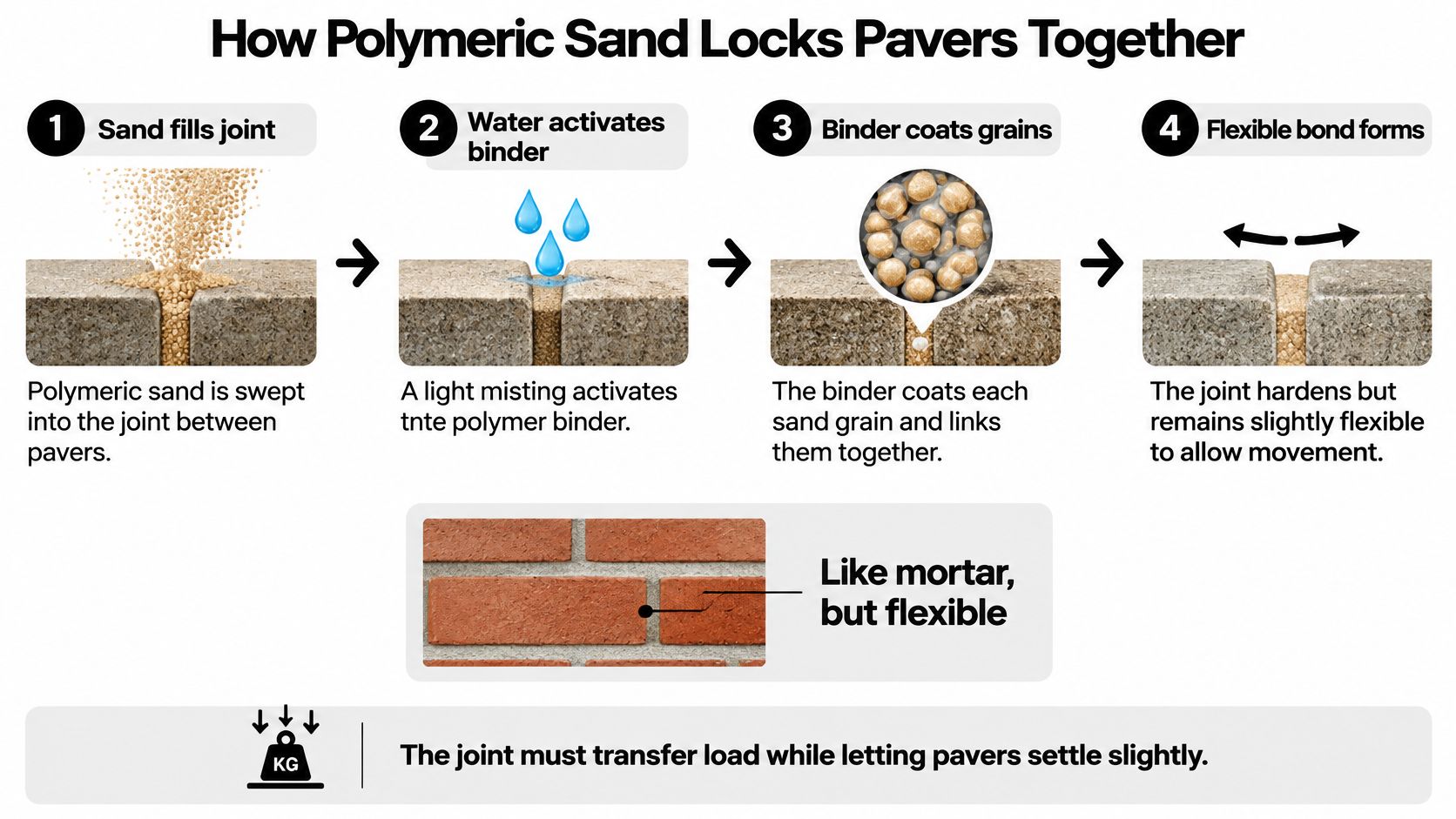
Polymeric sand contributes at the joint level by holding sand against erosion and keeping the joint filled. It doesn't rescue a thin base, a missing edge restraint or a joint that was never compacted to full depth.
The seven-step sequence
Set and compact the base. Every later step sits on it, so a soft spot here becomes a rocking paver later.
Spread and screed the bedding sand. The layer needs to be even and within its thickness limit, because thick bedding doesn't add stability.
Compact the pavers. This drives sand upward into the joints, and loose sand can't lock.
Sweep polymeric sand into dry joints. Work diagonally in small areas so the grains drop in instead of riding over the surface.
Compact to full depth. Voids reduce confinement, and a void under a cured top crust will collapse.
Clear every trace of sand from the paver face. Residue left now hardens into a haze that can be stubborn to remove.
Activate with a light, controlled mist and let it cure. Too much water washes binder out of the joint; too little leaves uncured material below the surface.
Freeze-thaw movement, monsoon runoff and sloped Prescott yards make the base the first thing I would check. If the pavers rock before you add sand, the joint isn't the root problem.
Polymeric Sand Compared With Plain Joint Sand
Choosing polymeric sand for pavers isn't a cosmetic decision. It changes how the joint handles water and how often you're back out there with a broom.
Criterion | Plain joint sand | Polymeric sand |
|---|---|---|
Binds after wetting | No, stays loose | Yes, hardens after water activation |
Erosion and washout | Washes out in heavy rain | Holds the joint better when installed correctly |
Weed and insect resistance | Limited | Suppresses weeds; does not eliminate them |
Joint-width requirement | Follows general sand grading | Must match the product's stated joint-width range |
Cleaning before activation | Sweep off the paver face | Clear all residue from the paver face before wetting |
Refilling frequency | Typically more frequent | Typically less frequent, with periodic inspection |
Neither column wins everywhere. The right choice follows the joint geometry and the water path, not a brand preference.
What the comparison means on a real patio
Plain sand is easier to sweep and top up, and it's forgiving when you need to refill a low joint. It also fails sooner under rain, foot traffic and wind, especially on an exposed slope. Polymeric sand holds the joint better and usually needs less frequent refilling, but any residue left on the paver face can dull the surface if it isn't cleared before activation.
Say a Prescott Valley patio takes a direct hit from a summer monsoon. Plain sand usually loses fill first along the sloped edge, where water concentrates. A well-installed polymeric joint on the same slope keeps its fill longer, but that's a pattern, not a measured result, and it changes with joint width, slope and installation quality.
The decision line is simple. Choose polymeric sand where joint stability and less frequent refilling are the priority. Choose plain jointing sand where water has to move through the joint, then design the rest of the assembly for infiltration before you buy. A polymeric joint on a base that can't drain is still a joint that will fail.
Why Polymeric Sand Joints Fail and How to Fix Them
Polymeric sand suppresses weeds. It doesn't eliminate them. A study of weed control in joint fillers found that polymeric-bound sand suppressed weed emergence and biomass among the tested fillers, but joint-filler composition, joint width and organic pollution over time all changed the result.
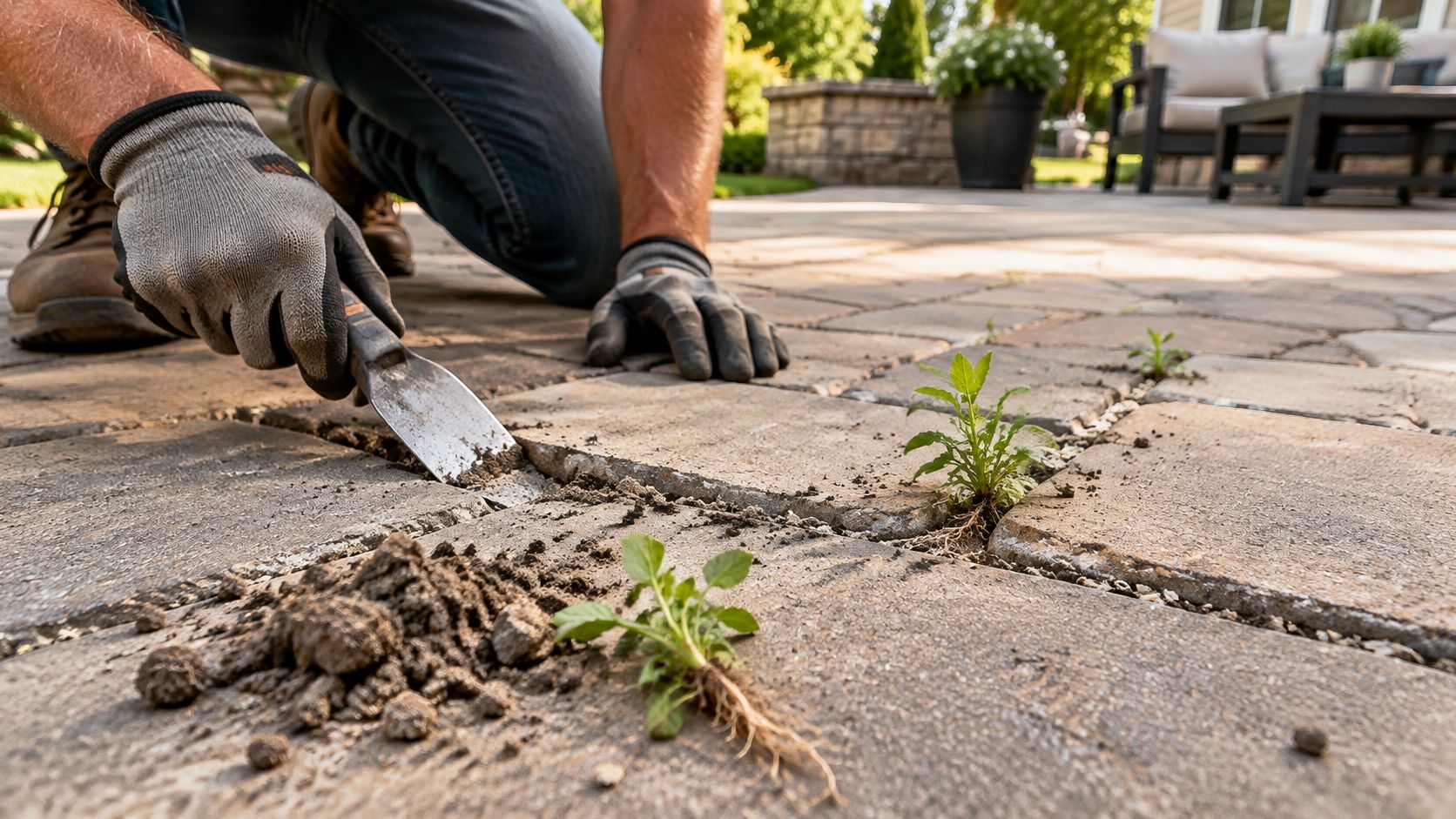
Most failures start before the bag is opened. The chain is predictable: insufficient joint depth or compaction, water left standing on the surface, base movement from an unstable subgrade, then debris from leaves, soil, seeds or irrigation overspray building a growth medium. Once cracks or voids appear, weeds and insects have a way in.
The honest claim: A polymeric joint is weed suppression, not a permanent barrier.
The failure chain in order
Shallow or undercompacted joint. The binder has less material to lock and a void underneath.
Water left on the surface. Standing water can carry binder away before it cures.
Base movement. A rocking paver opens the joint and breaks the bond.
Organic contamination. Dust, leaves and soil create a place for seeds to root.
Match the symptom to the fix
Symptom | Likely cause | What to do |
|---|---|---|
Sand missing from joints | Erosion, washout or low initial fill | Confirm joint depth, then refill and compact |
Weeds sprouting in joints | Dust, debris or organic material on the surface, or cracked joints | Clear debris and refill; expect suppression, not permanent elimination |
Soft or crumbling joints | Incomplete activation or curing in cold, wet or windy weather | Check the manufacturer's data sheet and avoid more water until cured |
Hazy film on the paver face | Residual binder not cleared before activation | Clean as the manufacturer directs; avoid adding more water |
Pavers rocking or shifting | Unstable base or settlement | Correct the base before refilling joints |
No product guarantees a fixed lifespan, so treat a set replacement date with caution. In Prescott, wind-blown dust, pine needles and irrigation overspray collect in joints faster than most homeowners expect. That makes debris removal and a post-monsoon inspection more useful than waiting for a calendar date. Our guide to patio paver maintenance covers the seasonal check in more detail.
If you're unsure whether the joint is soft or just dirty, this short walkthrough shows what to look for before you add more material.
Check joint fill, cracks, soft spots, debris and settled pavers after the monsoon season, and keep irrigation spray off the joints. Correct the drainage or settlement first. Refilling over a moving base only repeats the failure.
Does Polymeric Sand Affect Drainage
Sometimes. The joint is part of the structure, not a decorative filler, and water either stays on the surface or moves through the whole assembly. Some polymeric sands are marketed as permeable. Permeability still varies by product and by how the base, bedding, and joints are built, so check the manufacturer's test data rather than reading it off the bag.
The sealed versus permeable trade-off
A bound joint resists washout and weeds, and it lets neighboring pavers share load so one unit is less likely to rock under foot traffic. That lock only holds if the sand stays in the joint. Joints meant to infiltrate pass water into the base. Fines, compacted bedding, or an impermeable subgrade can stop that path and leave the patio wet even when the bag says permeable.
Northern Arizona monsoons are short and intense. They throw a lot of water at a patio in minutes, even in a dry year. If the grade sends that water toward the house or a low corner, joints stay saturated, edges erode, and sand leaves with the runoff. I would set the grade before choosing a joint material. A joint that looks worn after one storm is often an assembly problem, not normal aging.
On a fairly level patio where the goal is a sealed surface, a standard polymeric sand used inside its stated joint range is the usual starting point. On a larger sloped area where infiltration is the goal, the base has to be permeable too, and the product needs documented test results, not a marketing word. If the grade is unclear or water already pools, drainage comes first. Sand chosen from the label will not fix a patio that holds water.
Choose the joint for the assembly it has to work in.
If infiltration is the goal, start with our guide to permeable pavers for drainage.
Book a Paver Joint Check in Prescott
Start with three checks before you book anything. Measure the joint width and depth, look for soft or missing sand, and note where water pools after a monsoon storm. Those three details tell you whether the joint needs a refill or whether the base and drainage need attention first.
If pavers rock, the base is moving, or water runs toward the house, a professional inspection is the right next step. R.E. and Sons Landscaping is a licensed, bonded and insured design-build company based in Prescott that serves Prescott Valley, Chino Valley and Northern Arizona. Paver patios and walkways are part of our outdoor design and installation work, and we specialize in luxury outdoor living spaces, paver patios, artificial turf and custom backyard transformations. Contact the team through the company website to request a consultation.
Can I add polymeric sand to an older patio?
Yes, if the joints are clean, the base is stable and the joint width matches the product range. Remove old residue and loose material first, because new sand won't bond to a crumbled layer.
How do I know if my joints need refilling?
Sand is missing below the bottom of the paver chamfer, the base is exposed, or weeds return after you clear the debris. If the sand is still full and firm, the joint may just be dirty.
Can I apply polymeric sand in cold, wet or windy weather?
Check the manufacturer's data sheet for that product. The limits differ by formulation, so don't add water until the joint has cured as the label directs.
Who should I call about drainage concerns?
Call a landscaping team that inspects grade and the full paver assembly before choosing a joint material. A joint sand alone won't fix water running toward the house.
The next step is a site check, not another bag. If the joints are full, firm and draining, you may only need a cleaning. If they're soft, missing or rocking, the repair starts below the surface.
R.E. and Sons Landscaping designs and builds paver patios and walkways across Prescott, Prescott Valley, Chino Valley and Northern Arizona, and we can talk through your joints, grade and joint material before you choose a repair. If your patio is losing sand, rocking at the edges or holding water after a monsoon, request a consultation and we'll review the site with you before anyone buys another bag. Visit R.E. and Sons Landscaping to start the conversation.
Comments