
Arizona Desert Landscape Plants: 10 That Thrive Up North
A Phoenix plant list will kill a Prescott yard. Plants that shrug off 115°F in June often die in a Chino Valley January, when freeze-thaw cycles heave the soil and split agave leaves. At about 5,000 feet, the right move is different plants, not fewer of them.
Homeowners in Prescott, Prescott Valley, Chino Valley, and the surrounding Quad Cities need drought-tolerant plants that also take cold. R.E. and Sons Landscaping has been crafting outdoor living spaces in Prescott since 1999, and the ten species in this guide are the ones that hold their form through summer heat and winter freeze here.
Arizona holds a remarkably wide range of native plants, but elevation, drainage, and hard freezes narrow that list quickly in higher-elevation yards like Prescott's. Monsoon water sitting in a low corner rots crowns that would have survived a dry June. A plant that looks hardy on paper still fails if the soil stays wet after a storm, or if a January thaw refreezes around the roots.
Cold hardiness is only half the filter. Each of these ten also has to earn a spot beside rock, gravel, turf, and hardscape without constant replacement.
1. Parry's Agave (Agave parryi)
Parry's agave is the plant to reach for when a homeowner wants structure that survives winter without being wrapped in burlap. The blue-gray rosette stores water in thick leaves, so it rides out long dry spells, and it's cold-hardy enough for the higher elevations around Prescott and Prescott Valley, where most desert succulents turn to mush. Form stays the same in January as it is in July.
Plant it in well-draining soil and keep it out of the low corner where monsoon runoff collects. The crown sits above soil level. Bury it and rot starts at the base within a season. Establishment is the only real work. The Arizona Cooperative Extension watering guide notes that newly planted desert plants may need daily water during their first weeks, while mature agaves and yuccas may need irrigation only every 10 to 14 days in summer.
Where it earns its keep
Gravel front yards across the Prescott area, where one rosette reads as sculpture from the street.
Rock retaining walls on hillside lots in Prescott Valley, tucked into boulder pockets that drain fast.
Entry accents set back from the walkway, because those leaf tips find shins.
If you want to compare species before choosing, our guide to agaves in landscape design covers the wider family.
The comparison below lays out form, water needs, and maintenance side by side.
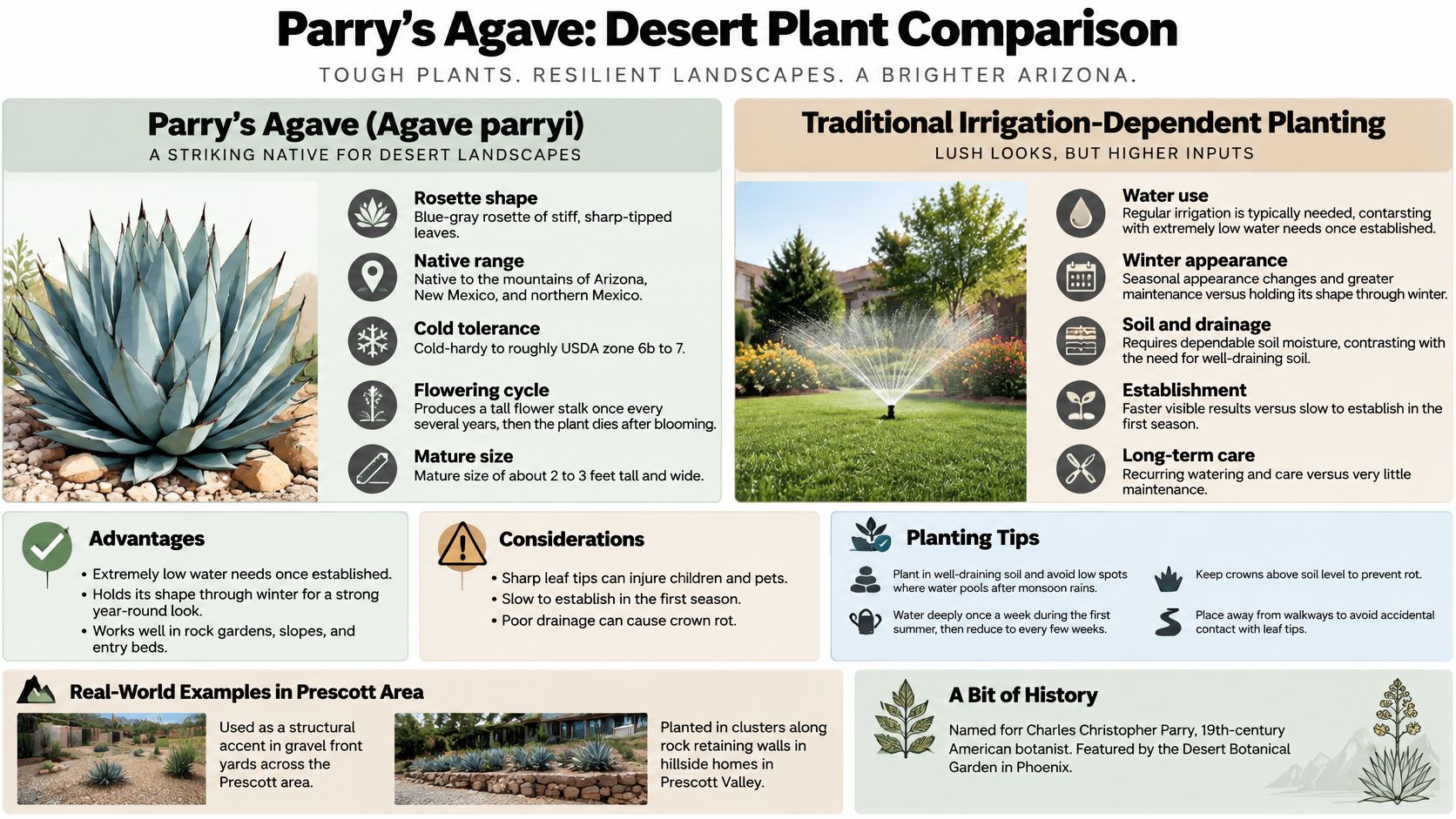
Practical rule: Fill the planting hole with water and watch it. If water still stands after a few hours, move the plant or build a berm. Agave tolerates drought fine. It does not tolerate wet feet.
2. Desert Marigold (Baileya multiradiata)
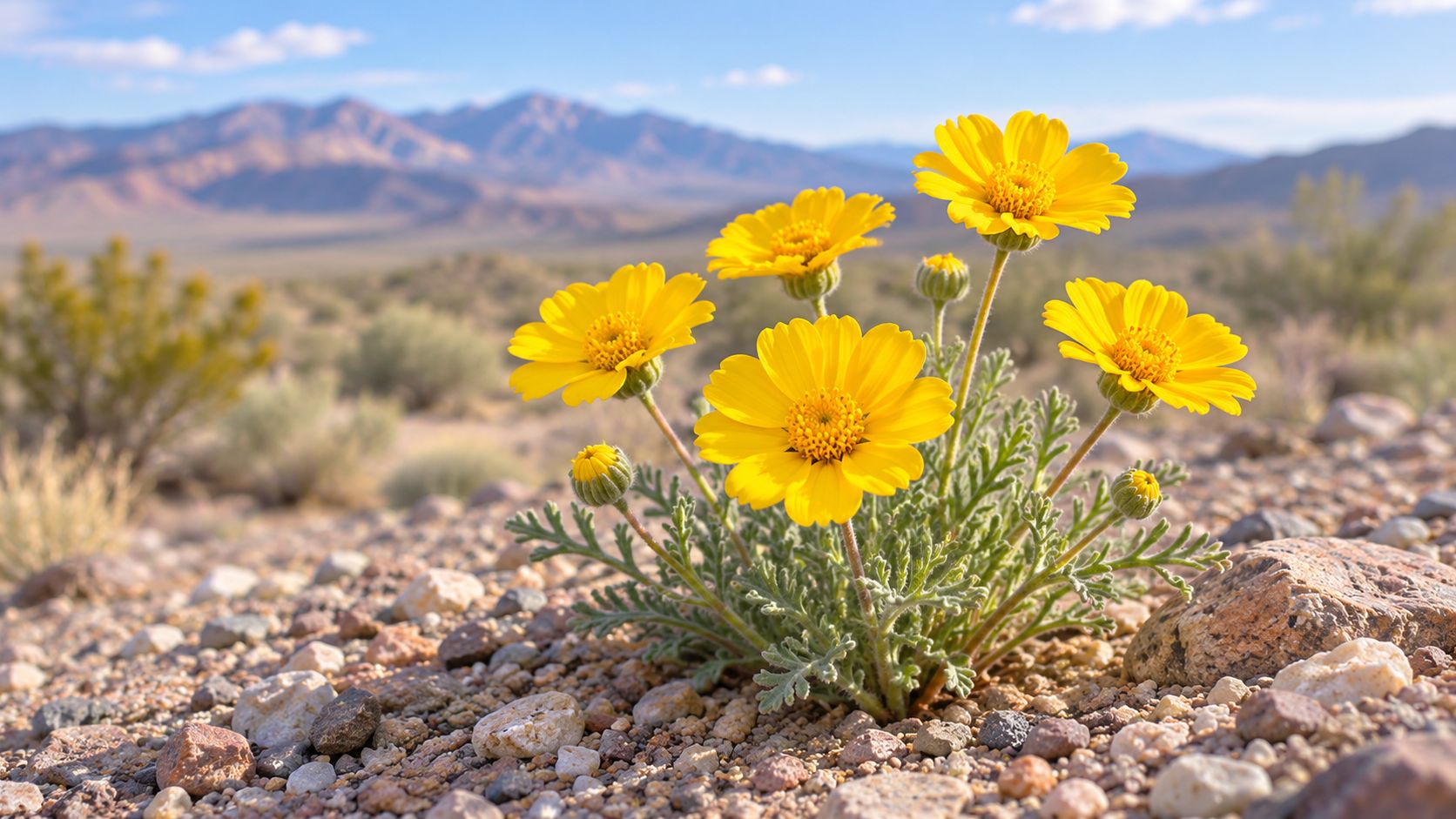
Desert marigold is the yellow that still shows up after the hose is shut off. This native wildflower carries bright daisy-like blooms from spring into fall on almost no supplemental water, and it reseeds into bare gaps along driveway edges and gravel shoulders. In Chino Valley and Prescott, that habit matters. A plant that depends on summer irrigation usually stalls once the last hard freeze and a dry shoulder take over the bed.
Individual plants are short-lived. They fade after a season or two and look ragged between flushes of bloom. Let seed drop and treat the patch as a shifting colony, not a permanent specimen. Homeowners here often pair it with blue grama and penstemon so the low-water meadow keeps moving through the season.
Getting it started
Sow in fall or early spring, after the last hard freeze, so seed uses natural moisture instead of fighting summer heat.
Scatter on prepared soil and keep the surface lightly damp until sprouts show, then back off.
Skip fertilizer. Nitrogen pushes soft leafy growth and cuts flower count.
Deadhead lightly for more blooms, or leave the seed heads standing and let the plant reseed.
Put desert marigold on its own low-water valve, separate from thirstier shrubs. The dry edge of the bed should get no more irrigation than it needs. Extra water on that edge does not buy more color. It just keeps the colony from settling into the gravel the way it should.
3. Parry's Penstemon (Penstemon parryi)
Parry's penstemon blooms before the rest of the yard wakes up. Tall spikes of pink to rose-purple tubular flowers rise in late spring and early summer, and hummingbirds find them within days. It's a mountain native of Arizona and New Mexico, which is why it handles the rocky, well-drained ground around Prescott better than most nursery perennials.
The honest drawback is the bloom window. Once the spikes finish, the plant thins out and all but disappears into the gravel until next spring. Plant it where something else takes over in July.
What it needs
Gravelly or sandy soil with sharp drainage. Heavy clay holds water against the crown and kills it over winter.
Regular water the first season, then occasional deep soakings rather than a weekly sprinkle.
Cut back spent flower stalks after bloom to keep the clump tidy and reduce self-seeding where you don't want it.
Keep mulch off the crown. Gravel or decomposed granite around the base beats wood chips in our humidity swings.
Rock gardens along front walkways in Prescott are the natural fit, and HOA common areas in Northern Arizona use it in pollinator borders because it delivers color early with no spray program. Give it full sun, or morning sun with a little afternoon relief on a west wall.
4. Apache Plume (Fallujia paradoxa)
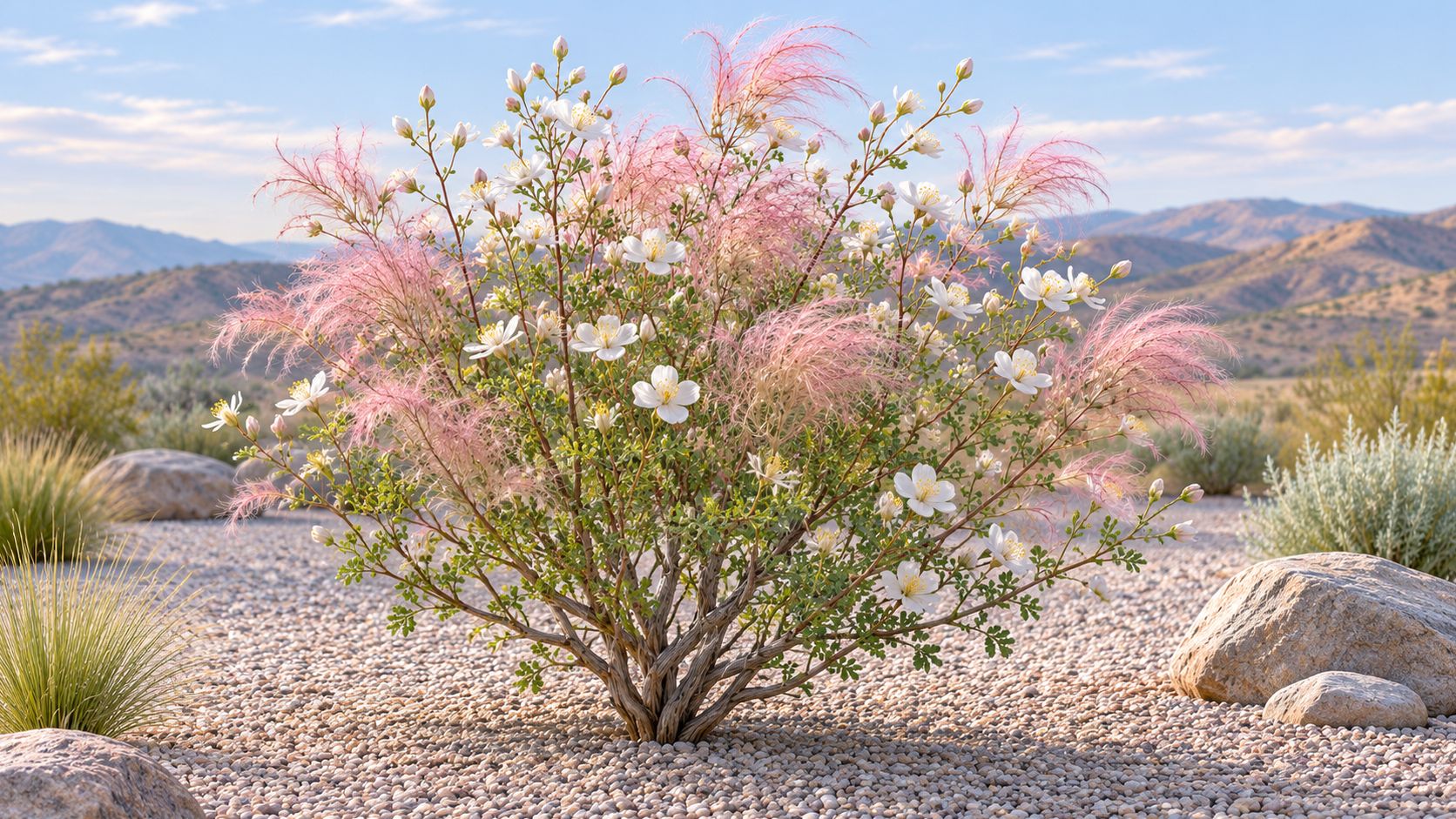
Apache plume is the low-water substitute for the thirsty privacy shrubs people ask for by habit. It produces white rose-like flowers in spring and early summer, then feathery pink seed plumes that carry the show into fall. Deep roots keep it alive through long dry stretches, and it takes the temperature swings of the Prescott area without dieback.
Because it's often planted along property lines in Prescott Valley and in naturalized borders around Chino Valley patios, fire behavior matters. Yavapai County's firewise plant guidance is blunt that fire-resistant plants aren't fireproof and still need irrigation and regular maintenance to resist ignition. The same guidance recommends keeping native tree limbs 6 to 10 feet above ground, removing shrubs beneath canopies, and isolating fire-prone natives more than 30 feet from structures.
A plant label tells you how much water a shrub wants. It never tells you what happens to that shrub in a dry January with a wind event behind it. Prune for open structure and clean out dead interior wood each winter.
Maintenance that matters
Prune lightly in late winter to shape the plant and push bushier growth.
Give it room. Mature plants spread wider than the gallon can suggests, so don't crowd it against a wall.
Water well every few weeks in year one, then mostly forget it.
5. Ocotillo (Fouquieria splendens)
Ocotillo looks dead for most of the year, and that's exactly the appeal. Long spiny canes stay leafless through dry spells, then push small leaves and bright red flower spikes within days of a good rain. As a sculptural element in a contemporary xeriscape, nothing else in the trade looks quite like it.
Be honest about the risk up here. Ocotillo is a Sonoran and Chihuahuan desert plant, and Prescott sits at the colder edge of what it tolerates. National Park Service research on plant responses to climate change in the Sonoran Desert found declines in dominant species including ocotillo during years with high temperatures, so even in its home range it isn't bulletproof. Plant it against a south or west wall, in the hottest, sharpest-draining spot you have, and wrap young canes with frost cloth for the first two winters.
Here's how a mature ocotillo handles a monsoon berm in a desert-style courtyard.
Planting notes
Full sun and fast drainage, no exceptions. Cold wet soil is what kills it, not cold air.
Deep water at planting, then rely on rainfall once the canes harden off.
Keep it off walkways. The spines are sharp and they don't soften with age.
Skip the mulch mound. Rock or gravel at the base, kept clear of the canes.
6. Blue Palo Verde (Parkinsonia florida)
Blue palo verde is Arizona's state tree and the best shade tree for a desert yard that can't afford heavy irrigation. Green bark does the photosynthesis while the tiny leaves drop in drought, and the airy canopy casts light, dappled shade that suits a patio, a seating area, or an outdoor kitchen.
Watering is where most of these trees get lost. University of Arizona research on irrigation of desert trees after establishment applied water roughly every 8 to 14 days during peak summer evapotranspiration in low- to medium-irrigation treatments, and palo verde held acceptable quality without supplemental irrigation during one test growing season. New trees still got weekly summer water of about 20 gallons each through a 1.5-year establishment period. That study ran in the low Sonoran Desert near Maricopa, so treat the intervals as a shape, not a schedule, and stretch them for Prescott's elevation and shorter season.
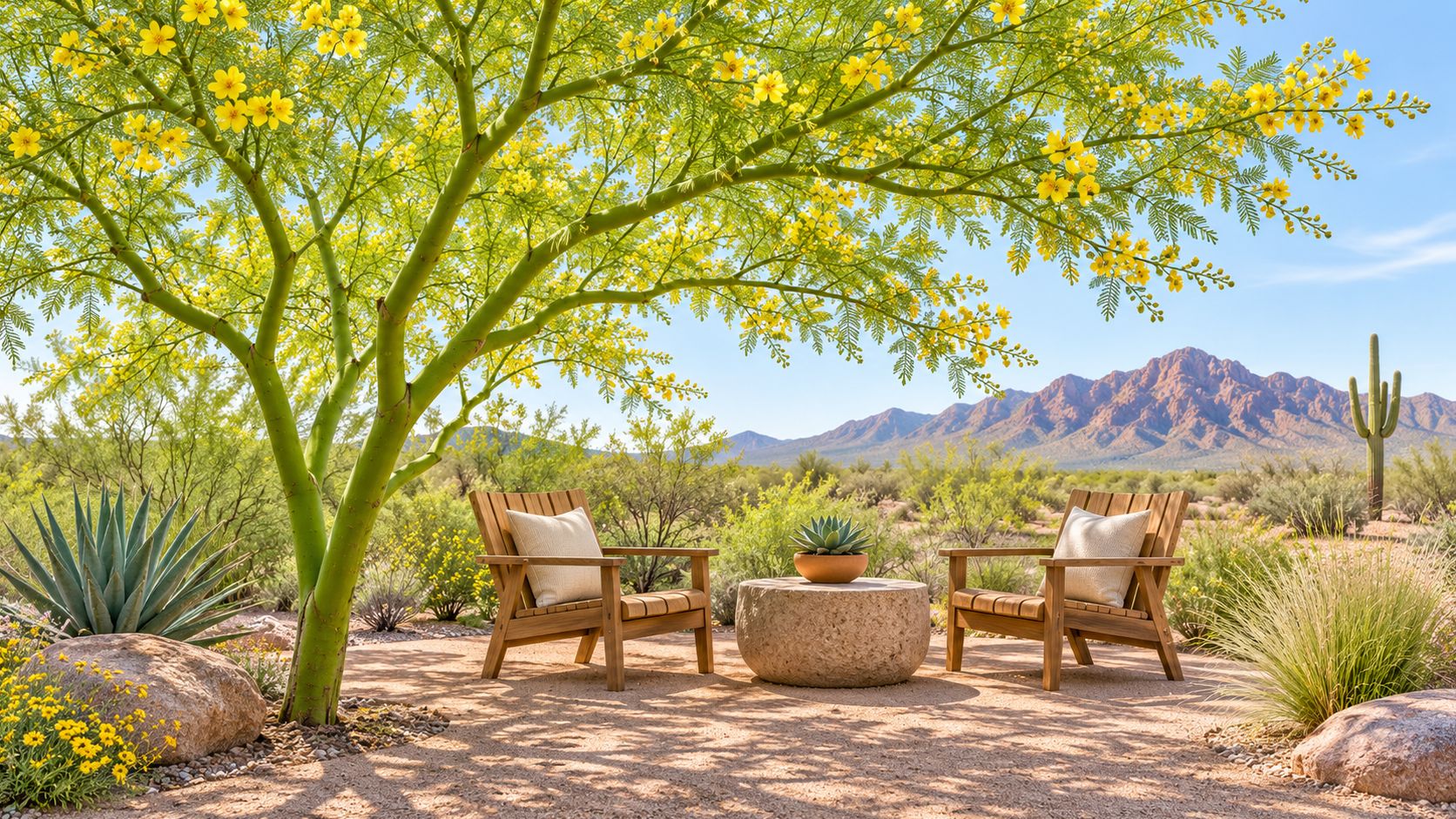
Cold reality check: Palo verde is marginal here. Give it a sheltered south or west wall, away from frost pockets at the bottom of a slope, and expect some tip damage in a hard winter. A well-sited tree recovers. A poorly sited one never fills out.
Care through the first two years
Stake the trunk so monsoon gusts don't rock the root ball loose.
Prune in late winter for structure and to remove weak, crossing branches.
Water deep and wide at the canopy edge, then let the soil dry between cycles.
7. Autumn Sage (Salvia greggii)
Autumn sage is the plant to use when a client wants steady color in a bed that also has to survive on a lean water budget. It's a compact woody shrub that blooms in red, pink, purple, or white from spring into fall, hummingbirds work it constantly, and it fits borders, walkway edges, and patio containers without fuss.
The trick is putting it on the right valve. Arizona's xeriscape guidance sets out seven core principles, and one of them is clustering plants with similar water requirements so frequent-water areas stay separate from occasional-water and no-water zones. A lawn, a new tree, and a salvia should never share a schedule. Our post on desert flowering shrubs covers how to combine it with other bloomers without overwatering the group.
Keeping it blooming
Full sun to light shade, with good drainage. It rots in a wet basin.
Prune after the first heavy bloom to trigger a second flush and keep the plant from going leggy.
Deep, infrequent water once established.
Use gravel mulch instead of wood chips in humid spots to keep the crown dry.
Mixed perennial beds around front entries in Prescott get autumn sage for exactly this reason. It delivers color across three seasons with no spray, no staking, and no deadheading marathon.
8. Blue Grama Grass (Bouteloua gracilis)
Blue grama is the closest thing to a lawn that survives a Prescott July without a sprinkler system running daily. Fine blue-green blades grow only a few inches tall, curly seed heads move in the wind, and mowing becomes an occasional chore rather than a weekly one. It handles heat, cold, and drought in the same season.
The water case is measurable. University of Arizona Extension reports that replacing turf with xeriscape can cut outdoor water use by about 50%, and in the low desert Bermuda or hybrid Bermuda with winter overseeding may require more than 55 inches of irrigation annually against less than 18 inches for an average xeriscape, per the Arizona xeriscape irrigation guide. Prescott's numbers differ, but the ratio holds.
Blue grama isn't a putting green and it isn't a play lawn for cleats. It's a soft, walkable groundcover that goes dormant and tan in a hard freeze. If you want green in February, this isn't the plant.
Establishing it
Seed in late spring, once soil has warmed and the last freeze is past.
Keep the surface lightly moist through germination, then taper hard.
Mow high and rarely, if at all, once the stand fills in.
Skip the fertilizer. Rich soil produces weak, floppy growth and fewer seed heads.
9. Desert Spoon (Dasylirion wheeleri)
Desert spoon does what agave does with sharper edges and a slower attitude. A rounded rosette of narrow, spoon-shaped leaves sits on a stout trunk, holding its shape through dry summers and cold winters. It's the plant that anchors a gravel and boulder design without asking for anything.
Watering depth matters more than frequency here. University of Arizona Cooperative Extension's guidance on recommended plants and their watering needs recommends watering at the drip line and reaching the full root-zone depth each time, about 2 feet for shrubs and 3 feet for trees. Succulents sit at the dry end of the range and often need water only every few weeks through the growing season. Shallow daily sprinkling builds weak roots and wastes water outside the root zone.
Placement notes
Full sun and very fast drainage. A slight berm helps in clay.
Keep the crown dry. Wet crowns in winter are the usual cause of loss.
Position away from walkways. The leaf edges are serrated and unforgiving.
Pair with boulders and gravel rather than bark, which holds moisture against the base.
Entry beds at commercial properties across Northern Arizona use desert spoon as a repeat element along a walk because it looks the same in every season and never needs staking or spraying.
10. Red Yucca (Hesperaloe parviflora)
The name is wrong and the plant is still excellent. Red yucca isn't a true yucca, it's a Texas and northern Mexico native with grass-like foliage and coral-red flower spikes that hummingbirds work from late spring through summer. It takes Prescott winters without protection and keeps its blue-green clumps through the cold.
What works
Sunny front beds in Prescott Valley subdivisions, where the spikes read from the street.
Driveway and curb lines in Chino Valley, since it tolerates reflected heat off concrete.
Mass plantings in three or five, because a single clump looks lonely against gravel.
Division every few years to control spread and refresh older centers.
Maintenance is minimal. Cut spent flower stalks at the base to keep the clump tidy, and water regularly through the first season before dropping to occasional deep soakings. It tolerates light shade but blooms hardest in full sun. The one mistake that costs plants is siting red yucca in a low, poorly drained spot beside a downspout, where the crown rots over winter.
Bring These Desert-Adapted Plants to Your Yard
West-facing walls in a Prescott yard can cook an agave that looked fine at noon. Heat hangs on the masonry long after sunset, and a plant chosen from a low-desert list may scorch there or freeze on a higher lot that drains more slowly.
Walk the yard at three different times of day: morning, mid-afternoon, and late evening. Mark where the sun lands. Then wait for the next storm and find the low spots where water sits for hours. Those pockets are where every plant on this list fails. A crown that stays wet through a cold night rots, even when the same species comes through a dry freeze on a slope.
Pick two or three species, not ten. Set them in the beds you see from the kitchen window or the front walk. Live with them for a season. Expand only after you know how your soil holds water and how hard that corner gets at night.
When you cut back spent agave leaves or yucca stalks, a reciprocating saw with the right blade makes fast work of the fibrous material. The EZARC Tools cactus pruning blade guide explains which blade geometry handles succulent tissue cleanly.
Arizona's Department of Water Resources defines xeriscaping as a method that uses drought-resistant plants to conserve water, and recommends regionally appropriate plant selection, efficient irrigation, and garden design as the practical route to lower water use. That's the same framework we design to in Prescott, because generic national advice doesn't account for the wide differences in elevation and microclimate between one neighborhood and the next.
R.E. and Sons Landscaping is a Prescott-based, licensed, bonded, and insured design-build company that has worked in these yards since 1999, with an Arizona ROC number 300642. The company installs xeriscaping with native, drought-resistant plants across Prescott, Prescott Valley, Chino Valley, Williamson Valley, Dewey, Mayer, Cottonwood, Camp Verde, Sedona, and Flagstaff. Homeowners get a free yard design as part of the consultation. To schedule one, call 928.533.7425 or book online.
10 Desert-Adapted Plants for Northern Arizona Yards at a Glance
Phoenix lists assume mild winters and fast drainage. At Prescott elevations, freeze-thaw, late cold, and monsoon saturation decide which of these plants hold. Treat the figures below as typical high-desert ranges.
Plant | Mature Size | Bloom / Seasonal Interest | Cold Hardiness | Water Needs | Best Use |
|---|---|---|---|---|---|
Parry's Agave | 2–3 ft tall and wide | Tall flower stalk every several years; dies after blooming | USDA zones 6b–7 | Very low once established | Rock gardens, slopes, and entry beds |
Desert Marigold | 12–18-inch flower stems; short-lived perennial | Yellow blooms in spring, with sporadic flowers through fall after rain | Tolerant of winter cold once established | Very low once established | Native wildflower beds and seasonal color |
Parry's Penstemon | Flower spikes 2–3 ft tall | Pink to rose-purple flowers in late spring and early summer | Tolerates cold winters | Low; occasional deep watering once established | Rock gardens, borders, and pollinator plantings |
Apache Plume | 4–8 ft tall and wide | White flowers in spring and early summer; pink seed plumes into fall | Adapts to variable high-desert temperatures | Very low once established | Privacy screens, informal hedges, and background planting |
Ocotillo | Canes reach 10–20 ft | Red spring flowers; leaves appear after rain | Can suffer cold injury in hard freezes; protect young plants | Extremely low once established | Sculptural accent in desert gardens |
Blue Palo Verde | Typically 15–30 ft tall | Small yellow spring flowers; airy canopy | Young trees are cold-sensitive | Low once established; weekly deep summer water while new trees establish | Patio shade and low-water street planting |
Autumn Sage | Compact shrub, 2–3 ft tall and wide | Red, pink, purple, or white flowers from spring through fall | Can die back in severe cold without protection | Low; deep, infrequent watering once established | Borders, walkways, and patio containers |
Blue Grama Grass | Short grass, a few inches tall | Curly seed heads; turns dormant in winter | Tolerates cold | Much less than traditional turf | Low-water lawn alternative and native meadow |
Desert Spoon | Broad rosette, a few feet tall and wide | Tall flower stalk appears after many years | Good cold tolerance for higher elevations | Very low | Architectural focal point in gravel and boulder landscapes |
Red Yucca | 3–4 ft tall and wide | Coral-red or pink flowers from late spring through summer | Excellent cold tolerance | Low; occasional deep watering once established | Sunny beds, driveways, and hummingbird gardens |
Frequently Asked Questions
When Is the Best Time to Plant Desert Natives in Prescott
Fall is the best window, roughly late September through October, because roots grow through the cool months before summer heat arrives. Spring works as a second choice once the last hard freeze has passed. Avoid June and July planting unless you can commit to daily checks for the first few weeks.
How Often Should I Water Once Plants Are Established
Deep and infrequent. Water at the drip line until moisture reaches the full root zone, then let the soil dry before the next cycle. Skip a scheduled watering after a good monsoon soaking. Cacti, agaves, and desert spoon want the least; trees want the deepest, widest soakings spaced furthest apart.
Can I Combine These Plants with Rock, Artificial Turf, and Pavers
Yes, as long as the water zones stay separate. Keep turf and any thirstier plantings on their own valve, run drip to the native beds, and set emitters at the canopy edge rather than against the trunk. Rock mulch and gravel work well around succulents because they don't hold moisture against the crown.
Do These Plants Need Fertilizer
Most need none. Native desert plants evolved in lean soil, and nitrogen produces soft growth, fewer flowers, and weaker winter hardiness. A thin layer of compost in spring is enough for autumn sage and red yucca.
What Kills Desert Plants in Northern Arizona
Water, most of the time, not drought. Overwatering established plants, planting too deep so water sits at the crown, and failing to break through a hardpan layer before planting a tree account for most losses. Winter drainage matters as much as summer irrigation.
If you want a yard that looks planted rather than decorated, R.E. and Sons Landscaping designs and installs xeriscapes built around native and drought-resistant plants selected for Prescott's elevation, cold winters, and monsoon drainage. We handle the design, the drip zones, the rock and gravel work, and the planting in one build, so the plants you choose in the plan are the plants that go in the ground. Visit R.E. and Sons Landscaping to schedule a free design consultation, or call 928.533.7425 to talk through your yard.
Comments