
8 Pavers and River Rock Ideas for Arizona Yards
Concrete pavers and slabs accounted for about 47% of the U.S. hardscaping products market in 2025, while interlocking pavers represented roughly 42.5% of the global concrete hardscape paver market. Pavers provide stable, usable surfaces, while river rock adds drainage, texture, and softer transitions.
That combination works especially well in Northern Arizona, where a yard may need a durable patio, a defined walking route, and better control of runoff without relying on thirsty turf. R.E. and Sons Landscaping helps homeowners in Prescott, Prescott Valley, Chino Valley, and nearby Northern Arizona communities solve outdoor layout, drainage, water-use, and maintenance challenges through design-build landscaping.
Can you use pavers and river rock together? Yes, when each material has a clear job and the installation separates structural paving from decorative or drainage rock. Pavers can define patios, paths, steps, and gathering areas. River rock can create planting-bed borders, dry creek beds, drainage swales, and visual transitions. The pairing fails when rock is placed over an unstable base or when grading sends water toward the home.
R.E. and Sons Landscaping guides projects through consultation, design approval, transformation, and enjoyment. The company is licensed, bonded, and insured, holds Arizona ROC #300642, and has served more than 2,500 satisfied customers. Homeowners receive complimentary outdoor design, while a dedicated maintenance department helps protect the appearance and performance of the finished work. The company's paver patios, walkways, rock and stone work, fire features, outdoor kitchens, and water-management solutions give Prescott-area homeowners a practical starting point for combining these materials. For another perspective on outdoor construction planning, see this East Texas fencing contractor.
The eight compositions below are visual references, not one-size-fits-all prescriptions. A modern courtyard may need tight edging and restrained colors, while a sloped Chino Valley property may need retaining walls, drainage layers, and carefully stepped paving.
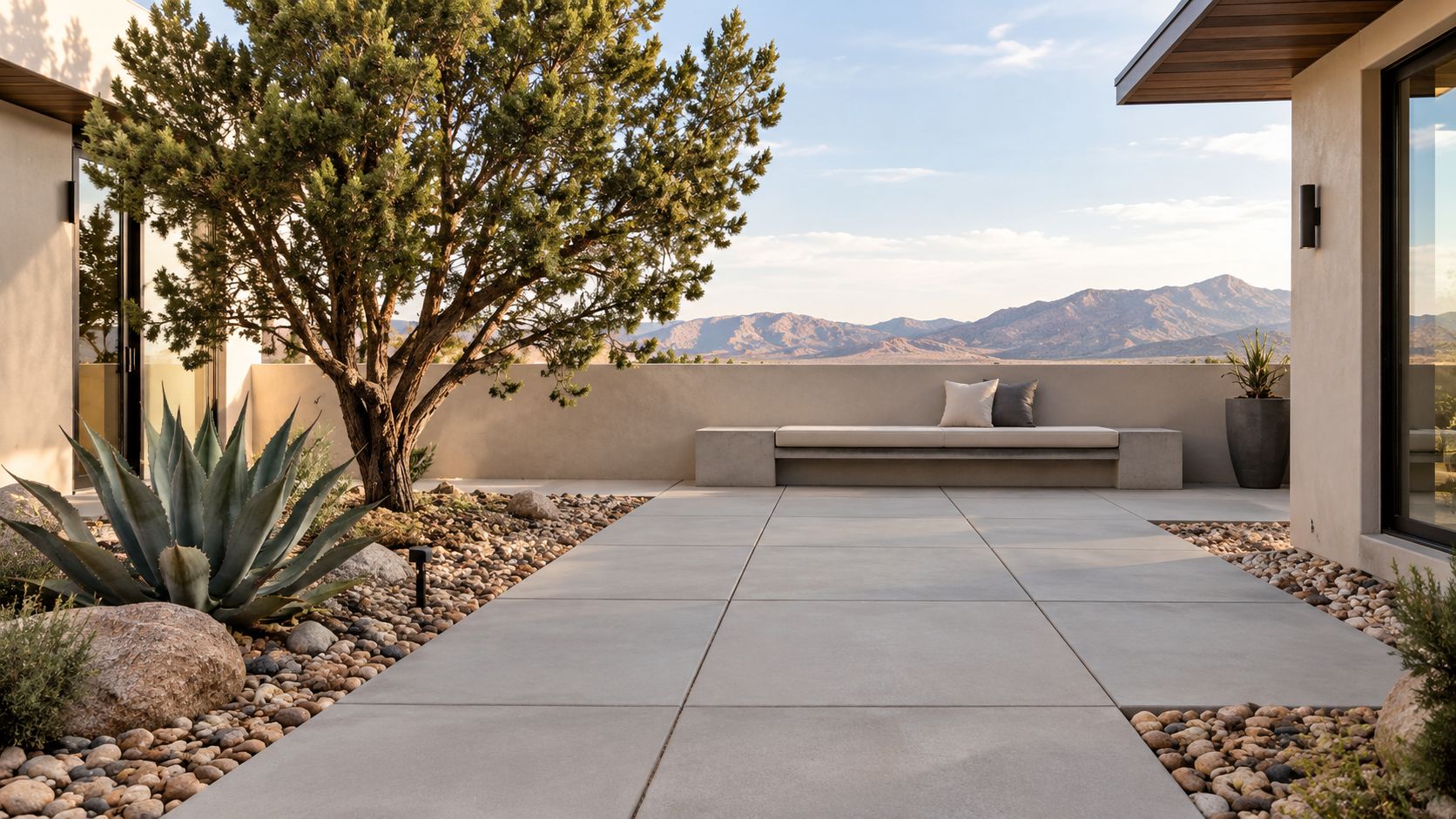
1. Modern Minimalist Paver Courtyards with River Rock Accents
A clean-lined courtyard gives pavers the leading role and uses river rock as a controlled accent. In Prescott, a 12 by 16 foot paver patio can establish a compact entertaining area, while river rock planting beds soften the perimeter without taking usable space away from seating. In Prescott Valley, pavers can radiate from a central fire pit, with decorative rock forming a deliberate outer ring. In Chino Valley, a straight paver walkway can sit beside a narrow river rock drainage swale.
Large-format units create the contemporary appearance many homeowners want. 18 by 18 inch or 24 by 24 inch pavers produce fewer grout lines and make a modest courtyard feel more open. Select colors that relate to the home's exterior and Northern Arizona's natural palette, such as muted sand, charcoal, rust, or warm gray. River rock in the 1 to 2 inch range adds texture without making raking and hand placement unnecessarily difficult.
What installation details matter most?
Water must move away from the foundation. A practical target is a 1/8 inch per foot slope away from the home, with the paved surface and adjacent rock areas graded together rather than treated as unrelated zones. Expansion joints every 10 to 12 feet can help accommodate temperature fluctuations, while landscape fabric beneath decorative river rock can reduce weed growth.
Practical rule: A minimalist design only looks simple after the grading, edge restraint, joints, and transitions have been planned carefully.
R.E. and Sons Landscaping also explains the role of river rock as landscape mulch. Use the rock intentionally around plantings and edges, not as scattered filler across the entire courtyard.
2. Rustic Southwestern Paver Designs with Natural River Rock Borders
Warm-toned pavers and rounded river rock suit the ranch homes, historic neighborhoods, and high-desert character found around Prescott. A tumbled paver patio in a clay or terracotta tone feels more connected to the region than a perfectly smooth, uniform surface. River rock borders can then echo the colors of nearby stone, soil, and natural vegetation.
A Prescott historic-neighborhood project might use a running-bond pattern in two related earth tones, with a river rock border separating the patio from planting beds. In Prescott Valley, a curved paver path lined with organic rock edges can lead from a driveway to a side-yard gate. In Chino Valley, warm pavers can connect a seating area to natural stone retaining walls, with river rock functioning as mulch and a transition material.
Rustic doesn't mean unplanned. Limit the paver palette to two or three warm tones so the surface has depth without visual noise. Tumbled finishes, running-bond layouts, and circular patterns generally feel less rigid than a strict grid. River rock in varied 1 to 3 inch sizes can create a more natural edge, but the border should still have a defined outside line so stones don't migrate into the walking surface.
How do you keep the Southwestern look authentic?
Use materials that relate to the setting. Natural wood pergolas, timber accents, logs, low stone walls, and drought-tolerant planting can reinforce the style without turning the yard into a theme set. Local sourcing is worth considering when it provides a compatible color and reduces the mismatch between imported materials and Northern Arizona's character.
The best rustic installations look relaxed at the surface and disciplined underneath. A stable compacted base, consistent paver elevation, and clear rock boundary prevent the informal appearance from becoming uneven or difficult to maintain.
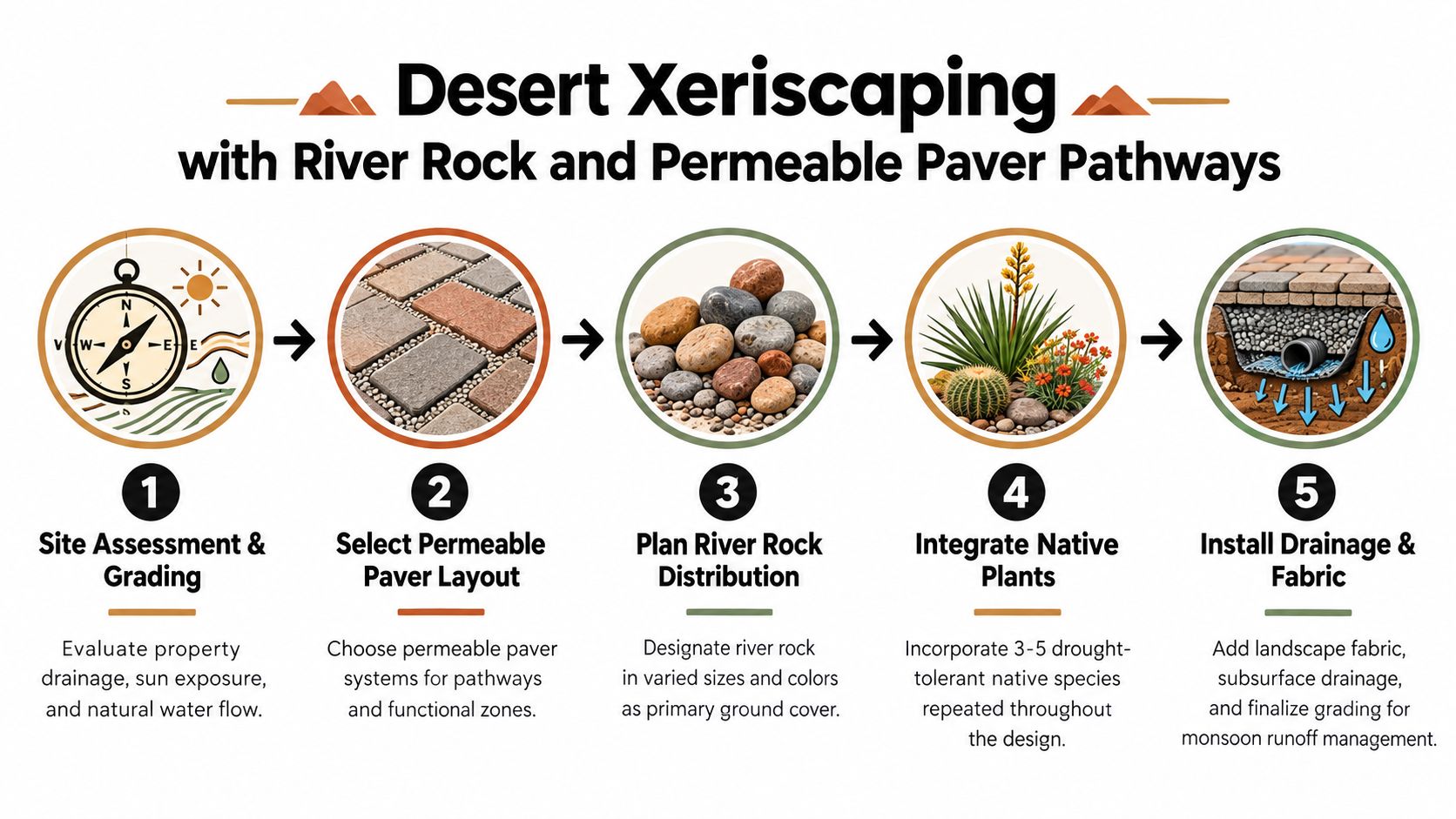
3. Desert Xeriscaping with River Rock and Permeable Paver Pathways
A xeriscaped yard can use river rock as the dominant ground coverage and reserve pavers for routes people use. That approach creates clear circulation between the front entry, side gate, patio, planting areas, and other functional zones without covering every square foot with hard surface.
Prescott homes may use permeable pavers to connect a patio with a garden or seating area, surrounded by river rock and Colorado spruce accents. Prescott Valley properties can contrast cream, rust, and black rock around repeated drought-tolerant specimen plants. In Chino Valley, permeable grid pavers filled with river rock can provide a more structured driveway treatment while allowing the design team to address runoff through the pavement system and subbase.
The distinction between permeable paving and decorative rock matters. Water performance depends on the storage layer, subgrade, rainfall, and clogging, not just on whether the surface looks open. A community-scale study reported permeable pavement reductions in total surface runoff ranging from 1% to 40% and peak flow reductions from 7% to 43%, while clogging reduced runoff-reduction effectiveness by 62% to 92% and peak-flow reduction by 37% to 65%. Those findings are summarized in the independent permeable pavement research.
What makes the planting look intentional?
Repeat a small group of plants instead of collecting too many unrelated species. Use three to five key native plants throughout the yard, vary river rock colors for rhythm, and add occasional boulders or flagstone accents so the ground plane doesn't become visually flat. Keep pathways slightly higher than rock areas where appropriate, but coordinate that separation with the overall drainage plan.
R.E. and Sons Landscaping provides additional guidance on permeable pavers for drainage. Fabric can help limit weeds beneath river rock, but it should be selected and installed with the intended infiltration and planting strategy in mind.
4. Layered Rock Garden Design with Mixed Paver Elevation Changes
Slopes need more than a decorative material change. A Prescott hillside may require several usable levels, each with its own paved surface, edge restraint, retaining structure, and drainage route. River rock can make those transitions look natural, but it can't replace a properly engineered base or retaining-wall drainage.
One practical composition uses three paver patio levels connected by river rock pathways and natural stone steps. In Prescott Valley, an upper entertaining terrace can face a lower fire pit area surrounded by rock. In Chino Valley, layered river rock formations can break up a significant grade change while directing water toward a planned collection or discharge point.
Begin with a site survey and grading plan before excavation. At each level, the pavers need their own controlled slope, commonly 1/8 inch per foot, even when the broader property has a much steeper grade. A 4 to 6 inch river rock swale between levels can visually separate surfaces and carry water, but its capacity and outlet must match the site.
How should a sloped paver project be built?
Retaining walls need proper back drainage, often including perforated pipe and suitable drainage material. Steps should have a consistent rise and run, commonly a 6 to 7 inch rise with an 11 to 12 inch run, so the route feels predictable underfoot. Larger river rocks at the edges of elevation changes can anchor the composition and reduce the appearance of loose material sliding across the slope.
The base depth for permeable paving also depends on loading, soil, and storage needs. A county technical manual lists 6 inches as a minimum base depth for pedestrian and bicycle applications, with typical depths ranging from 6 to 22 inches for different conditions. It also identifies underdrains as necessary where the long-term infiltration rate is below 0.5 inches per hour. Review the pervious pavement design manual before assuming a surface product alone will solve slope drainage.
A useful visual reference for terraced desert construction is shown below.
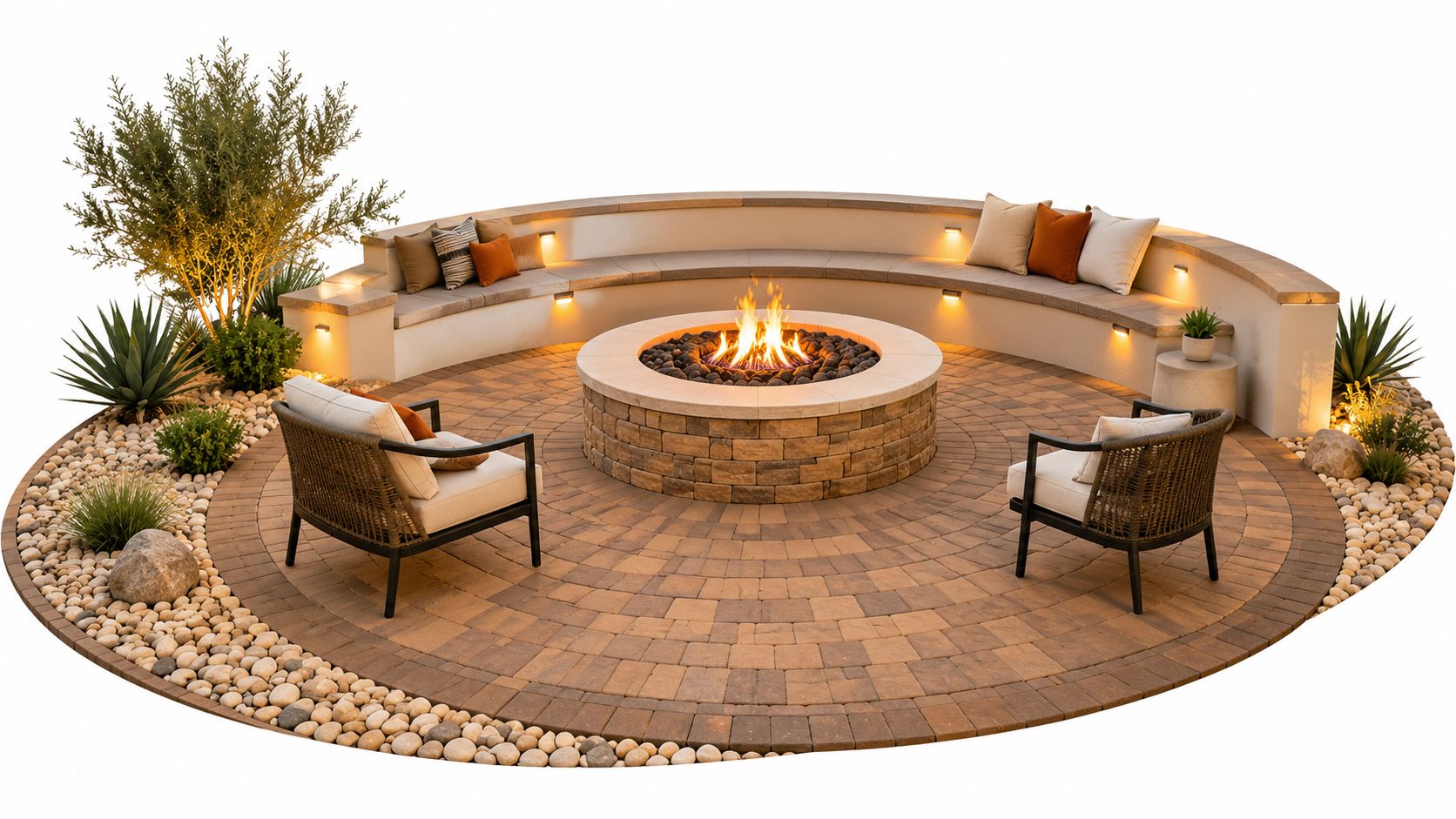
5. Contemporary Fire Feature Spaces with River Rock and Paver Gatherings
Fire features need a comfortable, stable gathering surface and a clear safety zone. Curved or circular paver layouts naturally direct attention toward a fire pit or fireplace, while river rock can define the outside edge, separate planting, and provide a visual break between the entertaining area and the rest of the yard.
A Prescott Valley design might use a 20 foot circular paver patio with a river rock border around a custom fire pit. In Prescott, curved paving can complement a built-in fireplace and bench seating. In Chino Valley, a larger entertaining zone may combine a fire feature, outdoor kitchen, and paver seating area, with river rock marking the transition between cooking, circulation, and planting.
Use lighter river rock, such as cream or tan, around the fire feature when it suits the design. It improves visual contrast and can make the perimeter easier to read after sunset. A series of paver rings in related colors can reinforce the circular focal point, but the rings still need careful cuts, stable edging, and a surface that drains rather than holding water near the fire pit.
What should be planned around the fire pit?
Maintain at least 8 to 10 feet of clearance between the fire feature and combustible vegetation. Seating should sit on a level, comfortable surface, not on loose rock. River rock step-ups or natural stone borders can define the edge, but they should not create an awkward trip point.
Monsoon rain makes drainage around fire features a practical concern. A Toronto laneway retrofit found permeable interlocking concrete pavers reduced average runoff volume by 33% and average peak flow by 43% compared with adjacent conventional concrete during 14 months of monitoring. The monitored PICP retrofit study also noted delayed peak flows. Local soil and installation details still control performance, so the result should guide planning rather than serve as a guarantee for every Prescott property.
For layout inspiration, R.E. and Sons Landscaping shares outdoor fire pit patio ideas.
6. Mediterranean-Inspired Paver and River Rock Courtyard Designs
Mediterranean courtyard design can work in Northern Arizona when the planting and water features are adapted to the local elevation and climate. Herringbone, basket-weave, and other traditional paver patterns create warmth through geometry, while cream or golden river rock provides a controlled border rather than covering the entire courtyard.
A Prescott courtyard could pair herringbone pavers with a cream river rock edge and drought-tolerant Mediterranean plantings. In Prescott Valley, a curved basket-weave layout can surround a small fountain accented with golden rock. A Chino Valley estate may use a larger paver entertaining space, a modest water feature, and specimen plants, with the paving carrying most of the foot traffic and rock reinforcing selected zones.
Keep the color palette disciplined. Two or three warm paver tones are enough when the pattern provides the visual variation. River rock should appear at borders, around a fountain, near planting pockets, or at a transition to a wall. Scattering it randomly across the patio will make the surface feel unfinished and may create uncomfortable walking conditions.
How can a courtyard stay inviting without wasting water?
Shade matters as much as ornament. A pergola, stone feature, or covered seating area can make the courtyard more usable during bright afternoons and more comfortable during cool evenings. Select plants that are suitable for Northern Arizona's elevation rather than choosing Mediterranean species solely for appearance.
A small water feature can serve as the focal point, but it needs a drainage and maintenance plan. The paved surface should direct incidental water away from structures, and river rock around the feature should be contained so it doesn't enter drains or migrate into paver joints. Curved edges work best when they follow the architecture and leave enough room for furniture, circulation, and service access.
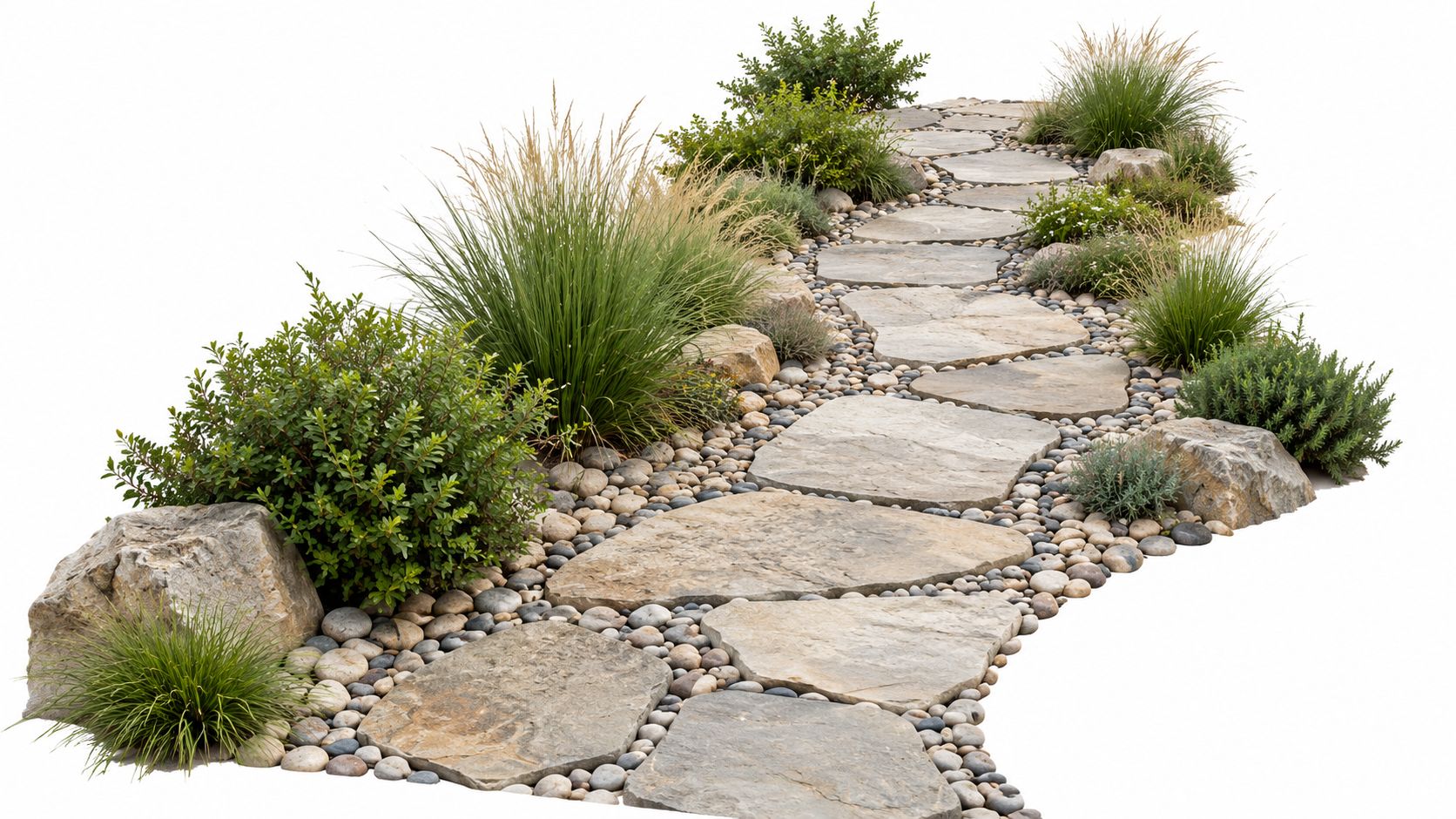
7. Naturalistic Rock Slab Paver Pathways with River Rock Ground Transition Zones
Irregular flagstone, slate, or quarried slab can preserve a property's natural character better than a rigid rectangular walkway. The pavers establish comfortable stepping points, while narrow river rock transitions connect the stones visually and allow the path to meander through native planting.
Prescott properties can use flagstone routes that curve through existing vegetation. In Prescott Valley, subtle slab walkways can preserve selected native plants while still connecting an outdoor room to the side yard. In Chino Valley, irregular quarried stone can link a patio to the surrounding greenery without making the entire yard look newly paved.
Vary stone dimensions by roughly 20% to 30% for an organic appearance. Gaps of 1 to 2 inches can hold river rock between slabs, while a river rock size of 1 to 1.5 inches gives the transition definition without overpowering the stone. For comfortable walking, space stepping surfaces approximately 10 to 12 inches apart, measured center to center, and adjust the route to the natural topography rather than forcing a straight line.
What goes beneath irregular stone?
The subbase remains important even when the surface looks informal. A poorly prepared base allows stones to settle independently, creating rocking slabs and uneven joints. Use compatible leveling and joint materials, confirm the route drains correctly, and establish firm edges where the path meets planting or loose rock.
Underlay cloth is not automatic here. If the purpose is to preserve natural plant establishment between stones, cloth may work against the desired result. Without it, plan for occasional hand weeding and expect the appearance to change as plants establish.
Avoid making the path too perfect. A naturalistic design should have intentional variation, but it still needs predictable footing, stable stones, and enough width for the people who will use it.
8. Luxury Resort-Style Entertaining Zones with Paver Decking and River Rock Elegance
Large outdoor living projects succeed when the design treats cooking, dining, lounging, circulation, lighting, drainage, and utilities as one system. Expansive paver decking can support those activities, while river rock defines boundaries and keeps the composition from feeling like one uninterrupted hard surface.
A Prescott Valley property might use a 1,500 square foot or larger paver entertaining deck with an outdoor kitchen, fire feature, and strategic rock accents. A Prescott estate can divide several levels into dining, lounging, and cooking zones, linking them with river rock transitions and premium stone elements. In Chino Valley, a complete outdoor living ecosystem may combine paver decking, a water feature, lighting, and resort-style furnishings.
How should a large entertaining zone be organized?
Start with the furniture and functions, not the paver color. Mark the kitchen work area, dining clearance, lounge seating, fire feature, circulation routes, service access, and drainage outlets before selecting patterns. Large-format pavers can create a refined appearance, while two or three complementary colors provide visual interest through placement rather than excessive variation.
Use river rock at borders and focal points, not as random decoration. Coordinate its color and size with the outdoor kitchen, fireplace, furniture, and nearby stonework. Plan subsurface utilities and drainage before paving begins, because retrofitting a gas line, electrical conduit, irrigation adjustment, or drain after installation can disrupt finished surfaces.
Professional lighting can extend use into cool Northern Arizona evenings, but fixtures and wiring should be included in the design rather than added as an afterthought. Premium materials also require skilled installation and ongoing care. A maintenance plan should include cleaning, joint checks, rock raking, planting care, and inspections after significant weather.
Pavers & River Rock, 8-Design Comparison
Design | 🔄 Implementation Complexity | ⚡ Resource Requirements | ⭐ Expected Outcomes | 📊 Ideal Use Cases | 💡 Key Advantages / Tips |
|---|---|---|---|---|---|
Modern Minimalist Paver Courtyards with River Rock Accents | Moderate, precise base prep, permeable detailing | Moderate, large-format pavers, river rock, native plants | ⭐⭐⭐⭐, high aesthetic, low-water, usable entertaining zones | Urban/suburban courtyards, outdoor kitchens, Prescott/Prescott Valley | Use large-format pavers; slope 1/8" per ft; landscape fabric under rock |
Rustic Southwestern Paver Designs with Natural River Rock Borders | Moderate, pattern work and textured finishes | Moderate, warm-toned tumbled pavers, river rock, plantings | ⭐⭐⭐⭐, strong regional character, slip-resistant surfaces | Historic homes, ranch-style properties, heritage-conscious yards | Choose tumbled pavers; limit 2–3 warm tones; source local materials |
Desert Xeriscaping with River Rock and Permeable Paver Pathways | Moderate–High, grading, permeable system and drainage design | Moderate, permeable pavers, drainage, varied rock sizes; low ongoing water use | ⭐⭐⭐⭐⭐, maximal water savings, low maintenance, runoff control | Water-restricted lots, HOA/municipal compliance, sustainability-focused sites | Repeat 3–5 native plants; combine rock sizes; install subsurface drainage & fabric |
Layered Rock Garden Design with Mixed Paver Elevation Changes | High, engineering, retaining walls, specialty grading | High, excavation, retaining materials, specialized labor | ⭐⭐⭐⭐, maximizes sloped usable area, strong visual depth | Sloped/hillside properties needing terraces and multi-level entertaining | Start with site survey; use perforated pipe behind walls; uniform step risers |
Contemporary Fire Feature Spaces with River Rock and Paver Gatherings | Moderate–High, fire installation, safety and code compliance | High, fire equipment, quality pavers, seating and clearance space | ⭐⭐⭐⭐, high social value, extended entertaining season | Homes prioritizing gathering zones and year-round entertaining | Follow fire codes; allow 8–10 ft clearance; use lighter rock for visibility |
Mediterranean-Inspired Paver and River Rock Courtyard Designs | Moderate, skilled pattern installation (herringbone, basket weave) | Moderate, quality clay/stone pavers, Mediterranean plant palette | ⭐⭐⭐⭐, timeless upscale aesthetic, strong curb appeal | Homeowners seeking classic, elegant courtyards and shaded patios | Limit to 2–3 warm tones; hire skilled craftsmen for traditional patterns |
Naturalistic Rock Slab Paver Pathways with River Rock Ground Transition Zones | Moderate, careful placement of irregular slabs, organic layout | Low–Moderate, irregular stone, river rock infill; less total paving | ⭐⭐⭐, subtle integration, low visual dominance, habitat-friendly | Conservation-minded landscapes, meandering garden paths, native sites | Vary stone sizes 20–30%; 1–2 in rock fill; allow curvature to follow terrain |
Luxury Resort-Style Entertaining Zones with Paver Decking and River Rock Elegance | Very High, full design-build, utilities, permits, complex coordination | Very High, premium large-format pavers, kitchens, lighting, drainage | ⭐⭐⭐⭐⭐, resort-quality spaces, significant property-value uplift | High-net-worth estates, large entertaining decks, comprehensive transformations | Begin with full design consultation; budget for premium materials and utility coordination |
Choose the Right Paver and River Rock Combination
The right composition depends on the problem the yard needs to solve. Choose geometric pavers with controlled river rock accents for a contemporary courtyard. Choose a permeable system when water management and reduced turf are central goals. Use engineered terraces for slopes, curved layouts for fire features, and irregular stone for naturalistic paths.
The material pairing only works when the structure beneath it matches the use above it. A pedestrian path, dining patio, driveway, fire feature, and multi-level entertaining deck don't place the same demands on the base, drainage, edging, or surface. River rock can add mass, texture, and useful coverage, but it won't stabilize pavers laid directly over a loose or shifting rock bed.
What should go between pavers and river rock?
Use a deliberate transition, such as a defined edge, narrow joint, compacted separator, or compatible drainage detail. Don't spread river rock across an unprepared paver base and expect it to stay in place. If you're considering pavers over an existing river rock bed, inspect the soil, slope, compaction, and drainage first. Existing rock can shift, create voids, trap water, and contribute to settlement or cracking when it hasn't been removed or incorporated into a properly engineered base. The guidance on laying pavers over river rock highlights why a direct installation requires caution.
How do you keep river rock from spreading?
Contain it with steel, concrete, stone, or another suitable edge restraint where it meets paving, turf, driveways, or drainage structures. Grade the rock zone so water doesn't carry stones toward a drain or public sidewalk. Rake displaced material back into place, remove sediment, and correct the source of movement instead of repeatedly topping up the border.
Are pavers suitable for Prescott weather?
They can be suitable when the base, slope, joints, edge restraints, and drainage are designed for the site. Permeable pavers aren't automatically maintenance-free. California guidance recommends keeping joints filled to the bottom of the paver chamfers and cleaning the surface when ponding covers more than 20% of the area. Review the permeable pavement maintenance guidance when selecting a system.
Does river rock always improve drainage?
No. Rock can support dry creek beds, borders, swales, and runoff zones, but large areas of rock or gravel can behave like an impermeable cover, increase stormwater flow, or clog drains and grates. A patio and rock bed still need a coordinated slope, commonly around 1/4 inch per foot where the design calls for that drainage grade, and some sites need subsurface drainage. The discussion of river rock patio drainage explains why grading matters more than the assumption that loose rock always absorbs water.
What maintenance does a paver and rock yard need?
Inspect after major storms, check whether river rock has moved, sweep sediment from paved areas, and watch for ponding. Nashville guidance recommends measuring drawdown for three days after storm events exceeding 0.5 inch. Standing water after that period indicates a clogging concern, and the guidance recommends vacuum sweeping instead of ordinary brooms or water spray. The permeable pavement inspection guidance provides a useful maintenance reference.
A practical checklist includes:
Base preparation: Remove unstable material and compact the correct base for the intended load.
Grading: Direct water away from foundations, steps, walls, and fire features.
Drainage: Provide swales, outlets, underdrains, or perforated pipe where the site requires them.
Edging: Restrain pavers and river rock at every exposed transition.
Weed control: Use fabric where appropriate, while recognizing that naturalistic paths may intentionally allow plant establishment.
Surface care: Rake displaced river rock and clean sediment from paver joints and permeable openings.
Inspection: Check drawdown, outlets, ponding, cracking, settlement, and erosion after significant storms.
Complex work benefits from design-build planning. Slopes, retaining walls, fire features, outdoor kitchens, water features, and integrated lighting all involve details that should be resolved before excavation. R.E. and Sons Landscaping offers complimentary design services and serves homeowners, builders, contractors, property managers, HOA boards, and commercial projects across Prescott, Prescott Valley, Chino Valley, and Northern Arizona.
Its four-step process, consultation, design approval, transformation, and enjoyment, gives homeowners a clear path from an initial idea to a finished outdoor space. The dedicated maintenance department can also support ongoing yard care after installation, including the routine attention that helps pavers and river rock continue to look intentional.
R.E. and Sons Landscaping provides complimentary outdoor design and design-build installation for paver patios, walkways, river rock drainage areas, fire features, outdoor kitchens, and complete Northern Arizona yards. Visit R.E. and Sons Landscaping to discuss your Prescott, Prescott Valley, Chino Valley, or nearby Northern Arizona project and begin the consultation, design approval, transformation, and enjoyment process with maintenance support available after installation.
Comments