
Water Feature Design in Prescott: A Homeowner's Guide
You're standing on a bare patch of decomposed granite in Prescott, trying to decide whether a waterfall will belong in a high-desert yard or become another project to repair after winter. R.E. and Sons Landscaping designs and builds custom water features for homeowners in Prescott, Prescott Valley, Chino Valley, Dewey-Humboldt, and nearby Northern Arizona communities.
The right water feature design isn't a catalog choice. It's a practical balance between appearance, sound, water use, evaporation, freeze risk, drainage, and the maintenance you'll accept after installation. This guide walks through the decisions that matter on-site, from choosing a feature type and reading your slope to sizing the pump, protecting equipment, and deciding when a licensed outdoor design expert should handle the work.
What Water Feature Design Really Means for Your Prescott Yard
Water features have been part of built environments for thousands of years. A historical review identifies basins and rain channels at Göbekli Tepe in Turkey, dating to nearly 12,000 years ago, as likely examples of purposeful water-feature planning for aesthetic and ritual use, with Egyptian, Greek, and Roman waterworks developing later. Roman fountain culture eventually became a major reference point for ornamental water design, which helps explain why today's residential fountains, streams, and waterfalls still feel architectural rather than incidental. (historical review of the water-features market)
On a Prescott property, design starts with the land, not the pump. A feature at the bottom of a sloped backyard has different drainage demands from a bubbler beside a covered patio. A sunny, exposed basin loses water differently from a shaded pondless vault, and a shallow shell faces more freeze-thaw stress than a properly built, serviceable reservoir.
Start with the decisions that affect ownership
Before choosing stone or hearing the first trickle, answer these questions:
What should you hear? A quiet spillway supports conversation. A boulder cascade creates a stronger presence and can help mask nearby road noise.
Where will you see it? The kitchen window and patio usually matter more than an unused side yard.
How much water can you reasonably replace? Dry air, wind, splash, and direct sun all increase top-offs.
Who will clean it? Narrow shelves and deep recesses may look intricate but make debris removal and leak diagnosis harder.
What happens in a freeze? Pumps, shallow basins, exposed plumbing, and trapped water need a winter plan.
The global market also shows that water features have become a substantial design category rather than a niche accessory. One market report values the industry at USD 4.65 billion in 2024 and projects USD 7.2 billion by 2035, while another estimates USD 3.42 billion in 2025 and forecasts USD 5.94 billion by 2034, with a 6.9% CAGR from 2026 to 2034. These are market estimates, not a promise about any individual project, but they do reflect a broad installation, equipment, and maintenance ecosystem. (market estimate and projection)
Prescott design rule: The feature you'll enjoy most is the one that fits your yard's exposure and your willingness to maintain it, not necessarily the one with the most dramatic catalog photograph.
Types of Water Features Worth Considering
Prescott homeowners usually narrow the choice to five formats. Each creates a different relationship between water, sound, space, and maintenance.
A pond with standing water offers the richest habitat and the strongest opportunity for aquatic plants or fish. It needs enough room for circulation, accessible edges, filtration, and safe cleaning. In Northern Arizona, open surface area also means greater evaporation exposure, algae management, debris collection, and winter preparation.
A fountain can be a stand-alone urn, a bubbling rock, or a compact bowl feature. It suits courtyards and patios because it creates concentrated sound without requiring a large footprint. The trade-off is splash. Water can land on surrounding stone, leave mineral scale, and require frequent wiping or adjustment when wind shifts.
A recirculating stream needs a longer grade and careful shaping so water doesn't escape around liner folds or erode the banks. It feels natural and can connect separate outdoor areas, but leaves, sediment, and monsoon runoff make access important. A spillway or shearing descent produces a cleaner architectural effect between basins. It needs precise leveling, stable edges, and a pump sized for the spillway width.
A pondless waterfall sends water over rock or a manufactured spillway into a hidden reservoir. There's no open pond to skim, and the protected vault can reduce exposure and water use. It's often the most forgiving option for a Prescott yard, especially where families want sound and movement without fish care or a large standing-water basin.
Feature Type | Best Site | Evaporation Loss | Freeze Risk | Maintenance Load | Water Use |
|---|---|---|---|---|---|
Pond | Large open yard | High, especially in sun and wind | High at exposed shallow edges | High, including algae and filtration | Moderate to high |
Fountain | Courtyard or patio | Moderate, with splash-related loss | Moderate | Moderate, including scale and pump cleaning | Low to moderate |
Recirculating stream | Sloped backyard | Moderate to high | Moderate to high | Moderate to high | Moderate |
Spillway | Patio, wall, or terraced yard | Moderate | Moderate | Moderate | Low to moderate |
Pondless waterfall | Sloped or compact yard | Lower than open ponds when properly contained | Lower, with winter drain-down | Low to moderate | Low to moderate |
The best match is usually straightforward. Choose a fountain for a small courtyard, a stream or waterfall for a slope, and a pond only when you want the habitat and accept the seasonal work. For more ideas suited to compact properties, see this guide to backyard water features for small yards.
Design Principles That Make a Feature Feel Right
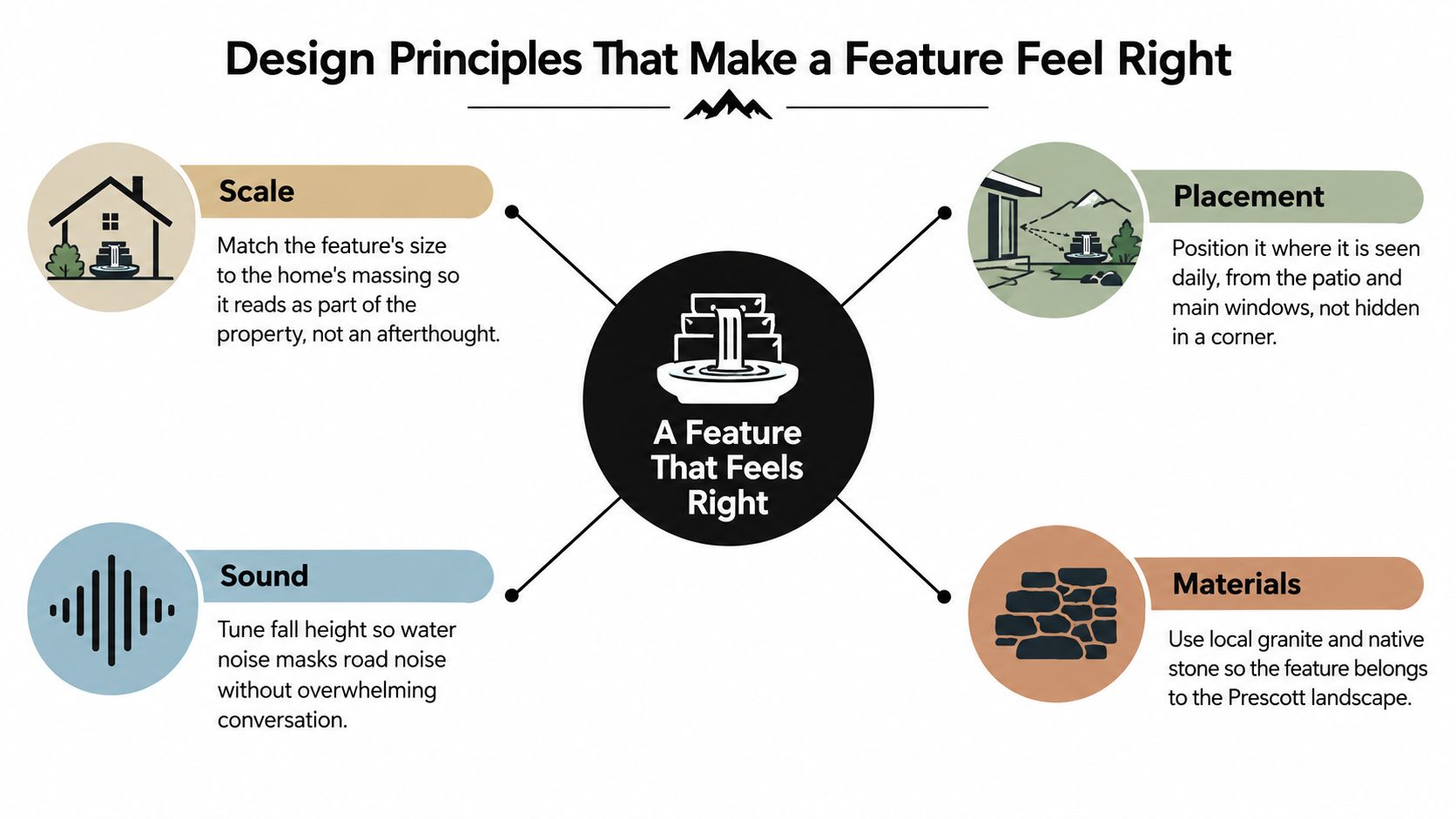
A feature can be technically sound and still look wrong. On-site, four checks usually reveal why: scale, sound, sightlines, and circulation.
Scale comes before ornament
Relate the feature to the home's massing and the outdoor room around it. A six-foot pondless waterfall may disappear against a two-story stucco wall, while that same height can overwhelm a small flagstone patio. The stone should also relate to the property. Local granite and native-looking stone generally sit more naturally beside Prescott's decomposed granite, junipers, and high-desert planting than a bright imported material with no connection to the setting.
Sound should serve the outdoor room
A thin sheet falling over a level spillway reads as a low background hush. Water breaking over boulders carries farther and feels more energetic. A fountain concentrates sound in a small radius, which can work beside a dining area but may not mask traffic at the edge of a larger lot.
Test the sound from the chair where you typically sit. If nearby homes are close, avoid creating a feature that forces conversation louder. If the water needs to soften road noise, increase the texture and fall rather than relying on a tiny decorative jet.
Point the interesting face toward daily views
Choose the primary viewing axis from the kitchen, back patio, or firepit. Then place the strongest cascade, stone arrangement, or illuminated surface toward that view. Keep the pump vault, access lid, plumbing, and electrical components out of the sightline, but don't bury them where a technician can't reach them.
Protect movement and maintenance access
People, pets, and wheelbarrows need a clear route around the wet edge. Leaves and sediment should be removable without stepping through plantings or dismantling the feature. A low-water planting plan can help with the surrounding composition, especially when you're balancing water use with shade, stone, and drought-tolerant planting. The Cactus Outlet's guide to how to design a low-water yard is a useful reference for that broader planting strategy.
Reading Your Site Before You Design
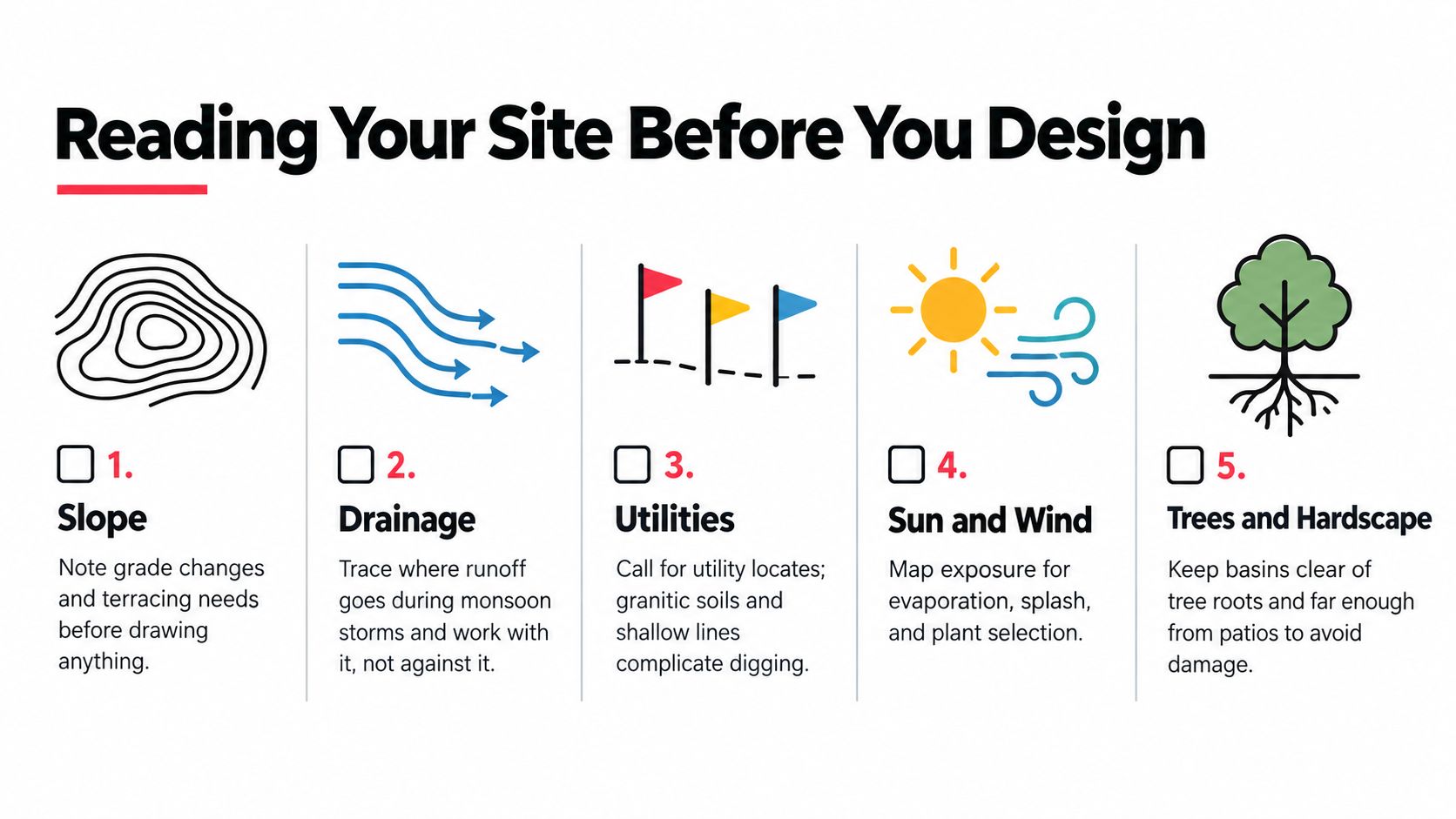
The site decides more than the sketch does. Start by observing where water already travels, where wind moves spray, and where the sun hits the proposed basin during the hottest part of the day.
Prescott's granitic soils often drain quickly, but they can also shed runoff downhill. A feature placed at the base of a slope may receive concentrated monsoon flow, carrying sediment into the basin or pushing water against a liner edge. If the feature sits below an upslope drainage path, plan a swale or French drain before building the water element.
Freeze-thaw movement creates a second concern. Shallow basins and poorly supported edges can crack or heave when trapped water freezes. Intense high-elevation UV also punishes exposed liners, flexible tubing, and plastic components that aren't protected by rock, soil, or a suitable cover. Afternoon monsoon winds can push mist onto patios, walls, windows, or electrical equipment.
A homeowner's site-analysis checklist
Trace the grade: Use a string and line level to compare the proposed basin with nearby patios and slopes.
Follow runoff: Look for erosion marks, gravel movement, and low spots left after storms.
Locate utilities: Call for utility locates before digging. A suspected underground line or septic component can force a complete redesign.
Map sun and wind: Note direct exposure, prevailing afternoon gusts, and where spray would land.
Check roots and hardscape: Keep excavation away from major tree roots and provide separation from patios, walls, and foundations.
Plan service access: Place the pump below the water surface where possible, but keep the vault within easy reach for cleaning and replacement.
Don't guess about a slope because the yard appears mostly flat. A small grade change can determine whether a stream holds its channel or sends water around the liner. Likewise, a hidden utility or easement may matter more than the preferred viewing angle. If the feature requires substantial excavation, new electrical work, or drainage changes, bring in a qualified professional before materials arrive.
Materials, Pumps, and Equipment That Hold Up
Materials should match the way Prescott's temperature swings, sunlight, and dry conditions stress a water feature. For flexible pond construction, 45-mil EPDM remains useful because it accommodates movement when installed over proper underlayment. Reinforced PVC can provide a stiffer liner option, while concrete offers a permanent shell when reinforcement, curing, drainage, and expansion details are handled correctly. Preformed poly basins install quickly in compact projects, but their shape limits can make repairs or future changes less flexible.
For stream beds, EPDM allows custom curves and shelves. Fiberglass shells provide a smooth, rigid surface and can simplify cleaning, but they demand careful bedding and support. No material eliminates maintenance. A liner can last well when protected from sharp rock and UV, while a rigid shell can still fail if the surrounding ground shifts or water freezes in the wrong place.
Material | Lifespan | Cost Range | Best Use | Watch-Out |
|---|---|---|---|---|
45-mil EPDM | Long service life with protection | Varies by project | Custom ponds and streams | Sharp rock, exposed edges, poor underlayment |
Reinforced PVC | Project-dependent | Varies by project | Stiffer lined basins | Temperature movement and seam quality |
Concrete | Long service life when engineered | Varies by project | Architectural basins | Cracking, curing, drainage, freeze-thaw movement |
Preformed poly basin | Project-dependent | Varies by project | Small fountains and compact ponds | Fixed shape and limited expansion |
Fiberglass shell | Project-dependent | Varies by project | Smooth stream beds and rigid basins | Bedding, access, and ground movement |
Size the pump at real operating head
A pump's zero-head rating is not its working output. Calculate Total Dynamic Head, or TDH, by adding the vertical rise and friction from the plumbing. A practical industry rule adds 1 foot of head for every 10 feet of tubing, plus the vertical rise, then uses the manufacturer's pump curve to find actual gallons per hour at that TDH. (TDH calculation guidance)
For waterfall aesthetics, common guide benchmarks use about 100 to 150 GPH per inch of spillway width for a moderate sheet, 50 to 75 GPH per inch for a gentler flow, and 150 to 200 GPH per inch for a stronger, turbulent effect. (waterfall pump sizing guidance)
A 300-gallon pond therefore needs roughly a 300-GPH pump for one basic turnover per hour before accounting for head loss, but the final selection must come from the pump curve, not that simple figure. Undersizing creates a broken sheet. Oversizing increases turbulence, splash, energy use, and make-up water.
For custom layouts, R.E. and Sons Landscaping describes custom water features as part of its garden offering. When comparing stone or hardscape finishes around the feature, Varun Marbles' parking marble guide can help you think through material appearance and surface use, although water-edge materials still need appropriate slip and freeze considerations.
Cost, Maintenance, and the Case for Easy-to-Live-With Design
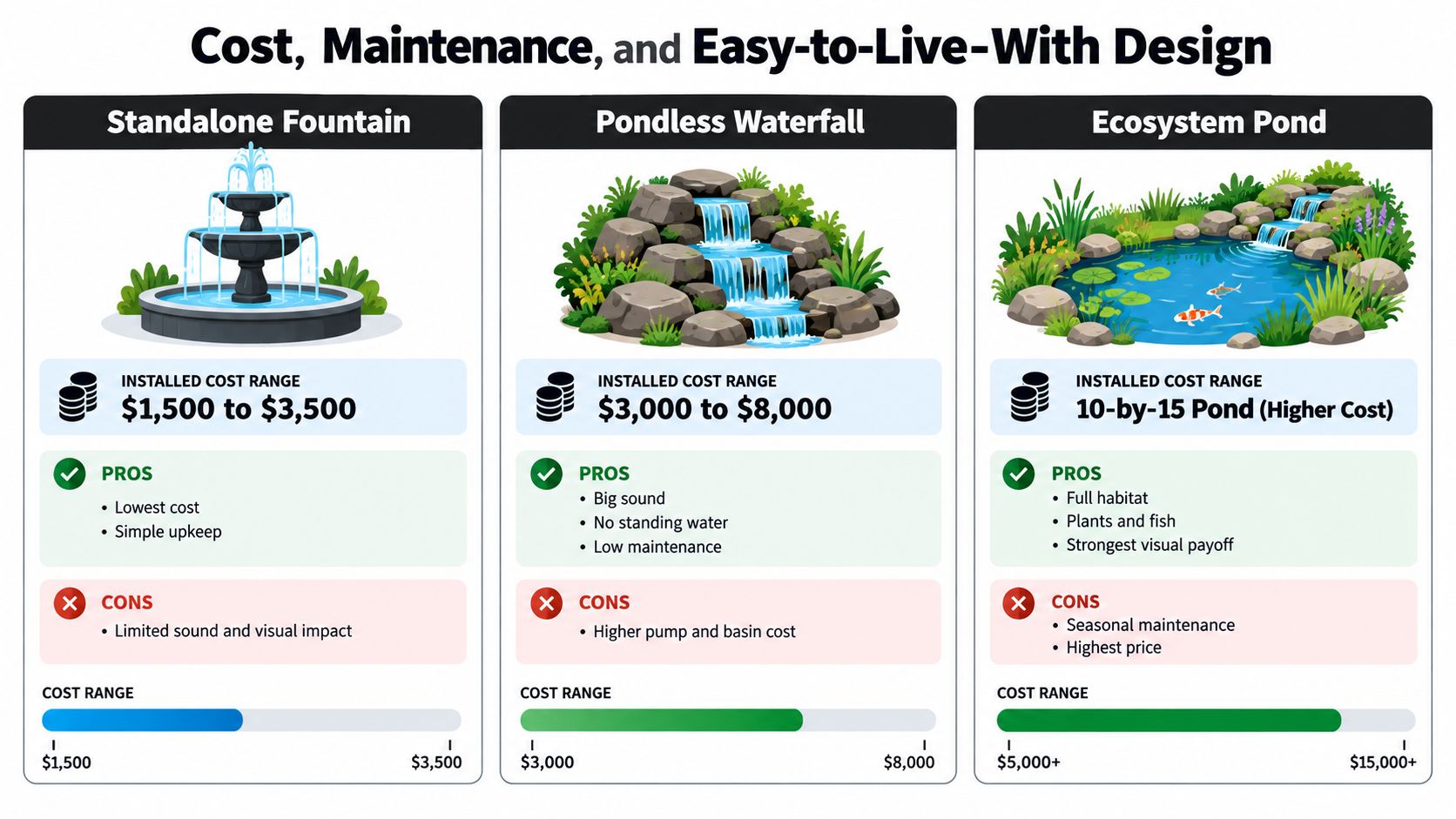
A water feature's installation price depends on excavation, stone quantity, plumbing distance, electrical work, access, basin size, and finish quality. For Prescott planning, a small standalone fountain often falls around $1,500 to $3,500, a pondless waterfall commonly falls around $3,000 to $8,000, and a 10-by-15 ecosystem pond with stream may run around $7,000 to $15,000, with excavation and rock potentially adding to the project cost. Treat these as planning ranges, not a quote.
Design maintenance into the layout
The cheapest installation can become the most expensive feature to own when routine tasks require awkward access. Keep basins reachable with a standard hose, use removable pump screens, and avoid deep, narrow recesses that trap leaves and sediment. Place filter lids where they can open without moving heavy boulders, and create an overflow route that can handle monsoon runoff without washing across a patio.
There isn't a universal maintenance calendar for ornamental water features. Service needs depend on complexity and exposure, and diagnosing water loss works best when you separate splash, overflow, evaporation, and leaks instead of assuming every falling water level means a failed liner. (maintenance and diagnosis guidance)
Budget for seasonal care
Expect regular observation, pump-screen cleaning, debris removal, and inspection of exposed tubing and edges. Ponds add algae control, filtration checks, plant management, and possibly fish care. Fountains often need mineral-scale removal where splash dries on stone. Pondless waterfalls reduce standing-water work, but the vault, pump, rock channel, and hidden plumbing still need access.
Winter care should include shutting down or adjusting the pump when freezing conditions threaten, draining vulnerable plumbing, and storing removable covers or ultraviolet-sensitive accessories. A fountain or pond that can't be safely drained is harder to protect than one designed with accessible low points and serviceable equipment.
Ownership test: If you can't explain how you'll clean the pump, remove debris, check the liner, and handle a freeze before construction begins, the design isn't finished.
For practical ongoing care, see the maintenance of water features guide. It's better to simplify the layout now than discover later that the prettiest recess is the one you can't reach.
Lighting, Plants, Safety, and When to Hire a Pro
Lighting, planting, and water should read as one composition after sunset. Warm 2700K LED spots aimed across the water surface create sparkle without pointing glare directly toward the viewer. Shielded, dark-sky-friendly fixtures suit Prescott's exterior-lighting expectations, while discreet uplights on adjacent boulders or junipers give the feature a grounded silhouette.
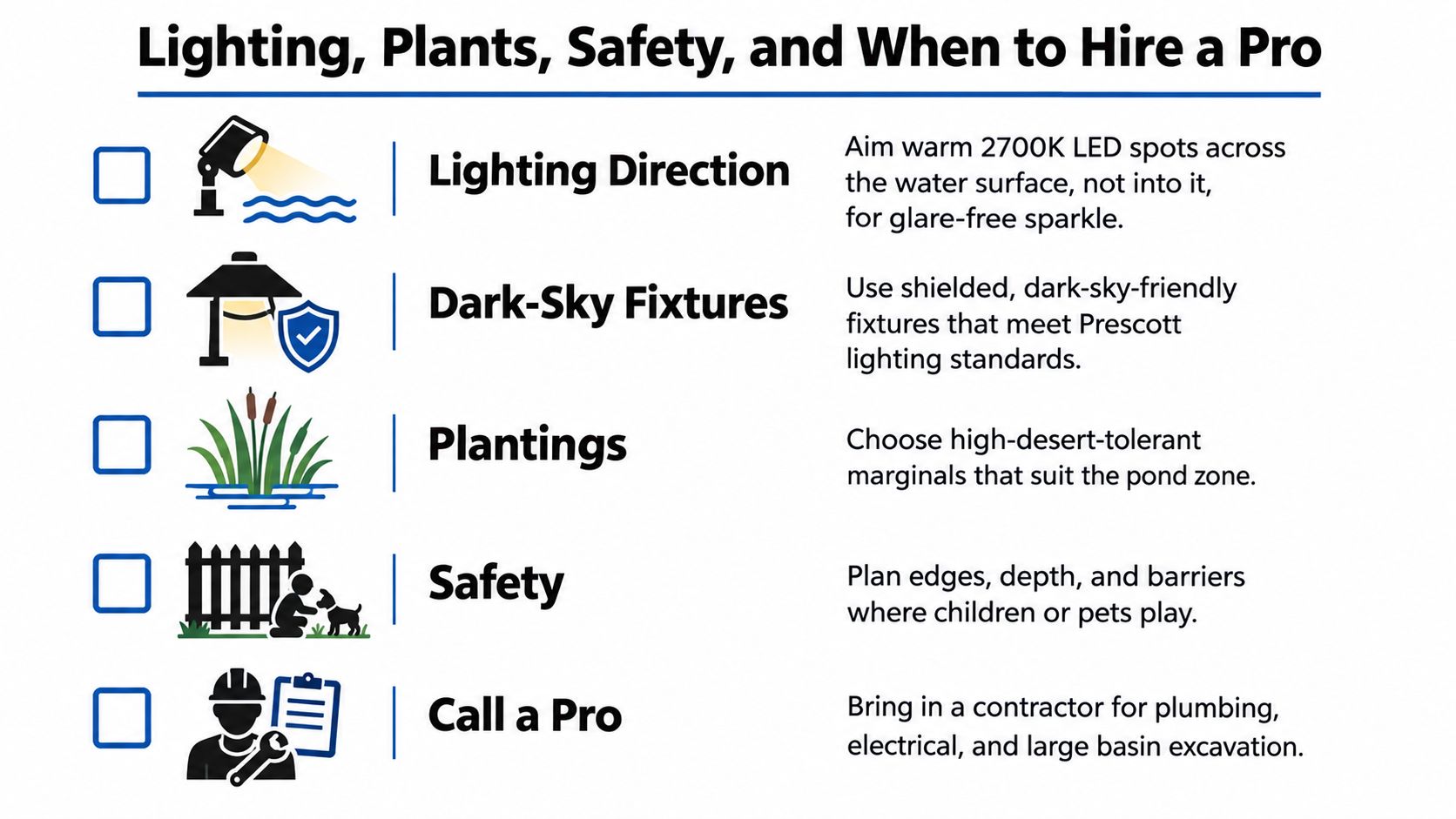
Plant the splash zone with species that tolerate dry air and local conditions. Dwarf coyote willow, horsetail in pots, blue grama, and agastache can support a high-desert composition when placed according to their moisture needs. Tropical lotus and water lilies can struggle above 5,000 feet, particularly when a design doesn't provide the warmth, depth, and growing conditions they require.
Protect people, pets, and equipment
Standing-water ponds need child-conscious edges, shallow areas, and a layout that doesn't create an unexpected drop beside a walking route. One practical approach is to keep play-adjacent water under 12 inches deep, but the right solution depends on the property, supervision, barriers, and applicable requirements. Electrical components should use GFCI protection, and equipment vaults should be secure and accessible.
Public or interactive features require a higher level of control. Technical guidance recommends recirculation, appropriate filtration and disinfection, ventilated plant-room space, secure chemical storage, written maintenance manuals, and inspection logs. One guideline specifies chlorine-based oxidising biocides at 3 to 5 mg/L and bromine-based products at 4 to 6 mg/L, with filter cleaning, pump cleaning every 3 months, and water changes included in the maintenance process. (public decorative water-feature guidance)
Safety guidance also calls for avoiding trip hazards, large level changes, slippery wet surfaces, deep water, litter traps, vandalism vulnerabilities, and operation below freezing. (landscape water-feature safety guidance) Interactive installations may also face specific requirements, including nozzle openings no larger than 1/2 inch, adjacent surfaces sloped away at a minimum of 2%, a continuous deck at least 3 feet wide, and free gravity drainage when the feature is off. (interactive water-feature requirements)
Aquatic play features need manufacturer-compliant installation, operating manuals, risk assessments, staff training, daily inspection, non-slip surfaces where appropriate, and checks for structural integrity, cleanliness, biofilm, suction hazards, and emergency closure procedures. (aquatic play guidance)
Know when professional work is appropriate
Call a licensed professional when the project involves new electrical work beyond an existing receptacle, significant grading, excavation near utilities or easements, structural retaining elements, complex plumbing, or a basin that could affect drainage and neighboring property. R.E. and Sons Landscaping identifies itself as licensed, bonded, and insured, with Arizona ROC #300642. The provided business information also references R.O.C. #322857, so homeowners should confirm the applicable license number and scope directly before signing a project agreement.
A professional plan should show the basin, overflow route, pump vault, service access, lighting, plant zones, and winter strategy before excavation begins. That's how a feature survives the second Prescott monsoon and remains enjoyable through the next freeze instead of becoming a hard-to-reach repair site.
R.E. and Sons Landscaping designs and installs ponds, waterfalls, fountains, bubblers, and pondless water features for properties in Prescott, Prescott Valley, Chino Valley, Dewey-Humboldt, and nearby Northern Arizona communities. Visit R.E. and Sons Landscaping to discuss a water feature design built around your site, water use, drainage, and long-term maintenance needs.
Comments