
HOA Landscape Maintenance Contract: The Board’s Field Guide
A board meeting is coming up, the grounds maintenance contract is nearing renewal, and the vendor's proposal says little more than “maintain common areas.” That wording may look harmless, but it leaves the board guessing about visit frequency, irrigation duties, seasonal cleanup, storm response, quality standards, and the cost of work outside the base service.
A well-built HOA landscape maintenance contract solves that problem before it reaches the budget or the residents. R.E. and Sons Landscaping serves HOA boards, property managers, and communities in Prescott, Prescott Valley, Chino Valley, and nearby Northern Arizona areas with practical upkeep of outdoor grounds and broader property support. The aim is straightforward: define the work clearly, price it transparently, inspect it consistently, and give the association a fair process when service falls short.
Why Your HOA Landscape Contract Is Bigger Than Routine Maintenance
Grounds maintenance is one of the most visible operating decisions an HOA makes. It affects entrances, shared green spaces, walkways, amenity areas, irrigation systems, and the overall condition residents see every day. It also represents a substantial budget commitment. Neutral industry guidance places grounds upkeep at about 15% to 35% of annual HOA expenses in many communities, and 30% to 50% in others, depending on common-area grounds and irrigation needs, as explained in this HOA landscape maintenance cost guide.
For a 200-home association with $500,000 in annual assessments, that can mean roughly $150,000 to $250,000 per year for groundskeeping maintenance alone, according to the same source. Some large HOA communities budget $50,000 to $400,000 annually for exterior upkeep. In Northern Arizona, irrigation monitoring, water decisions, seasonal turf care, and weather-related cleanup can make the contract more than a routine renewal.
Board-level perspective: The contract is both a financial commitment and the operating standard residents will use to judge the association.
Vague wording creates predictable trouble. A contractor may consider a task extra while the board believes it belongs in the monthly fee. Residents report declining beds or missed cleanup, but the board has no inspection record or contract section to reference. The vendor responds defensively because the agreement never defined a measurable result.
Vague Promise or Missing Clause | What Happens in Practice |
|---|---|
“Maintain common areas” | The parties disagree about which entrances, basins, frontage zones, and amenity spaces are included. |
“Prune as needed” | Shrubs become overgrown, and nobody can agree when pruning should have occurred. |
No irrigation responsibility | Leaks, controller errors, and stressed turf fall between the HOA and contractor. |
No storm-response term | Cleanup timing becomes a negotiation after wind, hail, or heavy rain. |
No separate pricing for extras | The board receives surprise invoices for mulch, replacements, repairs, or drainage work. |
No cure or termination process | Repeated misses continue because the HOA lacks a clear remedy. |
A board that treats procurement as paperwork often focuses on the lowest monthly number. A board that treats it as operations asks what will be performed, how it will be verified, and what happens when conditions change. The principles behind how MRO procurement works are useful here because the same discipline applies: define the requirement, compare like-for-like proposals, and document the purchasing decision.
For a practical overview of the service itself, boards can also review HOA landscape maintenance responsibilities. The central lesson is simple. A contract should make good service easier to deliver and poor service easier to identify.
Scope First, Pricing Second
The most reliable contract process starts with a site map and a written scope, not a vendor's monthly price. “Maintain the property” is not an adequate specification for a Prescott-area community with entry monuments, turf, native beds, walking paths, detention basins, irrigation zones, and high-traffic amenities.
What belongs in the written scope
Start by listing every maintained area and assigning a service level. An entrance may need more frequent grooming than a peripheral basin. A turf area may require different care from a xeric bed. A narrow frontage strip may need weed control and debris removal but no mowing.
The scope should define:
Mowing and edging: Identify turf areas, acceptable mowing practices, edge locations, clippings, and seasonal adjustments.
Pruning: State which shrubs, ornamental plants, and trees are included, along with clearance and appearance expectations.
Weed control: Specify whether hand removal, treatment, or both are included, and address product use and notification requirements.
Debris removal: Clarify whether blowing, litter pickup, leaf removal, and hauling are part of routine service.
Irrigation care: Assign controller programming, inspections, pressure checks, leak response, valve repairs, and winterization where applicable.
Seasonal work: Separate mulch, seasonal color, turf repair, plant replacement, storm cleanup, and drainage work from ordinary visits.
A useful contract describes a result that can be inspected. “Beds will be free of visible weed overgrowth at scheduled inspections” is more useful than “beds will be maintained.” The board and vendor can then agree on what the standard means before a disagreement arises.
Build the calendar around Northern Arizona conditions
Prescott's high-desert environment doesn't reward a generic calendar copied from another region. Temperature shifts, drought pressure, freeze conditions, monsoon storms, and irrigation demand can change the correct timing of work. The contract should include seasonal task schedules and identify when service frequency may change because of weather or water conditions.
Scope Category | Typical Frequency | Why It Matters |
|---|---|---|
Turf mowing and edging | Set by growing conditions and written schedule | Prevents inconsistent appearance and unclear visit expectations. |
Shrub and ornamental pruning | Seasonal schedule plus safety corrections | Protects plant form, visibility, and clearance around paths. |
Weed control | Routine inspections with treatment or hand removal as specified | Stops small issues from becoming widespread bed deterioration. |
Irrigation inspection | Documented inspection schedule | Identifies leaks, broken heads, pressure problems, and controller errors. |
Debris and litter removal | Each scheduled visit and after defined weather events | Keeps entrances, paths, and amenities presentable and safer. |
Mulch and seasonal color | Separate seasonal work order or defined allowance | Prevents the board from confusing enhancements with base maintenance. |
Turf repair and plant replacement | Unit-priced or separately approved | Gives the HOA control over variable restoration costs. |
Drainage and storm cleanup | Separate scope with response expectations | Clarifies who handles unusual water movement and weather damage. |
Line-item pricing matters because it lets the board compare proposals fairly. If one vendor includes seasonal color and another lists it separately, the lower apparent bid isn't actually lower. Scope first, then comparable pricing, then contract terms. That sequence prevents the monthly fee from hiding the actual cost of maintaining the community.
Key Contract Terms That Protect Your HOA
A strong contract doesn't rely on broad promises or the phrase “licensed and insured.” It identifies the evidence the vendor must provide, the standard the board will inspect, and the remedy available when the work doesn't meet the agreement.
Verify coverage before award
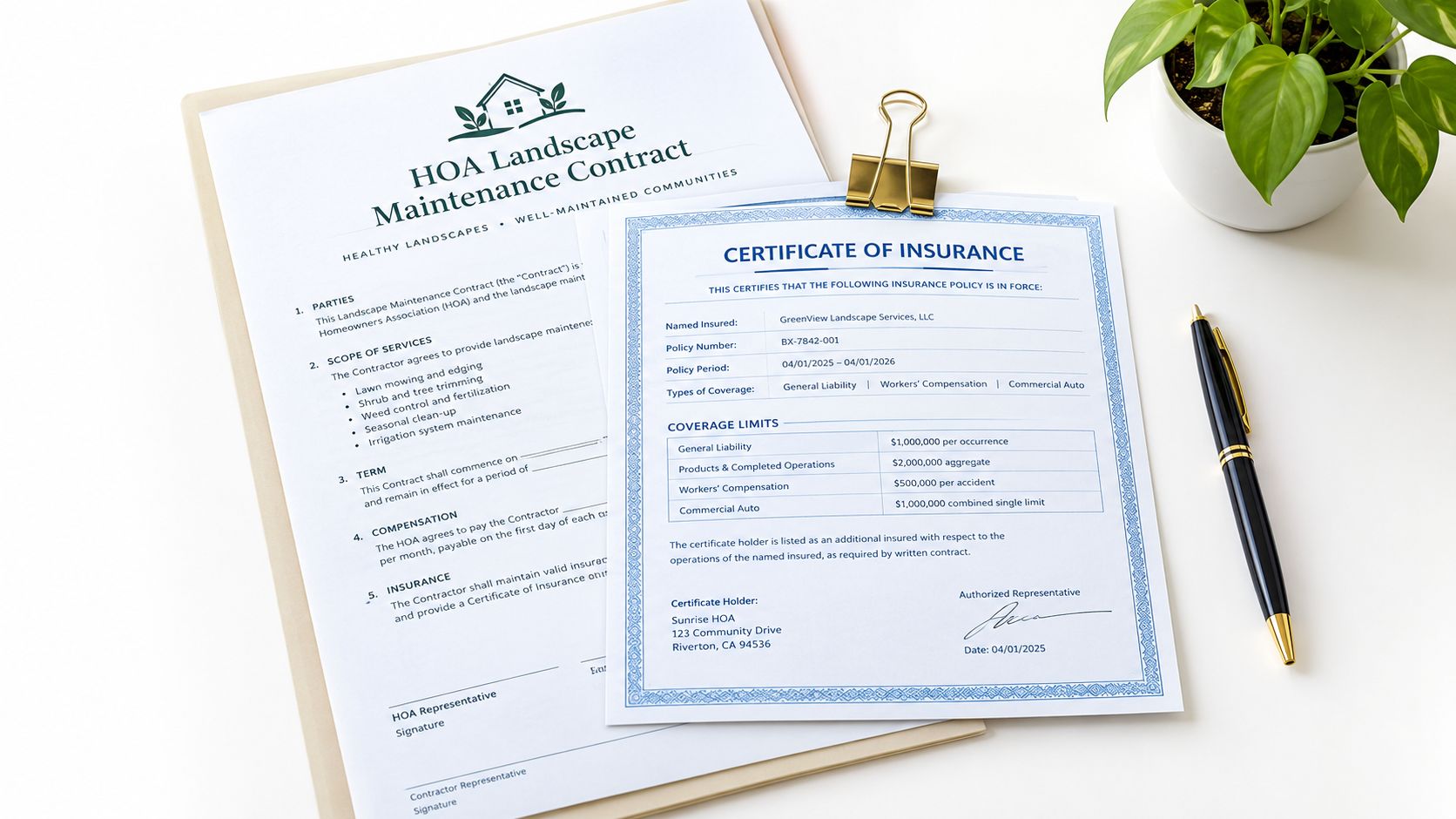
Require proof of general liability insurance and workers' compensation coverage before the contract is awarded and throughout the term. Many HOA-focused agreements also name the association as an additional insured on the liability policy. That endorsement matters because crews work on shared property where plant damage, vehicle incidents, injuries, and slip-and-fall claims can expose the association.
The contract should require a current certificate of insurance and identify who receives renewal documentation. The board shouldn't have to discover an expired policy after an incident.
Before approving a contractor, boards can use a practical checklist such as how to verify a contractor license. If the association uses standard forms, home service contract templates can help organize common sections, but a template still needs to be adapted to the community's actual site and governing documents.
Write remedies that work in the field
A useful agreement should address:
Inspection cadence: State when the property will be inspected, who records results, and how the vendor receives notice.
Cure periods: Give the contractor a reasonable, defined opportunity to correct an included service failure.
Documentation: Require service reports, irrigation observations, photos when appropriate, and records of approved extra work.
Weather adjustments: Explain when rain, freeze, drought, wildfire conditions, or storms may change the schedule and what notice the vendor must provide.
Termination rights: Define what repeated or serious nonperformance allows the HOA to do, including notice, cure, and termination procedures.
Warranty expectations: Clarify warranties for approved plant replacements, repair work, or installation-related items, without treating routine maintenance as a blanket plant guarantee.
Compare these two clauses:
Weak: “The contractor will maintain the landscaping in a professional manner.”
Stronger: “The contractor will perform the listed services at the frequencies in the seasonal schedule, document irrigation inspections, report conditions requiring approval, and correct included deficiencies within the stated cure period after written notice.”
For multi-year arrangements, independent HOA guidance recommends a 2 to 3 year term with an annual escalation cap of 3% to 5%, tied to CPI or a fixed rate, to reduce budget shock and vendor churn. The cap should apply only to clearly identified base services, while approved unit-priced work remains separately visible.
How to Inspect, Report, and Escalate Problems
A contract can't protect the HOA if nobody can show what happened. The most effective inspection system is simple enough to use consistently and specific enough to support a fair conversation with the vendor.
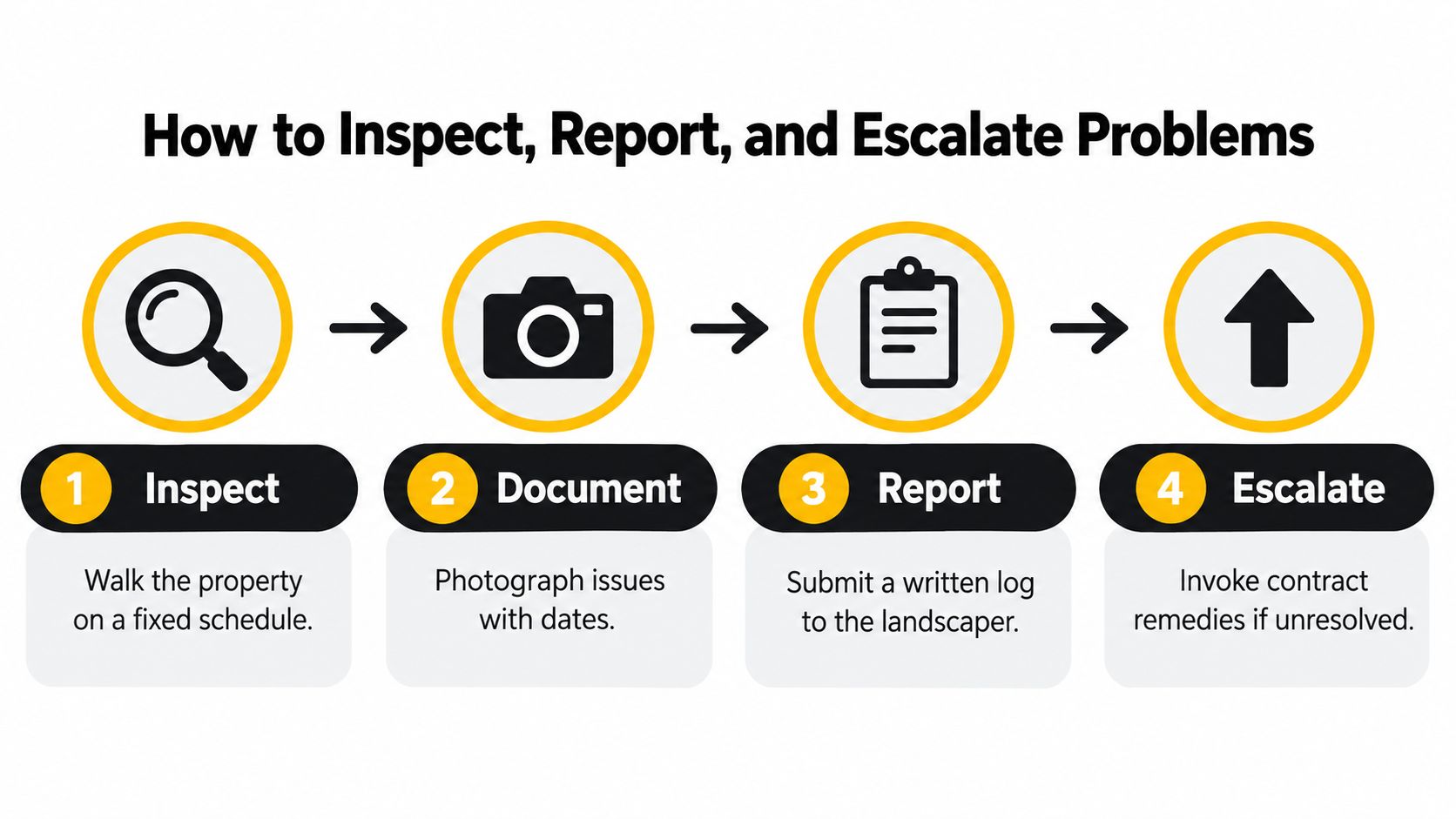
Use one repeatable inspection record
Walk the property on a fixed schedule and inspect the same zones in the same order. A board member, manager, or designated site representative can use a simple status such as acceptable, needs correction, or urgent. The value isn't the label itself. The value is consistency.
Record:
Date and location: Identify the entrance, path, basin, turf zone, or amenity area.
Photographs: Take clear photos that show the condition and preserve the date.
Contract reference: Note the relevant scope item, frequency, quality standard, or exclusion.
Resident input: Log the complaint, location, date received, and whether it describes a recurring condition.
Vendor response: Save the reply, proposed correction, completion date, and any explanation.
Classification: Mark the issue as included, excluded, unclear, or separately priced.
A resident complaint is useful evidence, but it isn't automatically proof of a contract breach. The board should compare the complaint with the scope and inspection record before demanding a remedy.
Match the response to the pattern
One isolated miss may need a direct correction request. A repeated failure after notice requires a more formal response. A serious safety issue, property damage, or refusal to perform may justify immediate escalation under the agreement.
Use this decision path:
Correct: Contact the vendor in writing when the issue is included and appears isolated.
Escalate: Issue formal notice when the same deficiency repeats, the cure period expires, or the response is inadequate.
Rebid: Seek competing proposals when performance remains unreliable, pricing no longer matches the scope, or the vendor can't provide a workable correction plan.
Replace: Follow the termination provisions when the failure is serious, persistent, or damaging to the association's interests.
The board should avoid emotional vendor changes based on one frustrating email. It should also avoid endless informal warnings when the record shows a repeated pattern. Evidence gives the board a defensible middle course.
A visual process can help managers train volunteers and maintain consistency across board turnover. The following video offers another way to think about field documentation and escalation:
Pricing Structures That Keep Budgets Predictable
The cleanest proposal separates predictable work from variable work. A flat monthly fee can cover defined base services, while unit pricing handles items that change with the site or season. That structure gives the HOA a stable operating number without pretending every site need is identical each month.
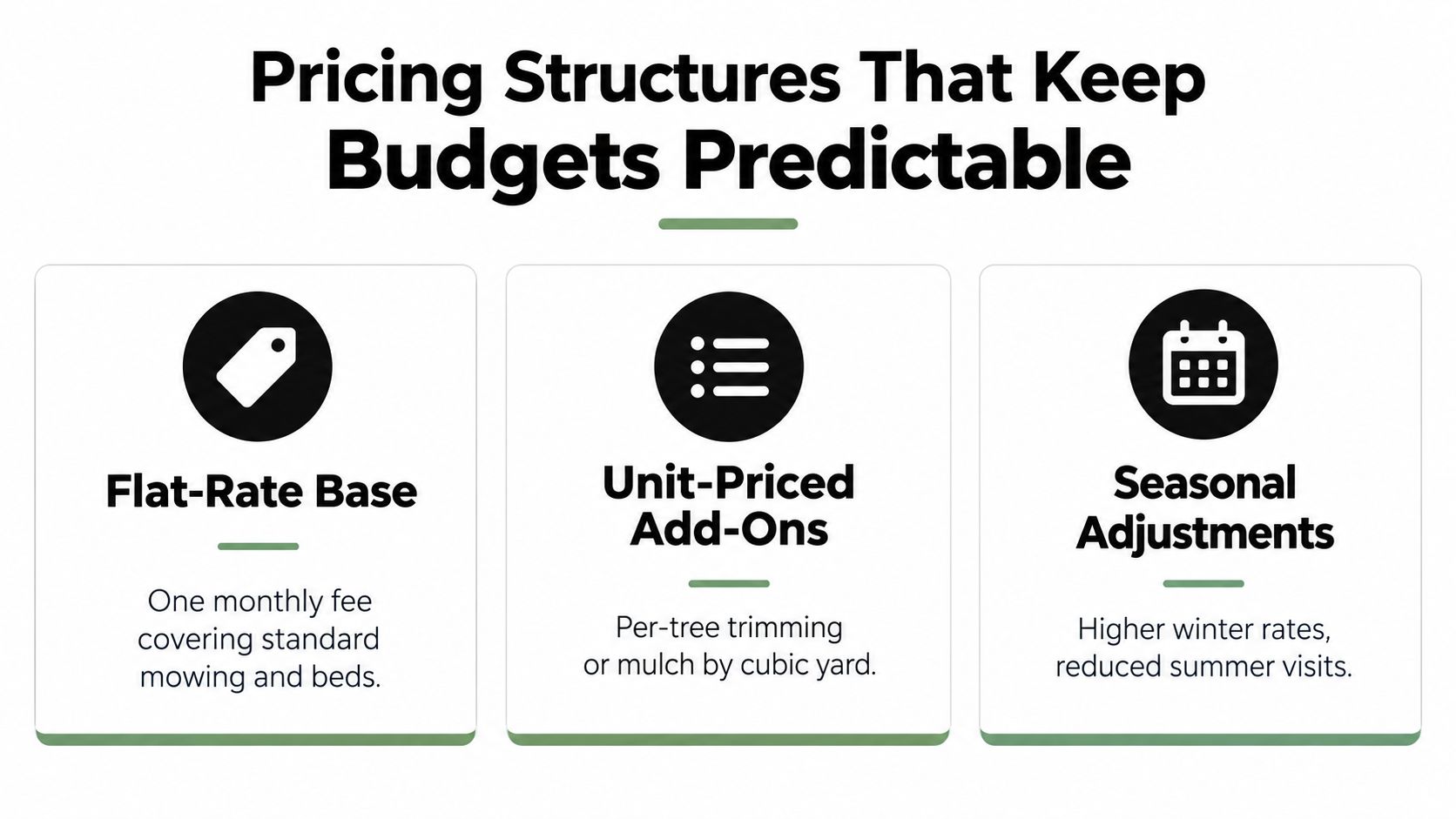
Compare the three useful models
Pricing Model | Best Use | Main Trade-off |
|---|---|---|
Flat-rate base | Routine mowing, edging, bed care, blowing, and defined inspections | Predictable, but only works when the base scope is precise. |
Unit-priced add-ons | Per-tree pruning, mulch, plant replacement, repairs, or storm cleanup | Transparent for variable work, but the board must approve and track quantities. |
Seasonal adjustments | Changes in visit frequency, irrigation attention, or seasonal services | Reflects actual conditions, but the schedule and triggers must be written clearly. |
For example, a proposal might include a flat base for routine common-area care, then list mulch by unit, tree work by size or location, and storm cleanup under a separate approved rate. That is more useful than an “all-inclusive” promise that later produces disputed invoices.
Boards comparing bids should create a side-by-side worksheet. Put every scope category in one column, then show whether each vendor includes it, excludes it, prices it by unit, or leaves it unclear. A proposal that appears inexpensive may just omit irrigation inspections, seasonal cleanup, or repair responsibilities.
Keep operating and reserve decisions separate
Routine care belongs in the operating budget. Major grounds capital items, such as irrigation-system replacement or significant replanting, belong in reserve planning when they meet the association's reserve criteria. One industry guide describes reserve components as major common-area assets with a predictable useful life and replacement cost exceeding a defined threshold, commonly $5,000 or more, and notes that industry practice often allocates 15% to 40% of annual assessment income to reserves, depending on the community, as outlined in this HOA budgeting and reserves resource.
Don't force a contractor to disguise a capital project as routine maintenance. Ask for a separate proposal, identify the funding source, and preserve the operating contract for recurring services.
Estimating platforms such as Exayard landscaping estimating software can help organize line items, quantities, and proposal comparisons. Boards can also use this practical reference on landscaping maintenance cost when preparing questions for vendors. The tool matters less than the discipline of comparing the same defined work.
Next Steps for Prescott HOA Boards
A Prescott-area HOA should not renew a grounds agreement until the board can answer four questions: What areas are included? What happens on each visit? Which costs are extra? How will performance be verified? If those answers aren't written down, the association is relying on assumptions that will eventually become a dispute.
Use this renewal checklist
Map the property: Mark entrances, turf, beds, paths, basins, frontage zones, irrigation areas, and amenities.
Review the last service term: Identify recurring complaints, missed tasks, disputed invoices, irrigation issues, and unresolved repairs.
Write the seasonal schedule: Account for local weather, water conditions, growing patterns, storm cleanup, and winter adjustments.
Separate pricing: Request a flat base, unit-priced add-ons, and clearly approved capital or restoration work.
Verify qualifications: Collect insurance documents, workers' compensation evidence, license information, references, and contact details.
Set inspection expectations: Name the responsible reviewer and require written service records.
Define the remedy: Include correction, notice, cure, rebid, and termination procedures.
The board doesn't need the longest agreement. It needs an agreement that a manager can administer and a vendor can perform without guessing. In Northern Arizona, that means the contract should reflect local irrigation realities and weather shifts rather than copy a generic schedule built for another climate.
R.E. and Sons Landscaping is a licensed, bonded, and insured Prescott-based company serving Prescott Valley, Chino Valley, and Northern Arizona. Its maintenance department supports ongoing outdoor grounds care, while the broader team also handles design-build work, artificial turf, putting greens, pavers, rock and stone work, water features, fireplaces, fire pits, outdoor kitchens, and bars. Office hours are Monday through Friday, 8am to 4pm, with consultations available online or by phone.
Frequently Asked Questions About HOA Landscape Contracts
How long should an HOA landscape contract run?
A 2 to 3 year term can support continuity when the scope is clear and the agreement includes an annual escalation cap of 3% to 5%, as recommended in HOA contract guidance at Effortless HOA. Shorter terms may make sense when the service has not been tested or the board is correcting a poor scope.
What should happen during drought or storm conditions?
The contract should state which irrigation duties remain active, how visits change, what notice the vendor must provide, and how storm cleanup is priced and scheduled. Don't leave water restrictions or emergency response to informal conversations.
How should the board handle resident complaints?
Log the date, location, photos, complaint details, and relevant contract section. Then determine whether the issue is included, excluded, unclear, or separately priced before requesting a correction.
When should the HOA rebid instead of renegotiating?
Rebid when documented problems repeat, the vendor can't meet the written scope, pricing is no longer comparable, or the correction process has failed. Renegotiate when the relationship works and the issue is a clear scope gap that both parties can fix transparently.
R.E. and Sons Landscaping helps Prescott-area HOA boards define dependable maintenance scopes, coordinate ongoing yard care, and plan improvements that fit Northern Arizona conditions. Review your current contract before renewal, then visit R.E. and Sons Landscaping to schedule a consultation or discuss a clearer maintenance plan with the team.
Comments