
How to Choose a Backyard Putting Green Contractor
You've decided a backyard putting green belongs in the yard, searched for a backyard putting green contractor, and now you're looking at a confusing mix of national franchises, turf companies, and one-person crews advertising from a pickup truck. The price may look simple on the screen. The jobsite is not. A green that rolls well depends on excavation, grading, drainage, compaction, turf selection, seaming, and infill calibration.
R.E. and Sons Landscaping is a Prescott-based design-build landscaping company serving Prescott, Prescott Valley, Chino Valley, Dewey-Humboldt, and nearby Northern Arizona communities. The team designs and installs artificial turf and custom putting greens, along with the surrounding patios, stonework, fire features, and outdoor living elements that make the green fit the property.
A poor hire can leave you with monsoon washouts, a soft base over hard caliche, a surface that loses true roll by the second summer, or a warranty that becomes difficult to enforce after payment. Protect your money in the right order: verify the contractor, evaluate the site, choose the turf and base system, then review the estimate and warranty before you sign.
Why Prescott Homeowners Need a Qualified Putting Green Contractor
Prescott yards create challenges that a generic turf installation checklist won't catch. A site may look level until a summer storm sends water across it. Compacted native soil and caliche can hold water below the surface, while roof downspouts or irrigation runoff can direct flow toward the proposed green. If the crew installs turf before solving those conditions, the finished surface inherits the problem.
What goes wrong after a poor installation
The visible turf is only the playing surface. Underneath, the contractor needs a stable, properly shaped base that supports consistent ball roll and moves water away from the green. USGA guidance describes a drainage-first process that includes excavation, grading, compacted aggregate, and a perforated drainage network, with main drains placed along the maximum fall and lateral drains spaced according to site conditions (USGA putting green construction guidance).
Northern Arizona weather makes the sequence especially important. Monsoon bursts expose low pockets, weak edges, and poorly compacted aggregate quickly. A contractor who only measures square footage and shows turf samples isn't evaluating the part of the project that determines whether the green stays firm and playable.
What a local contractor should handle
A qualified crew should discuss:
Runoff: Where stormwater travels from roofs, driveways, irrigation zones, and adjacent slopes.
Subsoil: Whether the crew expects caliche, clay-heavy soil, rock, or previously disturbed fill.
Playing design: Cup placement, contours, fringe, approach shots, and how the green connects to the rest of the yard.
Future work: Whether a patio, retaining wall, outdoor kitchen, or planting bed may alter drainage later.
Professional crews commonly complete a high-quality residential green in about 1 to 5 days, although complex sites can take longer (putting green installation trends and timelines). The schedule matters less than the order of work. Don't accept a fast completion promise if the contractor can't explain the base and drainage plan.
Credentials and Reputation Signals to Verify Before You Call
Before requesting a quote, run a basic verification check. You're not being difficult. You're confirming that the company responsible for excavation, drainage, and turf work has an identifiable business, proper coverage, and a history you can investigate.
Start with the Arizona license
Use the Arizona Registrar of Contractors to confirm the license is active, review any disciplinary information, and check that the classification fits the work being proposed. A broad landscaping description shouldn't replace a clear explanation of who is responsible for grading, drainage, base construction, and turf installation.
R.E. and Sons Landscaping lists Arizona ROC #300642 and identifies itself as licensed, bonded, and insured. You can also use this guide to verifying a contractor license before you invite a company to bid.
Verify insurance, not just the word insured
Ask for a current Certificate of Insurance. It should show general liability coverage and workers' compensation, with the carrier and broker information visible. As a practical screening benchmark, many homeowners look for $1 million per occurrence and $2 million aggregate in general liability coverage, but the certificate still needs to be confirmed with the listed broker.
Call the broker. Confirm the policy is active and hasn't been cancelled. This step matters because a certificate handed to you months ago doesn't prove current coverage.
Look for reputation that survives time
A polished website is useful, but it isn't enough. Check the Google Business profile, the physical address, the age of reviews, and whether customers describe the actual work being performed. A profile with 40 or more reviews and an average above 4.5 stars can be a useful signal, but read the comments for recurring complaints about drainage, cleanup, callbacks, or unfinished punch lists.
Ask for references from greens installed at least three years ago. Recent customers can tell you about the sales process. Older customers can tell you whether seams remain tight, infill stays level, drainage works after storms, and the contractor answers calls after the check clears.
For broader contractor-screening ideas, this contractor help from XTREME EDEALS INC. can provide another reference point. Manufacturer training or certifications from brands such as Southwest Greens or Tour Greens may also help, but they don't replace a local jobsite review and direct customer references.
What a Real Site Evaluation Should Look Like
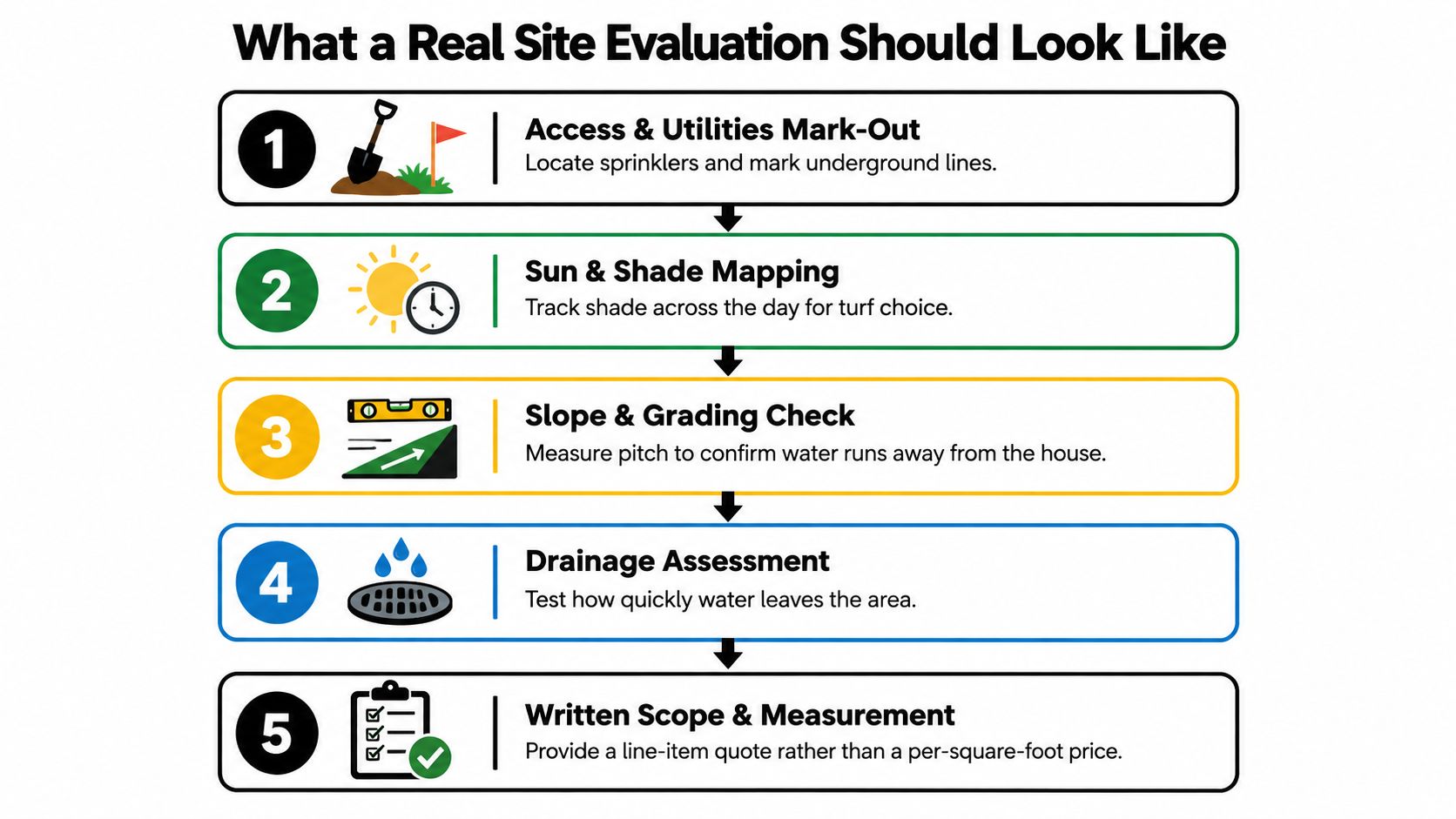
A real evaluation feels like a construction meeting, not a sales measurement. The contractor should spend time understanding how you'll use the green and how water behaves on the property before presenting a price.
The walkthrough starts with play
Expect questions about your putting habits. Do you practice mostly right-handed or left-handed strokes? How much distance do you want to work on? Do you want one cup or several? Do you want a fringe for chipping? Will the green connect to a future patio, pathway, or planting area?
Those answers affect the shape, approach zones, cup locations, and amount of fringe. A contractor who ignores use and only asks for the desired square footage is designing a rectangle, not a practice surface.
Drainage questions separate professionals from resellers
The contractor should identify where monsoon runoff crosses the yard, whether downspouts discharge near the green, and which direction existing water moves. Ask how the crew will handle caliche or clay-heavy soil if a test dig finds a restrictive layer.
A sound design generally uses a gentle 1% to 3% slope, equal to about one-eighth to three-eighths of an inch per foot of run, so water leaves without creating an obvious ball-roll distortion (backyard putting green grading guidance). On flat or poorly draining sites, perforated pipe within gravel or a French drain may be necessary (artificial putting green drainage guidance).
What you should see before accepting the quote
The contractor should perform a soil probe or test dig, identify the subgrade, and explain the proposed base. A residential plan may call for 4 to 6 inches of compacted decomposed granite, but the actual depth should reflect soil, slope, drainage, access, and the selected turf system.
You should also receive a sketch showing the green outline, contours, cup locations, fringe, swales, and drainage exit. If the contractor hasn't probed, sketched, or discussed runoff, don't hire them yet.
Choosing the Right Turf System and Base for Your Yard
Turf should be selected after the site and intended use are understood. In Prescott, sun exposure, heat, caliche, clay, and maintenance expectations matter more than a salesperson's favorite brand.
Compare the base choices
Crushed decomposed granite suits many residential yards because crews can shape it into putting contours and compact it into a firm, free-draining foundation. Compacted road base makes sense where the project needs a more structural aggregate layer or where the existing ground requires stronger support. Concrete or asphalt pads can work for a deliberately hard, engineered surface, but they demand careful planning for drainage, transitions, heat, and future changes.
For synthetic greens, USGA material describes compacted aggregate base layers of 6 to 8 inches, while contractor guidance also uses crushed-stone bases of 2 to 4 or more inches, depending on the system and site (USGA backyard putting green construction guidance). Don't accept a base specification without asking why it fits your soil and turf.
Match fiber and infill to use
Nylon putting surfaces generally prioritize a crisp, controlled roll. Texturized polyethylene can provide a softer residential feel, while polypropylene may suit simpler or more budget-conscious applications. Fiber profile, pile height, infill, and base firmness work together, so comparing a single sample in a showroom won't tell you how the finished green will perform.
For many Northern Arizona installations, sand-only infill is the sensible default. Rubber can retain more heat, while acrylic-coated sand may offer specialized performance but increases system complexity. The contractor should explain how silica sand, rubber, or coated sand affects roll, temperature, dust movement, grooming, and replenishment.
Option | Best For | Ball Roll Speed | Heat Behavior | Typical Cost Per Sq Ft |
|---|---|---|---|---|
Nylon putting surface | Practice-focused greens requiring a crisp roll | Faster, more controlled | Can feel hot in direct sun | Varies by system and site |
Texturized polyethylene | Comfortable residential play and integrated landscape use | Moderate and forgiving | Can retain substantial heat in full sun | Varies by system and site |
Polypropylene | Simpler practice areas and tighter budgets | Moderate, dependent on infill | Requires site-specific heat review | Varies by system and site |
Compacted DG base | Contoured residential yards | Supports consistent roll when properly compacted | Base choice doesn't eliminate surface heat | Varies by excavation and material needs |
Road base | Sites needing stronger structural support | Stable when properly graded | Surface temperature depends mainly on turf and exposure | Varies by system and site |
Review the contractor's best artificial grass putting green guidance, and learn basic proper divot repair guidance if your design includes natural-grass practice areas or chipping zones.
The Installation Process and What Each Day Should Look Like
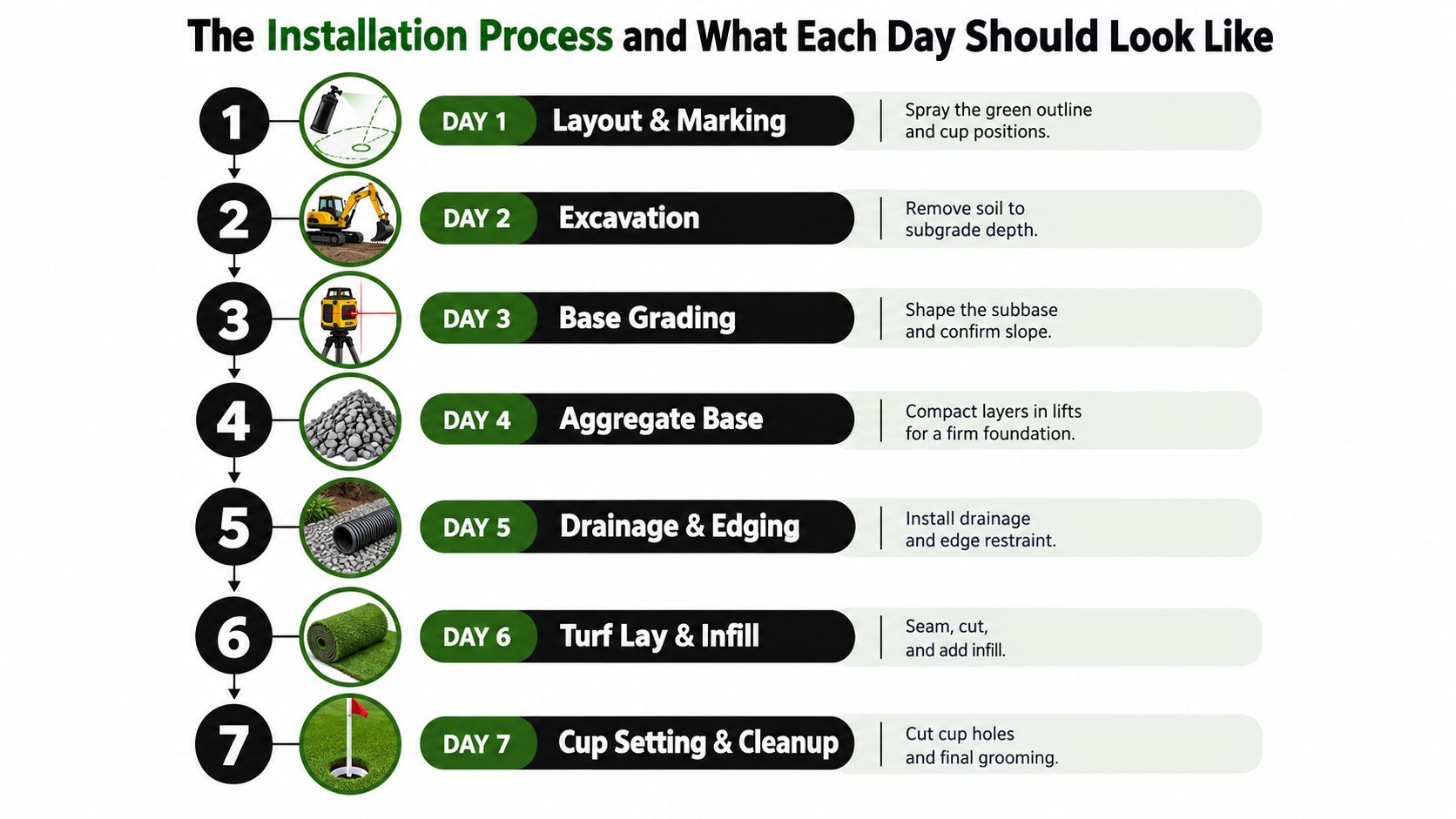
A professional build has a visible sequence. You should know what the crew is doing, what remains unfinished, and what condition the property will be left in at the end of each workday.
The early work establishes performance
The crew begins by marking the layout, cup locations, access route, utilities, and protection areas. Excavation follows, often reaching 4 to 8 inches below the existing surface, though the actual depth depends on the proposed assembly and site conditions.
After excavation, the crew installs geotextile fabric where appropriate, places aggregate in lifts, and compacts each lift with repeated plate-compactor passes. The base should be shaped toward daylight drainage, and the lead installer should verify the fall before turf covers the work.
What the later stages should show
Drainage and edge restraint need to be installed before the turf is finalized. The crew then lays and seams the turf, cuts the perimeter, sets the cups, and adds infill in controlled passes. The finished infill should support the fibers without burying them. Practical guidance places final infill at 0.5 to 1.5 pounds per square foot, with the infill surface about 1/16 to 1/8 inch below the fiber tips (USGA infill and maintenance guidance).
At the end of each day, spoil piles should be contained, access routes should be safe, and open excavations should be secured. Ask the lead installer what was compacted, where water will exit, and whether the measured slope matches the approved sketch. For general turf installation practices, this professional sod installation guidance offers useful context about preparation and finishing discipline.
Use this video as a visual reference for the installation sequence:
Understanding Cost, Timeline, and What Your Estimate Should Include
A contractor-installed backyard putting green commonly costs about $15 to $40 per square foot, while a higher-end bentgrass green may run $18 to $20 per square foot. At those price points, a 250-square-foot green often lands around $3,750 to $10,000 before grading, cups, surrounding hardscape, and other add-ons (backyard putting green cost baseline).
Don't treat the low end as a promise. Small greens can carry more mobilization and access cost per square foot, while complex contours, drainage, retaining work, rock excavation, and difficult material access can move the total upward.
What belongs in a written estimate
A legitimate estimate should identify the work rather than hide it inside a single allowance.
Line Item | Why It Matters | Typical Share of Total |
|---|---|---|
Site preparation | Identifies clearing, protection, access, and surface conditions | Must be itemized, not hidden |
Excavation and haul-away | Shows how subgrade work and spoil removal are handled | Depends on depth and soil |
Base material and compaction | Establishes the foundation for roll and durability | Depends on aggregate specification |
Drainage | Explains how water leaves the green | Site-specific |
Turf and infill | Defines fiber, system, color, and finishing material | Depends on selected system |
Cups and flags | Clarifies hardware quantity and installation | Depends on design |
Edging and transitions | Prevents loose edges and unfinished borders | Depends on surrounding landscape |
Add-ons | Separates plumbing, electrical, hardscape, and access work | Quoted separately |
Review this putting green installation cost guide with the contractor and ask what is included in each line. Tie-in rerouting, electrical work, restricted access, extra excavation, and drainage outlets should never appear as vague allowances that can expand without a clear approval process.
Most residential projects take 2 to 4 days, with a weather buffer during monsoon season. The contractor should state the anticipated schedule, what could delay it, and how change orders are authorized.
Red Flags, Warranty Traps, and Questions That Protect Your Investment
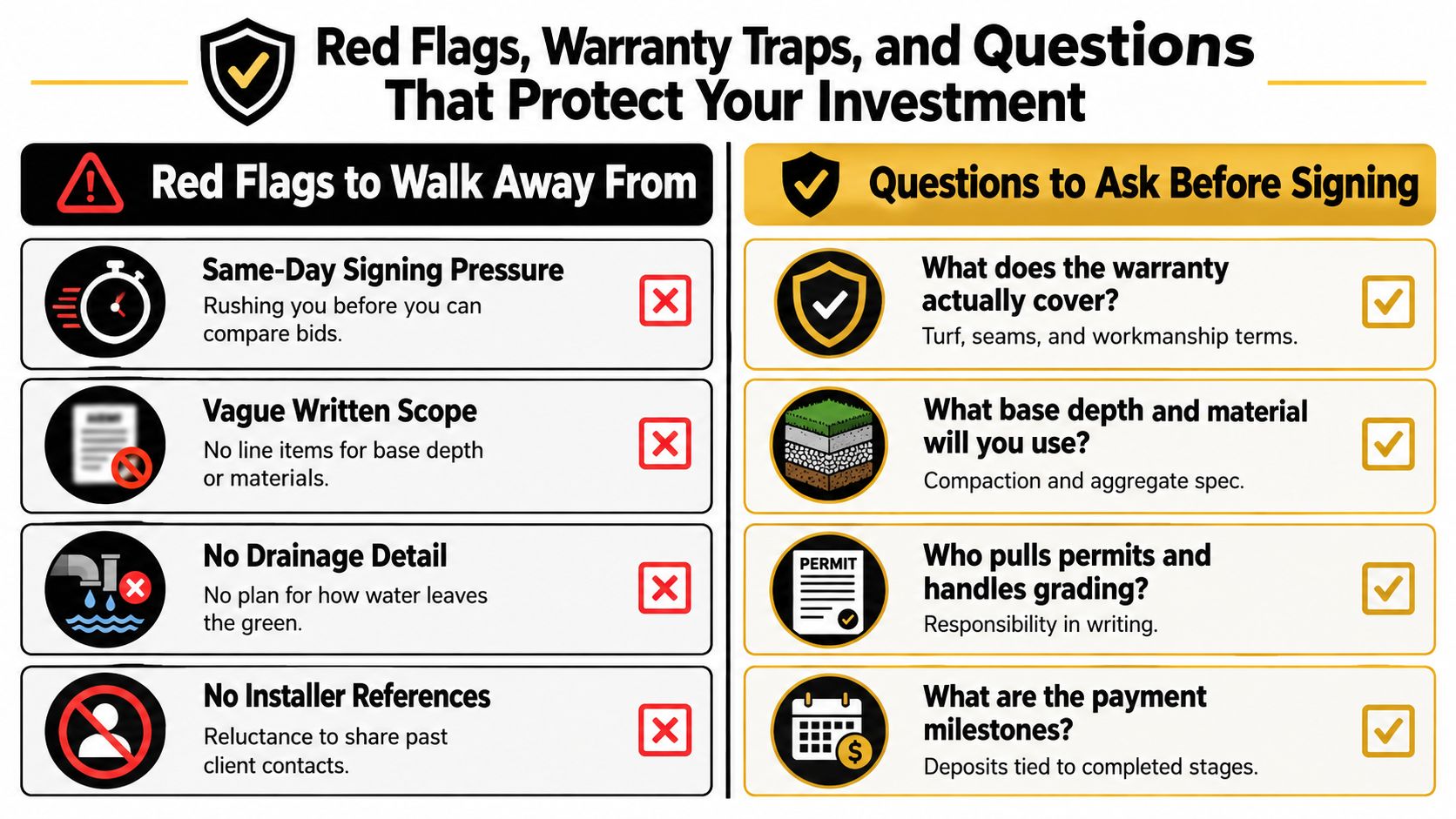
The contractor who pressures you to sign today is usually asking you to skip the comparison that protects you. Walk away from a bid with no drainage detail, no line-item scope, or no willingness to provide older installer references.
Read the warranty by component
Turf coverage and installation workmanship are different obligations. Manufacturer turf warranties commonly run 8 to 15 years, while workmanship coverage for seams and the base is often only 1 to 3 years. Read whether the coverage is prorated or non-prorated, what labor is included, and who pays for removal, repair, infill replacement, and travel if a claim is accepted.
A clause blaming every issue on “site conditions” can swallow the contractor's responsibility. The contract should identify which conditions the contractor inspected, which conditions remain unknown, and how additional work receives written approval.
Ask these questions before signing
What is the seam warranty in writing? Ask whether labor, materials, infill, and removal are included.
Who handles monsoon repairs? Get the response process and responsibility for washouts or edge damage.
What is the response window for settling issues? The contract should define how quickly the contractor inspects a reported problem.
Is the deposit refundable? Review cancellation terms and whether the deposit covers committed materials.
Can you name three clients with installs older than five years? Older references reveal how the surface performs beyond the sales period.
Avoid unbalanced cancellation fees, holdback releases tied only to verbal approval, and payment schedules that demand the final balance before the punch list is complete. Keep the signed contract, material lot numbers, infill quantities, approved drawings, and pre-installation site photos in one file.
Practical rule: If the contractor can't explain how water leaves the green, don't negotiate the price yet. Fix the scope first.
R.E. and Sons Landscaping offers site-specific design and installation for custom backyard putting greens, including grading, drainage, aggregate bases, turf, infill, edging, and cup placement in Prescott and nearby Northern Arizona communities. Visit R.E. and Sons Landscaping to request a consultation and discuss your yard before you commit to a contractor or estimate.
Comments