
What Is River Rock Stone? Sizes, Uses and Limits
River rock stone is water-rounded rock made from many minerals, not one stone type, with common products ranging from 1 to 3 inches. R.E. and Sons Landscaping helps homeowners in Prescott, Prescott Valley, Chino Valley, and nearby Northern Arizona communities match that stone to drainage, foot traffic, color, and upkeep.
But if a stone looks smooth and substantial, does that mean it'll stay put when runoff crosses the yard? Not necessarily. The rounded shape that makes river rock attractive also makes it easier to roll, while sun exposure can make a broad stone bed uncomfortable beside a patio or pet area.
What River Rock Stone Is in a Prescott Yard
River rock is a product name, not a geological identity. It describes fragments that moving water has worn into rounded, oval, or egg-shaped pieces. The U.S. Geological Survey's geological thesaurus describes gravel as a loose accumulation of predominantly rounded pebbles and small stones, and fluvial sediment as material transported or deposited by running water.
That distinction matters when you're choosing material for a Prescott yard. A load might contain granite, quartzite, basalt, sandstone, limestone, or a mixture from an alluvial deposit. Those stones don't necessarily share the same hardness, density, or resistance to weathering, even when their outlines look alike.
For a homeowner, the useful question isn't just “What is river rock stone?” It's “What will this particular load do where I'm putting it?” A decorative border beside a patio has different demands from a downspout outlet or a dry creek carrying water across the property.
What does the bag label actually tell you?
A river-rock label usually tells you something about appearance and a nominal size range. It doesn't establish a universal construction specification, guarantee the source geology, or confirm that the material suits a walking surface.
Before ordering, identify these project conditions:
Water exposure: Is this an accent bed, a splash zone, or an active runoff route?
Traffic: Will people cross it occasionally, push a wheelbarrow over it, or walk there daily?
Containment: Can edging hold the material, or does the location slope toward lawn, pavement, or a drain?
Material source: Is the load a consistent stone type or a mixed deposit?
A bark-covered bed that repeatedly loses material to wind may be a candidate for stone, but that doesn't make every rounded product suitable. Plant needs, reflected heat, access, and drainage still govern the choice.
Buying rule: Treat “river rock” as the start of the specification, not the finished specification.
For homeowners around Prescott Valley and Chino Valley, the practical approach is to choose the job first, then the diameter, containment, and palette. Use the size chart to narrow the material before buying on color or a bag name.
River Rock Sizes Depths and Landscape Jobs
River rock size, job, and planning depth
Size class | Diameter | Best landscape job | Depth or caution |
|---|---|---|---|
Small gravel | About 3/16 to 3/4 inch | French drains and trench fill | Can migrate into grates; not the default choice for surface mulch |
Washed drain rock | 3/4 to 1-1/2 inch | Drainage swales and some drain applications | Adequate for some drainage; still needs a shaped channel |
Decorative and path rock | 1 to 3 inches | Beds beside patios and light walkways | About 2,700 lb per cubic yard; plan 2 to 3 inches in beds and 3 to 4 inches in paths |
Runoff rock | 2 to 4 inches | Dry creek beds, swales, and surface runoff | Plan 4 to 6 inches; check stone stability against actual flow |
Cobbles | About 64 to 256 mm | Creek margins and accents | Hard to walk on; can roll on slopes |
The USGS aggregate guide places gravel at approximately 3/16 to 3 inches and identifies cobbles at about 64 to 256 mm. The NRCS Home Drainage Guide identifies approximately 3/4- to 1-1/2-inch washed drain rock as adequate for some drainage applications, not every channel or flow condition.
For decorative beds and light walkways, the O'Leary Development Group sizing guide commonly places stone in the 1-to-3-inch range, while 2-to-4-inch material suits dry creeks and surface runoff. A typical 1-to-3-inch product weighs approximately 2,700 pounds per cubic yard, according to Hello Gravel's river-rock product listing, so delivery access and placement matter before the truck arrives.
How should you read a size row?
Start with the outdoor project, not the diameter. Then check whether the caution disqualifies that material from your site.
A lightly used crossing through a decorative bed isn't equivalent to the route from the back door to an outdoor kitchen. Rounded stone can feel uneven under shoes, and a deeper loose layer won't automatically make it more comfortable. For frequent walking, a properly built paver surface may be the better decision.
If you're weighing paving against loose aggregate, Tiles Mate Pty Ltd.’s a paving guide for backyard renovations offers useful context on natural-stone paving choices. Use it to compare surface types, not as a Northern Arizona drainage specification.
What changes the selection during a storm?
Slope, flow concentration, and the outlet can override the chart. A material that behaves acceptably in a nearly level accent bed may move when a downspout directs water onto it.
A deeper layer isn't a substitute for adequately sized stone. Nor does choosing larger pieces eliminate the need to establish where water will discharge. The table's depths are planning allowances, not engineered channel dimensions.
For layout possibilities, these dry creek bed landscaping ideas can help connect a drainage route with the rest of the yard. Circle the row for the wettest, hardest-working location, not just the prettiest bed.
How Moving Water Rounds a Stone
Think of beach glass: sharp fragments become smoother through repeated movement and contact, not because someone applies polish. River stone develops through a comparable sequence of impacts, chipping, and abrasion.
The diagram follows a fragment from broken rock to rounded stone.
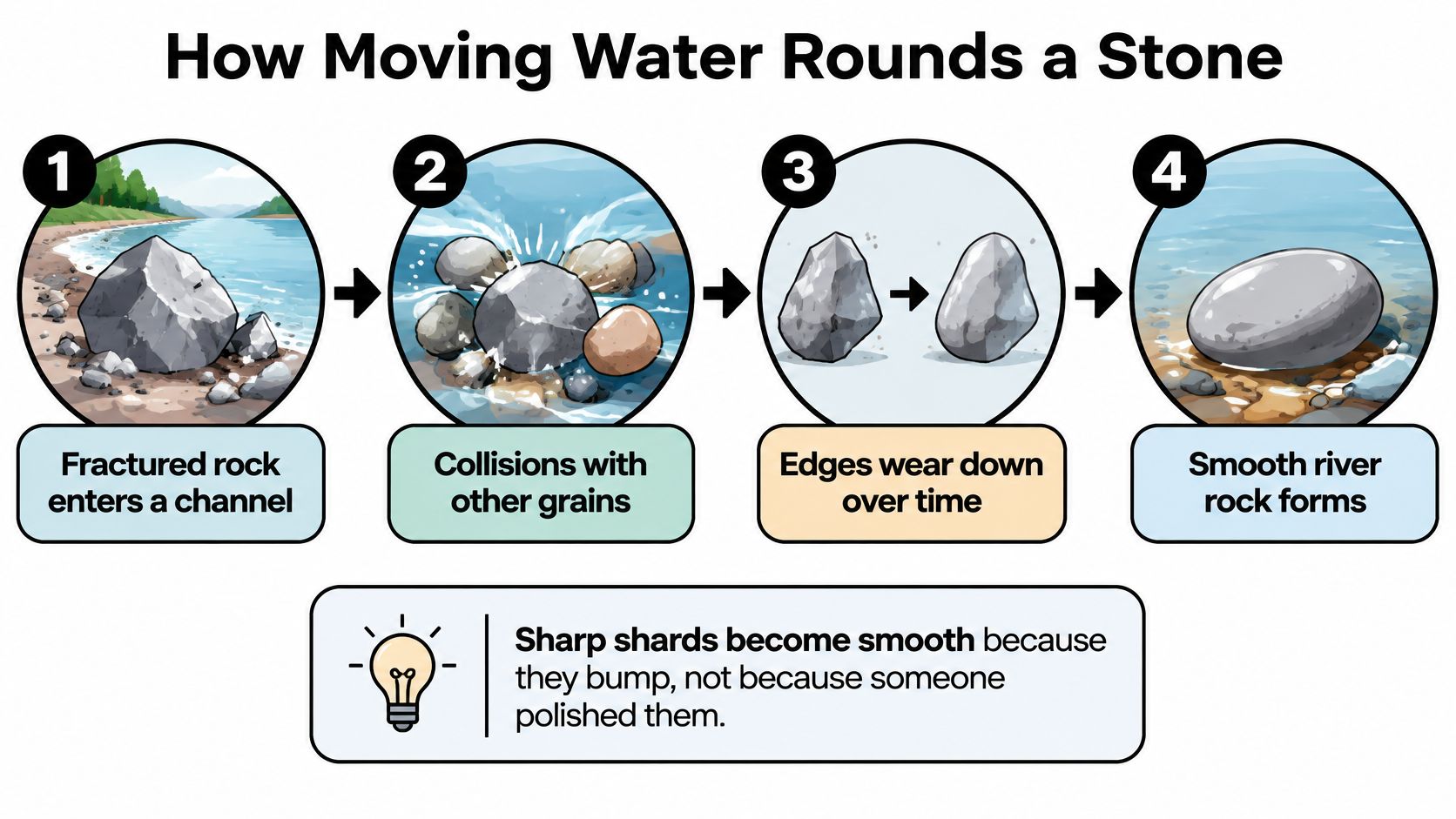
Why do corners disappear before the stone gets much shorter?
A fractured piece enters a channel with projecting corners and irregular surfaces. As flowing water moves it against other particles and the channel floor, those projections take repeated impacts.
The rounding process has two stages: projecting edges wear away first, then continued abrasion gradually reduces the dimensions of the smoother, convex particle. Experimental and modeling work discussed in Earth Surface Dynamics indicates that as much as 50% of a pebble's mass can be lost during initial rounding while its effective axis-based size remains approximately constant.
That doesn't mean every landscaping stone has lost that amount. It means length and width alone don't describe the material removed from corners. Stones with similar outside dimensions can occupy different volumes, and their parent rocks can have different densities.
Does every rock round at the same rate?
No. The physical properties of the source rock affect how readily it chips and wears. A study of downstream pebble-shape changes in Himalayan rivers found increasing roundness with transport distance, with the rate depending on lithology.
The mechanism is impact attrition, with collisions producing shallow cracks and chips rather than instantly turning a whole stone into powder. Flow also sorts the material: stronger water can transport larger fragments, while quieter sections deposit material they can no longer carry.
This video provides another view of moving water and sediment.
For yard work, the important endpoint is a rounded surface with limited mechanical interlock. It's attractive along a creek margin, but there are fewer corners to resist movement on a grade.
A polished appearance tells you about the surface. It doesn't establish load capacity, stability, or durability.
Mechanically tumbled quarry stone can imitate this appearance. Ask how the product was produced if natural river origin matters to the design.
Colors Minerals and Why the Source Matters
Color helps you choose a palette, but it doesn't certify performance. Water-transported sediment can differ substantially in texture, composition, and hardness, as the USGS water-science glossary explains through its definitions of sediment and fluvial material.
A mixed load can work beautifully beside informal planting and pines. The same combination may look busy against patterned pavers, brick, and several stucco colors. That's a design decision, not a quality ranking.
What can the parent rock tell you?
Use these traits as starting points, then inspect the actual product rather than identifying stone by color alone.
Parent rock | Common visual character | What to check before buying |
|---|---|---|
Basalt | Dark gray to black | Surface condition, fractures, and consistency across the load |
Granite | Speckled or salt-and-pepper appearance | Whether the mix complements nearby paving and walls |
Quartzite | Often pale, with a hard-looking crystalline surface | Actual source identification rather than a color-based assumption |
Sandstone | Frequently warm tan or brown | Loose grains, dusty surfaces, and weakly cemented pieces |
Limestone | Often light gray, cream, or pale tan | Weathered surfaces and suitability for the exposure |
Mixed alluvial stone | Several colors and textures together | How much variation will arrive in the full delivery |
Granite and quartzite are commonly selected where durable stone is wanted, but fractures and weathering still matter. Sandstone can shed grains when its cement is weak, while limestone can respond differently to weathering than harder silicate-rich material. A smooth finish can hide those differences during a quick glance at the supplier's yard.
How do you match river rock to a Prescott home?
Take samples to the property and place them against the actual stucco, brick, pavers, and planting. Cool grays can simplify a busy facade; warm tans can tie stonework to soil colors and sandstone accents.
View it dry: Dust and dry surfaces can make a load appear lighter.
Wet a sample: Water often darkens stone and reveals contrasting colors.
Check the whole mix: A handful may miss the strongest reds, blacks, or whites in a blended product.
For fire-pit surrounds, use decorative stone outside the combustion area unless the product is specifically approved for direct heat. Choose the palette for the finished design, then verify that the material also meets its practical role.
River Rock Versus Other Decorative Stone
Material | Shape and lock | Best job | Water and heat behavior |
|---|---|---|---|
River rock | Rounded, weak interlock | Dry creeks, accents, drain surfaces | Voids pass water, but stones can roll; exposed rock gets hot |
Crushed angular stone | Angular, stronger interlock | Properly specified bases, slopes, and high-flow outlets | Better resistance to displacement; still heats in full sun |
Decomposed granite | Fine material that compacts | Paths and xeriscape ground cover | Walkable when prepared correctly; can crust, track, and erode in a channel |
Wood mulch | Organic, no structural lock | Plant beds needing soil protection | Cooler surface under the cited municipal guidance; decomposes and needs replenishment |
River rock is principally a surface and accent material, not a compacted structural base or a complete drainage system. Its rounded finish can suit a natural-looking creek, but angular aggregate generally provides better interlock where movement would damage the installation.
This comparison shows the distinction between decorative surfaces and structural aggregate.
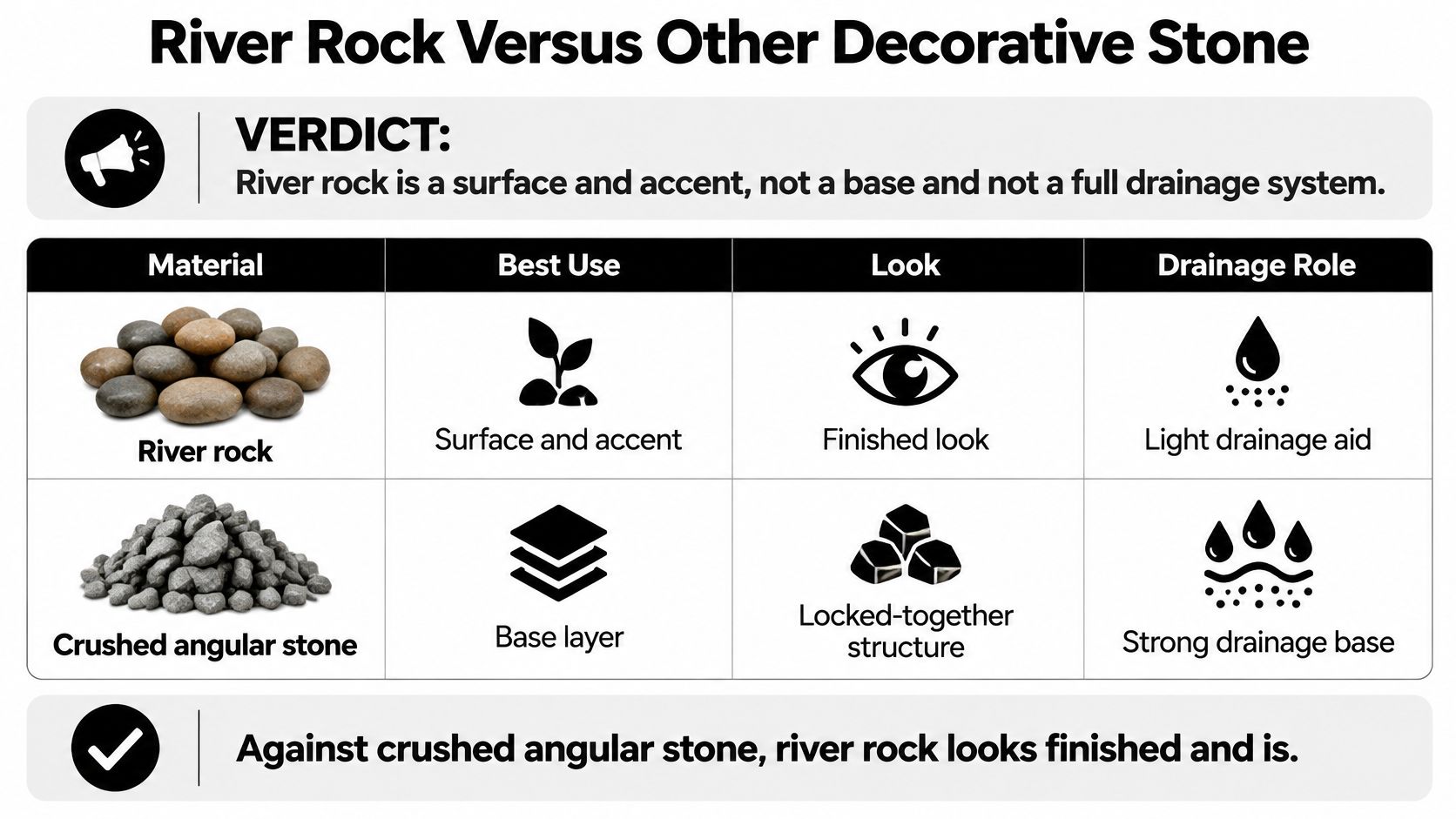
Which material works better where people walk?
Smooth stone has fewer sharp projections than crushed aggregate, but that doesn't make a loose river-rock bed a comfortable everyday path. Underfoot stability depends on the entire assembly, including particle shape, confinement, and preparation.
Angular material belongs beneath pavers when it meets the base specification. For a compacted informal path, consider the uses and limitations described in this guide to what decomposed granite is used for. Don't send concentrated roof runoff down a decomposed-granite walkway and expect the finish to remain undisturbed.
How hot does river rock get?
Municipal guidance from Round Rock's water-conservation program reports summer rock surfaces around 140 to 170°F, compared with about 80 to 85°F for wood-based mulch, and warns that rock can remain hot into the night. These are guidance figures, not a temperature forecast for a particular Prescott property.
The practical implication is clear: don't replace a shaded planting bed or comfortable play surface with a broad field of exposed stone without considering use. Beside a west-facing wall, a pet run, or a sitting area, reflected and stored heat can work against the outdoor space you're trying to create.
Design priority: Keep the places people touch and occupy comfortable. Use stone where its appearance and hydraulic role justify it.
Does rock coverage improve stormwater control?
Not automatically. Extensive rock coverage can increase runoff, and small pieces can collect at drain grates. Water passing between stones still needs somewhere to go beneath or beyond them.
A defined creek, drainage transition, or narrow accent is often more useful than an all-rock yard. In Northern Arizona, combine those features with shade-producing plants, appropriate planting-bed mulch, and stable circulation surfaces rather than asking one material to perform every job.
How to Install and Care for River Rock
Prepare the water route before spreading the finish material. A tidy-looking stone bed can conceal poor grading, and correcting that grading after delivery means moving heavy material twice.
Walk the water. During or just after rain, mark where roof and patio runoff travels. Observe from safe ground and photograph ponding, outlet scour, and water approaching the house.
Shape the bed or shallow channel toward an appropriate receiving area. Use a string line and level to check the route rather than assuming the existing ground falls in the right direction.
Compact disturbed subgrade. Remove loose organic debris and prepare the underlying soil so settlement doesn't create unexpected pockets. Avoid disturbing established roots merely to make an ornamental bed uniform.
Add a suitable separation geotextile where soil migration or persistent flow warrants it. Choose the fabric for the soil and hydraulic conditions; plastic sheeting isn't a substitute for a permeable separation layer.
Set durable edging. Metal, stone, or concrete borders help contain rounded pieces. Keep the border from becoming a dam across the intended water path.
Place the selected material to the planned depth without assuming more is always better. Mulch Mound's downspout-drainage guide gives planning ranges of 2 to 3 inches for decorative beds, 3 to 4 inches for paths, and 4 to 6 inches for drainage features.
Finish below adjoining lawn where appropriate. Keep the downspout splash-zone surface slightly recessed so loose stone doesn't create mower strikes or an abrupt walking edge.
Leave drain grates visible and accessible. Don't bury an intake under decorative gravel or block access needed for cleaning.
The installation sequence depends on keeping the intended route open.
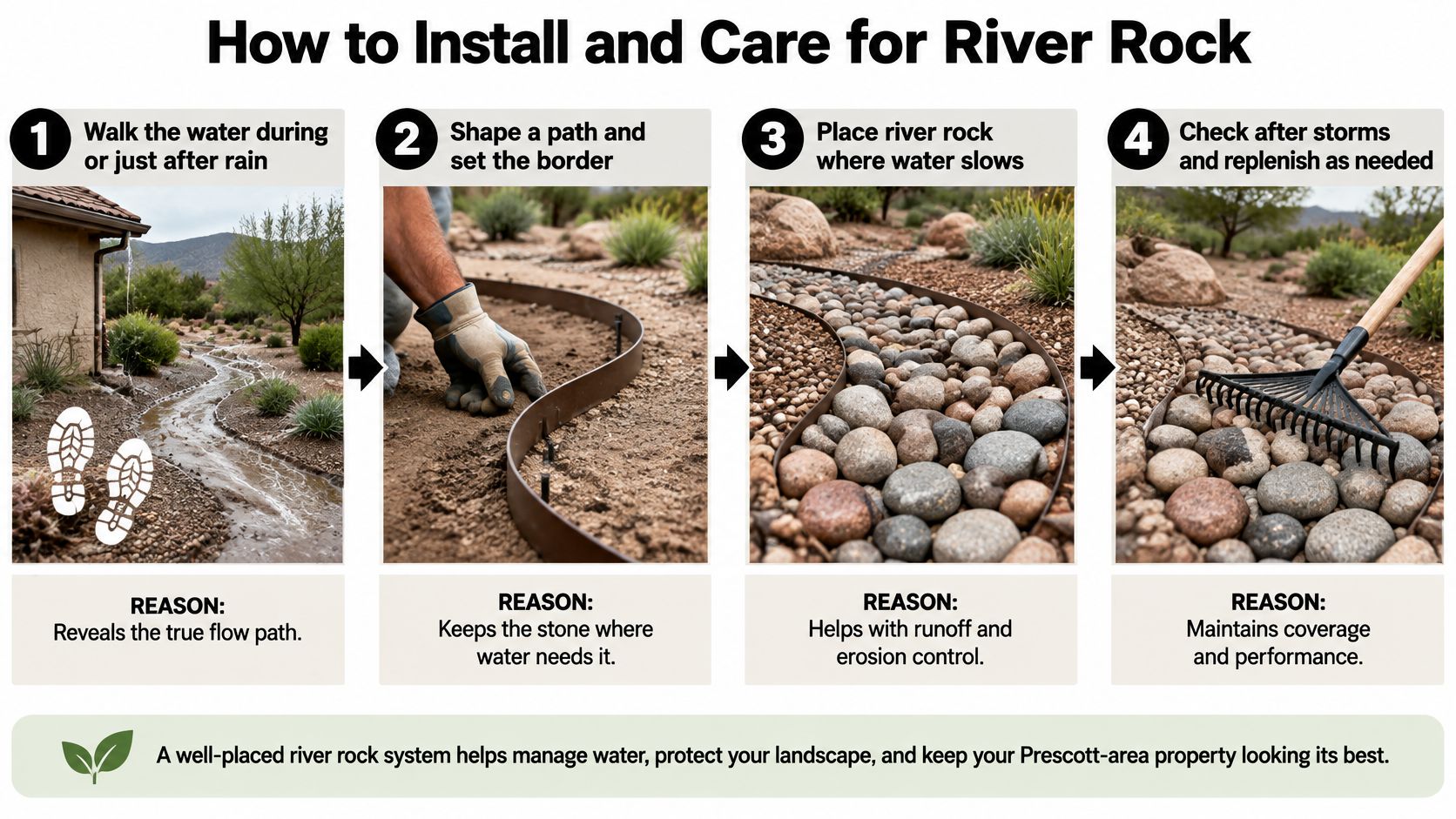
What maintenance actually matters?
Blow leaves off with controlled airflow rather than aggressively raking stones onto nearby paving. Pull weeds while they're small, clear grates, and inspect the outlet after strong monsoon runoff.
Reset displaced pieces before ordering more material. Repeated movement calls for a design correction, not endless topping up; these rock erosion-control considerations help distinguish surface repair from an underlying flow problem.
A maintenance crew can include those checks in ongoing property care. These steps finish and maintain a designed water path; they don't replace a stormwater system when the volume or consequences require professional drainage design.
Frequently Asked Questions About River Rock
Will river rock stop weeds?
No, river rock won't make a bed permanently weed-free. Windblown dust and decomposing leaves collect between stones, giving seeds a place to germinate above any fabric, so debris removal, intact edging, and occasional pulling still matter.
Is river rock comfortable for dogs and children?
It can suit a short crossing, but it isn't the default choice for a play area or pet run. Loose cobbles can shift, small gravel can lodge around paws, and sun-exposed stone can become uncomfortable, so choose a purpose-built surface and provide shade where children and animals spend time.
Is tumbled quarry rock the same thing?
It can look similar, but mechanical tumbling and natural river transport are different processes. If a supplier sells tumbled stone as a rounded decorative product, judge its composition, sizing, and intended application rather than assuming the finish proves river origin or long-term stability.
Can I just spread river rock over bare soil?
Not as a reliable drainage fix. First remove weeds and debris, establish the grade and outlet, and determine whether separation fabric, containment, or an underlying drainage assembly is needed; otherwise, the finished bed may hide ponding or lose material during runoff.
Choose river rock for a defined creek, drain transition, or restrained accent that complements the house. Choose a properly specified angular aggregate, compacted decomposed granite, or paving where structural stability and regular walking are the main demands.
R.E. and Sons Landscaping offers design-build, rock and stone installation, and ongoing maintenance for homeowners in Prescott, Prescott Valley, Chino Valley, and nearby Northern Arizona communities. Visit R.E. and Sons Landscaping to schedule a consultation covering your runoff route, stone selection, edging, and the surrounding outdoor space before you order material.
Comments