
Focal Point Landscape Design for Northern Arizona Yards
A focal point is the single feature that draws the eye first and provides a space its destination; use one primary feature per outdoor room. Effective focal point design ensures that feature is visible from the places you use, not just from the middle of the yard.
You may already have attractive stone, healthy plants, and a comfortable patio, yet still look outside and wonder what's missing. Usually, the answer isn't another ornament. It's a clearer relationship between what you see and where you're meant to go.
R.E. and Sons helps homeowners in Prescott, Prescott Valley, Chino Valley, and nearby Northern Arizona communities plan and build those connections through complete garden design, hardscape, planting, and outdoor living features.
What a Focal Point Is and Why Your Yard Needs One
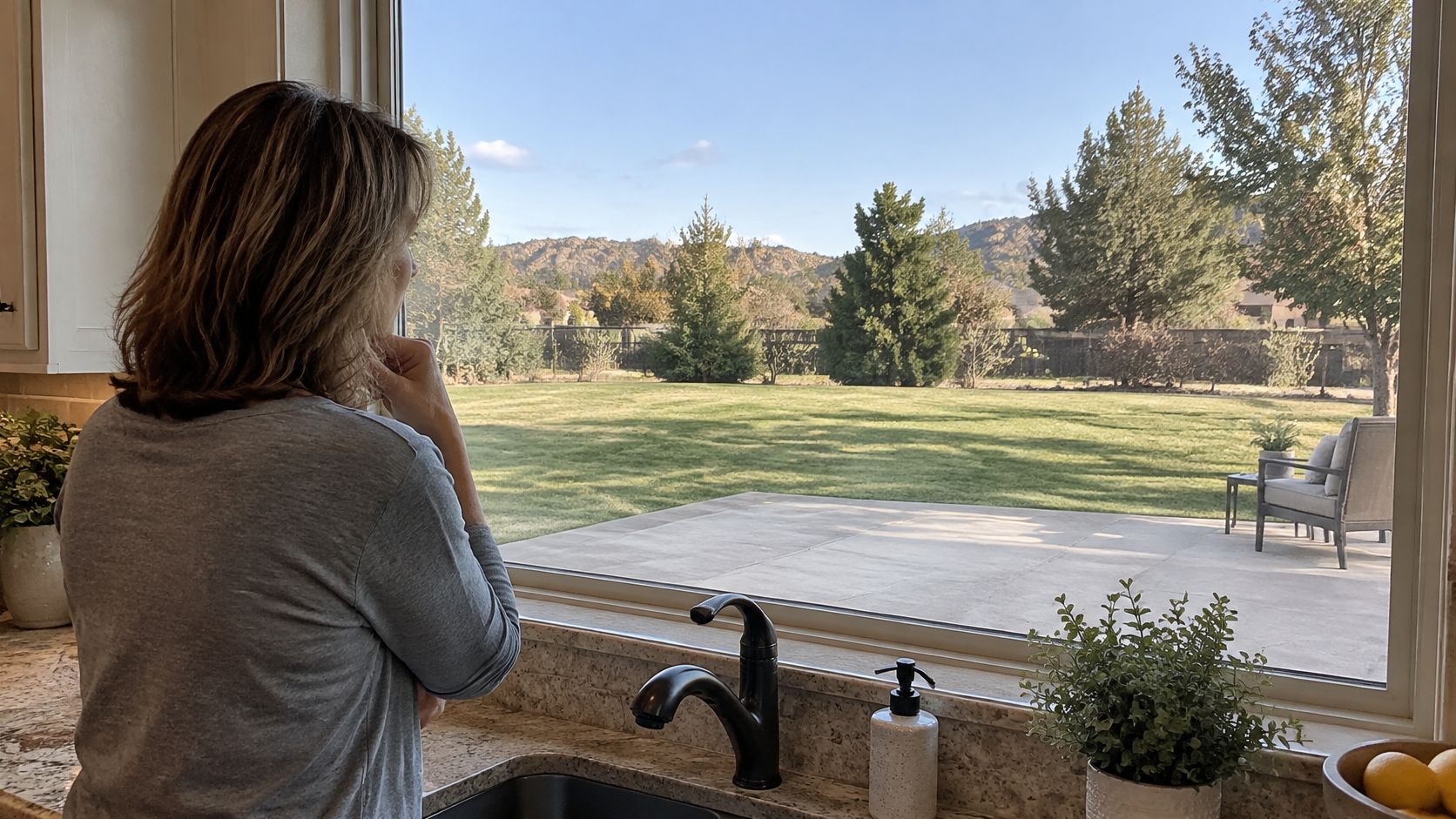
You're standing at your kitchen window in Prescott, looking past a chair, a shrub, and an empty patch of gravel. A focal point is the feature that gives your eye somewhere deliberate to land.
It works like a stage spotlight: the surrounding scenery still matters, but you know where to look. Without that emphasis, several perfectly decent features can compete until none looks intentional.
This kitchen-window view is a useful starting point for deciding what deserves attention.
What can serve as a focal point?
A specimen tree, boulder group, fire feature, water element, sculpture, outdoor kitchen wall, or framed hillside view can all work. The right choice gives the space a purpose rather than filling a vacancy.
The landscape-vision paper available through Distant Reader describes focal features as visual anchors that attract more attention than surrounding areas and can become destinations people move toward. That's why placement matters as much as the object itself.
For a quiet courtyard, HD Asian Art's discussion of stone Buddha statues as garden focal points offers a useful example of sculpture as a contemplative destination. Give such a piece an appropriate setting and breathing room rather than surrounding it with unrelated decorations.
Design judgement: Keep an existing feature if it already gives people a reason to pause. Improve its setting before buying a replacement.
In Prescott Valley and Chino Valley, a broad backyard may need definition more than ornament. A patio can become a gathering room, while a side path can lead toward a sheltered seat. From the street and inside the house, the result should look planned rather than accumulated.
Focal Point Rules at a Glance
A focal feature needs distinction, but distinction doesn't always mean greater height. The University of Florida Extension landscape-design guide identifies size, color, form, and texture as the principal ways to create contrast.
Use these checks before committing to a purchase or excavation. Test the actual view, including the fence, neighboring trees, and house wall, rather than judging the feature in isolation.
Focal point design rules and field tests
Design Rule | What It Does | Field Test |
|---|---|---|
One dominant feature per outdoor room | Gives the eye a single destination | Name the focal point within five seconds of standing in the space |
Contrast in size or height | Makes the feature stand out from its background | Feature is the tallest or largest element in the main view |
Contrast in color or texture | Separates the feature from surrounding plants and paving | Only the focal point uses the strongest color in the view |
Contrast in form | Keeps the silhouette readable from a distance | Squint at the view and check the outline still reads |
Sight-line alignment | Ties the feature to doors, windows and path ends | Centerline lines up with a window or path endpoint |
Proportion to the space | Prevents a feature from disappearing or dominating | Feature feels balanced against the nearest patio or wall |
Clear viewing aperture | Keeps the feature visible from the main seat | No plant or structure blocks the view from the primary seat |
Does the feature have to be the tallest object?
No. Treat the height test as a check on prominence within the composed view, not permission to compete with a mature pine or the house. A low fountain can stand out against a quiet wall through sound, movement, and contrasting texture.
Likewise, reserving the strongest color for the destination doesn't require a brightly painted object. A pale boulder against dark foliage may provide enough separation. Adding vivid pots beside it could weaken the effect.
Squinting helps remove distracting detail. If everything looks equally important, simplify the surroundings before enlarging the centerpiece.
A proposed feature should pass every applicable check, not just look attractive close up. If you can't see it from the main seat, or it overwhelms the walking space, resolve that problem before building.
How to Place a Focal Point Across Your Yard
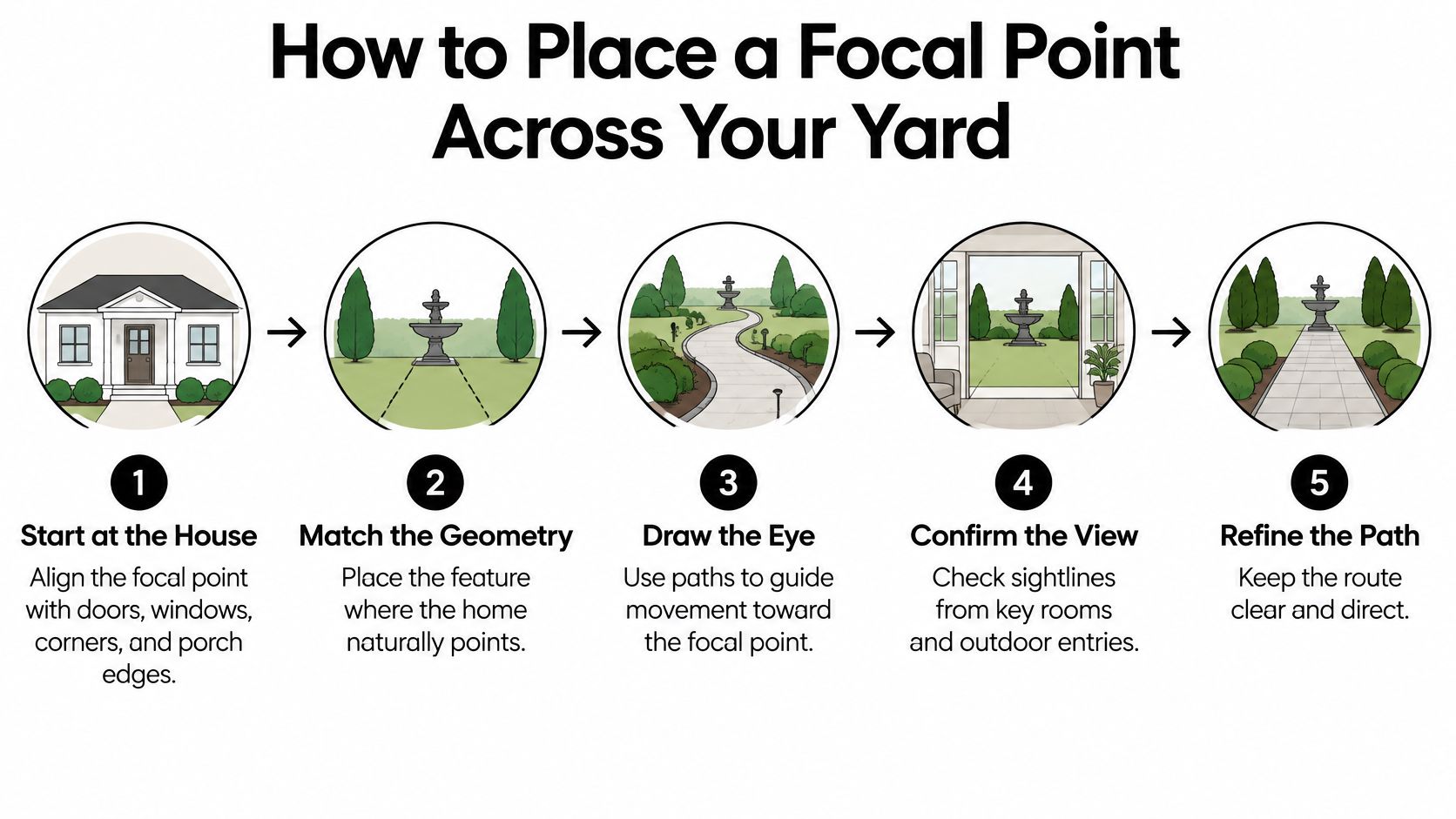
Start with the house, not the empty corner. The North Carolina State University Extension landscape-design handbook recommends extending sight lines from building corners, doors, windows, and porch edges to guide feature placement.
A path then gives people a practical way to approach the destination. At a bend, the feature can explain where to turn; at an endpoint, it can make the walk feel worthwhile.
This placement sequence keeps the architecture and circulation connected.
How do you test the location before construction?
Use a tape measure, stakes, string, cones, and a length of garden hose. Cardboard attached securely to a temporary frame can represent a wall or sculpture more accurately than a stake alone.
List the viewpoints. Include the front entry, kitchen window, patio seating, fire-pit zone, primary bedroom window, and driveway approach path. Photograph each view without zooming.
Record what you notice first. It may be a plant or existing feature, but it could also be a hose reel, equipment enclosure, or bright storage box. An unintended distraction often explains the unfinished feeling.
Choose the viewing zones. Decide whether the same feature can serve several viewpoints or whether separated outdoor rooms need different destinations. Don't force a courtyard sculpture to organize the entire property.
Mark a candidate location. Use stakes for height and hose for footprint. Represent the surrounding seating and access space too, not just the centerpiece.
Test normal use. Sit in the patio chair, stand at the sink, and look from indoors at the times you use those rooms. Check glare, shadows, and whether a door frame cuts across the feature.
Adjust the alignment. Move the marker toward a window centerline or path bend. Use paving edges, low walls, or repeated planting to frame the approach without screening the destination.
Mark the approved footprint. Confirm access, drainage, utilities, and installation logistics before excavation. A boulder location isn't workable if equipment can't reach it safely.
What if the viewpoints disagree?
Give priority to the places where you spend time. On a compact Prescott lot, the back-door view may matter more than a composition that only works from the far fence.
Say a fountain aligns beautifully with the kitchen window but blocks the route from the sliding doors. Shift the fountain and adjust the planting frame rather than accepting an awkward daily detour.
The landscape design layout guide can help connect those viewing decisions with patios, paths, and usable space. The common mistake is approving placement while standing in the middle of the lot, then discovering the finished feature is hidden from the house.
Scale and Materials That Make a Focal Point Read
Measure from the main seat to the proposed feature, then mock up its height and width at that actual distance. A piece that looks substantial in a showroom can disappear across a broad patio.
Compare the mock-up with the nearest wall, paving area, and walking route. You're checking whether the feature has enough presence without making the space feel crowded.
Which materials hold attention?
An eye-tracking study of Istanbul's Dolmabahçe and Topkapı Palace landscapes found longer average fixation durations for natural elements and higher fixation counts for artificial elements. That distinction supports a useful design approach: combine a clear constructed accent with planting that adds detail and seasonal interest.
It isn't a formula for copying palace gardens into Prescott. It's a reason to avoid treating the object and its planting as separate purchases.
Focal point materials and their Northern Arizona trade-offs
Material | Visual Strength | Northern Arizona Watch-Out |
|---|---|---|
Natural boulders and flagstone | Texture and a grounded, regional look | Large stones need proper placement and bedding to stay secure |
Concrete pavers and decorative block | Clean lines and color variety | Light colors can reflect strong afternoon heat onto seating |
Steel or weathering-steel art | Sculptural silhouette and a strong accent | Finish and patina depend on exposure and maintenance |
Masonry fireplace or fire-pit stone | Warm focal glow and a gathering point | Mortar joints need checks after freeze-thaw cycles |
Specimen trees and desert-adapted shrubs | Seasonal color and living form | Species must suit Prescott elevation and water plans |
Water features | Sound and movement | Evaporation and water use in a dry climate require careful planning |
Artificial turf putting green | Crisp lines and a year-round surface | Surface heat and debris management need attention in summer |
Take material samples outside before approving them. Look at stone beside the house finish and paving in both direct sun and shade; a sample that looks muted indoors may become the brightest surface in the yard.
Material check: Choose the finish for the conditions it will face, not just the photograph you like.
Year-round legibility matters too. A flowering specimen needs an appealing branch structure or evergreen companions so the composition doesn't disappear after bloom. For art and masonry, keep enough separation from surrounding foliage that mature growth won't conceal the defining outline.
Eight Focal Point Ideas for Northern Arizona Yards
Choose a destination that fits how you want to use the yard. In Houzz's 2024 U.S. Outdoor Trends Study, 33% of homeowners upgrading outdoor areas said they were extending their living space, which helps explain the appeal of outdoor kitchens and fire features.
These examples show how the destination can be useful as well as attractive.
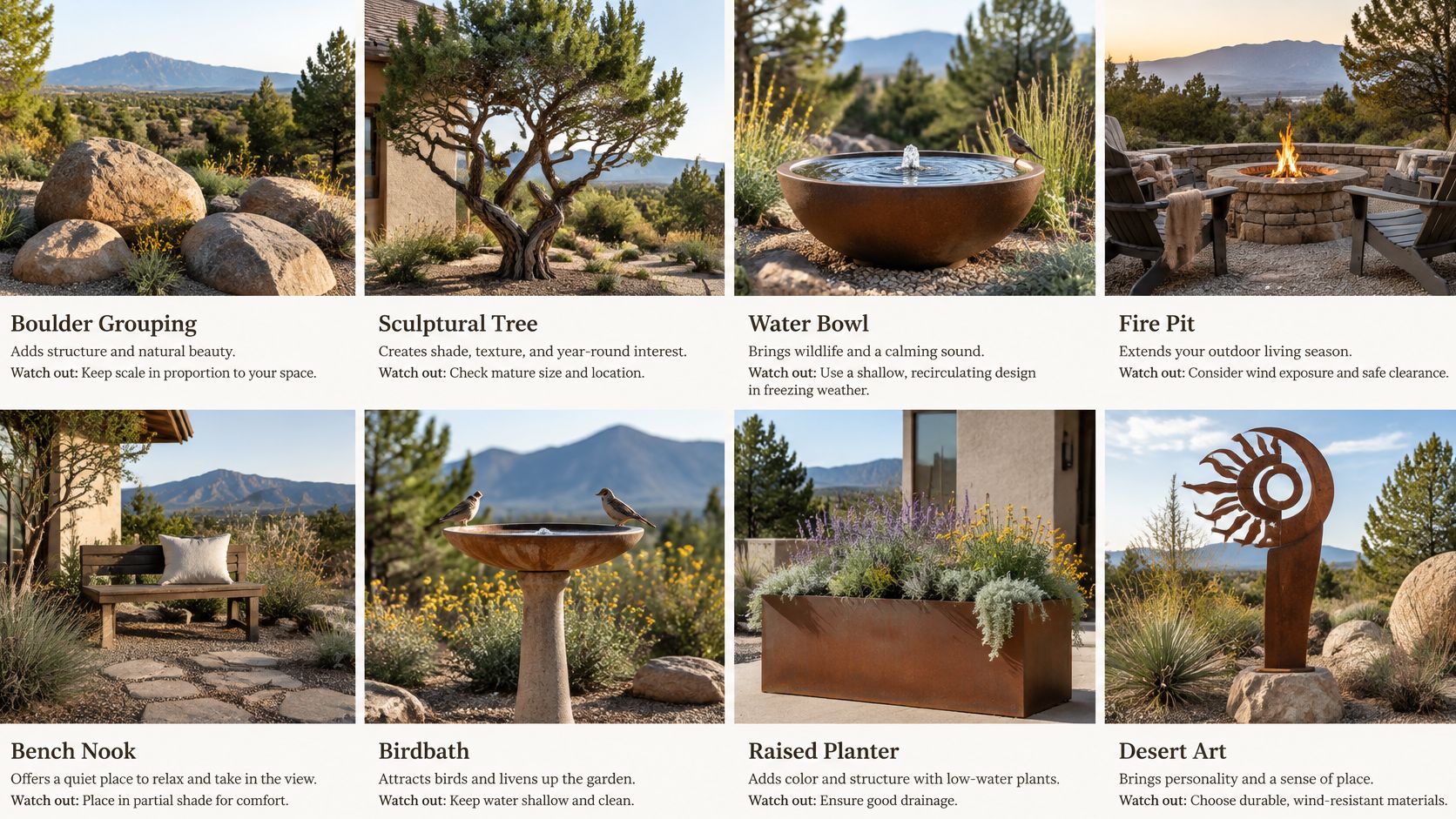
Could a boulder grouping anchor a side yard?
Place locally compatible stone at a path endpoint where it's visible from the entry or back door. This suits compact lots and keeps a narrow passage from feeling leftover.
Set the stones into the grade rather than perching them on gravel. Preserve drainage around the grouping.
Would a fire pit improve the back patio?
A fire pit with flagstone seating creates an evening destination in cooler Prescott weather. It works especially well in an open-plan backyard viewed from the living room.
Keep the seating arrangement comfortable when the fire isn't operating. Confirm fuel arrangements, overhead clearance, and applicable fire restrictions before installation.
Can an outdoor kitchen wall organize the view?
From sliding doors, a kitchen wall can provide a composed backdrop instead of exposing grill covers, storage, and equipment. It suits larger backyards with room to separate cooking from circulation.
Coordinate the wall finish with the house. Don't make the cook stand in the main route between the door and dining table.
Could a putting green become the path destination?
A custom artificial-turf putting green framed by low planting gives an active household a reason to cross the yard. An open backyard offers more freedom for shaping the approach and practice area.
Keep planting clear of play lines and account for surface heat. R.E. and Sons Landscaping designs and builds outdoor features like these for homeowners across Prescott, Prescott Valley, and Chino Valley.
The video offers another way to consider how outdoor features relate within a finished space.
Where would a small water feature work?
A recirculating bowl or wall fountain against stone can serve a compact courtyard, particularly when seen and heard from a nearby seat. Choose a sheltered position and restrained flow rather than a tall spray exposed to wind.
Don't assume recirculation eliminates refill needs. Make the basin and pump accessible for service.
Which specimen tree could frame a window?
Desert willow or a suitable Arizona cypress may work when the specific plant matches the site's elevation, exposure, and mature-space allowance. A flowering form can suit an open backyard; a carefully selected evergreen can provide winter structure.
Use the Northern Arizona native-plant guide to begin the selection conversation. Don't choose solely from a nursery label without checking local suitability.
Could shaded seating be the centerpiece?
A pergola over a paver patio gives people a visible destination on hot afternoons. It can define an outdoor room within a broad yard or shelter a compact seating area.
Check the actual afternoon sun angle. An attractive overhead pattern doesn't necessarily shade the chairs when you need it.
How should courtyard sculpture be displayed?
A sculpture on a stable plinth suits a compact courtyard viewed from an entry or hallway. Leave its outline clear and use restrained surrounding plants.
For accessory inspiration, Little Green Leaf's outdoor decor picks can help you compare styles. Select supporting pieces sparingly so the courtyard doesn't become a collection of competing objects.
Maintenance, Water and Cost Over the Life of a Focal Point
Compare the installed feature with the years of care that follow. Access for cleaning, replacement parts, plant growth, and seasonal shut-down can matter as much as the initial construction.
The Arizona Department of Water Resources states that planting can account for as much as 70 percent of residential water use statewide and recommends regionally appropriate plants, efficient irrigation, and rainwater harvesting. Review water demand before approving the feature, not after the surrounding garden is finished.
Upkeep and water demand by focal point type
These are relative planning categories, not quoted prices or measured consumption. Site access, foundations, utilities, artwork selection, and finish choices change the construction scope.
Focal Point Type | Upfront Cost Level | Water Demand | Ongoing Upkeep |
|---|---|---|---|
Boulder or stone grouping | Medium | None for the stone itself | Low: cleaning and drainage checks |
Water feature | High | Ongoing replenishment for evaporation and splash | Medium to high: pump, basin and algae care |
Specimen tree | Medium | Set by species and irrigation plan | Medium: pruning and establishment support |
Fire pit or fireplace | Medium to high | None directly | Low: cleaning and seasonal checks |
Artificial turf putting green | High | Occasional cleaning rather than lawn irrigation | Low: brushing and debris removal |
Outdoor kitchen wall | High | None directly | Low to medium: covers and cleaning |
Pergola or shade structure | Medium to high | None directly | Low: periodic sealing or finish care |
Sculpture on a plinth | Artwork-specific allowance plus installation | None directly | Low: cleaning and base checks |
What should you budget for after installation?
Ask for a written maintenance scope alongside the construction proposal. Include service labor, consumables, energy for pumps or lighting, replacement components, and any irrigation changes.
Water features: Allow for pump and basin cleaning, algae management, and winter operating decisions. The water-feature maintenance guide explains the service considerations.
Trees and planting: Plan for appropriate pruning and irrigation adjustment. Inspect establishment stakes and remove them when the tree no longer needs support.
Stone and masonry: Clean with products suited to the material, inspect joints, and seal only where the surface warrants it.
Putting greens: Remove debris and brush the surface as specified by the installer.
Kitchens and pergolas: Inspect covers, connections, coatings, and exposed finishes.
A boulder composition, architectural element, shaded seat, or suitable low-water specimen can avoid the operating demands of a water-centered display. Low maintenance still isn't maintenance-free.
R.E. and Sons Landscaping's maintenance department can support ongoing care in Prescott, Prescott Valley, and Chino Valley, with water requirements reviewed before the build.
Confirm Your Focal Point Plan Before You Build
Approve the plan only when the feature works as part of daily life. A beautiful centerpiece isn't ready for construction if it compromises access or creates upkeep you don't want.
Destination confirmed: Each outdoor room has a clear primary feature.
Views tested: Temporary markers have been checked from indoor, standing, and seated positions.
Scale approved: The proposed footprint fits the adjacent hardscape and leaves usable circulation.
Materials evaluated: Samples and construction details suit Prescott-area exposure and winter conditions.
Care accepted: You understand cleaning, irrigation, seasonal service, and replacement responsibilities.
What happens at a design consultation?
Bring your viewpoint photos, a simple yard sketch, and the results of your marker tests. Include anything you want to preserve, along with concerns about water use, access, or maintenance.
R.E. and Sons Landscaping is a licensed, bonded, and insured design-build company serving Prescott, Prescott Valley, Chino Valley, and Northern Arizona. Its process moves through consultation, design approval, transformation, and enjoyment, with complimentary design services.
Consultations can be booked online or by phone. Office hours are Monday through Friday, from 8am to 4pm.
Can a focal point be added to an existing yard?
Yes, often by opening sight lines, adding framing plants, or improving lighting rather than rebuilding the whole yard. Some existing features may need relocation, especially when they block the strongest view or interrupt a walking route.
Do focal points need lighting?
Lighting helps fire features, kitchens, and paths remain useful after dark, but not every object needs a spotlight. Aim fixtures carefully to avoid glare into windows and neighboring properties, and check their direction seasonally as plants grow.
R.E. and Sons Landscaping provides design and installation that links focal features with patios, paths, planting, and everyday use. Visit R.E. and Sons Landscaping to arrange a consultation, and bring your viewpoint photos so the conversation begins with how your yard works.
Comments