
Artificial Turf Drainage: A Step-by-Step Guide for Prescott
For stormwater calculations, Ohio stormwater guidance specifies a volumetric runoff coefficient of 0.95 for synthetic turf, effectively treating approximately 95% of rainfall as runoff requiring management. That's the fact most turf sales pitches skip. The carpet may let water through, but your yard still has to store it, move it, or discharge it somewhere safe.
If you own a home in Prescott, Prescott Valley, Chino Valley, or elsewhere in Northern Arizona, good artificial turf drainage isn't a product label. It's a complete water path designed for short, intense monsoon storms, your soil, and your grades. This guide turns each layer into a target you can check against any quote before work starts.
Drainage Targets Every Artificial Turf Yard Needs
Artificial turf drains only as well as the system beneath it. A quote should state measured rates for the turf, base, soil, and outlet rather than rely on a claim that the backing is permeable.
R.E. and Sons Landscaping is a licensed, bonded, and insured design-build company serving Prescott, Prescott Valley, Chino Valley, and Northern Arizona. In this climate, the water path has to be sized for short monsoon bursts, sloped toward a real outlet, and checked layer by layer before base stone goes in.
A 2025 New Jersey Department of Environmental Protection review reports Synthetic Turf Council guidance of at least 10 inches per hour for the turf, backing, and infill layer, and at least 14 inches per hour for the base and finish stone. The same review warns that a turf system rated at 10 inches per hour still depends on soil that can accept or move that water.
Drainage Benchmarks to Write Into Your Quote
Benchmark | Target value | Source or standard |
|---|---|---|
Turf, backing and infill | At least 10 inches per hour | Synthetic Turf Council guidance cited by the NJDEP review; tested under ASTM F1551 or EN 12616 |
Base and finish stone | At least 14 inches per hour | Synthetic Turf Council guidance cited by the NJDEP review; tested under ASTM F1551 or ASTM D2434 |
Field permeability reference | A stricter sports-surface benchmark, used when a spec calls for it | FIH field requirements |
Finished surface fall | Gentle, consistent fall that sheds water without feeling sloped | Synthetic Turf Council base-system guidance |
Drain trench and pipe grade | Continuous positive fall to the outlet, with no sags or backfall | Project grading plan and outlet invert |
Subsoil permeability threshold | Fast enough to accept the design storm without ponding; slow soil or a high water table justifies collection lines | On-site infiltration result and water table depth |
Design storm for subsurface drainage | Short, intense monsoon storms for your lot, contributing area, and discharge route | Local storm pattern and runoff path |
Topsoil removed in residential builds | Strip organic topsoil to stable subgrade before base stone | University of Florida IFAS |
Roof water belongs in this plan too, since downspouts can overwhelm a small yard drain. For roof runoff control, see this gutter protection advice from HIBCO ROOF.
Ask the installer to mark where each number is measured: carpet and infill rate, stone rate, soil result, finished fall, pipe fall, and the final discharge point. If one layer is slower than the next, water will stack there first.
Copy these targets into any quote and ask the installer to show how each one is met on your lot.
How to Test Your Soil and Water Path First
Water needs a safe destination after it passes through the turf. Your grades, soil, and discharge point decide whether that destination is native ground, a pipe, or your foundation.
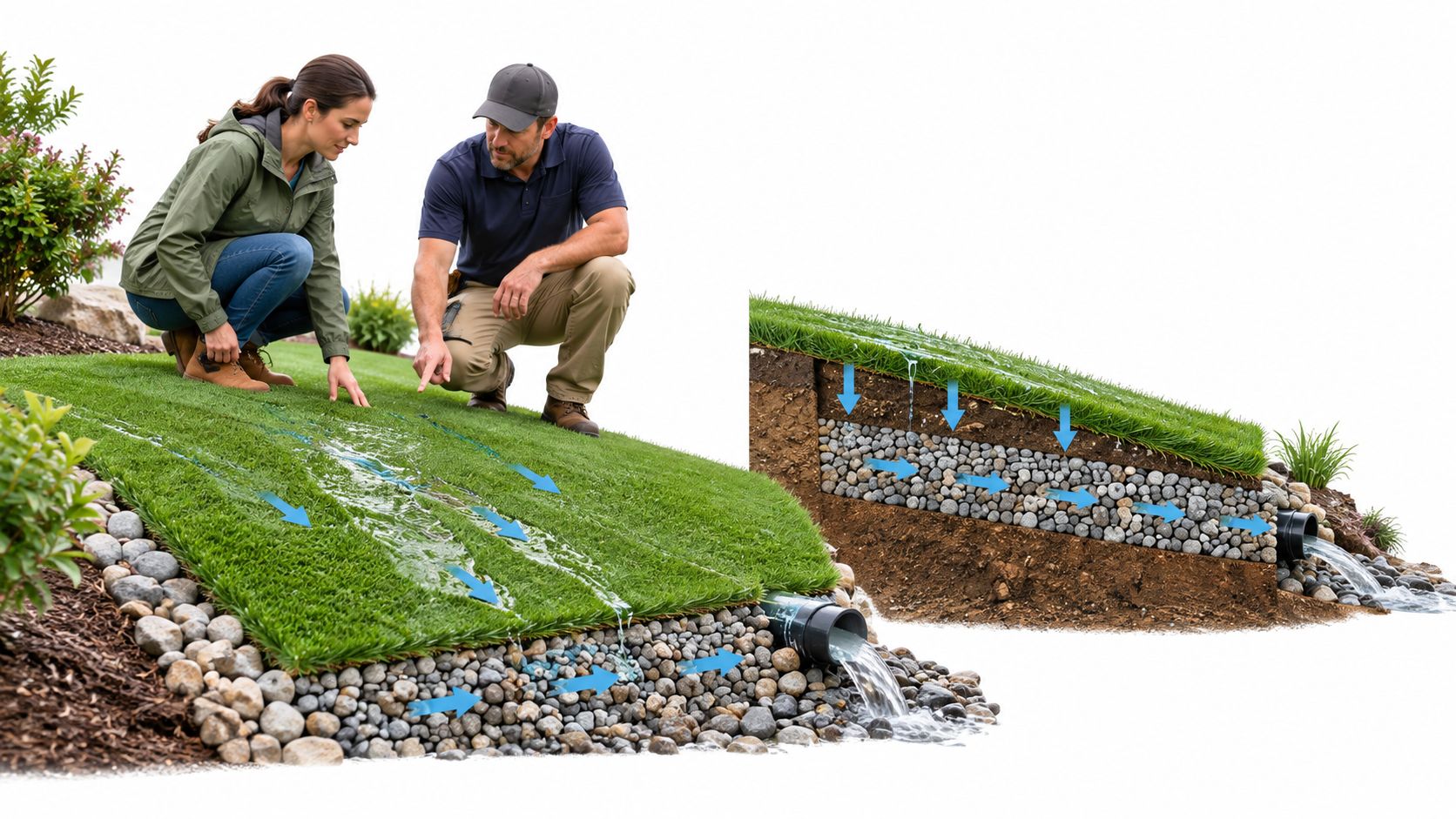
This photo shows the basic idea beneath the surface before you test your own yard.
Walk the Yard When It Is Wet
Mark incoming water: Walk during or right after rain and note flow from roofs, driveways, patios, and neighboring lots. Perimeter runoff can swamp a correctly built base.
Dig one test hole: Go about 30 inches deep where turf is planned, fill it with water, and time the drop. That result tells you more than any soil map.
Name what you see: Record clay, decomposed granite, rock, or mixed fill. Compare your rate with the subsoil threshold in your quote and decide if collection lines are justified.
Check for a blocking layer: Note how deep you reach bedrock or seasonal water. A shallow barrier stops infiltration even if the top layer drains well.
Measure Grades and Pick a Real Outlet
Run a level and string line: Find fall toward the house, walkways, or low corners. Small errors matter because finished turf can't hide them with mowing or growth.
Identify the discharge point: Choose a storm inlet, an approved dry well, or open ground that carries flow away from structures. "It will soak in" isn't a discharge plan without a test behind it.
Design for bursts, not drizzle: Prescott monsoon cells dump water fast. Plan the route for peak flow, then confirm the outlet can take it.
For grading basics that apply before turf enters the picture, review this local guide to yard grading and drainage planning.
This short video helps you visualize how surface water should move once grades are set.
You should finish with three things on paper: a sketch of the water path, a soil result, and a clear choice between shallow infiltration and subsurface collection. If an installer can't produce those, I wouldn't sign yet.
Choosing Catch Basins, French Drains and Outlets
No single number chooses the component. You match the component to soil acceptance, slope, discharge route, and how you'll clean it later.
Drainage Components Compared
Component | Best fit | Main risk | Maintenance access |
|---|---|---|---|
Surface swale or berm | Gentle slopes where water can be routed off the yard | Moves water rather than storing it, so it needs a safe destination | Open and easy to check |
Perforated French drain | Slow or clay soils with a clear lower outlet | Fines clogging the gravel wrap or pipe; a negative grade stops flow | Hard to reach once buried unless cleanouts are added |
Catch basin with perimeter inlet | Edges where surrounding grade drains toward the turf | Sediment buildup that blocks the inlet | Grate and sump can be opened and cleaned |
Dry well or infiltration pit | Soils that accept water with no nearby foundation | Fails on clay or a high water table; undersizing causes backup | Limited access; needs periodic inspection |
Connection to storm system or approved discharge | Sites where infiltration is not feasible | Outlet capacity must handle monsoon flows | Outlet can be checked after storms |
Start with soil acceptance. A dry well is simple on freely draining ground and useless on tight clay. Next, trace slope and discharge. A French drain without a lower outlet is a buried trough, not a drain.
Then check neighboring grades. If surrounding ground drains toward your lawn, intercept that water at the edge with a swale, berm, or catch basin before it enters the base. Finally, weigh storm volume and maintenance access. Buried pipe needs cleanouts, and inlets need grates you can open without a struggle.
Research in the Journal of Irrigation and Drainage EngineeringIR.1943-4774.0000992) found that a single runoff coefficient, or "C factor", could not adequately represent a synthetic turf system's changing response to rainfall. Infiltration, temporary storage in the aggregate base, soil saturation, underdrain flow, and outlet capacity interact over time.
Practical rule: Pick the simplest component that both your soil test and your discharge route support, then add cleanouts wherever buried pipe must be inspected.
That rule sounds conservative. It's cheaper than excavating a failed dry well after the first monsoon.
How Big the Drain Must Be for Monsoon Storms
Size comes from two questions. How much water must the base hold during the storm, and how fast can the outlet move the rest?
Average rainfall won't answer either question. Northern Arizona monsoon cells arrive in short, intense bursts, so a small outlet can fall behind even when total rainfall looks modest.
A Sizing Sequence You Can Ask to See
Measure the catchment: Add the turf area plus any roof, driveway, patio, or sloped grade draining onto it. Roof area is often missed, which is why professional gutter installation for homeowners matters when downspouts discharge near turf edges.
Set design rainfall: Use the storm depth and intensity specified for the design event, not a typical rainy day.
Test the aggregate section: Confirm the measured rate exceeds your project requirement with reserve capacity, because infill and fines will reduce performance over time.
Calculate base storage: Multiply base area and thickness by usable void space to find what the section can hold while soil and pipes catch up.
Size the outlet: Match pipe, basin, or approved connection capacity to flow beyond that storage, then verify the receiving path can take it.
Plan overflow: Give excess water a visible route away from the house and neighboring lots. Overflow will find a route anyway. I'd rather choose it on paper.
Write four outputs into the quote: catchment area, design rainfall, measured infiltration rate, and outlet size. Add the overflow route as a fifth line. If those five items aren't listed, the drain wasn't sized. It was guessed.
How to Grade and Build the Base Layers
Each layer must pass water to the next one. Order, gradation, and compaction decide whether that happens.
The University of Florida's Institute of Food and Agricultural Sciences explains that common residential synthetic-turf construction removes approximately 2 to 3 inches of topsoil and heavily compacts the remaining soil to create a firm, uniform foundation. That compaction reduces the soil's infiltration capacity and increases runoff risk compared with living turf. Your base design has to work around that altered profile, not pretend it didn't change.
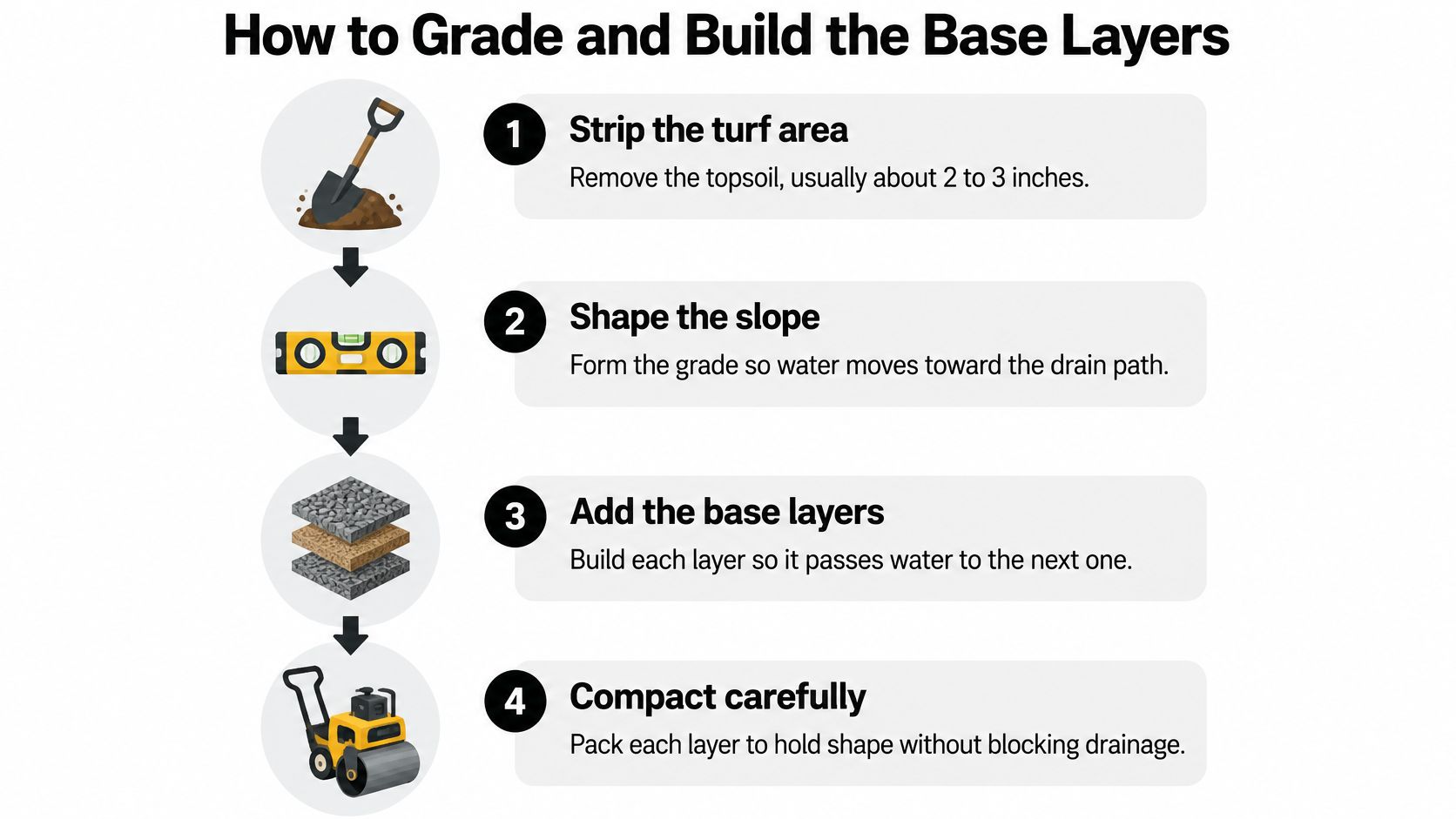
This infographic summarizes the build order before the detailed steps.
Build From the Subgrade Up
Strip and remove topsoil: Clear the area to the planned depth so finished turf sits at the right elevation against patios and walkways.
Shape subgrade elevations: Grade every area toward a collection line or outlet. Flat subgrade under sloped turf still traps water.
Proof-roll and repair: Roll the exposed ground, find soft spots, and replace weak material now. Soft spots become settlement and ponding later.
Place geotextile only where specified: Fabric can separate layers, but it can also trap fines if the wrong product or location is chosen.
Install aggregate in lifts: Compact each lift with a plate compactor and match gradations between layers. Abrupt particle-size changes can stall water at the boundary.
Lay perforated pipe on positive grade: Surround it with free-draining backfill, keep perforations clear, and cap exposed ends so sediment can't enter during construction.
Survey before covering: Check pipe slopes with a laser level while you can still fix them. This ten-minute check prevents the most expensive failure.
Add pad, turf, and infill: Keep finished fall consistent, secure edges, and brush infill evenly so it doesn't plug backing perforations in low areas.
Run a water test: Flood test sections, watch outlet flow, and mark any persistent ponding before handover.
Two Mistakes Behind Most Failures
Don't compact aggregate while it's saturated. You'll lock in a dense, uneven section and lose storage. Don't let perimeter runoff enter the field either. Berms and swales help, but they don't replace a base and outlet matched to the site.
Putting greens raise the stakes because ball roll exposes tiny grade errors. If your project includes one, review how drainage and contours interact in this guide to a custom backyard putting green.
Survey pipe slopes before covering them. After backfill, a grade error becomes an excavation.
Diagnosing Drainage Problems and Keeping Systems Working
Start at the outlet, then check grade, then suspect the base. Most visible water problems trace back to a blocked or undersized exit, so work downstream first.
Symptom, Likely Cause and Fix
Symptom | Likely cause | Fix |
|---|---|---|
Ponding that lasts after rain stops | Compacted subgrade or low spots | Regrade, proof-roll and correct soft areas |
Slow water at edges or cleanouts | Blocked drain or negative pipe grade | Clear the line and re-survey slope before backfilling |
Water moving toward a foundation or walkway | Perimeter runoff entering the field or wrong surface fall | Add perimeter interception and regrade away from structures |
Infill or sediment at drain outlets | Fines migrating into the base or an uncovered drain | Clean outlets, cap exposed drains and check the geotextile |
Pooling at one seam or edge | Differential settlement under the base | Inspect compaction and repair the affected area |
Water backs up only in heavy storms | Undersized outlet for short, intense flow | Add outlet capacity or a planned overflow route |
Ponding that lingers usually points to compaction or low spots. Water at a foundation points to perimeter runoff or wrong fall. Infill at an outlet means fines are migrating, which connects directly to your choice among artificial turf infill options and how well edges contain them.
A system that handles ordinary rain but backs up in a monsoon burst doesn't need more brushing. It needs more outlet capacity, more storage, or a planned overflow route.
A Routine That Protects the System
After every major storm: Clear outlets, cleanouts, and grates. Note where water sat, how long it stayed, and which cleanout showed flow.
Each season: Open access points, confirm perimeter inlets still collect from surrounding grades, and check for settlement at seams and edges.
Before monsoon season: Inspect the full route, keep irrigation and runoff from surrounding areas off the turf, and don't stockpile soil where it can shift grades.
Roof drainage affects this routine too. Blocked gutters dump concentrated flow at turf edges, so review the benefits of effective gutter systems if downspouts discharge near your yard.
Brushing and rinsing keep fibers upright and the surface tidy. They won't clear a buried line, fix negative grade, or stop sediment moving through an outlet. Keep outlets clean, record what you find after storms, and ask your installer how discharge is managed. Notes from three storms diagnose faster than guesses from one sunny afternoon.
Book a Drainage Check Before You Install
Book a site drainage check before you choose turf. R.E. and Sons Landscaping serves Prescott, Prescott Valley, Chino Valley, and Northern Arizona as a licensed, bonded, and insured design-build company.
A useful check covers soil and water path review, grade measurements, a discharge plan, and a written base specification tied to measurable targets. The process runs in four steps: consultation, design approval, transformation, and enjoyment. You get complimentary garden design, and you can schedule online or by phone during office hours, Monday to Friday, 8am to 4pm.
Does Artificial Turf Drain on Clay Soil
The turf can drain, but clay below it may not accept the water. You usually need subsurface collection and a positive outlet rather than relying on infiltration. A soil test decides, not the turf warranty.
Do I Need a French Drain for Artificial Turf
You need one when soil is slow, grades trap water, or surrounding ground drains toward the lawn and a lower outlet exists. On freely draining ground with safe surface fall, a simpler route may work. Don't bury pipe without an outlet and cleanouts.
How Do I Know the Drainage Works Before the First Storm
Ask for a controlled water test, outlet observation, and documented grades before final payment. You want no persistent ponding and visible discharge where the plan says it should occur.
Before you sign, ask any installer these questions:
Where does water go after it leaves the turf?
What rate did you measure in my soil, and where is it written?
What happens in overflow during a monsoon burst?
Where are the cleanouts, and how do I inspect them?
Clear answers protect your yard, your foundation, and your budget.
R.E. and Sons Landscaping designs and builds artificial turf yards with the base, grades, and discharge route planned before installation, so Prescott-area homeowners don't discover drainage problems during the first monsoon. Visit R.E. and Sons Landscaping to schedule your drainage check and get a written specification for your yard.
Comments