
Outdoor Kitchen Vent Hood Guide: Sizing, Specs and Code
The grill is lit, the roof is doing its job, and the smoke has nowhere to go but into the chairs. That is the usual failure on a covered patio in Prescott or Prescott Valley: heat, grease, and combustion gases stack under the beam and drop back into the same air everyone is sitting in.
R.E. and Sons Landscaping designs and builds outdoor kitchens and bars for homeowners in Prescott, Prescott Valley, Chino Valley, and nearby Northern Arizona communities. If the cook line is under a cover, the hood is part of the building, not a last-minute accessory.
What an Outdoor Kitchen Vent Hood Does and Who Needs One
Picture the built-in grill tucked under a patio beam. On a calm evening the plume rises, hits the ceiling, and rolls sideways toward the table. An outdoor kitchen vent hood is there to catch smoke, grease, heat, and combustion by-products at the cooking surface and move them out of the occupied space.
It only does that job if the canopy, the duct, and the structure were drawn together. A hood bought after the beam, the veneer, and the cabinet run are finished often has no legal path outside.
Who should plan one in from the start:
Built-in cooking: A grill, side burner, fryer, or open broiler under any roof.
Covered and semi-enclosed rooms: Pergolas, solid patio covers, and outdoor rooms with walls.
People building the whole space: Homeowners and builders who want framing, power, and the exhaust route settled before finishes go on.
Who can usually skip it: Occasional grilling in a wide-open yard, with no overhead cover and no enclosing walls, clears on its own. There is no ceiling for smoke to pool against.
Ventilation is a functional safety part. Treat it like gas and electric rough-in. If the kitchen layout is still open, it is worth the time to explore backyard kitchen layouts so the cook zone, seating, and exhaust path are one drawing. From here, the key decisions are vented versus ductless, how much air the grill needs, which current listings match that air, which metal survives the yard, and which duct and permit checks happen before anyone orders a fan.
Vented and Ductless Hoods Compared Side by Side
For most covered outdoor kitchens with a built-in grill, a vented hood ducted to the exterior is the right choice. A ductless unit only suits light use in a space where an exterior duct cannot be run.
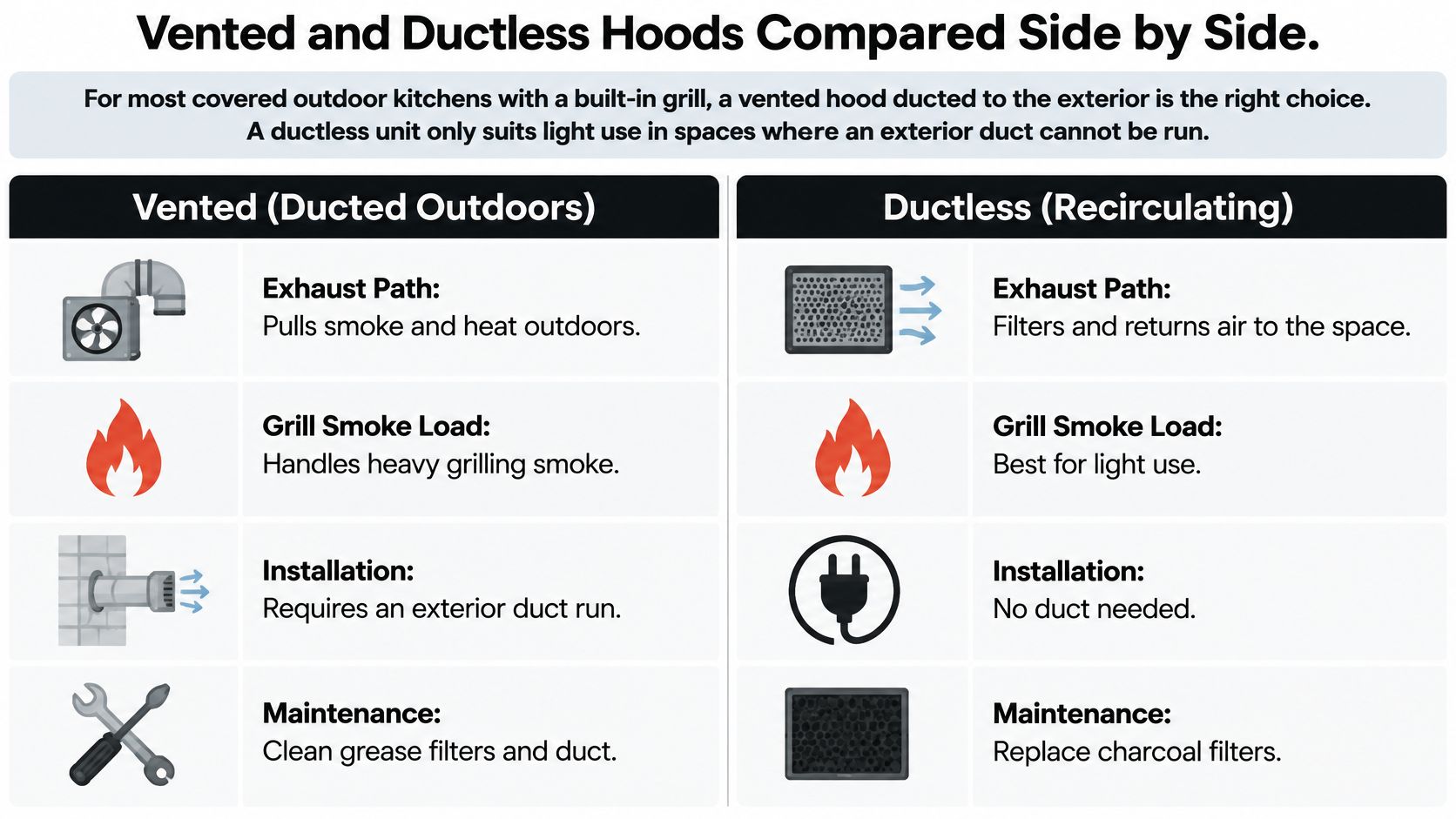
Vented vs ductless outdoor hoods on the criteria that matter
Criterion | Vented hood | Ductless hood |
|---|---|---|
How air moves | Pulls smoke and heat through ductwork and exhausts it outdoors | Filters air through charcoal and returns it to the space |
Capture of smoke and grease | Strong when the canopy is deep and the duct is short and smooth | Limited, mainly effective on odor and light smoke |
Installation | Needs a duct route to the exterior, a makeup-air check, and electrical work | Needs power and a mounting point, no exterior duct |
Best fit | Covered kitchens, grills under roofs, high-heat and frequent cooking | Small side-burner stations in open or lightly enclosed spaces |
Code and permits | Must meet exhaust, clearance, and termination rules | Simpler on paper, but local rules still apply |
Upkeep | Clean grease filters and inspect the duct and termination | Replace charcoal filters on the manufacturer's schedule |
Why the label matters less than capture
Two hoods can move the same air and still perform very differently. The ASHRAE handbook chapter on kitchen ventilation reports that contaminant removal can vary by as much as threefold among hoods at the same airflow, because canopy depth, geometry, installation height, and cross-drafts decide whether smoke is caught before it escapes. Where a maker publishes one, ask for an ASTM E3087 capture-efficiency value, then for tested CFM at the duct you will build.
Say a 36-inch hood sits under a shallow beam. Smoke hits a flat underside and spills at the open edge. A deeper canopy, hung at a height the grill maker allows, gives that plume a volume to enter before a gust shoves it sideways. Deep canopies generally beat shallow or flat-bottom shapes for that reason.
Ductless hoods recirculate through filters. That can cut odor at a small station. It does not give heavy grill smoke, grease, or combustion gases a way out of a covered room.
Practical rule: Use a vented hood for covered grills, high heat, and frequent cooking. Use ductless only for a small side-burner station under an open structure where no exterior wall or duct route is practical.
How Much Airflow Your Grill Setup Needs
Under a covered patio, a grill can send smoke sideways before it reaches a hood that is too narrow or poorly placed. Choose airflow by considering both the grill's exhaust requirement and whether the canopy can capture the plume. Cubic feet per minute (CFM) describes airflow, but the advertised rating alone does not tell you how much air the installed hood will move or how well it will contain smoke.
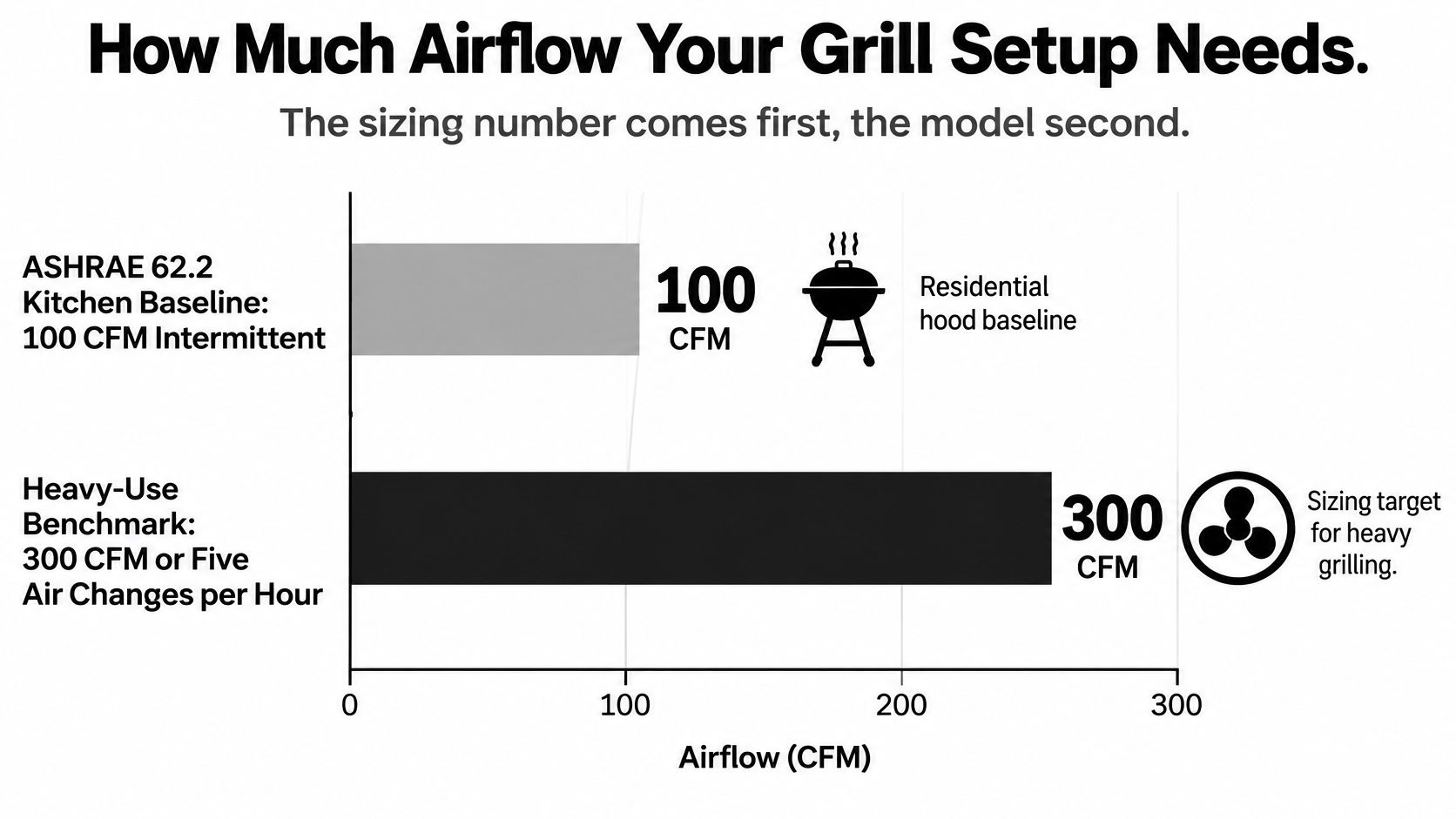
Airflow reference points for outdoor hood sizing
Reference point | Value | What it means for your grill |
|---|---|---|
ASHRAE 62.2 intermittent kitchen baseline | 100 CFM | Residential starting point, not a grill target |
Alternative requirement for other kitchen exhaust | 300 CFM or 5 air changes per hour | Reference for other kitchen exhaust, such as downdraft systems |
Common hood-sizing rule of thumb | 40 CFM per linear foot | A preliminary floor based on hood width |
36-inch hood at 40 CFM per foot | 120 CFM | Preliminary width-based floor |
42-inch hood at 40 CFM per foot | 140 CFM | Preliminary width-based floor |
72-inch hood at 40 CFM per foot | 240 CFM | Preliminary width-based floor for a long island |
Grill manufacturer exhaust requirement | The maker's published CFM for that grill | Use this as the target if it exceeds the width-based floor |
ASHRAE Standard 62.2 gives a residential reference of 100 CFM (50 liters per second) for an intermittently operated vented kitchen range hood, and 300 CFM (150 liters per second) or five air changes per hour for other kitchen exhaust fans, such as downdraft systems. These are indoor ventilation reference points, not specifications for outdoor grills. A widely used sizing rule of thumb is 40 CFM per linear foot of hood width, but it is only a starting point. Grills produce concentrated heat, grease, and combustion products, so use the grill maker's exhaust requirement when available and consider how the hood and duct will perform once installed.
Width math, then the grill spec
The width rule is straightforward: a 36-inch hood is 3 feet wide, giving a preliminary floor of 120 CFM. A 42-inch hood is 3.5 feet, or 140 CFM; a 72-inch hood is 6 feet, or 240 CFM. These figures help compare hood widths, but they do not account for the grill specification, duct losses, or smoke escaping around the canopy. Under a Prescott-area patio cover, open sides can let gusts push smoke away from a narrowly sized hood.
Advertised CFM is often a free-air rating. Long duct runs, elbows, narrow ducts, screens, and termination caps reduce delivered airflow and can increase noise. Check the fan's performance against the duct route you intend to build, rather than assuming the listed number will reach the cooking surface. Exhaust also needs incoming air; Jennifer Gilmer Kitchen & Bath fan advice explains why the two sides of that airflow need to be planned together when a covered patio opens into the house.
For example, if a grill under a 42-inch hood specifies 500 CFM, the manufacturer's requirement is higher than the width-based floor of 140 CFM. Size to the grill's published requirement, then avoid undermining it with a restrictive duct. A larger fan cannot make up reliably for a route choked by elbows, and a high advertised rating is no substitute for a canopy that captures smoke.
A short clip on how canopy and airflow work together can help clarify the relationship before you choose a blower.
Before shopping, measure hood width in feet, check the grill maker's exhaust requirement, and sketch the duct route. Those three checks give you a practical starting point for comparing airflow ratings with the system you can realistically install.
Current Hood Models Compared by Specs and Price
Retailer listings give a useful starting point, but a higher advertised CFM does not guarantee better smoke capture once the hood is installed. Compare the canopy dimensions and the duct route alongside the listed airflow. Prices and specifications can change, so check the retailer's current listing before buying.
Published specs and prices for four outdoor vent hoods
Model and retailer | Width | Airflow (CFM) | Listed price | Buying note |
|---|---|---|---|---|
Trade-Wind outdoor hood, Outdoor Home Store | 72 in | 2,300 | $4,462 | Sized for long islands; far above residential floors, so plan replacement air |
Vent-A-Hood Pro Series, BBQ Depot | 42 in | 900 | $3,433 | Blower-based pro series; compare installed airflow |
Zephyr Cypress, BBQGuys | 42 in | 1,200 | $2,799 | Highest listed airflow at this width in the set; verify duct performance |
Lynx Sedona, Abt Electronics | 36 in | 1,200 | Request a quote from the retailer | 24 in high by 32 in deep; deeper canopy for capture |
The Outdoor Home Store lists its 72-inch Trade-Wind outdoor hood at 2,300 CFM and $4,462. Its size suits a long island, and its high listed airflow means replacement air needs to be planned with the exhaust system. The BBQ Depot lists a 42-inch Vent-A-Hood Pro Series at 900 CFM for $3,433. The BBQGuys lists a 42-inch Zephyr Cypress at 1,200 CFM for $2,799. By listed price and airflow, the Zephyr offers more CFM per dollar than the Vent-A-Hood. That comparison does not account for canopy capture or airflow after installation, so check the duct route and hood dimensions before choosing.
The Abt Electronics listing for the Lynx Sedona gives the hood's rating as 1,200 CFM and its dimensions as 24 inches high by 36 inches wide by 32 inches deep. Its canopy depth can help capture smoke, but the listed rating still needs to be considered alongside the installed duct. The current price is available from Abt Electronics on request.
Shortlist models by hood width and the grill maker's CFM target. Then compare canopy depth and expected installed airflow. A high sticker CFM cannot make up for a shallow canopy that lets smoke escape at the lip.
Match the hood to the grill, burners, and power plan rather than sizing it alone. This guide to outdoor kitchen appliances can help you compare the equipment as a set.
Materials, Finishes and Weather Protection for Prescott Yards
Prescott yards punish finishes. High-desert sun fades paint, dry wind carries dust into every seam, monsoon rain drives into open sides, and freezing nights stress seals and fasteners. The metal and the placement have to answer that weather together.
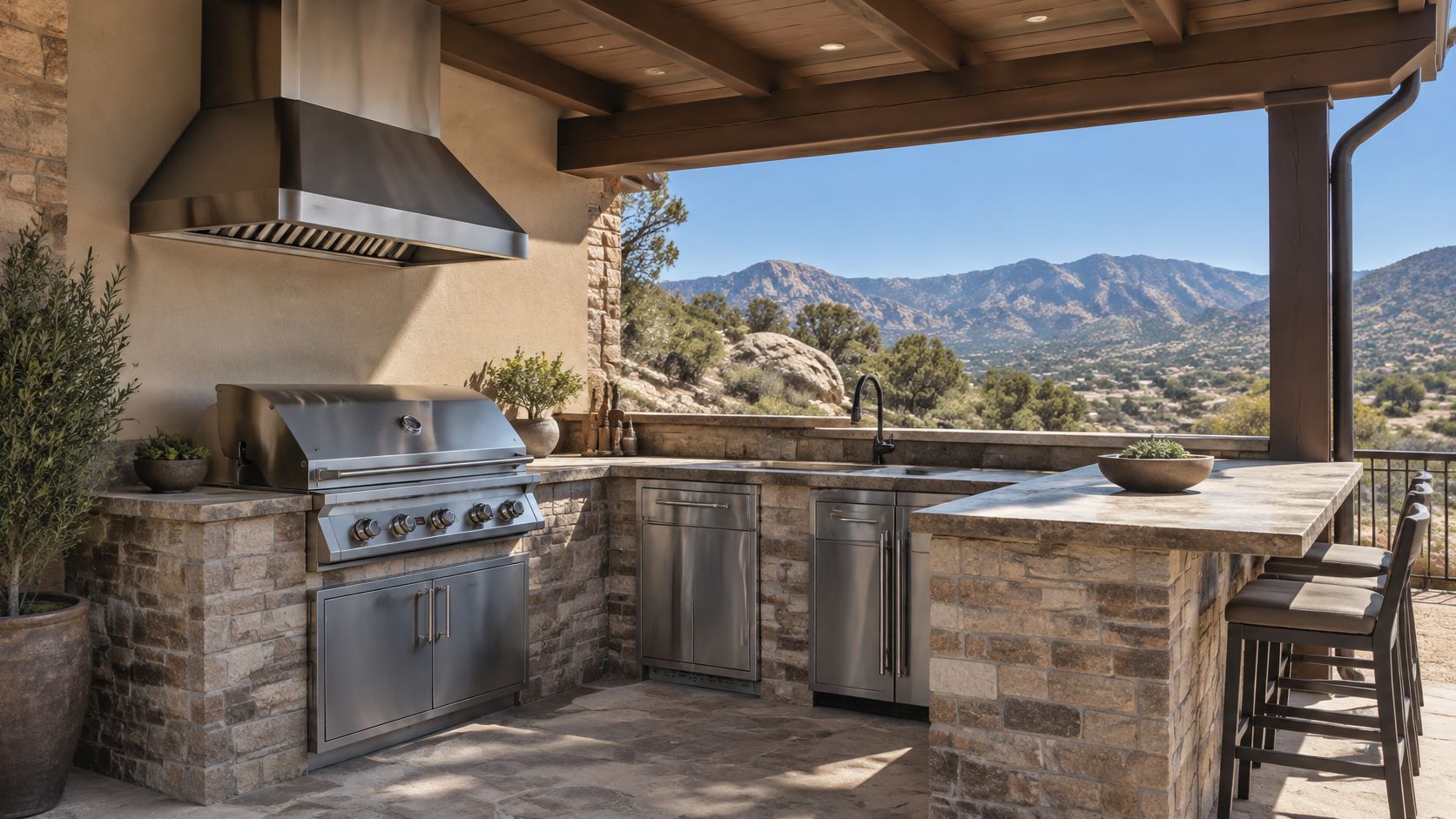
304 stainless is the pick where rain and sun reach the hood. 430 stainless is a fair budget choice in a covered, drier spot. Painted or powder-coated steel can match a color scheme under a solid cover, but a chip exposes bare metal that rusts, so touch-up is part of owning it. Brushed stainless hides fingerprints and water spots. Polished shows every mark, which is why brushed is the usual outdoor face.
For an open-top broiler, IRC exhaust provisions call for a metal hood at least No. 28 gauge (0.0157 inch or 0.395 mm), at least as wide as the appliance. The same provisions identify a 1/4-inch (6.4 mm) minimum separation from combustible cabinets or materials, and 24 inches (610 mm) from the cooking surface to combustibles. Stone veneer and masonry often hide wood framing or trim, so those gaps have to be found before the veneer goes on. R.E. and Sons Landscaping checks material and those clearances together during design for Prescott, Prescott Valley, and Chino Valley kitchens.
Weather protection is mostly placement. Put the hood under the roof, keep the canopy over the whole cooking zone, use stainless fasteners, and seal every penetration. A well-placed hood under cover outlasts a premium hood left in the rain. Counter surfaces next to that canopy take the same grease and sun, and The Cabinet Coach's outdoor countertop guide is a useful pass on materials that sit beside a hot cook line. The hood also has to land on a frame that can carry it, which is why the outdoor kitchen metal frame gets decided before the canopy is ordered.
Code, Ductwork and Makeup Air Checks Before You Build
Under a covered patio, a hood is part of the exhaust and safety system, not a finishing accessory. It needs to carry cooking air outdoors through a smooth, airtight duct with its own run, a backdraft damper, and no discharge into an attic, crawlspace, soffit, or enclosed cavity. Short, direct duct runs help limit airflow resistance and grease buildup.
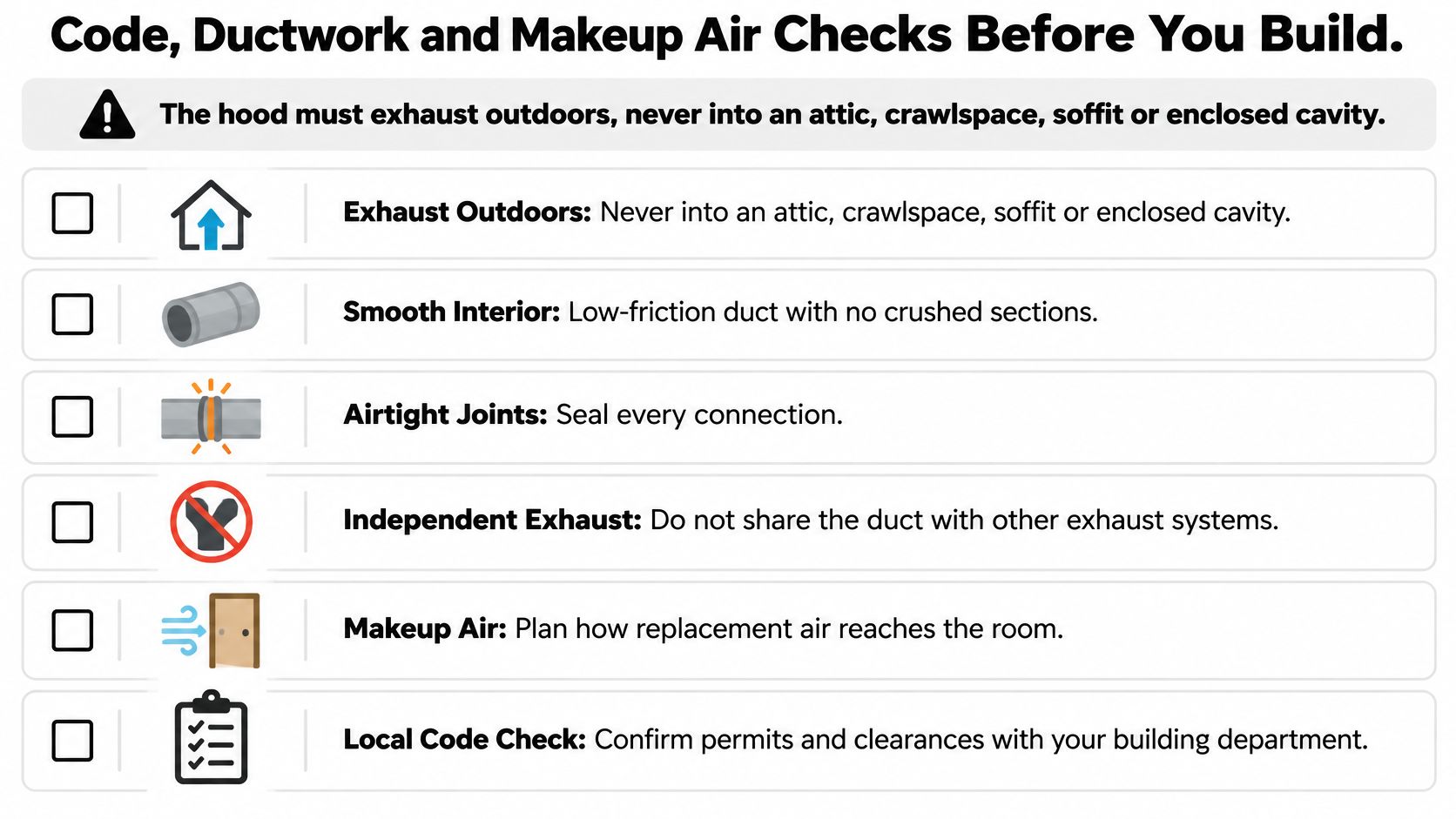
Plan the termination before fixing the duct route. The Building America Solution Center's IRC-based duct guide specifies at least 10 feet, or 3 feet above, an outdoor air inlet, and at least 3 feet from an operable window. These clearances help keep exhaust from being drawn back into the building. In Prescott, Prescott Valley, Chino Valley, and elsewhere in Northern Arizona, account for rooflines, prevailing wind, and nearby doors when locating the outlet.
Code and duct requirements for an outdoor hood
Requirement | Value | Why it matters |
|---|---|---|
Hood width | At least as wide as the cooking appliance | Helps capture smoke and heat |
Hood to combustible material clearance | 1/4 inch minimum | Limits heat transfer into framing or cabinets |
Cooking surface to combustible material | 24 inches minimum | Keeps flame and heat clear of wood or trim |
Duct termination from outdoor air inlet | 10 feet, or 3 feet above | Helps keep exhaust out of fresh-air intakes |
Duct termination from operable window | 3 feet minimum | Helps keep smoke out of openings |
Exhaust rate triggering makeup air | Above 400 CFM | Helps limit depressurization and backdrafting |
Makeup air rate | Approximately equal to the exhaust rate | Replaces air removed by the hood |
Duct construction | Smooth, airtight, with backdraft damper, exterior discharge only | Keeps exhaust out of the structure |
Makeup air once the fan is large
The U.S. Green Building Council guidance states that a range hood capable of exhausting more than 400 CFM requires makeup air supplied at approximately the same rate, with automatic operation linked to the hood and a means of closure. The 900 CFM and 2,300 CFM listings compared earlier both exceed that threshold, so each needs a makeup-air plan. A covered patio connected to the house can still draw on doors and combustion appliances if a powerful fan removes air without a suitable replacement path.
Advertised CFM alone does not tell you how well a hood will capture smoke. Installed performance also depends on the hood covering the cooking area and on a duct route that lets air move without unnecessary resistance. A high-capacity fan paired with a poor route can still leave smoke under the patio while increasing the chance of pressure problems indoors.
These figures are reference points from IRC-based guidance, and local adoption varies across Arizona jurisdictions. Have the building official, a licensed electrician, and a mechanical professional confirm the design and applicable requirements before construction. For planning the sequence of duct, gas, and electrical work, use these steps for building an outdoor kitchen.
Maintenance Schedule That Keeps the Hood Working
Grease in filters, baffles, and ducts cuts airflow and raises fire risk. Corrosion at fasteners and seams weakens the canopy. A hood that is never opened will slowly stop doing the job you paid for.
Clean grease filters or baffles monthly during grilling season. Look for a film on the metal and weaker pull at the canopy lip. If suction feels soft, the filter is already late.
Wipe exterior stainless monthly, or after a heavy cook, with a non-abrasive cleaner. Work along the grain so you lift water spots and dust instead of scratching them in.
Inspect the canopy and fasteners twice a year, before and after winter. Check seams for rust, screws for play, and seals for gaps that monsoon rain can exploit.
Test the light and fan monthly. Dead bulbs, new noise, or a fan that sounds busy but moves little air are the early mechanical tells.
Check the exterior termination and backdraft damper once a year. Debris, nesting, or a flap stuck open or closed will undo a clean filter.
On ductless units only, replace charcoal filters on the maker's schedule, or sooner when odor comes back between cooks.
Book professional duct cleaning when grease is visible inside the duct or the exhaust has clearly slowed.
Spring in Prescott loads pollen and dust onto the canopy. Monsoon season blows debris toward open sides and into the termination. After freezing nights, look again at seals and fasteners before the first warm-weekend cook. R.E. and Sons Landscaping's maintenance department can take those recurring checks for clients who don't want them on a personal calendar.
The warning sign is simple. If the hood struggles to pull smoke, or the canopy smells of grease between cleanings, inspect it before the next cookout.
Outdoor Kitchen Vent Hood Questions Homeowners Ask
Do I need a vent hood over an outdoor grill?
Not always. An open yard with no overhead cover and no walls can handle occasional grilling. A covered grill, a built-in burner, or a fryer needs a hood, because the roof holds the smoke in the seating area.
Can I use a ductless outdoor hood?
Only for light side-burner use in an open or lightly enclosed spot where no duct to the exterior is practical. It is a poor match for a built-in grill you use often under a solid cover.
Does an outdoor hood need a permit in Prescott?
Usually yes, because the duct and the electrical work are part of the project. Confirm with the Prescott or Prescott Valley building office, since local adoption of the code is not the same in every town.
How much airflow does a 42-inch hood need?
At least 140 CFM as a width floor. If the grill maker publishes a higher exhaust requirement, that higher number is the one you build to.
Does a hood need makeup air?
Yes once exhaust exceeds 400 CFM. Supply makeup air at roughly the same rate, and have it start automatically with the hood, with a way to close it when the fan is off.
Recommended Specs and Your Next Step in Prescott
A solid residential outdoor kitchen vent hood spec, pulled from the checks above, looks like this:
Width at least equal to the grill or burner row, and ideally over the full footprint.
Airflow set by the grill maker's published requirement, and never below 40 CFM per linear foot.
A deep canopy, because capture beats a bigger free-air number.
304 stainless where the hood is exposed, 430 stainless or a sound coating where it stays covered and drier.
No. 28 gauge metal minimum on any hood over an open-top broiler.
A smooth, airtight, independent duct to the exterior, with a backdraft damper.
Makeup air whenever exhaust exceeds 400 CFM.
Then do the work in this order:
Measure the full cooking width, not just the grill lid.
Get the grill maker's exhaust requirement in writing.
Map the duct route and where it terminates outside.
Confirm the permit path with the Prescott or Prescott Valley building office.
Book a consultation online or by phone with R.E. and Sons Landscaping, Monday through Friday, 8am to 4pm.
The team is licensed, bonded, and insured under Arizona ROC #300642, and homeowners receive complimentary yard design. Bring the width, the grill model, and a sketch of the roof. That is enough to tell whether the hood, the duct, and the cover can be built as one job.
R.E. and Sons Landscaping designs and builds covered outdoor kitchens and bars across Prescott, Prescott Valley, Chino Valley, and Northern Arizona, including the hood, duct route, and clearances that keep smoke out of the seating area. If your grill sits under a roof and you want the ventilation planned with the structure, visit R.E. and Sons Landscaping to schedule a consultation online or by phone, Monday through Friday, 8am to 4pm.
Comments