
Outdoor Putting Green DIY for Northern Arizona
The patio is already there, the monsoon dirt is still in the joints, and the lawn beyond it looks tired after another dry Northern Arizona stretch. You want a place to roll a few putts after work. You do not want a thirsty patch of grass that has to be watered just so it stays green enough to walk on.
That is the usual start of an outdoor putting green DIY plan in Prescott or Prescott Valley. R.E. and Sons Landscaping designs and builds custom artificial-turf putting greens for homeowners across Prescott, Prescott Valley, Chino Valley, and nearby Northern Arizona. The work follows a four-step path: consultation, design approval, transformation, and enjoyment. The useful question is not which turf photo looks smoothest. It is whether the lot can shed water, stay firm, and stay usable when the afternoon sun hits.
Can You Build a Putting Green in Prescott
A homeowner in Prescott Valley had a short side yard between a patio and a rock slope. The idea was simple: a compact practice green, less irrigated lawn, and a spot the kids could use without dragging a hose across the yard all summer. On paper the area looked flat. Underfoot it was native soil that had already settled into a shallow dish after one wet season.
A green is a base, not a rug
A decorative patch of synthetic grass can hide that dish for a week. A surface built to drain and stay firm will not. Turf laid over native dirt can look level on day one, then settle, hold water, or roll a ball off line once the fibers and the soil move in different directions. Excavation, compacted aggregate, consistent slopes, edging, and a drainage base decide whether the green stays playable.
Shrinking irrigated lawn can matter on these lots. An EPA review reported that water-efficient landscaping used 76 percent less water per unit area than turfgrass in one comparison, equivalent to approximately 55.8 gallons per square foot, as detailed in the EPA turfgrass water-use review. The same report cited an Arizona estimate that a 3,000-square-meter turfgrass lawn could use 9,000 to 15,000 gallons of water per month, compared with 800 to 1,300 gallons for shrubs, trees, and other lower-water vegetation.
Savings are a site result
Those figures do not travel with the turf roll. Savings depend on the area converted, climate, irrigation, infill, cleaning, and the surrounding yard. A compact synthetic green can cut the watered footprint and still leave a place to practice. It does not promise the same gallon count on every Prescott lot, and rinsing dust off the fibers is not the same as irrigating a lawn.
Practical rule: Plan the site and the water first. Order turf only after the finished grade and the outlet make sense.
The reader who should use this guide lives in Prescott, Prescott Valley, Chino Valley, or a nearby Northern Arizona town, wants a short-game spot, and is willing to treat the ground as the project.
Where Should a Backyard Putting Green Go
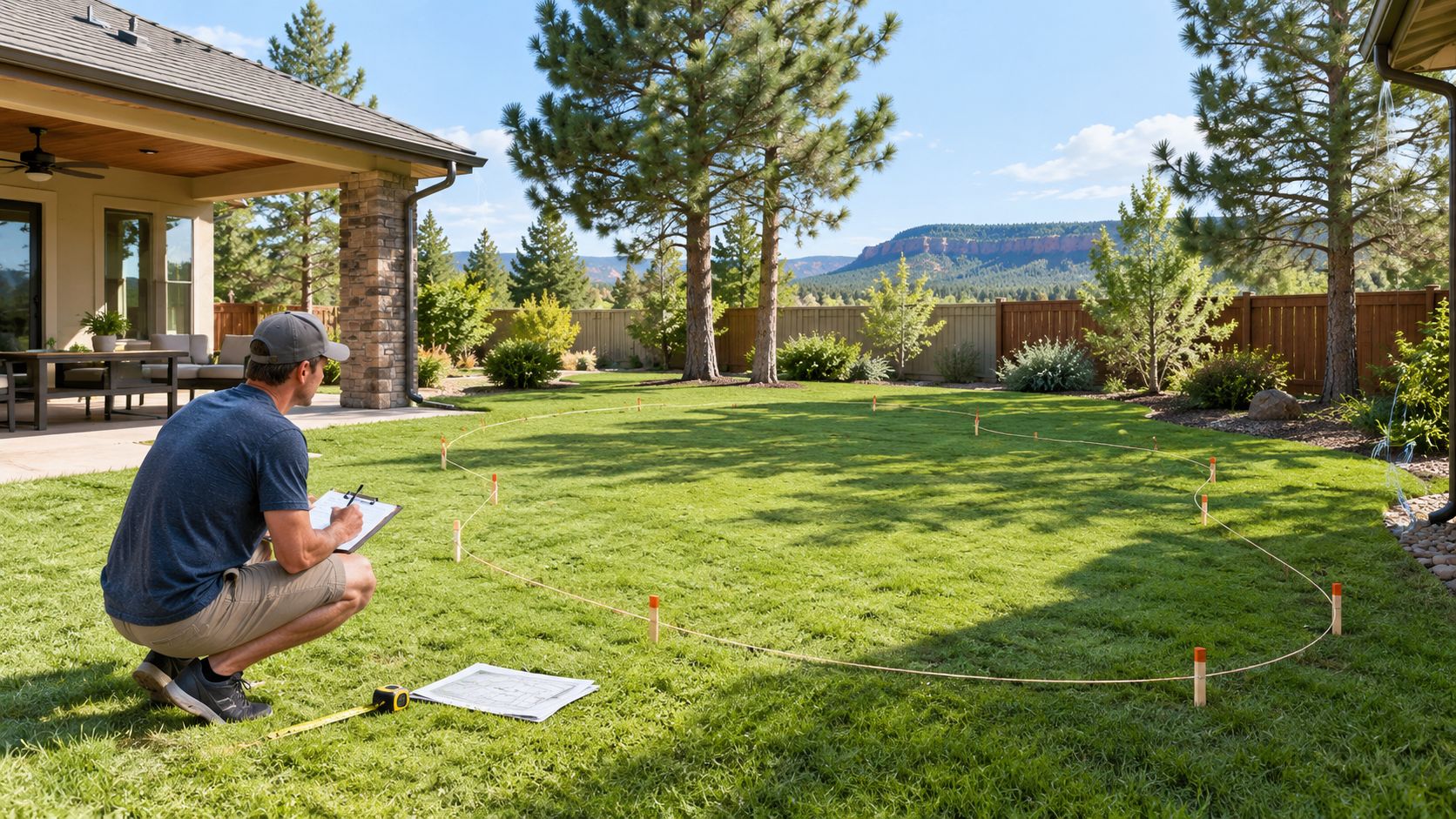
Walk the yard at the hottest part of the afternoon, not at 8 a.m. when the patio still feels pleasant. Stake the footprint against sun, roof and patio runoff, tree litter, pet paths, and the way people already walk from the house. A green that sits in the natural low point will catch monsoon water from pavers and a roof, even if the view from the kitchen is perfect.
Heat is a siting problem
Recent evidence found artificial turf surfaces consistently run 9.4–33.7°C hotter than natural turf, while a 2025 field study reported synthetic turf can exceed natural grass by 3.34°C on average, according to the NCCEH artificial turf review. Other research has documented artificial-turf temperatures above 76.7°C on hot days. Surface temperature is not air temperature, and lower water use does not remove burn or heat-stress risk for kids, pets, or bare feet.
Shade from the house or a simple structure is useful. A new tree planted at the edge is a poor trade if roots heave the base and needles pack the pile. On sloped Prescott-area lots, keep the green off the gathering patio's downhill edge so storm water has a path around the surface instead of across it.
Before you order material, measure the proposed area at peak sun and write down a maximum surface temperature you will accept.
Sun path: Note where the green is exposed from late morning through midafternoon.
Runoff: Mark roof scuppers, patio falls, and any swale that already carries storms.
Debris: Stay clear of heavy needle drop, pet corners, and the main door path.
Use: Leave enough fringe that people can walk around cups instead of across them.
A spot that feels right at breakfast can be the wrong recreation surface by 3 p.m.
How Do You Drain an Outdoor Putting Green
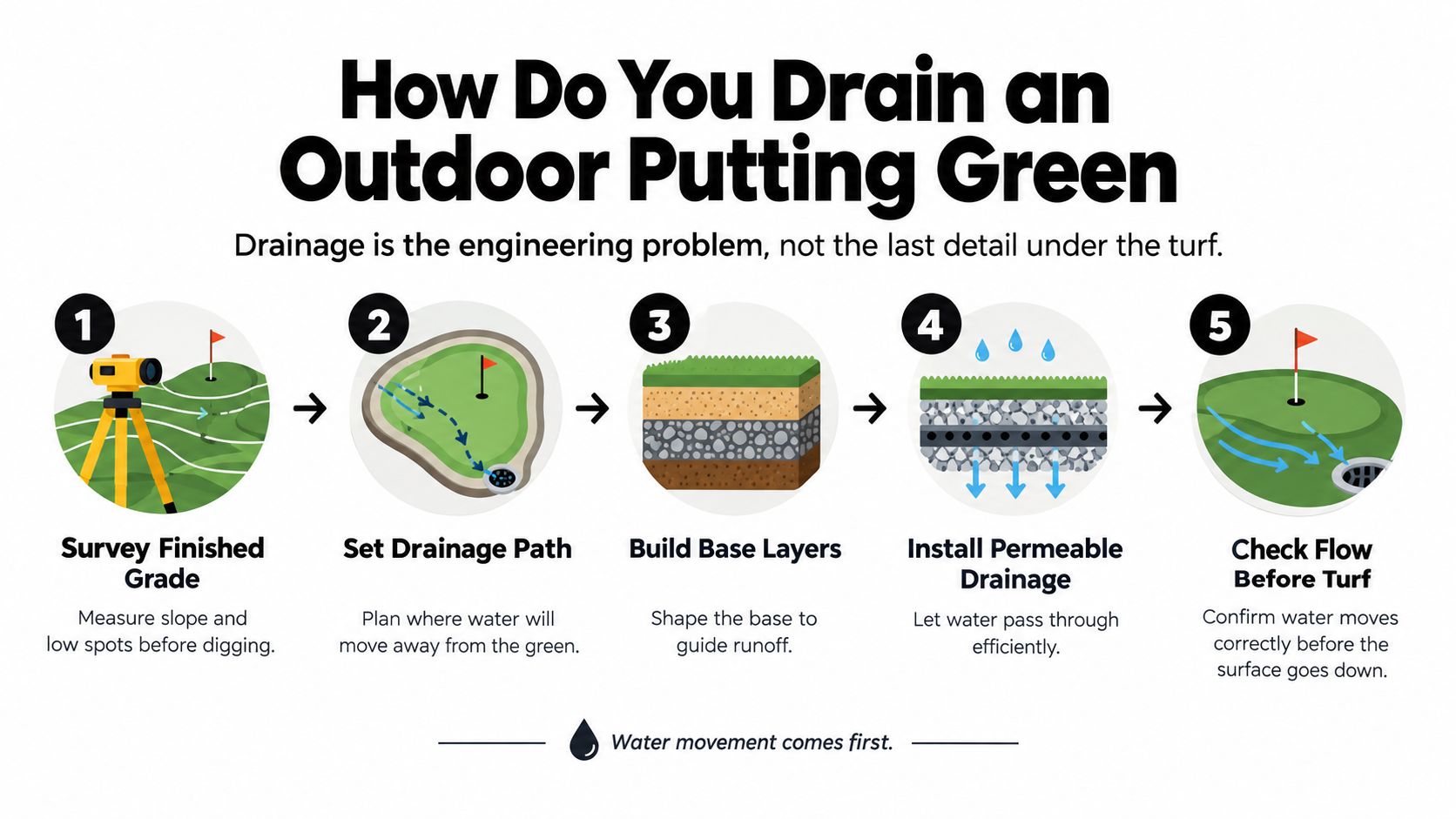
Drainage is the engineering problem. Turf is the cover you put on after the water has a way out. A smooth-looking surface still fails if a bowl, a flat pipe, or a blocked outlet holds water underneath.
From finished grade to a water test
Survey and stake the finished elevations before you dig. Excavate to a stable subgrade, shape out every depression, and compact so the green does not settle into new bowls. Set a main drain along the maximum fall with 4-inch perforated pipe, then run laterals across the slope.
USGA putting-green construction guidance limits lateral spacing to 15 feet, requires a continuous pipe slope of at least 0.5 percent, and calls for perimeter drainage where a cavity wall can collect water. A layered build uses a minimum 4-inch gravel drainage blanket beneath approximately 12 inches of sand-based rootzone, held within about plus or minus 1 inch. Arkansas Extension warns that standing-water pockets can cause the green to fail and recommends closer-than-10-foot drain spacing where native soil is used.
A synthetic backyard green often uses a thinner prep: a gravel layer, then compacted aggregate, with exact depths set by the site and the product. That is not the same build as a sand-based course green. Either way, confirm the outlet can take the flow, keep soil out of the gravel, and water-test before you cover it.
When slope alone is not enough
Surface grading can be enough on a gentle, well-drained pad with a clear downhill exit. A perforated drain, a dry well, or a connection to an approved system is the wiser call when water would otherwise sit against a foundation, a retaining wall, or a patio. If you want a wider look at how larger sites move water, you can compare commercial landscape drainage options and then scale the idea back to a yard. Infill choice comes later, once the base is proven, which is why it helps to read through artificial turf infill options only after the outlet works.
A short field check on a graded base shows why the water test belongs before any turf is cut.
The result you want is a finish-grade map and a proven exit path, not a deeper hole filled with extra rock.
How Do You Install Turf Edges and Cups
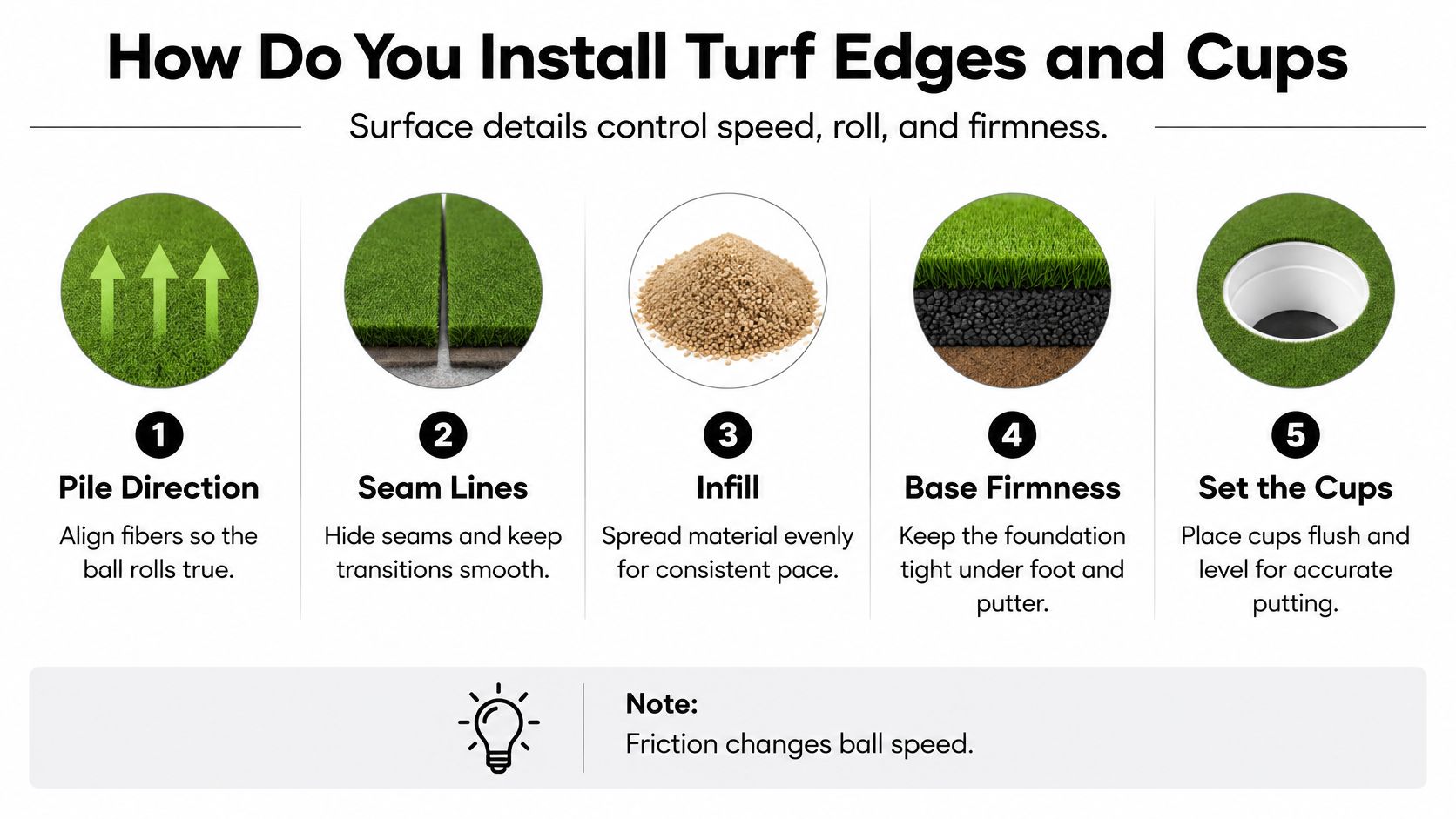
Once water leaves the pad, the surface has to play. A golf ball rolls while it continuously slows down. Friction changes its speed until it stops, which is the point made in the USGA putting science guide. Pile direction, seam placement, infill distribution, base firmness, and cleanliness decide how far the putt travels. A pretty fiber can still break sideways if the nap changes mid-green.
Edges, nap, and cups
Set rigid edge restraint so crushed aggregate cannot creep into planting beds or patio joints. High edging becomes a lip and a trip. The turf should meet the restraint without a gap, and cuts around drains should stay flush so a ball does not hop.
Lay the fibers in one consistent direction. Hide seams off the main putting lines. A seam under a straight six-footer is the break people blame on the green when the cause is the joint.
Spread infill evenly, then firm the surface in the way the product allows. Check for pockets with a ball, not only with your eye. Place each cup with enough surrounding green for a realistic approach. A cup jammed against the border forces every putt across the edge and wears one lane.
What a custom layout is for
R.E. and Sons Landscaping designs custom artificial-turf putting greens for homeowners in Prescott, Prescott Valley, and Northern Arizona as part of broader outdoor spaces. The layout has to match how the yard is already used, not a generic rectangle unrolled wherever the delivery truck stopped.
Edge first. Lock the perimeter before you trust the roll of the turf.
Nap second. One fiber direction, seams off the practice lines.
Cups last. Flush rims, clear approaches, and no lip at the cut.
If the base is already right, these details are what make the speed repeatable.
Should You DIY or Hire a Prescott Landscaper
A handy homeowner can build a small green on a gentle grade when there is room for an outlet and the soil is stable. A design-build install is the better fit when the lot slopes, the soil shifts, or the discharge has to pass a patio, a retaining wall, or a foundation. R.E. and Sons Landscaping is a licensed, bonded, and insured company, Arizona ROC number 300642, with a maintenance department after the green is in.
Published guidance commonly cites a 1–2 percent minimum slope, while other guidance recommends approximately 2 percent or a 4- to 5-inch compacted crushed-rock base, as summarized in putting green installation dos and don'ts. A deeper base is not automatically better. Poor compaction, weak edge restraint, or an unplanned discharge point can still cause settlement and ponding. Professional review is warranted near foundations or retaining walls.
Site condition | Reasonable DIY fit | Better with a local pro |
|---|---|---|
Gentle grade, clear outlet, stable soil | Yes, if you can compact and water-test | Optional, for speed and finish |
Sloped lot or variable native soil | Only the easy fringe work | Grading, drains, and outlet design |
Patio, wall, or foundation nearby | Not the discharge route | Reviewed path so water does not flood joints |
Green tied into pavers, rock, or planting | Edging help at most | Full layout so levels meet |
What actually moves the cost
There is no honest single price. Cost follows green size, excavation and haul-off, aggregate and drainage, turf and infill grade, edging, cups, access for equipment, and whether the green has to meet pavers, rock, or planting. A tight side yard in Chino Valley can cost more labor than a larger open pad in Prescott Valley.
A consultation and a complimentary design conversation are the practical next step, with office hours Monday through Friday, 8 a.m. to 4 p.m. If you want to see how a contractor scopes this work, start with what a backyard putting green contractor handles. Choose DIY on a simple pad, hybrid help for drainage only, or a full install when the risk sits next to the house.
How Do You Keep a Putting Green True
Construction ends. Speed does not stay put by itself. Prescott wind, foot traffic, and monsoon silt change the pile and the edges long before the turf wears out.
A short seasonal list
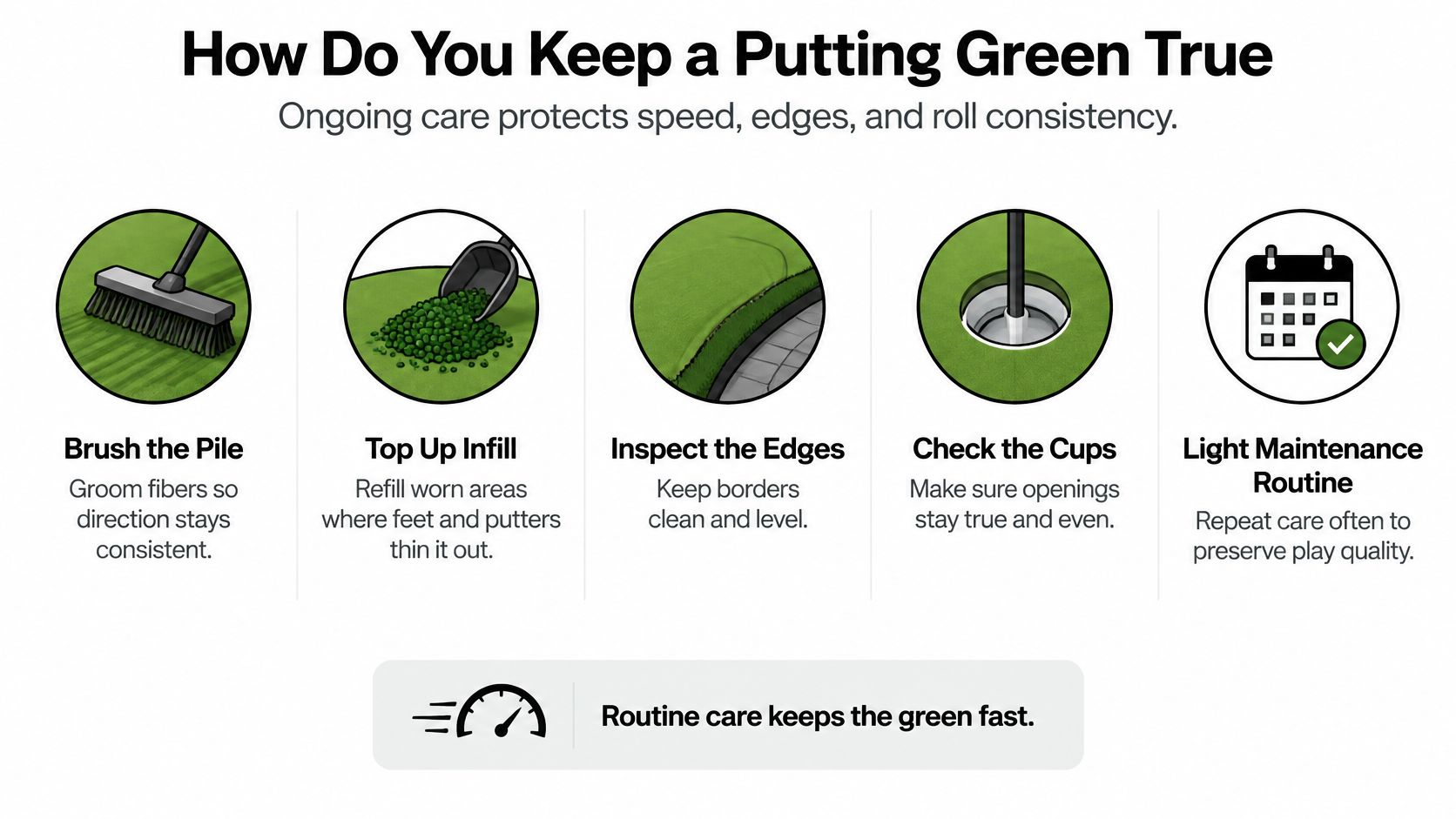
Brush or groom so the pile keeps one direction. Top up infill where feet and putters thin it, especially in front of the cups. Keep grit, needles, and silt off the fibers before it packs the base of the pile. After a storm, roll a ball across the same line. If it dies in the same spot twice, look for a low area or a clogged outlet instead of blaming the turf.
Rinse or run a light irrigation only when the warranty allows it. Cleaning heat and dust should not float the infill or void coverage. Check edges after windy weeks so rock and mulch do not creep onto the fringe. In summer, play mornings or evenings. Keep pets and furniture off one lane so you do not crush a single path into a slow strip.
Golfers who also run events already know that pace and logistics have to live together. The same idea shows up when you balance course conditions and event operations: the surface has to be ready when people show up, not only on install day. A homeowner can follow the list, or the R.E. and Sons maintenance crew can. Either way it is separate from the original build. More of that routine is in putting green maintenance.
Routine care keeps the green fast. A soft base or a buried low spot will not brush out.
Outdoor Putting Green DIY Questions
Do you need a permit or HOA approval
Check the city, the county, and the HOA before you excavate. There is no single Prescott-area answer. Some boards care about turf color, setbacks, and drainage toward a neighbor. Others only review visible changes. Get the written rule for your lot, then design the outlet to match it.
How soon can you play
Play after seams have set, infill is in place, and the water test is done. Rushing putts on a soft base presses ruts into the aggregate. People later blame the turf for a dent the first weekend made. If your shoe leaves a deep print, wait.
Can the green sit beside a patio
Yes, if overflow misses the joints and the planting beds. The patio should not dump roof and hardscape water onto the green, and the green should not send its exit flow back into the paver sand. Grade both surfaces so each has its own way out.
Can kids and pets use it
They can, with the heat, shade, and debris routine already set. Hot fibers, pet waste, and toys left in one lane are use problems, not install problems. Pick cooler hours, keep a rinse plan that the warranty allows, and brush the pile after heavy play.
If the lot, the outlet, or the heat still feels uncertain, schedule a consultation with R.E. and Sons Landscaping online or by phone, Monday through Friday, 8 a.m. to 4 p.m. Ask for a site look in Prescott, Prescott Valley, Chino Valley, or nearby Northern Arizona before you commit to a weekend dig.
R.E. and Sons Landscaping designs and builds custom outdoor putting greens for Prescott, Prescott Valley, Chino Valley, and nearby Northern Arizona yards, with drainage, base work, turf, and cups planned as one outdoor space. If you want that plan checked against your sun, slope, and patio before you dig, visit R.E. and Sons Landscaping and set a consultation for Monday through Friday, 8 a.m. to 4 p.m.
Comments