
Putting Green Maintenance in Prescott: A Homeowner Guide
A July monsoon storm has just moved through Prescott. You step onto the backyard putting green and find dust across the surface, infill pushed toward the edges, and a ball that skips instead of rolling true. If the green is natural grass, the problem may be uneven moisture or disease pressure. If it's artificial turf, brushing and infill redistribution may solve it, but only if you catch the issue early.
R.E. and Sons Landscaping helps homeowners in Prescott, Prescott Valley, Chino Valley, and nearby Northern Arizona communities design, install, and maintain artificial turf and custom backyard putting greens. The central problem is simple: putting green maintenance in the high desert must account for intense sunlight, monsoon dust, freezing weather, and restricted water use, not just ordinary lawn-care habits.
Why Putting Green Maintenance in Prescott Is Different
Prescott's climate changes how a green behaves from one season to the next. Strong ultraviolet exposure can fade artificial fibers and dry natural turf. Summer monsoon storms bring windblown dust, pollen, and debris that settle into infill or compact the surface. Winter freeze and thaw can shift edging, open seams, and create drainage problems. Water restrictions and HOA rules also affect how often you can irrigate or rinse a surface.
The first question is: what type of green do you have?
Artificial turf: Maintenance focuses on fiber recovery, debris removal, infill balance, odor control, seam inspection, and drainage.
Natural grass: Maintenance includes mowing, irrigation, fertilization, aeration, topdressing, disease monitoring, and careful seasonal recovery.
Those two surfaces may look similar from the patio, but they need entirely different tools and schedules. Artificial turf generally avoids mowing and routine fertilization, but it still needs brushing and infill management. Natural grass can provide a highly responsive playing surface, but it demands precision. Penn State Extension lists an acceptable mowing range of 5/32 to 3/16 of an inch for creeping bentgrass and creeping bentgrass and annual bluegrass mixtures, and recommends lowering mowing height gradually rather than all at once. Penn State's golf-course turf guidance explains why a putting surface isn't maintained like residential turf.
Prescott rule: Choose the maintenance system before choosing the surface. A low-water artificial green still needs service, while a natural green needs a reliable irrigation and turf-management plan.
The rest of the routine depends on that choice. Artificial turf owners should concentrate on short, frequent inspections rather than waiting for visible matting or odor. Natural-grass owners need a seasonal calendar that follows growth, moisture, temperature, and frost conditions. In both cases, the best results come from correcting small changes before they become base, drainage, or turf-health failures.
Weekly and Monthly Routine for Artificial Turf Greens
Artificial turf is lower maintenance than natural grass, but “low maintenance” doesn't mean no maintenance. Prescott dust, pine needles, pet activity, and foot traffic gradually flatten fibers and move infill away from the areas that need support.
What to do every week
Start with a static-free broom, stiff-bristle push broom, or backpack leaf blower. Work against the direction of the turf lay, especially around cup collars, walk-out paths, and the approach from the house. These are the places where repeated traffic begins to mat fibers.
Use the blower to remove loose debris first. Then brush with controlled passes instead of aggressive scrubbing. The goal is to lift the yarn without pulling at seams or stripping away infill.
A putty knife provides a simple spot-check tool. Slide it carefully into a low-traffic area to assess whether the infill is still supporting the fibers. If the surface feels thin or the blade leans over quickly, the area may need redistribution or a small top-up.
A useful weekly inspection takes only a few minutes:
Surface: Look for leaves, needles, dust films, and pet waste.
Fibers: Check for shiny, flattened, or permanently leaning sections.
Edges: Inspect seams, cups, collars, and transitions to pavers or soil.
Infill: Look for bare areas and piles along borders.
Drainage: Watch for water that remains after rinsing or rain.
The company's guide to maintaining artificial turf in Prescott is useful for homeowners who want a local reference for brushing, debris removal, and inspection.
What to do each month
Use a power brush or turf rake across the entire green. Brush in more than one direction so the fibers don't develop a permanent traffic pattern. For low spots, use a drop spreader to distribute compatible infill evenly, then brush it into the turf rather than leaving loose material on top.
A light rinse with a garden hose helps settle dust and reduce static. Rinse during an approved watering period and avoid flooding the surface. If water pools, stop treating the symptom and inspect the grade and drainage.
For homeowners comparing materials, this overview of gardens with synthetic putting greens offers useful context on how synthetic surfaces are assembled and used. In Prescott, I generally favor a cooler acrylic-coated sand infill over inexpensive black rubber crumb. Acrylic-coated sand is better suited to intense sun exposure, while cheap rubber crumb can heat up, break down, and leave residue.
Every few months, apply a turf-safe enzymatic cleaner with a five-gallon spray tank, especially where pets use the yard. Follow the product label and rinse only as permitted by local rules. Enzymatic cleaners can help manage organic residue, but they won't repair a drainage problem or remove compacted infill.
Keep a static-free broom, backpack blower, turf rake, drop spreader, and five-gallon spray tank together. That makes routine care easier and helps you develop a five-minute weekly inspection habit. Small corrections are cheaper and less disruptive than waiting until a seam lifts or a whole traffic lane becomes glossy and flat.
Seasonal Care Schedule for Natural Grass Greens
Natural grass in Prescott requires a calendar, but the calendar must remain flexible. Bentgrass and bermudagrass respond differently to elevation, cold nights, heat, irrigation, and recovery time. Mowing, water, nutrition, cultivation, and disease monitoring must work together.
Spring recovery
As winter dormancy ends, inspect the green for thinning, crown injury, snow mold, and compacted areas. Remove damaged debris and address winter drainage before encouraging new growth. Dethatching may be appropriate where dead material has accumulated, but aggressive removal can injure a weak surface.
Topdressing with 1/4 inch of USGA sand is one of the practices specified for the spring program in this regional approach. Apply it only when the grass can grow through the material and when the sand is compatible with the existing root zone. A mismatched material can create layering and interfere with water movement.
At Prescott-area elevations, overseeding choices should match the green's exposure and irrigation capacity. Pure bentgrass or Yukon bermudagrass may be considered for suitable sites, but the correct choice depends on sun, shade, winter exposure, and the existing turf. Begin a light fertigation program only after the grass shows active recovery and the soil has warmed enough to support growth.
For broader timing and irrigation principles, see these best lawn-care practices for Prescott landscaping.
Summer stress and monsoon pressure
Before monsoon humidity arrives, make sure the green has adequate nutrition without forcing excessive soft growth. Excess growth can increase mowing demand and may worsen disease pressure when the surface stays wet overnight.
Bentgrass may need a temporary mowing-height adjustment during heat stress. The regional plan uses 0.180 inch only on bentgrass, and any change should be gradual. Penn State identifies mowing height, mowing frequency, fertilization, irrigation, thatch management, grooming, and rolling as factors that work together to influence green speed. Its green-speed guidance supports an integrated approach rather than chasing speed with a single setting.
Irrigate at dawn when the turf needs water, while following Prescott restrictions and HOA requirements. Arkansas Extension describes the goal as deep and infrequent irrigation, with watering triggered by signs such as purplish color or visible footprinting rather than a fixed daily habit. The Arkansas turf guide also connects frequent mowing with playability and recovery.
During monsoon conditions, inspect for dollar spot and brown patch. Look for circular lesions, thinning, or discolored patches, and avoid responding by just adding water. Moisture readings can separate a dry area from a saturated one. USGA guidance recommends collecting 3 to 4 soil-moisture readings per 1,000 square feet, at the same time of day and from representative locations, before making irrigation decisions. This USGA hand-watering workflow shows how calibrated readings and evapotranspiration can support small, targeted applications.
Fall preparation
Fall is the time to correct compaction and prepare the root zone for cold weather. Core aeration opens channels for air and water, but it must be followed by proper cleanup, topdressing, and recovery. Purdue Turfgrass guidance recommends hydrating the green before aerification and keeping it well hydrated afterward. It also notes that mowing height often needs to rise slightly for the first few days while sand topdressing remains on the surface. Purdue's aerification checklist explains the sequence.
Overseed cool-season bentgrass only when conditions support establishment. Use soil-temperature readings and the expected local frost window instead of applying seed strictly by a calendar date. Before the first hard freeze, apply a winterizing potassium fertilizer according to soil-test results and product directions.
Winter care
Winter is a rest period, not a license to ignore the surface. Limit traffic when the turf is frozen, check occasionally for snow mold, and watch for crown desiccation in exposed areas. Keep mower blades, irrigation components, moisture meters, and aeration tools clean and serviced so they're ready when growth resumes.
Time and Cost Comparison Between Turf and Grass
Artificial turf usually requires more money at installation, while natural grass asks for more recurring attention. The right choice depends on whether your household values predictable routine work and water savings, or prefers a living surface and accepts seasonal management.
The USGA notes that even a modest public course may spend more than $10,000 per year maintaining each green, with daily mowing at roughly 1/8 inch or lower, specialized walk-behind equipment, irrigation, licensed pesticide applications, and aeration. This putting-green maintenance overview also cites backyard recurring costs such as mower sharpening at about $100 per year, fertilizer at $75, fungicide at $150, and insecticide at $50 for an approximately 1,000-square-foot green. Those figures are useful context, although a private Prescott green may have a different size, grass type, service level, and water rate.
Category | Artificial Turf | Natural Grass |
|---|---|---|
Installation | Higher upfront investment, including base preparation, turf, infill, cups, and drainage | Lower or moderate installation cost, but irrigation, root-zone preparation, seed, sod, or sprigs affect the total |
Weekly work | Blowing, brushing, debris removal, and inspection | Mowing, moisture checks, irrigation adjustments, and surface inspection |
Seasonal labor | Brush recovery, infill redistribution, rinsing, seam checks, and odor treatment | Aeration, topdressing, overseeding, fertilization, disease management, and mowing adjustments |
Water use | Rinsing and occasional cleaning, subject to restrictions | Regular irrigation during active growth, with careful scheduling |
Supplies | Infill top-offs, cleaner, brushes, and occasional edge materials | Seed, fertilizer, sand, fungicide where appropriate, mower service, and irrigation repairs |
Long-term issues | Fiber wear, infill migration, seam lifting, drainage, and edge repairs | Thatch, compaction, disease, winter injury, irrigation variation, and turf replacement |
A professional visit may be occasional for artificial turf and more regular for natural grass. Exact Prescott pricing depends on access, square footage, drainage, surface condition, and the work required, so a written quote is more useful than a generic online range.
The practical question is direct: which trade-off matters more to your household, money at installation or time and water over the life of the green?
Common Problems Prescott Homeowners See and How to Fix Them
A surface that looks dry isn't always asking for more water. A surface that looks dirty isn't always asking for a stronger cleaner. Prescott greens often fail because the owner treats a structural, moisture, or infill problem as a cosmetic one.
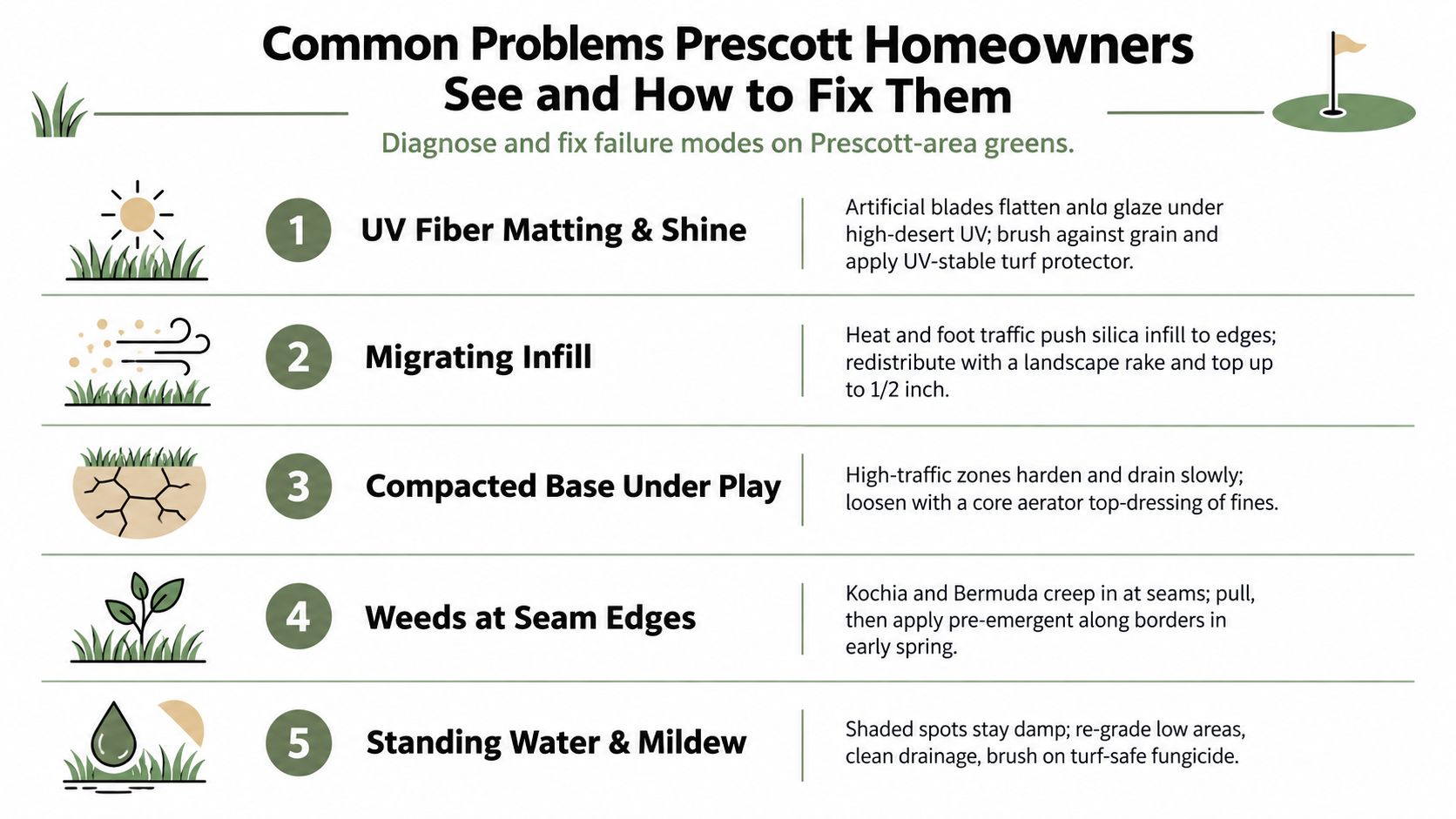
Artificial turf symptoms
Shiny, flattened fibers usually point to UV exposure and traffic. Brush against the lay with a power brush or stiff turf rake. If fibers stay flat, the problem may be permanent wear rather than a cleaning issue. A UV-stable turf protector can help protect suitable materials, but test it in an inconspicuous area first.
Dust and migrating infill become more obvious after monsoon winds or repeated foot traffic. Brush material back from the edges with a stiff rake, then top up low areas gradually. Don't bury the turf under a heavy layer in one pass, because excess infill can slow the ball and hide drainage defects.
Pet odor often comes from organic residue trapped below the surface. Remove solids promptly, rinse appropriately, and use a turf-safe enzymatic cleaner. Persistent odor after cleaning may indicate poor drainage or contaminated base material.
Seams lifting need immediate attention. Keep traffic off the area, photograph the separation, and check whether the edge has pulled away from the base. A seam that repeatedly opens, especially after freeze and thaw, may require professional repair or base correction.
Weeds at edges usually enter through seams, borders, or thin soil over the backing. Pull young weeds carefully and avoid cutting the turf or damaging the seam. Broad chemical applications can stain fibers and may not address the entry point.
Natural grass symptoms
Localized dry spots can result from poor head coverage, blocked nozzles, runoff, or hydrophobic soil. USGA guidance recommends identifying the anomaly with calibrated moisture readings before adding water. Its perimeter-management guidance describes checking coverage, surface flow, and drainage before increasing irrigation.
Collar decline around the cup often reflects traffic, mower stress, a collar dam, or inconsistent moisture. Improve coverage where needed, aerate locally if water is trapped, and inspect the grade between collar and green.
Dollar spot and brown patch need a diagnosis based on symptoms, moisture, fertility, and humidity. Avoid applying products without confirming the problem and following the label. Monsoon humidity can change how quickly the surface dries, so morning inspection is especially valuable.
Snow mold and crown desiccation can appear after winter freezes, particularly where turf is weak or exposed. Remove affected debris, avoid traffic on frozen grass, and support recovery when temperatures and soil conditions permit.
Yellowing at elevation may indicate iron deficiency, low fertility, root stress, or poor drainage. A soil test and root-zone inspection are more reliable than applying iron blindly.
The embedded video offers another visual reference for maintenance conversations:
Standing water, repeated seam movement, soft base areas, or turf that stays saturated after reasonable drainage time point beyond routine maintenance. Those symptoms call for a contractor to evaluate grade, base compaction, drainage outlets, and irrigation layout.
When to Hire a Professional and What to Ask
DIY maintenance works well when the surface is accessible, the problem is limited to debris or light matting, and you have the right brush and inspection habits. It becomes less practical when the green has persistent drainage issues, extensive pet damage, failed seams, or turf that no longer responds to brushing.
Call for an evaluation when you see:
Standing water: Pools remain after irrigation or rain.
Persistent odor: Cleaning and rinsing don't resolve the smell.
Separating seams: Edges pull apart or repeatedly reopen.
Permanent matting: Fibers stay flat after stiff brushing.
Large turf loss: Scalped or winter-killed natural turf extends beyond a small repair area.
Uncertain warranty status: A repair could affect an installation warranty.
Ask every Prescott-area contractor the same questions. Do they work on putting greens specifically, or only general lawns and turf? Are they licensed and insured? Can they provide references in Prescott, Prescott Valley, Chino Valley, or nearby communities? Will they provide a written scope of work that identifies the surface, infill, drainage, repairs, cleanup, and warranty terms?
Also ask what infill product they use, how they protect cups and seams during service, and whether they own the specialty equipment needed for the job. A power broom, turf rake, moisture meter, greens roller, and suitable spray equipment matter when the goal is ball roll rather than appearance alone.
Homeowners researching broader outdoor-service providers can also browse our landscaping solutions to compare how different companies describe maintenance, repairs, and project scope. For a Prescott-specific contractor discussion, this guide to choosing a backyard putting green contractor gives you a useful set of screening questions.
A professional service visit may include a surface inspection, moisture or drainage review, debris removal, brushing, infill assessment, seam and edge inspection, odor treatment, mowing or turf-health recommendations, and a written repair plan. Pricing varies with size, access, condition, and whether the work involves routine care or reconstruction, so compare itemized quotes rather than choosing from a vague service label.
R.E. and Sons Landscaping provides custom putting green installation, artificial turf care, grounds maintenance, and site-specific evaluations for homeowners in Prescott, Prescott Valley, Chino Valley, and Northern Arizona. Visit R.E. and Sons Landscaping to discuss your green's surface, drainage, maintenance needs, and the next practical step.
Comments