
Bluestone Patio Guide for Northern Arizona Homes
The patio you keep picturing is the flat spot behind the house where dinner, a fire, and a few chairs should just work. In Prescott, Prescott Valley, Chino Valley, and nearby Northern Arizona towns, that spot also has to shed monsoon rain, stay walkable after a cold night, and not turn into a griddle by midafternoon.
R.E. and Sons Landscaping is the licensed, bonded, and insured design-build company that helps homeowners, new-home builders, and property managers turn that wish into a finished outdoor room. The path is consultation, design approval, transformation, and enjoyment, and design services are complimentary.
The patio has to look right with the house, move water off and away, stay usable in strong sun, and hold through seasonal cold. A bluestone patio can do that when the stone, thickness, slope, and base are chosen together.
Is a Bluestone Patio Right for Your Yard
A Prescott Valley family may want one level place for a table by the slider and a clear walk to a fire pit. A Chino Valley lot may need that same gathering space on soil that softens after a wet winter. Neither yard is served by a pad that rocks, ponds, or looks temporary a year later.
This guide fits if you're deciding whether natural flagstone belongs there, and if you want the calls that come before a pretty layout. A color sample won't tell you whether water will sit, whether a slab will split, or whether the open middle of the patio will be too hot to use in July.
What you're actually deciding
Three choices get mashed together in a showroom conversation. Keeping them separate is how you avoid buying a look that the yard can't support.
The stone itself: Whether the slabs are the regional sandstone people mean by bluestone, and how the color reads against your stucco.
The climate check: What to ask about absorption and freeze performance before a lot is approved for higher-elevation cold.
The assembly: How thickness, support, and a draining base change when the patio only carries foot traffic, or when a kitchen or fireplace lands on it.
A bluestone patio is the right call when you want a natural cleft surface and you're willing to specify the stone and the water path together.
Poured concrete can be the better fit if you want a uniform slab and the lowest first cost. Flagstone earns its place when the yard also needs to meet planting, turf, or a paver walk without looking pasted on. The judgments that matter first are the material in your hand and the path water takes once the patio is built.
What Makes Bluestone Different from Other Stone
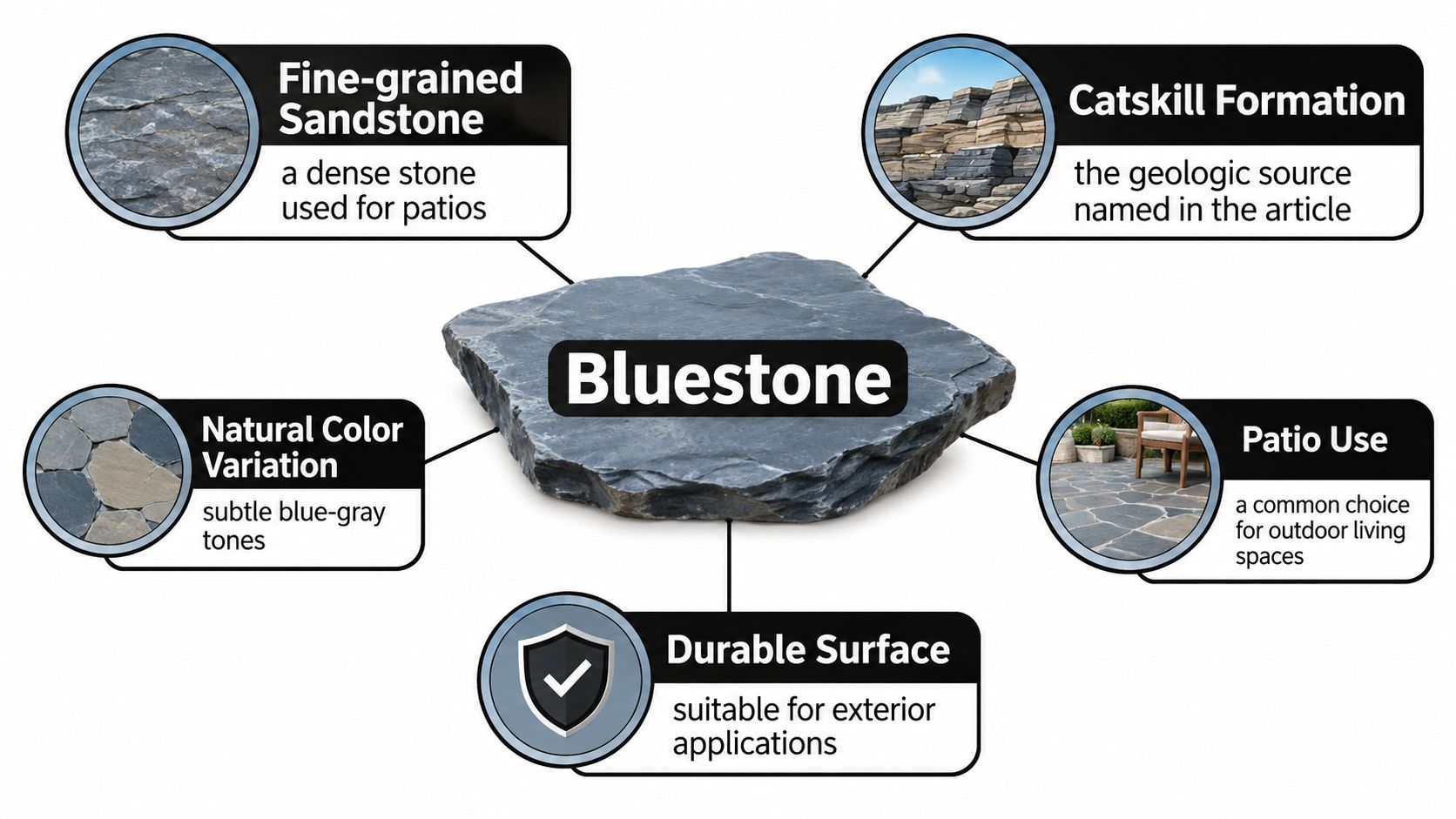
Patio bluestone is primarily a fine-grained sandstone tied to the Catskill Formation of northeastern Pennsylvania and adjacent New York. Sand-sized grains settled in the ancient Catskill Delta during the Middle to Upper Devonian, about 370 to 345 million years ago, when erosion off the ancestral Acadian Mountains carried sediment into a shallow inland sea. That origin is laid out in the bluestone geologic background.
The practical result is the way the rock breaks. Natural bedding planes let quarries split it into relatively flat slabs, which is why it works as flagstone for patios and walkways instead of only as building block.
Why the name doesn't match the color
Blue is a trade name. Pennsylvania bluestone is often gray, and the tone shifts with minerals and with the quarry. Commercial U.S. production is concentrated in south-central New York and northeastern Pennsylvania, so this isn't a product made in every state. You're buying a distinctive regional stone, and two pallets can read differently against the same wall.
What you can see and feel on a pallet:
Natural cleft surface: The split face isn't polished. Texture underfoot and small ridges catch the light.
Layered pieces: Some slabs show the bedding that let the rock split. That layering is why the pieces come out flat.
Slab-to-slab variation: Color and grain change across the lot. That's the material, not a stain or a mold, as long as you approve the range before setting starts.
Set it next to a uniform concrete paver and the difference is origin, not a finish coat. The cleft face, the layered split, and the regional color range come from how the sediment was laid down more than a third of a billion years ago. Those traits are what you're specifying when you ask for bluestone, not a single paint chip called blue.
Will Bluestone Survive Northern Arizona Weather
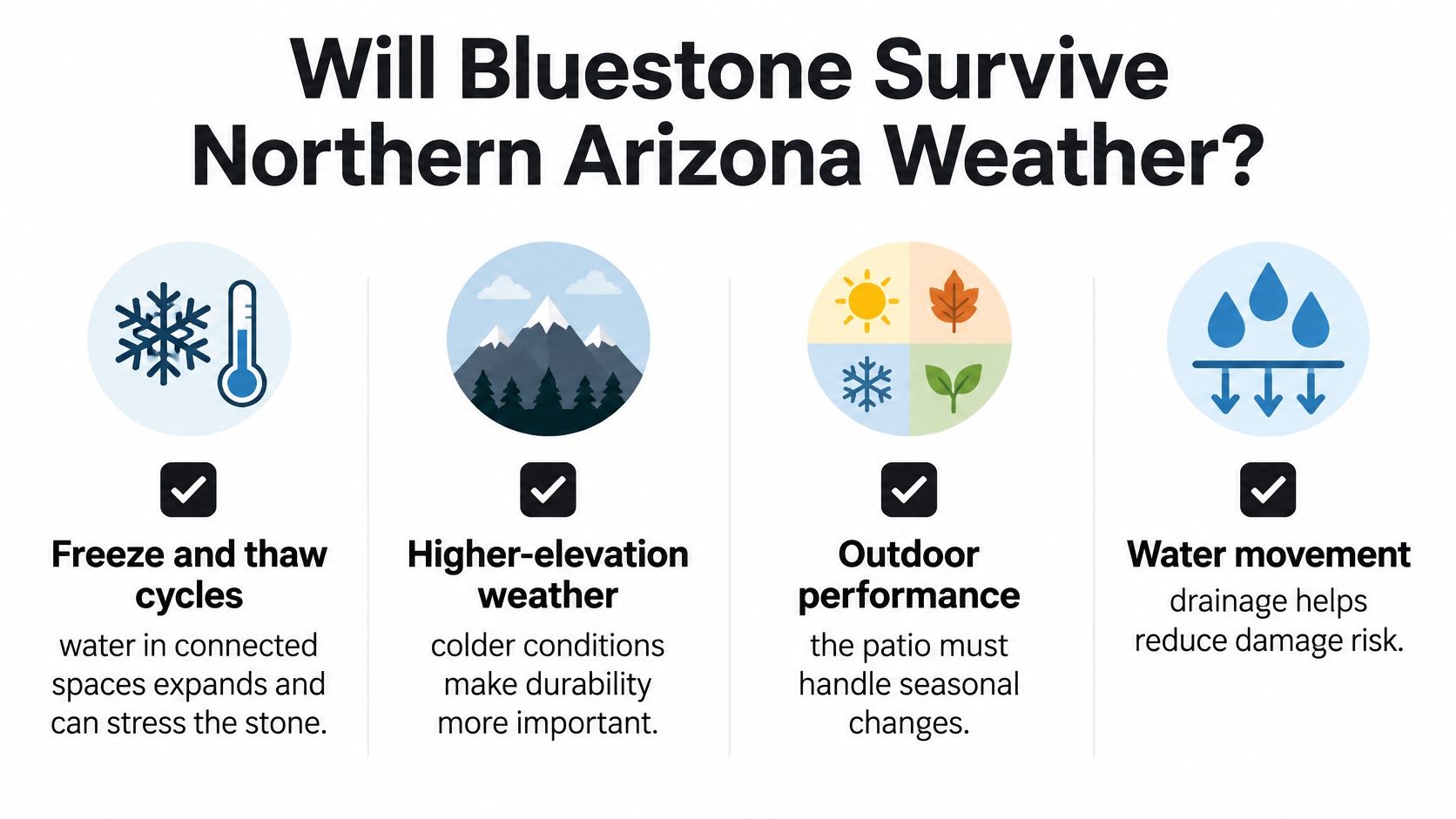
Higher elevations around Prescott don't punish stone just because the air is cold. Distress starts when water sits in connected pores, freezes, expands, and stresses the rock from the inside. Saturation before the freeze, pore size and connectivity, and the number of cycles all matter. Absorption by itself isn't a durability guarantee.
Published figures show why a generic label fails. One technical sheet reports about 2.12% water absorption under ASTM C97/C97M, while other published specifications sit near 1.2% to 1.5%, as listed on a bluestone technical data sheet. The quarry and the lot have to be verified before you approve installation.
What to ask before you approve the stone
Don't accept a color name in place of test data. Natural stone performance measures that belong on your checklist include absorption, density, and flexural strength, plus freeze-thaw results when the patio will cycle through cold, wet weather. Then look at the actual slabs.
This lot's absorption and density: You want numbers for the stone being delivered, not a brochure average from another quarry.
Flexural strength and freeze-thaw: Ask whether freeze-thaw performance has been tested. A low absorption figure doesn't replace that record.
Open seams and weak laminations: Pass on pieces already splitting along a bed. Those planes are where water and ice work.
Sound bluestone can still move if water is trapped underneath. Pitch the surface about 2%, roughly 1/4 inch per foot, toward a free edge, drain, or other approved outlet, the fall described in cold-climate stone drainage guidance. The base has to let that water leave. A dry-looking top over a soaked base still heaves.
Practical rule: Give water a path across the slabs and a path beneath them. Shedding the top face isn't the whole job.
Check finished elevations at walls, door thresholds, steps, and low points before the stone goes down. Correcting a birdbath after the patio is set means lifting work you already paid for. The answer to the freeze question isn't "bluestone is frost-proof." It's a short spec: name the quarry and stone type, get ASTM C97 absorption for the lot, ask about freeze-thaw testing, and know who stands behind a slab that fails.
Bluestone Patio Design Ideas That Work Outdoors
Rectangular cut pieces give you clean borders and joints you can line up with a door or a kitchen run. Irregular fieldstone reads more relaxed, and it can wrap a planting pocket or a curved walk to a fire pit without forcing every edge into a grid. Either one can frame the slider, keep a night path clear, and leave a seating pocket that doesn't crowd the cooking zone.
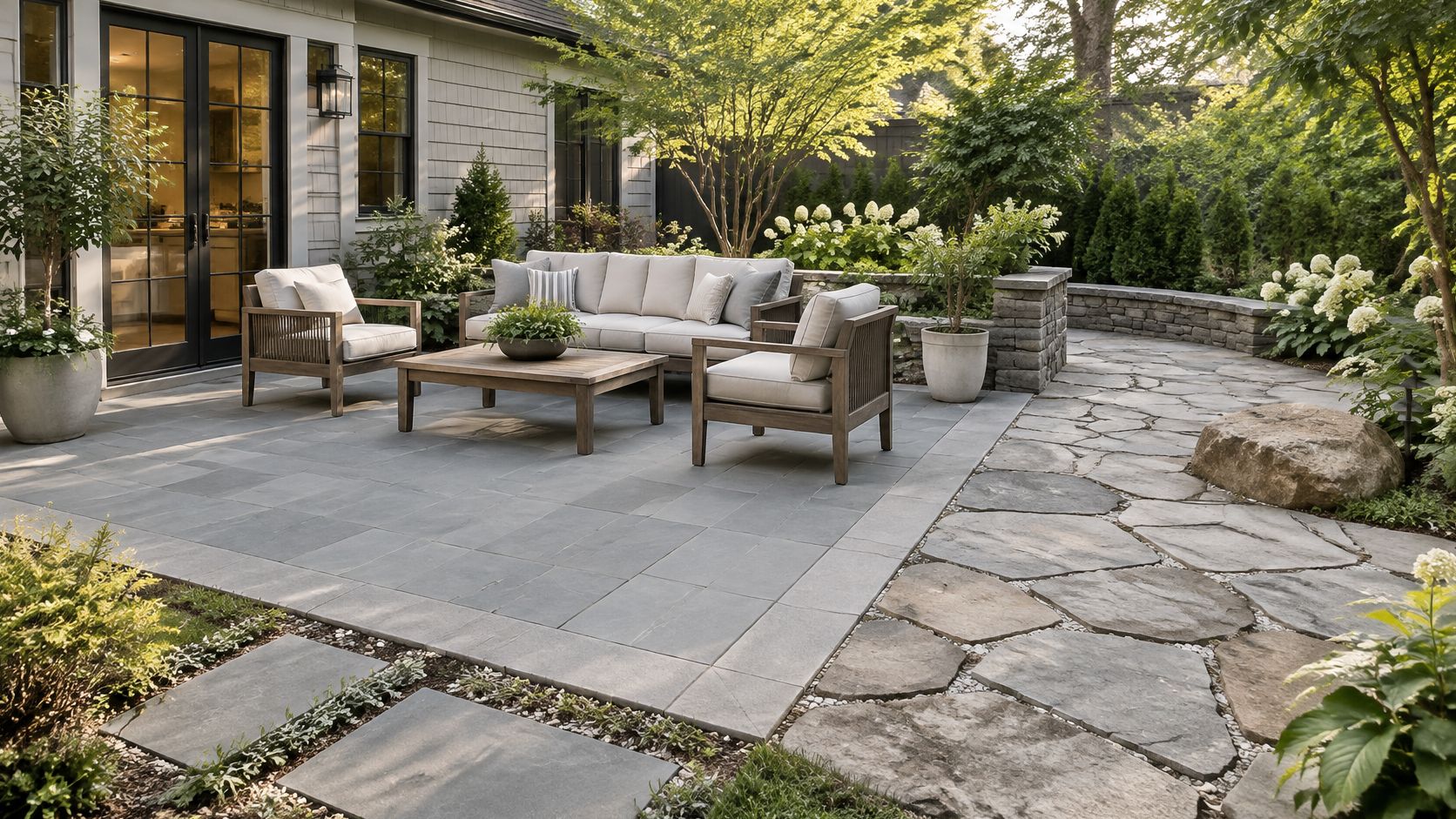
On a typical Prescott lot the useful plan stays simple. Dining sits close to the house so trays aren't a hike. The walk to the fire stays free of chair legs. A fireplace, fire pit, or outdoor kitchen gets its own footprint so the slabs around it aren't a squeeze. More shape comparisons are in these stone patio design ideas if you want to look at borders before a site visit.
Shade and seating in high-desert sun
Heat belongs in the plan, not in a furniture order after the stone is down. Reported hardscape measurements show a standard concrete patio can reach about 140–160°F when the air is about 95°F, while shaded surfaces may run 20–45°F cooler, from a guide to cooling a patio without central air. Bluestone won't automatically hit those numbers. Color, finish, orientation, airflow, and shade all change the result.
R.E. and Sons Landscaping can place shade trees, a pergola, covered seating, and planting so the only chair isn't in the open middle. Light-to-medium tones and seating pulled out of peak sun make afternoon dining and kids' play more realistic. A fire feature still belongs. It just shouldn't be the reason the whole field of stone sits in full western exposure.
A short look at how outdoor stone is laid out helps when you're comparing tight borders with open joints.
How to Choose a Bluestone Patio Installation
Thickness and support have to match the load. Typical cut patio bluestone is about 1.5 inches thick, and irregular fieldstone often runs 1 to 2 inches. A technical guide lists 1.5 inches as the minimum practical thickness for natural-stone flags under normal foot traffic and outdoor furniture, with thinner pieces better on a continuous concrete or mortar bed, per natural stone patio construction guidance.
Three ways the stone gets supported
Sand-set suits a pedestrian patio when the base is built as structure, not a loose sand pile. Mortar-set is the usual home for thinner flags that need a continuous bed. Slab-supported stone, set over concrete, is the conversation when an outdoor kitchen, fireplace, built-in bar, or heavy furniture will sit there. A dining set and a masonry fireplace aren't the same load.
The base is drainage and structure together. For a pedestrian patio, the commonly cited assembly is about 4 inches of compacted dense-graded aggregate over a well-drained subgrade, then about 1 inch of bedding. Driveway loads generally move that aggregate toward 6 inches. That same guide names ASTM D2940 aggregate and ASTM C33 bedding sand, as noted in this paver base and bedding reference.
Shape the subgrade so water leaves. Place aggregate in lifts. Compact each lift before the next one goes down. The slabs won't correct a soft foundation.
Method | Best use | Stone support | Main risk |
|---|---|---|---|
Sand-set | Foot traffic and furniture on a drained base | Flags at practical patio thickness on bedding | Settlement if compaction or slope is skipped |
Mortar-set | Thinner pieces and a more rigid field | Continuous mortar or concrete bed | Trapped water if the bed and joints can't drain |
Slab-supported | Kitchens, fireplaces, bars, heavy furniture | Structural slab under the stone | Load placed on a slab that wasn't designed for it |
R.E. and Sons Landscaping's design-build work ties grading, drainage, base, and stone together, especially where the patio meets the house. The sequence for modular paving is in how to install paver patios, and the same grading habits apply before flagstone is set. If an older brushed slab already sits in the yard, cleaning and sealing textured concrete from South Mountain Window Cleaning, LLC is a useful read so that surface and the new stone aren't treated as the same material.
The stone is the wearing surface. The compacted lifts underneath are what keep it from rocking after a wet winter.
What a Bluestone Patio Costs to Own and Maintain
No single local price belongs here, because the invoice moves with choices rather than with a flat rate per square foot. Slab thickness, cut versus irregular stone, patio size, equipment access, drainage corrections, shade structures, and add-ons such as a fire pit or outdoor kitchen all change the number. A thin flag that needs a full bed can cost more to support than a thicker piece on a sound aggregate base. The thickness ranges that drive that choice sit with the installation methods above.
Digging slope and base correctly during excavation costs less than lifting a finished patio to fix a low spot. Weak compaction shows up later as rocking stones and uneven joints, and that repair disturbs planting and furniture you already placed. That's the ownership math. First cost and later disruption come from the same details.
Habits that protect the surface
Care in a grit-heavy Northern Arizona yard is ordinary, and it still matters.
Clear the joints: Debris and standing water in the joints work against the drainage you built.
Rinse grit: Sand on a cleft face acts like sandpaper under chair legs.
Watch for rocking: A stone that moves is a base or bedding issue. Waiting usually means the next slab follows.
Pause on chemicals: Don't seal or deep-clean until the installer confirms the product suits this stone.
Homeowners comparing upkeep with other hardscape can read paver cleaning for local homeowners from Ventura County Roof Cleaners for how textured paving gets washed without guessing at chemicals. Your lot still needs a product check for bluestone, not a copied paver recipe.
R.E. and Sons Landscaping has a maintenance department for homeowners and properties that want scheduled care after installation. What you spend up front and what you do each season are tied to stone weight, support, water, and shade. A blog post can't promise one price or one lifespan. A closer look at what moves a stone budget is in stone patio installation cost.
Questions to Settle Before You Build
A sound bluestone patio in Prescott, Prescott Valley, Chino Valley, and nearby Northern Arizona still depends on verified stone, the right thickness, slope, and a base that drains. With those four settled, the patio can work as an outdoor room instead of a surface you explain away after the first winter.
Schedule a consultation with R.E. and Sons Landscaping online or by phone, Monday through Friday, 8am to 4pm. The company is licensed, bonded, and insured, holds Arizona ROC number 300642, and has more than 2,500 satisfied customers.
Can bluestone meet turf, pavers, or planting?
Yes, if edging and elevations are planned so soil and irrigation don't wash onto the slabs. A bed that sits higher than the patio will dump mulch and water onto the stone every time you irrigate.
Can it sit beside a fire feature or outdoor kitchen?
Yes, when the support and the clearances are designed for that weight and that use. The feature isn't an afterthought set on the same bedding as a chair.
Does a natural cleft surface need a slip check?
Yes. Wet stone and finish vary, so ask for the specific material's slip information instead of assuming texture equals traction.
Will every gray stone sold as bluestone match?
No. Identify the quarry, the lot, and the test data before installation. A similar gray from another source isn't the same specification.
R.E. and Sons Landscaping designs and builds bluestone patios for Prescott-area yards, pairing the stone with drainage, shade, and the outdoor features you use. If you want a backyard sitting area that sheds water and stays comfortable through Northern Arizona seasons, visit R.E. and Sons Landscaping to schedule a consultation.
Comments