
Landscape Lighting Design Guide for Prescott Homeowners
You step onto the patio after sunset, and the yard disappears beyond the porch light. Turn on the floodlight, and you can see the grill, but now you're looking into glare. Outdoor lighting design solves that problem by putting useful light where you need it, without lighting the whole property.
R.E. and Sons Landscaping helps homeowners in Prescott, Prescott Valley, Chino Valley, and nearby Northern Arizona communities plan lighting alongside paths, patios, planting beds, and outdoor living spaces. The starting point isn't a fixture catalog. It's understanding how you use the yard, where visibility matters, and which local dark-sky rules apply.
What Landscape Lighting Design Is and Why It Works in Layers
Outdoor lighting design is planning where light falls, how bright it is, what color it has, and when it runs. A successful plan makes your Prescott yard comfortable to use after dark while keeping unnecessary light out of the sky and neighboring windows.
Think about a restaurant dining room. Light over the table helps you see your meal. Softer wall lighting makes the room comfortable. A small accent draws attention to artwork. One bright ceiling bulb wouldn't do those jobs equally well.
What does each lighting layer do?
The same approach works outside. Start with the activity, then choose the fixture.
Four lighting layers and what each one does
Layer | Job in the yard | Typical fixtures | Prescott example |
|---|---|---|---|
Ambient | Soft general glow over a space | Wall washers, low post lights, bollards | Back patio glow after dinner |
Task | Light for steps, grade changes, and work areas | Step lights, path lights, grill-area fixtures | Stone stairs down a sloped lot |
Accent | Highlight texture, shape, and focal points | Uplights and spotlights | Ponderosa pine or boulder beside the patio |
Safety | Mark edges, entries, and changes in level | Shielded path lights, amber security fixtures | Driveway edge and front gate |
These layers can overlap. A path light may help with both a walking task and orientation. What matters is that you can explain why it's there.
Modern systems grew from earlier outdoor lighting methods, with Bill Locklin's 1953 experiments using 12-volt automobile lamps helping establish residential low-voltage outdoor lighting, as described in the history of landscape lighting.
Today, electrical distribution and visual comfort deserve as much attention as appearance. Prescott's dry high-desert nights, freeze-thaw winters, and summer monsoon storms also belong in the discussion about fixture exposure, connections, and cable routes.
Practical rule: Give every fixture a clear job before deciding how it should look.
The Utah State University Extension responsible-lighting guidance provides a useful standard: lighting should be purposeful, targeted, no brighter than necessary, controlled, and warmer where possible.
How to Plan Your Landscape Lighting Layout Step by Step
A homeowner buys a box of path lights on Saturday, spaces them evenly along the walkway, and by Sunday night the yard looks like a runway while the back steps stay dark. The problem is the order of operations. Planning works in the opposite sequence: observe first, assign each light a job second, shop last.
Every step below asks the same three questions: which layer does this light serve, where does its beam land, and when does it turn off.
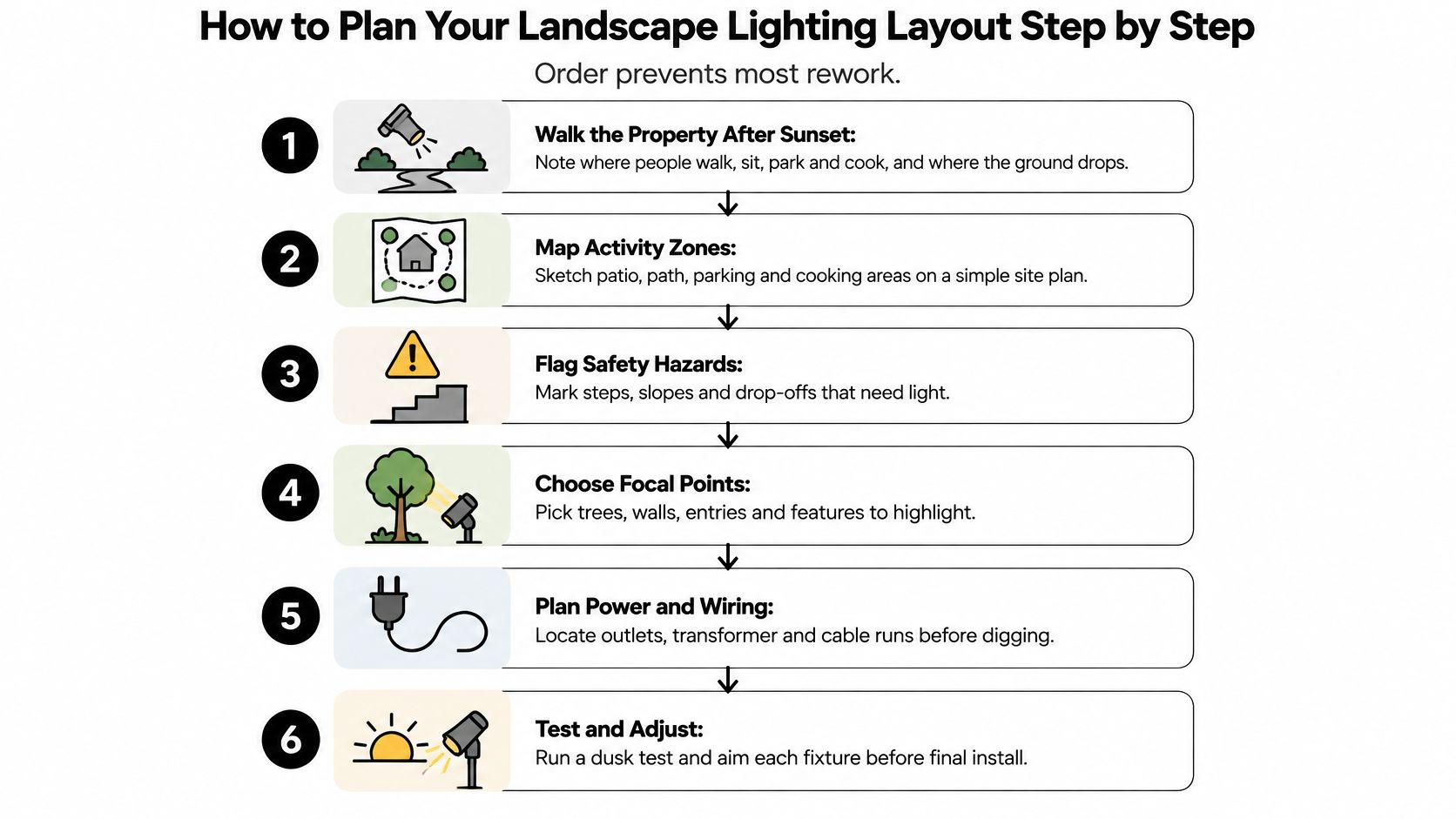
Use this process graphic as a field checklist.
What should you check before choosing fixtures?
Walk the property after sunset. Carry a flashlight and follow the routes people actually take: parking spot to door, patio to grill, gate to walkway. A dark stair edge or an awkward transition beside a retaining wall rarely shows up in a daytime sketch.
Sketch activity zones and property boundaries. Mark the entry, walkways, patio, fire feature, outdoor kitchen, planting beds, trees, and architecture. The sketch works like a floor plan: you decide where everything goes before anything gets bought. Include neighboring windows, because a fixture that feels gentle from your patio may shine straight into a bedroom next door.
Give each proposed fixture a job. Mark hazards before decorative focal points, then name the layer each light supports. The common slip is spacing matching fixtures at regular intervals. A repeated pattern looks intentional, yet it answers none of the three questions above.
Set output for the task. DarkSky's home-lighting assessment suggests 300 lumens or less for pathways, 300–800 lumens for exterior work areas, and output below 1,000 lumens where practical. Treat these as starting benchmarks. When a beam lands where it should, less light usually does the job.
Choose shielding, color, and aiming as one decision. A warm lamp behind an exposed bulb still glares, and a decorative label does not qualify a fixture for an exception. Check each intended use against the lighting rules that apply to the parcel before ordering.
Plan power and service access. Place the transformer near a properly protected outdoor receptacle, and route cable where later digging is unlikely, especially in beds that get reworked through Prescott's planting seasons. Coordinate the lighting with the broader landscape design layout so trenching never crosses a finished patio.
Run a nighttime test before final installation. Set fixtures temporarily, then check each target from the walking route, a seated position, and the property line. Correct poor aiming before touching brightness, and record the final positions before backfilling or permanent mounting.
What should your installer document?
Ask for three records: a zone map, a fixture schedule, and a night-test sheet. The schedule should list output, color temperature, optics, and controls for each fixture. The test sheet should record glare concerns and final aiming angles.
Then review the walking route together in person. A drawing can show fixture locations. It cannot show how comfortable the finished scene feels from your favorite chair.
For another visual reference while considering placement, watch the following video.
Fixtures, Color Temperature and Brightness Levels for Your Yard
Walk the yard after sunset and the fixture housings matter less than what their light really does. A path light, a patio wash, and a tree uplight are three different jobs, and each needs its own distribution, color, and output. Pick the distribution first. The fixture style comes second.
Color temperature, measured in Kelvin, describes how warm or cool the light appears. Brightness and beam control are separate decisions, so a warm rating alone will not keep glare off a neighbor's porch.
What do the Kelvin values mean?
Kelvin works like a stovetop dial. Low numbers glow amber, like embers. High numbers run bluish, like an overcast noon.
DarkSky's luminaire guidance describes 1800–2200 K as very warm or amber, 2700–3000 K as warm white, and 4000 K or higher as cool or blue-appearing. Its luminaire criteria use a 3000 K ceiling, while more conservation-oriented guidance favors approximately 2200 K for most outdoor applications.
Shorter-wavelength blue-violet light draws particular attention in dark-sky country, and Prescott's dry high-desert air carries light farther than most homeowners expect. Even so, a warmer lamp changes only one variable. Brightness, direction, and operating hours still shape the result.
The values below are design starting points, not code approvals. Your parcel's lighting classification takes priority, and some classifications call for amber sources rather than warm white.
Starting color and output values by yard area
Area | Color temperature | Shielding | Output guidance |
|---|---|---|---|
Pathways and steps | 2200 to 2700 K | Fully shielded | 300 lumens or less per path fixture |
Patios and seating areas | 2200 to 2700 K | Fully shielded or controlled cutoff | Layered; keep total site output under 1,000 lumens where practical |
Exterior work areas, including outdoor kitchen, grill, and garage door | 2200 to 2700 K | Fully shielded | 300 to 800 lumens |
Trees, shrubs, and stone accents | 2200 to 2700 K preferred; 3000 K only with justification | Partially shielded only where permitted and aimed on target | Set by aim and beam angle; counts toward site total |
Fire pit and gathering area | 2200 to 2700 K | Fully shielded | Low level; counts toward site total |
Why doesn't the lumen rating tell the whole story?
Lumens measure emitted light, not the illumination reaching a step. A flashlight label makes the same promise: total output, with no guarantee of where that light lands. Mounting height, beam angle, spacing, and surface reflectance all change the result. A fixture aimed across pale flagstone reads far brighter than the same fixture aimed into dark gravel.
DarkSky defines a fully shielded fixture as emitting no light above the horizontal plane through its lowest light-emitting or reflective part. Its shielding and responsible-lighting explanation also stresses direction, intensity, and how long the light stays on.
For spacing and glare details along walking routes, see the guide to pathway lighting that improves safety and nighttime curb appeal in Prescott landscapes. Then verify the finished installation at night. A calibrated illuminance meter shows what a step actually receives, while the packaging only shows what the lamp emits.
In Northern Arizona's dark surroundings, even modest spill is conspicuous. Stand at the property line and look back toward each fixture. If the source itself is visible, adjust the aiming before reaching for more output.
Prescott Code, Dark-Sky Rules and Electrical Safety
A Prescott mailing address does not settle which lighting rules apply to your parcel. City limits, county jurisdiction, and the lighting's intended use each shape the answer. Two neighbors on the same street can face different requirements, so identify the reviewing authority before you buy a single fixture.
Yavapai County adopted an updated outdoor-lighting ordinance for new permit applications. The county's dark-sky ordinance update divides lighting into recreation, safety and security, and decorative categories, each with its own conditions. Effective dates and category definitions can shift with amendments, so confirm which version governs your application before finalizing the plan.
How do the city and county requirements differ?
Prescott classifies illumination of trees, shrubs, fountains, statues, flags, and building facades as Class III decorative lighting. The Prescott outdoor-lighting code calls for full-cutoff luminaires except for listed exceptions and references Illuminating Engineering Society recommended practices. The county framework sorts the same fixtures differently. One yard can sit under both systems, and they do not always agree.
Lighting use and the questions it raises
Lighting use | Typical classification | Shielding direction | Confirm with the reviewer |
|---|---|---|---|
Patios, walkways, and play areas | Recreation in the county framework | Fully shielded | Allowed color temperature and operating hours |
Entries, driveways, and gates | Safety and security | Shielded, aimed only at the protected area | Whether controls or curfews apply |
Trees, fountains, statues, and facades | Class III decorative in Prescott | Full cutoff unless a listed exception applies | Whether the other jurisdiction permits partial shielding on the same parcel |
Light reaching a property line | Depends on the adjacent land use | Set by aim and shielding, not fixture choice | The illumination limit that applies at that boundary |
Property-line limits are measured as illumination on a horizontal plane at grade, not as fixture output, as noted earlier. The limit that applies depends on the neighboring land use and the parcel's jurisdiction, so get that figure from the reviewing authority rather than assuming one number covers every boundary.
Ask the reviewer to confirm classification, permitted shielding, color restrictions, operating hours, and any retrofit obligations. A permitted exterior modification or a fixture replacement can trigger broader compliance questions than the swap itself.
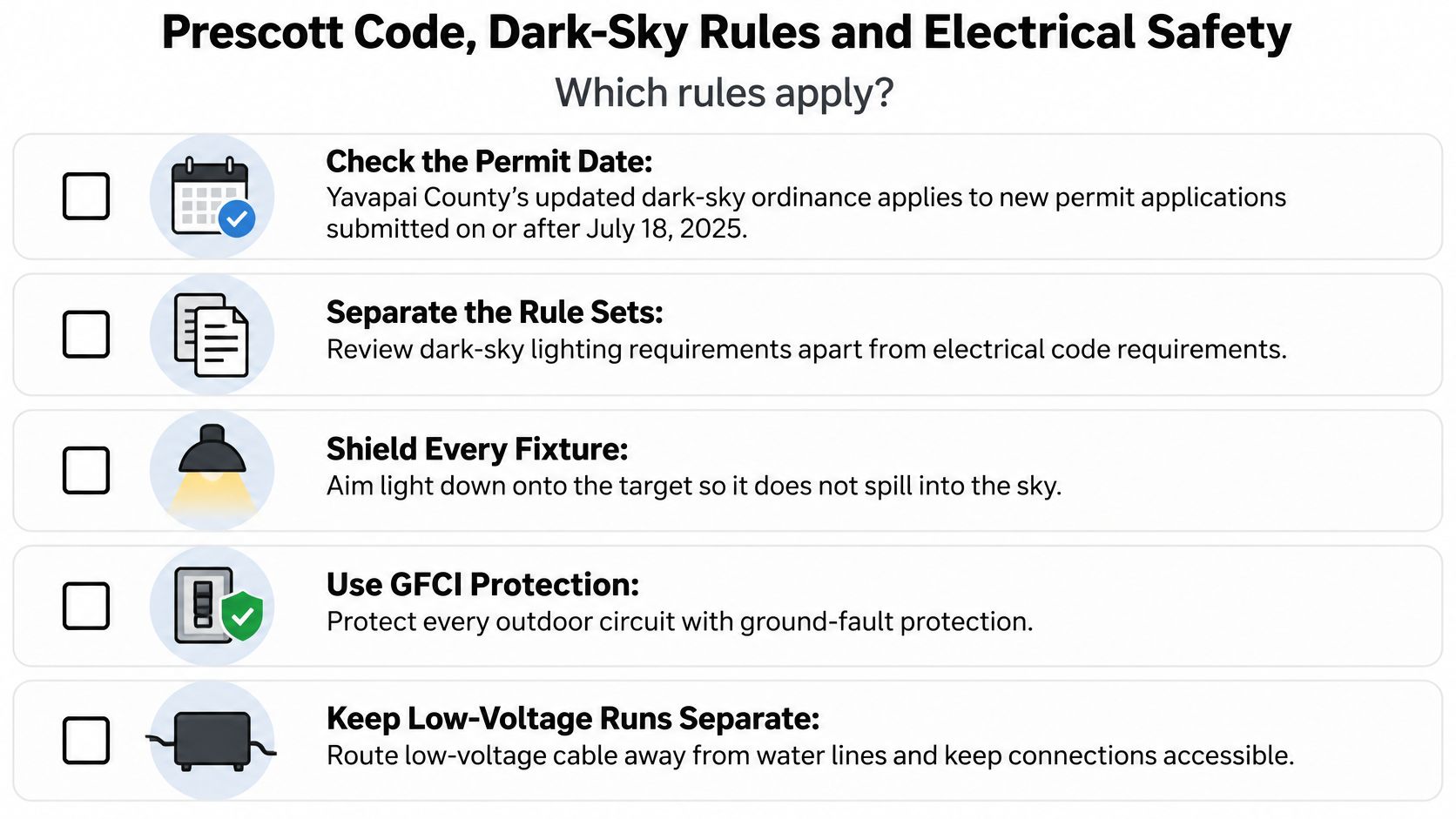
Use this checklist to organize the code and electrical discussion.
Does low voltage remove the electrical safety requirements?
No. A low-voltage path light works like a doorbell circuit at the fixture itself, but the system behind it is not low-voltage throughout. The transformer feeds from a line-voltage receptacle, the receptacle sits outdoors in the weather, and buried cable shares the soil with sprinkler lines and roots. Each of those points carries its own protection and permitting questions.
Verify electrical responsibility. Have a licensed electrician check final connections and permit-required electrical work.
Coordinate wet areas. Include lighting infrastructure when planning or installing a water feature, rather than improvising connections afterward.
Protect future access. Keep transformers and serviceable connections accessible.
Locate utilities first. Call 811 before digging.
The electrical checklist and the dark-sky review are separate tasks. Completing either one does not replace the other.
What Landscape Lighting Costs to Run and Maintain
A yard can look calm at midnight while still paying for light nobody uses. Running cost comes from the whole system: lamp wattage, beam control, transformer draw, photocells, timers, and how long each layer stays on.
The U.S. Department of Energy outdoor-lighting examples show why lamp technology, wattage, and controls change demand. Those examples are commercial-scale reference points, so treat them as evidence that the system design matters, then calculate your own yard from its actual fixtures and schedule.
How do you estimate your own operating cost?
Use one worked example, then swap in your own numbers. Say a plan has twelve 5 W LED path lights. That is 60 W total, or 0.06 kW. If they run 5 hours each night, they use 0.3 kWh per night and 9 kWh over a 30-day month. At a sample rate of $0.16 per kWh, the lamp energy costs about $1.44 for the month.
Add the support hardware. An 8 W transformer-and-control draw running the same 5 hours uses 1.2 kWh per month, or about $0.19 at that sample rate. The example total is 10.2 kWh and roughly $1.63 per month. A timer that ends the run one hour earlier removes one fifth of the lamp-hours in this example.
Scale it only when fixtures match. Twenty of the same 5 W lamps draw 100 W, or 0.1 kW. At 5 hours, they use 0.5 kWh per night and 15 kWh over 30 days, about $2.40 at $0.16 per kWh before transformer and control draw. Mixed wattages need a separate line for each wattage group.
An efficient lamp left on unnecessarily still uses electricity. Ask what runs, when it runs, and why.
For installation pricing, request an itemized written estimate. Fixture count, cable length, rocky-ground trenching, transformer capacity, controls, and electrical work affect scope. A per-fixture price alone can hide important differences between proposals.
What maintenance should you plan?
Treat this as a suggested homeowner routine, with manufacturer instructions taking priority.
Clean and inspect twice yearly. Dust on lenses can make a shielded fixture seem dimmer than it is.
Re-aim after plant growth. A shifted branch can turn a soft wall wash into glare.
Review seasonal settings. Adjust timers as sunset changes and household routines shift.
Inspect after weather. Prescott's freeze-thaw cycles and monsoon storms can expose cable or loosen mounts.
Replace failed components promptly. Restore the intended pattern rather than brightening nearby fixtures to compensate.
Keep the approved fixture schedule with your maintenance records. It helps prevent a replacement lamp from introducing a noticeably cooler color or an unnecessarily brighter patch.
Three Prescott-Area Lighting Plans in Practice
These are illustrative design scenarios, not customer case studies. Each begins with a different outdoor activity and remains subject to the property's actual jurisdiction and electrical review.
How could a Prescott Valley patio support cooking and conversation?
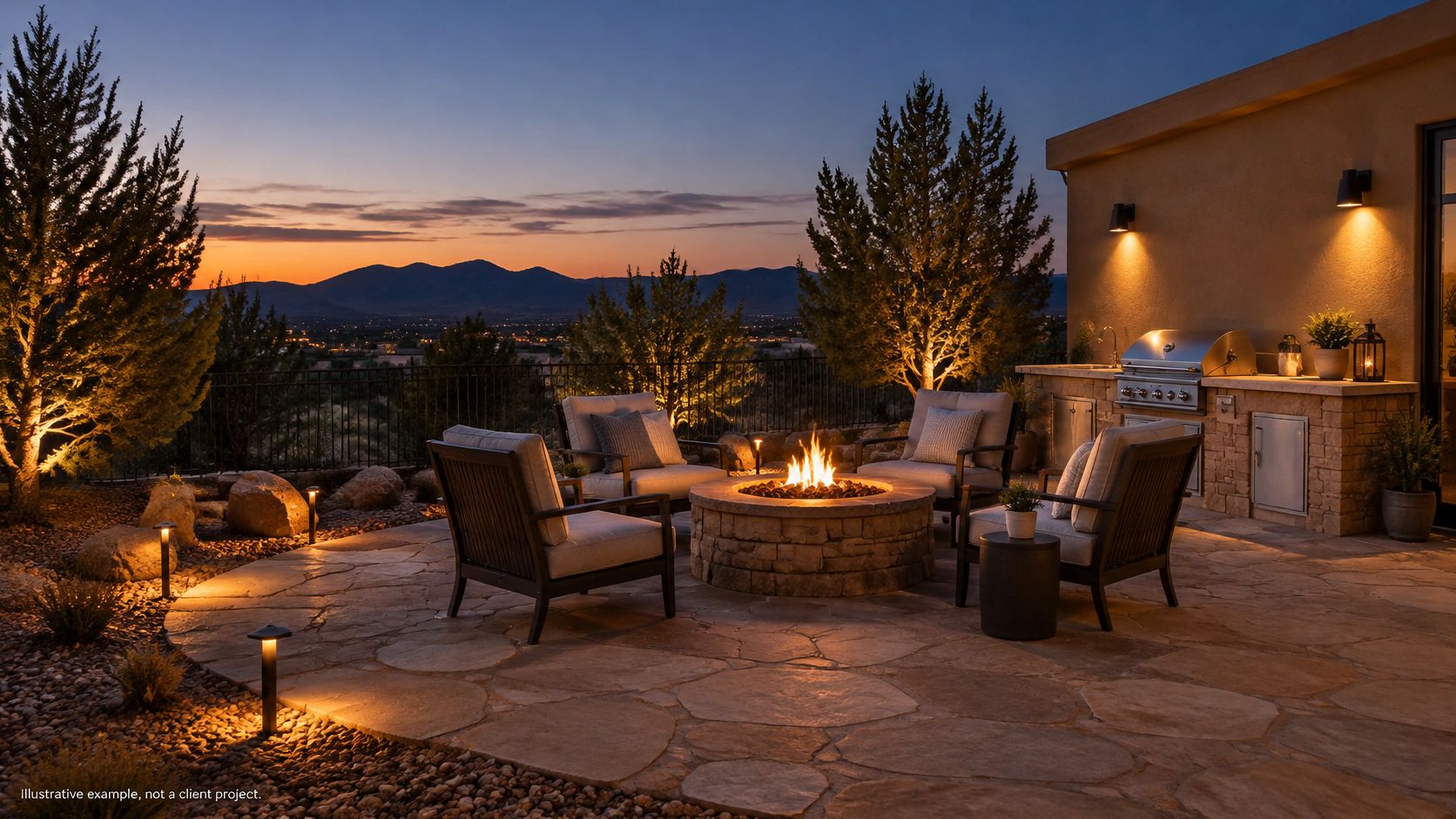
Consider a backyard with flagstone paving, a fire pit, and an outdoor kitchen. The cook needs useful counter light, while seated guests need comfortable surroundings without seeing a bright lamp.
A proposed plan could use ambient wall washers in the 2200–2700 K design range and shielded grill fixtures within the 300–800 lumen task benchmark discussed earlier. A hypothetical timer could switch the patio circuit off at 10 p.m., with the combined design evaluated against the earlier 1,000-lumen guideline rather than assigning every fixture its maximum output.
The trade-off is deliberate restraint. Keep the fire-pit perimeter low-key so added electric light doesn't overpower the gathering area.
Transferable lesson: Give cooking and conversation separate controls, because they don't need the same illumination.
This patio image illustrates the warm, restrained atmosphere such a plan can aim for.
What would change on a rural Chino Valley property?
Consider a long gravel driveway without streetlights. The priority isn't illuminating every stretch of gravel. It's identifying the entrance, gate, parking transition, and pedestrian route.
Where the applicable classification requires it, use narrow-band amber safety fixtures with full shielding. Add downward-directed path lighting where people leave vehicles and walk toward the house.
A photocell can prevent daytime operation, but it doesn't limit nighttime duration. Pair it with scheduling or suitable occupancy control where appropriate.
Transferable lesson: Mark decisions and transitions instead of turning a rural approach into a continuously illuminated corridor.
Can a Prescott home highlight a ponderosa pine?
Consider a specimen pine beside a large boulder, with a neighbor's bedroom beyond it. Before proposing an uplight, establish whether the city's full-cutoff requirement has an applicable exception.
If a partially shielded accent is permitted, confine the beam to the intended feature and check the view from the boundary. A hypothetical dimmer setting could reduce the accent after 11 p.m., but that operating choice doesn't itself establish code compliance.
If approval isn't available, redesign around a compliant downward-directed treatment. Don't treat branches as a substitute for fixture shielding.
Transferable lesson: Preserve the focal point only when its lighting can satisfy the rules and neighboring sightlines.
Frequently Asked Questions About Landscape Lighting in Prescott
What color temperature should landscape lighting be in Prescott?
Stay within 2200–2700 K for most zones. That range keeps light warm enough to limit glare and skyglow in the high-desert air. Where the applicable classification requires it, use narrow-band amber rather than ordinary warm-white LEDs.
Do I need a permit for landscape lighting in Prescott?
It depends on which jurisdiction covers your parcel. Properties inside city limits follow Prescott's outdoor lighting rules, while unincorporated areas fall under the Yavapai County ordinance, which applies to new permit applications on or after July 18, 2025. Swapping a bulb rarely triggers a permit. New wiring, a larger exterior remodel, or fixtures tied to a building application can. Confirm the requirement with the planning office for your address before installation.
How many lumens does a path light need?
Start at 300 lumens or less per fixture. That output marks the walking surface without forcing guests to look into a bright source. If the path still reads dim, adjust shielding or spacing before raising output.
Is low-voltage landscape lighting safe?
It reduces shock risk at the fixtures themselves. The rest of the system still carries real electrical demands, though. Transformers, outdoor receptacles, line connections, and protection devices need appropriate professional attention.
What does landscape lighting cost to run?
Multiply the system's actual input power by operating hours, then by the rate on your utility bill. As an example, a 30-watt system running eight hours a night draws about 7 kilowatt-hours a month. Check your per-kWh rate to turn that figure into dollars.
Who should I call for a plan?
Start with a design-build consultation that covers zones, fixture output, controls, and jurisdiction for your parcel. Arrive with dusk photos and notes on how you use each area. Have a licensed electrician verify connections and permit-required work, and arrange utility locating before digging.
Before accepting a quote: Ask who handles code review, nighttime aiming, electrical work, and follow-up adjustments. Those responsibilities should be spelled out before installation begins.
Confirm Your Lighting Plan Before You Buy
Walk the finished plan once before you buy a single fixture. A sketch reviewed at the kitchen table costs nothing to change. A cable run buried under fresh gravel does.
Bring your property address, dusk photos taken from the street and the yard, and a rough budget range to the first meeting. Note how you use each area after dark and where the electrical panel and outdoor outlets sit. That detail helps the designer tell a lighting problem apart from a layout problem.
What should the written proposal include?
Ask for a written plan you can mark up and question. It works like directions for a trip: a missing step only shows up once you are already on the road.
Zone map. Show activity areas, fixture locations, cable routes, and neighboring sightlines.
Fixture schedule. Identify lumens, Kelvin values, shielding, optics, and the purpose of each light.
Control settings. Explain dimming, scheduling, occupancy response, and separate circuits.
Jurisdiction review. Identify the Prescott or Yavapai County requirements that apply to your parcel.
Electrical responsibilities. State who handles licensed work, permits, testing, and service access.
Nighttime verification. Include aiming and a final comfort check from walking and seated positions.
What does the local design-build process involve?
A consultation follows a set order. The designer walks the property, notes how you move through the yard, and marks activity zones on a site plan. You review fixture choices, light levels, and control settings together, then approve the written design before any cable goes in the ground. After installation, the crew returns at night to aim fixtures and correct glare from doorways, seating, or a neighbor's window.
Booking that visit before you purchase materials leaves time to approve the complete plan first.
R.E. and Sons Landscaping plans outdoor lighting alongside paths, patios, planting, and outdoor living features for Prescott-area homeowners. Schedule a consultation through the company's website or by phone to work through a plan that fits your yard, your evening routines, and the rules covering your property.
Comments