
Installing a Water Feature in Prescott: A Homeowner's Guide
You're standing in a Prescott backyard with a shovel, a rough idea, and a patch of soil that seems to contain more rock than dirt. The question isn't where to put a pond. You need to decide whether a recirculating fountain, wildlife pond, or pondless spillway fits the yard, how much maintenance you'll accept, where water and electricity can reach, and how monsoon runoff will behave at that exact location.
R.E. and Sons Landscaping helps homeowners in Prescott, Prescott Valley, Chino Valley, and nearby Northern Arizona communities solve those problems through a design-build process. The team evaluates the site, designs ponds, waterfalls, fountains, bubblers, and pondless features, then handles construction and startup with the local conditions in mind.
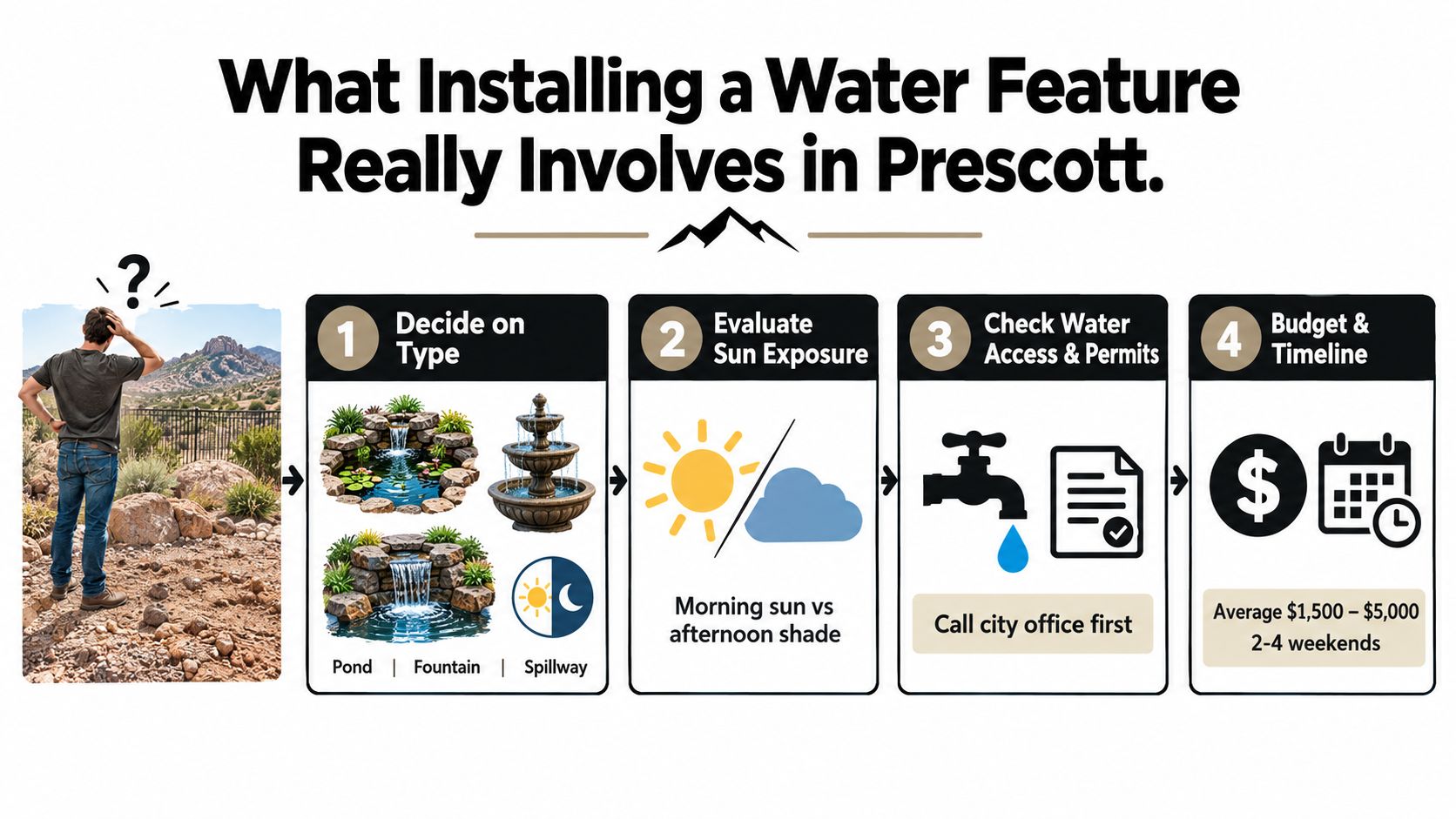
What Installing a Water Feature Really Involves in Prescott
Installing a water feature in Prescott is built work, not unpacking a weekend kit. A project manager starts with a site walk, not a shovel. The first visit should identify viewing angles, sun exposure, drainage, access for materials, utility locations, electrical options, and the type of water feature that suits the property.
A basic project sequence looks like this:
Choose the feature type. A recirculating fountain usually offers the simplest operation. A wildlife pond creates a more natural habitat but brings greater biological and cleaning demands. A spillway or pondless waterfall gives you sound and movement without an open pond surface.
Sketch the footprint. Mark the basin, shelves, spill points, edging, pump access, and the route for power and water.
Check the site. Utility locating, drainage review, and a look at soil and slope should happen before excavation.
Build the material list. Include liner, underlayment, stone, plumbing, pump, filtration, electrical components, edging, and access covers.
Select and test the pump. Flow needs to match the height, width, and visual character of the feature.
Install and commission. The system should be tested before the final stonework hides plumbing or access points.
Prescott's environment changes each decision. Hard water leaves mineral scale on pumps, basalt, nozzles, and basin edges. Strong ultraviolet exposure at roughly 5,400 feet makes exposed liner and plastic components more vulnerable than they would be in a shaded garden. Rocky granite subsoil can turn a small excavation into a chipping-hammer or mini-excavator job. Above 6,000 feet, freeze-thaw cycles also deserve attention when you plan exposed plumbing and winter shutdowns.
Practical rule: Design access for cleaning and repairs before you place the decorative rock. A feature that looks finished but hides its pump becomes expensive to maintain.
Water features have served both practical and ornamental roles for thousands of years. Fountains date back nearly 5,000 years, and examples from around 2000 BCE in Minoan Crete routed spring water through clay pipes into tiered basins at sites including Knossos and Zakros. The history of water features also explains how Roman fountains functioned as water infrastructure before domestic plumbing shifted fountains toward decoration. Modern pumps now let homeowners create movement without a raised reservoir.
Choosing the Right Spot and Style for Your Yard
The best location balances sun, slope, access, sound, and maintenance, not just the view from the patio. Morning sun can help a feature feel bright without exposing the entire basin to the hottest afternoon conditions. Full afternoon exposure increases evaporation and can make algae and mineral buildup harder to manage. In July, an unshaded pond in Prescott may lose roughly a quarter-inch of water daily, so shade is a practical operating consideration, not merely a planting preference.
Study the yard at different times of day. Look for:
Sun path. Note where morning light and afternoon shade fall across the proposed basin.
Tree proximity. Pines provide useful shade, but falling needles can load skimmers and filters. Large roots may also complicate excavation.
Slope and runoff. A sloped yard can support a gravity-fed stream and lower basin, but monsoon water must be diverted around the feature rather than through it.
House relationship. Keep splashback away from walls, foundations, walkways, and areas where seepage could create a problem.
Sound and neighbors. Water noise can mask traffic and mechanical equipment, but a tall spillway may carry farther than expected across a quiet yard.
Service access. The pump, autofill, electrical connection, and filter need reachable locations after the stone is installed.
Style should follow the architecture and the surrounding setting. Stacked-boulder spillways can echo the Granite Dells and feel native to a rocky Prescott setting. A basalt urn fountain works well in a xeric courtyard because it creates movement without requiring a large naturalistic footprint. A wildlife-friendly pond can support native pollinators, but it needs thoughtful planting, safe edges, and a maintenance plan that accepts more organic material.
For a more detailed look at design options, review this guide to custom water features.
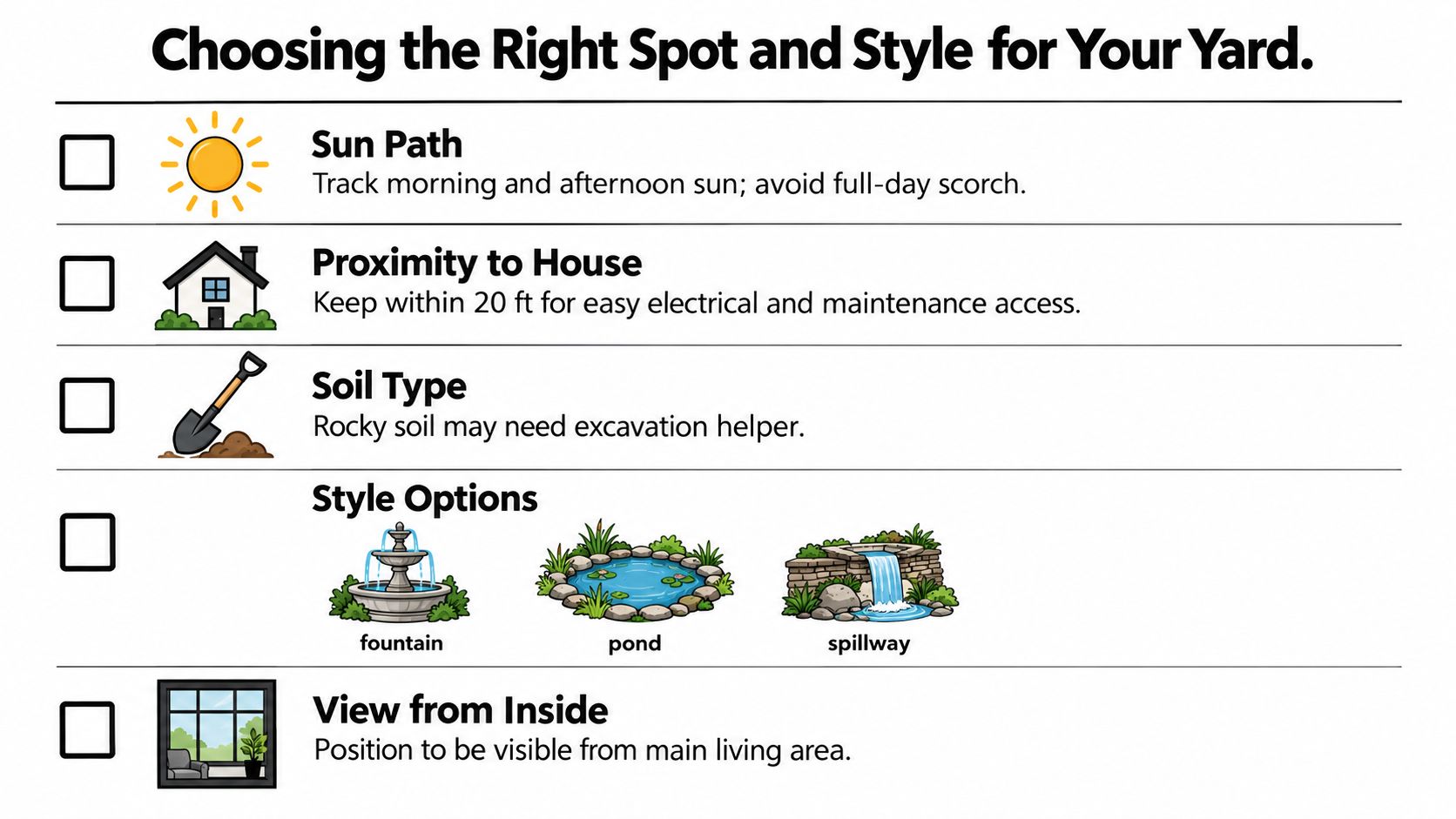
Before committing to a footprint, stand inside the house and on the patio. Confirm that you can see the feature from the rooms where you spend time, identify where overflow will go during a storm, and make sure the pump can be serviced without dismantling the setting.
Building the Basin and Waterproofing the Feature
Start by marking the basin and spillway with paint, stakes, or a hose. Include shelf zones if you plan to use marginal plants, and make the finished edges level before you excavate. In much of Prescott, a shovel alone won't be enough for granite-heavy ground. A chipping hammer, demolition bar, or rented mini-excavator may be the realistic tool choice, especially where the feature sits near compacted construction fill or exposed bedrock.
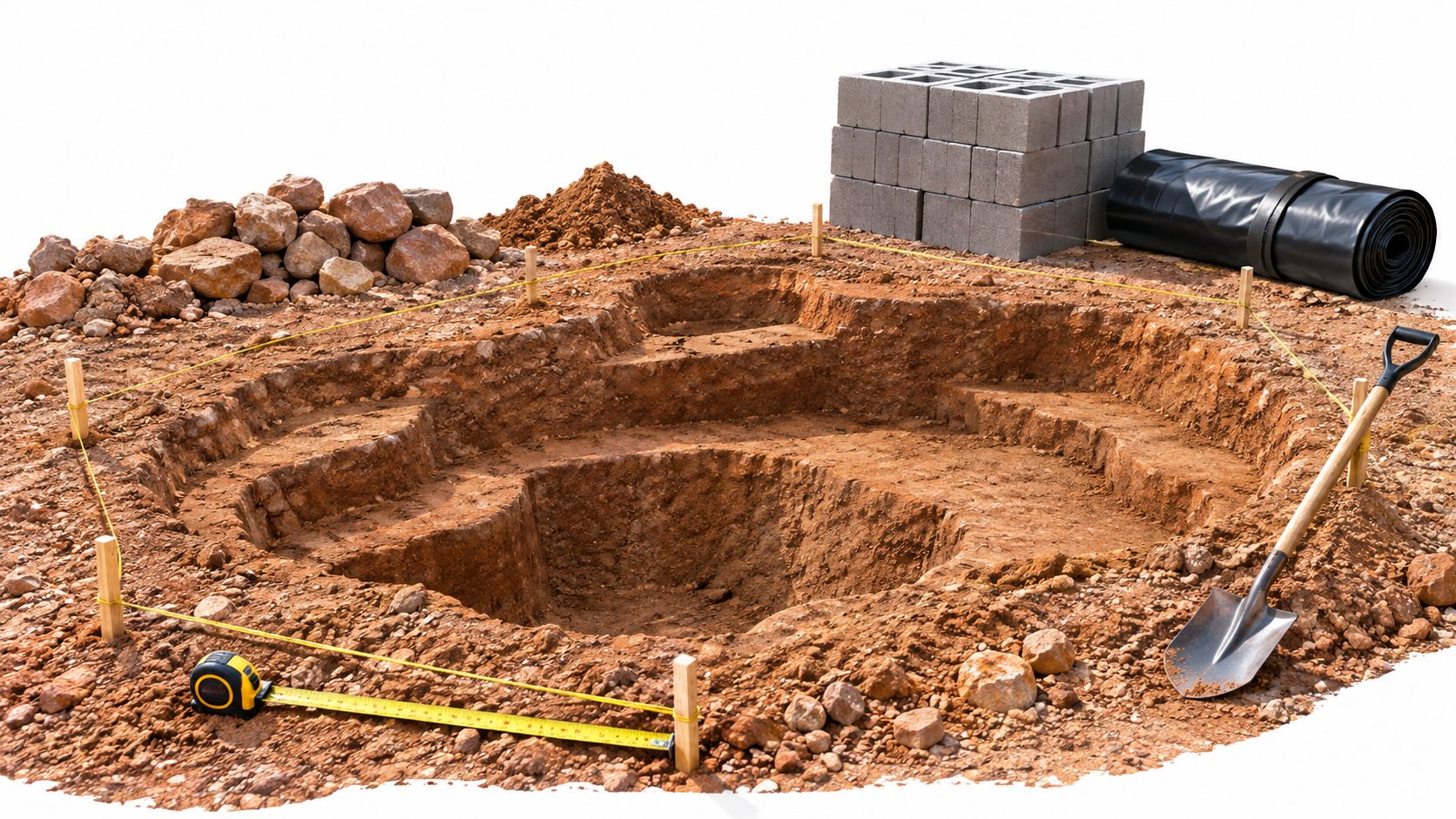
Remove sharp rocks and roots from the excavation, then install geotextile underlayment before the EPDM liner. The fabric protects the liner from punctures and distributes pressure beneath stones. Size the liner rather than guessing. For a backyard pond or waterfall, add twice the maximum depth to both the maximum length and maximum width, then include at least 2 feet of overlap on each side. Aquascape's installation calculations provides the same basic sizing rule.
How to protect the basin in a high-desert yard
Prescott's intense sun makes exposed liner a weak point. Fold and anchor the liner under stone or a finished edge, and don't leave a thin lip exposed above the waterline. Native flagstone, boulders, and decomposed granite can conceal the liner while making the feature look integrated rather than placed on top of the yard.
An autofill can reduce the daily attention required during hot weather. Connect it to a dedicated irrigation stub with appropriate backflow protection, rather than improvising a hose connection beside the basin. Anchor the basin edge and surrounding stone so monsoon runoff can't shift material into the water or undermine the spillway.
Startup testing before planting
Fill the basin gradually and inspect seams, folds, corners, and plumbing penetrations for leaks. Let the substrate settle, then run the pump and check the water path before you finish every visible edge. The standard sequence for a basic recirculating feature is to excavate, level the reservoir, connect the pump and hose, test the flow, and conceal the lid with stone or pebbles. This installation guide also recommends protecting indoor-powered cables in conduit or armoured cabling and using an RCD for outdoor electrical safety.
Don't add fish immediately to a new pond. A common pond-waterfall sequence uses excavated shelves, geotextile, EPDM liner with 12 to 18 inches of edge overlap, a protected pump, and several days of circulation before fish are introduced so filtration can stabilize. This waterfall installation guide outlines that approach.
Sizing Pumps, Plumbing, and Filtration Correctly
A pump isn't selected by basin size alone. Match its flow to the width of the spillway, the height of the rise, the desired sound, and the amount of water movement you want to see. A pump that is too small produces a weak trickle. One that is too large can splash, empty the reservoir quickly, overload the filter, and make a small feature look frantic.
For the local feature sizes described here, practical starting ranges are:
Small spillways: 200 to 400 GPH.
Fountains under 3 feet tall: 600 to 1,200 GPH.
Ponds up to 200 square feet: 1,500 to 2,500 GPH.
Those ranges come from the project specifications used for this guide. For a broader waterfall comparison, another installation guide gives approximate ranges of 400 to 1,200 GPH for accent falls 1 to 2 feet high, 1,200 to 3,000 GPH for falls 2 to 4 feet high, and 3,000+ GPH for falls above 4 feet. The waterfall flow guide is useful because it shows why feature height and width matter together.
Account for elevation and friction
Vertical lift reduces delivered flow. The project specification here uses a planning allowance of roughly 10% of flow for every vertical foot, so a pump rated for a flat run may underperform once it pushes water uphill through fittings and tubing. Read the pump curve at the intended head height rather than relying only on the largest number printed on the box.
Use flexible PVC or tubing sized to the pump output. Practical installations may use tubing from 3/4 inch to 1.5 inches, depending on the pump and run. Keep bends gradual, avoid unnecessary fittings, and place a submersible pump on a brick or stable pad so it doesn't sit directly in silt.
Keep debris away from the impeller
A pre-filter sponge protects a submersible pump from leaves, pine needles, and monsoon sediment. Add a UV clarifier when algae control is a concern, but don't treat UV as a substitute for circulation, shade, cleaning, and sensible nutrient control.
For falls and spillways, install a ball valve on the outlet. It gives you a simple way to reduce flow and tune the sound after the stones settle. Skimming debris before it reaches the pump is easier than pulling a clogged impeller during a hot Prescott afternoon.
For practical cleaning routines, see this guide to keeping pond water clear.
Electrical Safety, Permits, and Site Constraints
The hidden infrastructure can determine whether a water feature is affordable and feasible. Before excavation, identify the route from the electrical source, the water connection, the drainage path, and the access route for rock and equipment. A feature may fit visually while failing because the pump can't be powered safely or stormwater has nowhere to go.
Outdoor pumps should use a GFCI-protected circuit, and safety guidance says the pump should plug directly into the GFCI outlet rather than through an extension cord. Exterior outlets also need weatherproof covers. This water-feature electrical safety guidance explains why splashing water and temporary cords are a poor combination.
Call 811 before digging. Older Prescott-area yards may contain shallow irrigation, gas, or power lines, and a small basin can cross several utility paths. Ask the City of Prescott or Yavapai County which permits and inspections apply to your property and the type of electrical work planned. Requirements can vary with location, construction method, wiring, and proximity to structures, so a contractor shouldn't promise that every feature follows the same approval path.
A low-voltage system may simplify a small fountain, but it still needs proper outdoor-rated components and a safe transformer location. Hardwired equipment requires more coordination, and the electrical route may involve trenching, conduit, disconnects, and panel capacity. Don't bury the cord and don't hide an unprotected junction behind decorative stone.
Water connections deserve similar care. If an autofill or make-up line connects to potable water, backflow protection should be reviewed by a qualified plumber. Homeowners who want a plain-language explanation can read EZ Plumbing's backflow advice before discussing the connection with their installer.
Check property lines, easements, foundation clearances, drainage patterns, and equipment access before finalizing the design. The most expensive surprise is often not the basin stone. It's the electrical, drainage, utility, and access work that someone ignored during the sketch.
What a Water Feature Actually Costs to Install
Water-feature pricing varies by type, excavation, stone selection, plumbing, electrical work, and access. A 2025 cost guide reports that an installed water fountain typically costs $1,500 to $8,800, with a national average of $5,100. It places pool waterfalls at $2,000 to $8,800 and pondless waterfalls at $3,000 to $11,000, while the broader range runs from $50 to $40,000 depending on materials, scale, and complexity. HomeGuide's water fountain cost guide provides those national planning figures.
Those numbers are useful for framing the market, but a Prescott estimate needs a site-specific review. Granite excavation, imported specialty stone, long utility runs, difficult access, retaining work, and monsoon drainage can move the project more than the pump or basin itself.
Feature Type | Typical Cost Range | Common Hidden Costs |
|---|---|---|
Small bubbling rock fountain | $400 to $900 installed | Excavation, basin leveling, electrical connection, finish rock |
Standalone or urn-style fountain | $800 to $2,500 | Plumbing adjustments, leveling, delivery, stone or pedestal work |
Pondless waterfall | $1,500 to more than $4,000 | Boulder placement, larger pump, excavation, drainage, electrical trenching |
Excavated pond | $3,500 to $8,000 for 100 to 200 square feet | Liner protection, filtration, rock edging, soil removal, utility routing |
The cost ranges in this comparison are project planning figures, not guarantees. Independent guidance places a typical pondless waterfall near $7,000, with most homeowners spending $4,000 to $10,000, and identifies poor leveling, inadequate drainage or utility checks, and incorrect pump sizing as common technical problems. This pondless waterfall benchmark also recommends suction pipe capacity of at least twice pump delivery and pressure testing pipework to at least twice theoretical maximum pressure before commissioning.
Prescott homeowners often overspend on imported stone and underspend on trenching for electricity and water. A kit that looks inexpensive can become a larger project once excavation, electrical work, liner protection, and rock are included. Carry a contingency of 15% to 20% in the project budget, and account for pump replacement at $150 to $400 annually, with replacement commonly planned every 4 to 6 years, according to the project assumptions provided for this guide.
Maintenance, DIY vs Hiring, and Your Next Step
The feature you choose determines the maintenance commitment. A small bubbling fountain has less water volume and fewer biological variables than a planted pond. A larger pond or waterfall may provide more habitat and a richer sound, but it also gives debris, mineral scale, algae, and pump problems more places to develop.
Prescott's seasonal routine should include:
Top off water: During July and August, plan on replacing roughly 2 to 4 inches of water weekly as evaporation removes water from exposed basins.
Remove mineral scale: Scrub calcium deposits from basalt, pump housings, nozzles, and visible waterlines before buildup restricts flow.
Clear storm debris: Inspect skimmers and pump pre-filters within 24 hours of a monsoon storm, when silt, leaves, and needles can enter an open basin.
Prepare for freezing: Winterize exposed lines before the first hard freeze reaches the Granite Dells area, especially on features above 6,000 feet.
Protect the pump: Never allow the reservoir level to fall below the pump intake, and keep access covers serviceable.
A water-feature maintenance guide can help organize recurring inspections. The same principle applies to any water-storage component. Homeowners managing larger tanks may also benefit from this practical guide to maintaining a poly water tank, particularly where sun exposure and sediment are concerns.
When DIY makes sense
A capable homeowner can handle a prefab fountain or a small pondless basin under 150 gallons if the work doesn't require difficult excavation, trenching, or electrical changes. The person doing the work should be comfortable with site leveling, plumbing connections, pump access, safe stone placement, and GFCI requirements.
Hiring is the safer choice when the feature is larger, deeper than 18 inches, built into a slope, close to utilities, or integrated with retaining walls and drainage. A licensed contractor should be able to explain the design, utility checks, permits, material choices, startup process, insurance, and maintenance expectations before construction begins.
R.E. and Sons Landscaping is a licensed, bonded, and insured design-build company serving Prescott, Prescott Valley, and Northern Arizona. Its water-feature process covers site evaluation through construction and startup, with related work and a maintenance department available for ongoing care.
Spend one weekend measuring the proposed footprint, photographing the site in morning and afternoon light, marking likely water and electrical routes, and calling 811 before buying materials. Bring those notes to a local contractor, ask for a written scope that separates visible materials from hidden infrastructure, and choose the feature you can maintain through Prescott's dry summers and storm seasons.
R.E. and Sons Landscaping can evaluate your Prescott-area yard, design a pond, waterfall, fountain, bubbler, or pondless feature, and coordinate the excavation, stonework, plumbing, electrical planning, and startup testing. Visit R.E. and Sons Landscaping to schedule a consultation for a water feature built around your site, budget, and maintenance comfort.
Comments