
Landscape Design with Pond: Siting, Size and Upkeep
A pond planned from a photo may not suit your Prescott yard. Start with measurements, water rules and drainage. The basin needs to fit the lot, stay clear of monsoon runoff, and have a legal water source and a maintenance plan. R.E. and Sons Landscaping serves homeowners in Prescott, Prescott Valley and Northern Arizona, and can address these factors before excavation begins.
Pond Size and Depth to Match Your Yard
A pond that fits the outline of a yard can still leave too little room for access, planting or safe overflow. Keep at least half your usable yard open for the patio, lawn and play area. For fish, plan for 2 to 3 feet of depth at minimum, with 3 feet or deeper recommended for koi and better winter stability.
Consider a homeowner with a 6,000 square foot lot who puts a pond in a low corner because it looks natural. Monsoon runoff crosses the yard, carrying soil and decomposed granite into the basin. The water turns cloudy, and the pond has no clear route for overflow or room for maintenance. The problem is not pond size alone. Its location and the space left around it matter just as much.
R.E. and Sons Landscaping is a licensed design-build company serving Prescott, Prescott Valley, Chino Valley and Northern Arizona. Pond sizing is one of the early decisions that shapes the rest of the project.
How big should a backyard pond be
Pond Type | Surface Area | Fish Suitability | Best Fit |
|---|---|---|---|
Container or half-barrel | 10 to 40 sq ft, 1 to 2 ft deep | None or 1 to 2 small fish | Patio or entry courtyard |
Small backyard pond | 41 to 100 sq ft, 2 to 3 ft deep | Goldfish and hardy plants | Small patio or courtyard yard |
Medium garden pond | 101 to 250 sq ft, 2.5 to 4 ft deep | Goldfish; koi possible with biological filtration | Typical suburban backyard |
Koi or large pond | 251 sq ft and up, 3 to 5 ft deep | Koi with full filtration and pump plan | Large lot with engineered drainage |
Choose a size based on the space you can maintain, not only the fish you want. A container pond suits a patio or entry courtyard, though its shallow water is not fish habitat. A small pond can support goldfish, but protect it from full afternoon heat. A medium pond allows planting shelves and open water, while using more room for seating and circulation. A koi pond requires a full filtration and pump plan, along with space for its equipment.
How deep does a pond need to be for fish in Prescott
Depth helps moderate temperature changes. In Prescott, a shallow ornamental pond can ice over during cold nights, while a deeper zone gives fish water below surface ice. Goldfish can fit the depth ranges shown for small and medium ponds. For koi, choose a pond at least 3 feet deep and plan for full filtration. Plant-only ponds can be shallower, but their smaller water volume warms more quickly, so algae and evaporation need closer attention.
Two-minute check: Measure the open area for the pond, compare it with the table, and note whether your chosen depth may need an engineered drain or permit review.
Exclude slopes, utility corridors and the wheelbarrow path from your usable pond area. If the only way to fit your preferred size is to crowd a wall or patio, choose the next smaller size band. A pond you can clean and access is easier to maintain, and leaving room around it helps avoid trapping sediment or taking over the yard.
How to Site a Pond Without Regretting It
Siting decides whether you enjoy the pond or fight it. Work through these steps in order, and mark each one on a simple sketch before you pick stone or plants.
The siting sequence below shows the checks to complete before you stake the outline.
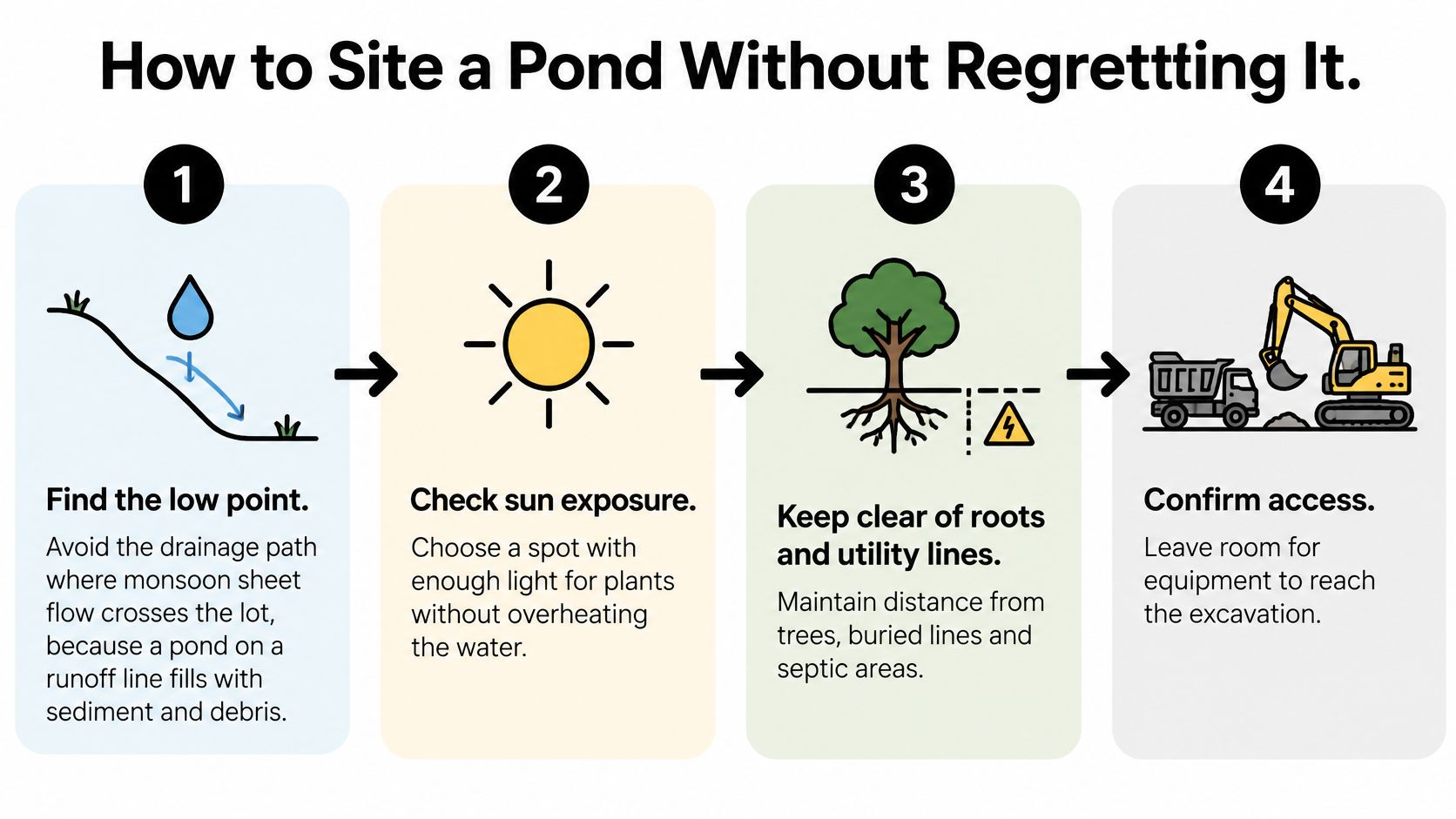
Find the low point, then avoid the drainage path. A pond can sit near a low area, but not where monsoon sheet flow crosses the lot. Put it on the runoff line and you'll import sediment, fertilizer and trash every storm.
Check sun through the day. Plan for roughly 4 to 6 hours of direct light for water lilies, with afternoon shade if you can get it. Full Prescott summer sun warms shallow water and feeds algae.
Keep clear of large trees. Stay roughly beyond the mature canopy edge to limit leaf litter and root intrusion. You'll also reduce the debris load your skimmer has to handle in fall. Dense planting and standing water deserve a pest check too, and this guide on how landscaping affects pest activity explains how plant and water choices around the house can change what you attract.
Mark sightlines from inside the house. Stand at the kitchen sink, patio door and bedroom window. A pond you can't see becomes a pond you stop maintaining, and safety suffers when you can't supervise it.
Reserve a service path of at least 3 feet. You need clear access to the pump vault, filter, skimmer and drain without stepping on coping or liner. If equipment is buried behind boulders, routine cleaning won't happen.
Test the soil with a percolation check. Dig a small hole, fill it, and watch how fast it drains. Prescott's decomposed granite and rocky soils often drain quickly, while compacted clay holds water but can crack as it dries, which changes your liner and base decisions.
Route inflow around the basin. Use a shallow swale or low berm uphill of the pond to catch soil and fertilizer before they reach the water. Controlled inflow through one pretreatment point beats sheet flow over every edge.
Your deliverable is one sketch showing sun, runoff, sightlines, service access and the diverted inflow path. If you can't draw where overflow goes during a heavy storm, you aren't ready to dig.
Water Source, Circulation and Filtration Basics
A pond in Prescott needs a dependable fill plan, a circulation system suited to its use, and equipment that can be serviced after a freeze. Check state and local rules on groundwater and water features before relying on a well or city line. The Prescott city water code prohibits using treated, metered potable water to fill or refill artificial lakes and prohibits spray-type fountains connected to the Prescott water system.
Where should pond water come from
Plan for both initial filling and summer make-up water. Roof runoff can be directed to storage or a rain garden, and shading part of the pond can reduce water loss. A recirculating waterfall loses more water to splash and evaporation than a calm surface, so a wide or dramatic fall has a practical water cost in June and July. Review these water feature installation considerations before settling the pump and stone layout.
Fish add a nutrient load that the filter must process. Uneaten food becomes waste, so feed only what the fish consume and remove visible leftovers. Floating pellets for pond fish are easier to monitor and remove than food that sinks into rockwork.
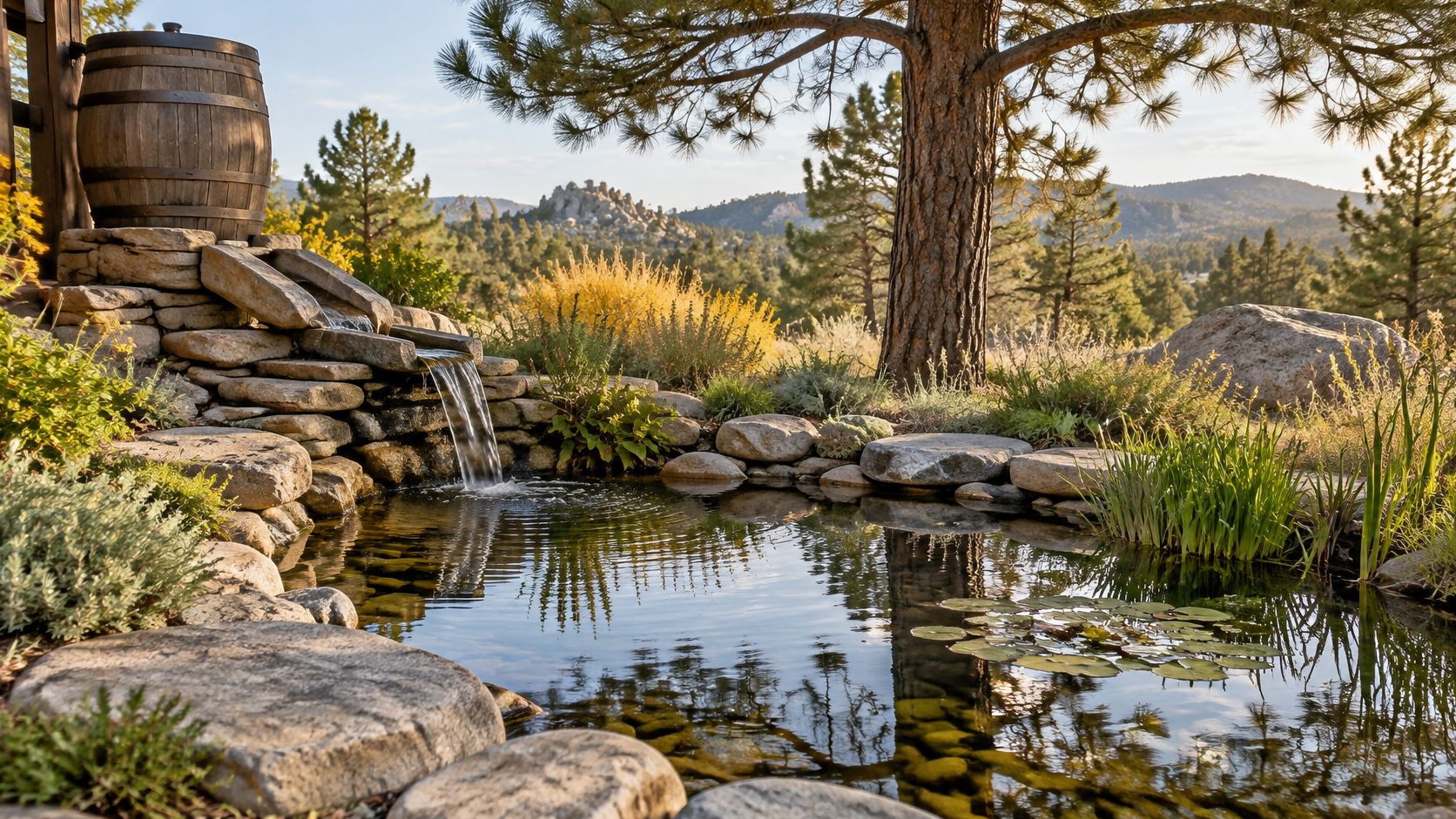
The pond below shows a contained fall and calm surface, a more controlled recirculating arrangement than a wide spray.
How do you size a pond pump
For a fish pond, plan to circulate roughly once an hour; a plant-only pond can turn over less often. For example, a 12 ft by 10 ft pond at an average depth of 2.5 ft holds about 300 cubic feet, or roughly 2,240 gallons. That calls for about a 2,200 gallons per hour pump before accounting for waterfall height and pipe friction. Select a pump based on delivered flow at the actual head height, not its box rating.
Use mechanical filtration to catch solids and biological filtration to process dissolved waste. Place the skimmer opposite the return so surface debris moves toward it, and install a sediment catch before the pump to limit grit reaching the impeller. In Northern Arizona, protect lines from freezing and keep unions accessible for seasonal service. If a filter cannot be opened without moving boulders, cleaning becomes harder to keep up with.
Plant Zones and Edges That Keep a Pond Stable
Define purpose and volume first, build shelves second, plant third. If you reverse that order, you'll buy plants for water depths you didn't build.
The zone diagram below maps shelf depth to plant type so you can set shelves during excavation, not after the liner is in.
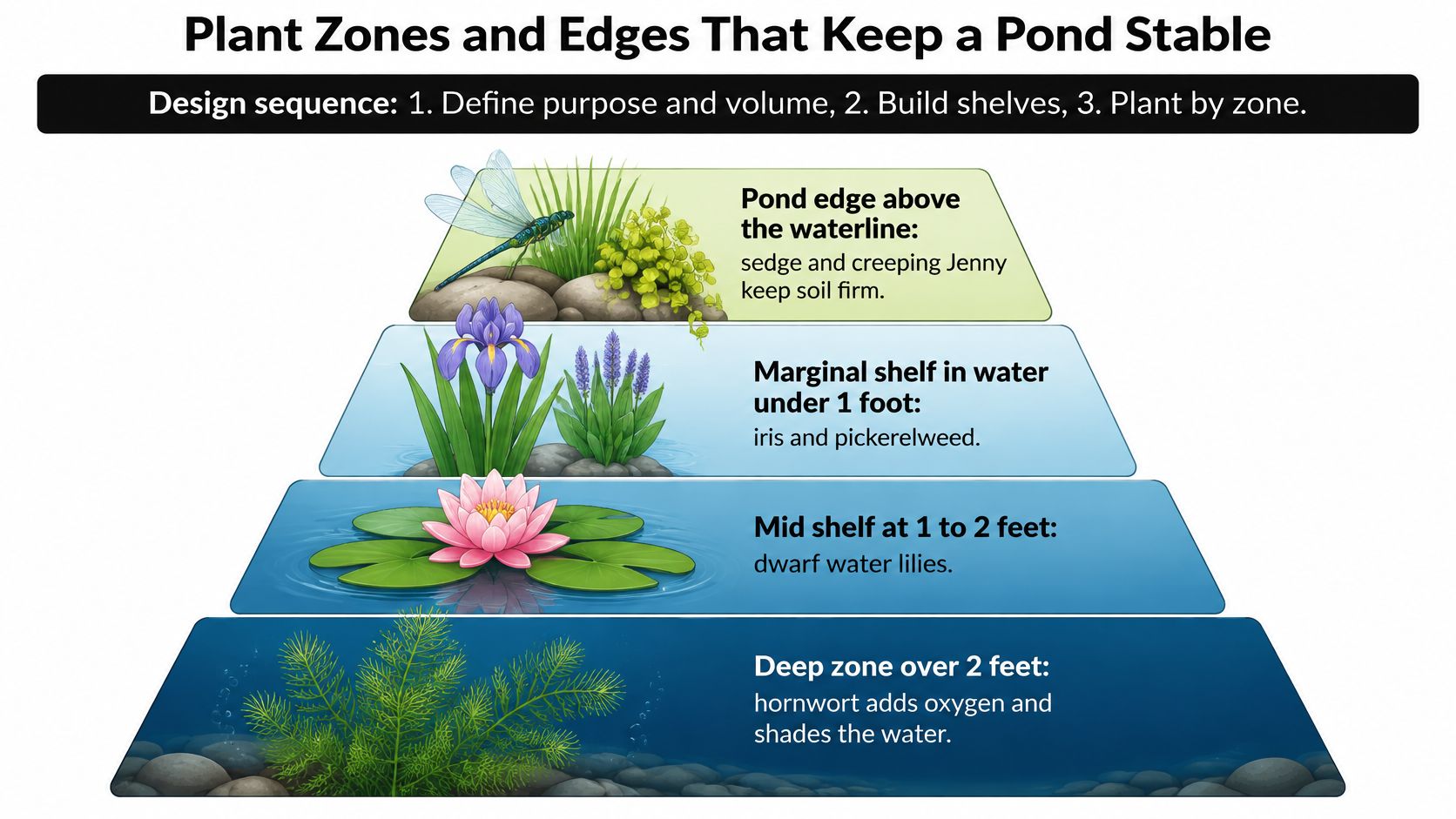
The Purdue Extension pond guide puts aquatic vegetation at roughly 20 to 40% of the pond area, with marginal plants in water shallower than 1 foot and water lilies and lotus in the 1 to 6 foot zone. Too little planting leaves nutrients for algae. Too much blocks circulation and hides the water you're paying to maintain.
Zone | Water Depth | Typical Plants | Share of Pond | Why It Matters |
|---|---|---|---|---|
Marginal shelf | Under 12 in | Iris, pickerelweed, rushes | Counts toward 20 to 40% total | Softens edges and takes up nutrients |
Lily zone | 12 in to 6 ft | Water lilies, lotus | Counts toward 20 to 40% total | Shades water to limit algae |
Submerged zone | Deeper than 6 ft or basin floor | Oxygenating species checked against invasive lists | Counts toward 20 to 40% total | Adds oxygen and uptakes nutrients |
Open water | Remaining basin area | None or minimal | At least 60% | Lets pump flow and gives visual access |
For the planting around the basin, use species that tolerate reflected heat, alkaline soil and dry spells between irrigation cycles. This guide to native plants for Northern Arizona helps you separate true pond plants from upland natives that belong outside the liner.
The short video below shows how shelf planting looks once plants are placed by depth rather than grouped by color alone.
What edge keeps a pond from slumping
Build a level shelf so the liner holds water evenly around the full perimeter. Set flagstone or stone coping on a compacted base, not on loose backfill that settles after the first storm. Avoid steep, unstable banks. They look natural on installation day and slump after heavy rain, pulling liner and stone with them.
Plant to the zones and keep at least 60% of the surface open.
Common failures are predictable. Homeowners place the pond at a low point without controlling sediment inflow, skip the level edge, overfeed fish, or let fertilizer wash in from lawn and beds. Each one raises nutrient load or reduces volume, and the filter gets blamed for a design problem.
Tie hardscape to the pond without crowding it. Run a stone or flagstone path that stops at least 3 feet back from the edge so the service path stays clear. Set a bench at the best sightline, and place low garden lighting to the side so it lights plants without glare on the surface.
Safety by Design for Kids, Pets and Older Adults
A grandchild visits while you are in the kitchen. You can see the patio, but a boulder and tall rushes block the pond's far edge. That blind spot is a design problem. Plan the pond so visibility and physical barriers do not depend on uninterrupted supervision.
Barriers, warning signs, separation from play areas, and gently sloping edges are commonly recommended safety controls. In Prescott, check applicable local water and building requirements before choosing a barrier or changing the pond's grade. A safer layout starts with the household's needs, then accounts for how people approach and exit the water.
What makes a backyard pond safer
Sightlines from indoor living areas: Keep the water edge visible from rooms where adults spend time. Avoid placing tall plants or large rocks where they block the view.
Separation from play zones: Use a fence, hedge, or grade change to keep play away from the pond. A ball game should not lead directly to the water.
Lockable gates where children are present: Choose a latch a small child cannot lift. A gate that is easy for a child to open provides little protection.
Non-slip coping: Use textured stone and keep algae off walking surfaces, especially where people step close to the edge.
No concealed drop-offs: Make depth changes gradual and visible, particularly near entry points.
Escape shelf or gently graded margin: Provide a stable route out of the water for a child, pet, or older adult. Loose rock is difficult to grip.
Protected drains and pump intakes: Fit grates that prevent fingers, clothing, or a small animal from being caught.
GFCI protection and glare-free lighting: Protect pond electrical equipment with GFCI protection. Aim lights so they do not shine into the eyes of someone approaching at night.
Swimming lessons do not replace barriers or safe grading. Supervision matters, but daily routines include moments when an adult's attention is elsewhere.
Safety choices involve trade-offs. Dense planting can support birds and dragonflies, yet hide a child near the water. Steep stone edges may suit a formal design, but make self-rescue harder for an older adult with limited upper-body strength. For a family yard, choose a visible, gently graded margin over a dramatic drop.
Pond safety also depends on how water leaves the site. Set up controlled overflow and stable edges so monsoon runoff has a defined route rather than flowing toward a patio or neighboring property. Plan that route with the pond, not as an afterthought.
Seasonal Maintenance for High Desert Ponds
A low-maintenance pond still needs an operating plan. You're maintaining water, equipment, plants and overflow paths in a climate that swings from freezing nights to monsoon runoff.
The EPA WaterSense supporting statement for soil moisture controls reports average study savings of 49 percent for soil-moisture-based controls and notes inefficient systems and overwatering can waste up to half of outdoor water use. That matters around a pond because the surrounding beds are often overwatered while the pond itself gets blamed for high water use.
Season | Key Tasks | Watch For |
|---|---|---|
Spring (March to May) | Restart pump, clean skimmer, check edges and liner after freezes, reset irrigation | Freeze-thaw movement and winter debris |
Summer (June to August) | Top up evaporation loss, test water clarity, trim plants, check emitters | Evaporation, algae and early monsoon storms |
Fall (September to November) | Remove leaves, thin plants, cut back feeding, clear overflow path | Leaves sinking, sediment and storm runoff |
Winter (December to February) | Protect or drain pump per design, keep an open water pocket, check pump housing | Ice damage to pumps, lines and edges |
What should you check each visit
Check pump and filter operation first, then remove debris before it sinks. Inspect edges and the overflow path for erosion, displaced stone and liner exposure. Look for leaks by tracking water loss against evaporation, not by guessing after a windy week. Adjust irrigation so emitters aren't spraying into the basin or onto hardscape, which adds nutrients and wastes water. For clarity problems between visits, use this guide on how to keep pond water clear to separate a filter issue from a feeding or runoff issue.
Plan sediment removal roughly every 2 to 7 years, depending on how much runoff you've allowed into the pond. A protected basin with a pretreatment area sits at the long end of that range. A pond on a drainage path may need attention much sooner.
These checks protect more than appearance. They preserve water quality, reduce premature pump failure, and keep runoff from undermining patios, walls and neighboring areas.
Get the scope in writing before installation. Ask for visit frequency, equipment checks included, irrigation adjustments, cleanup responsibilities, and which conditions trigger a repair recommendation. R.E. and Sons Landscaping's dedicated maintenance department can cover that scope for homeowners in Prescott and Prescott Valley who don't want to manage it season by season.
Confirm the Build Plan Before You Break Ground
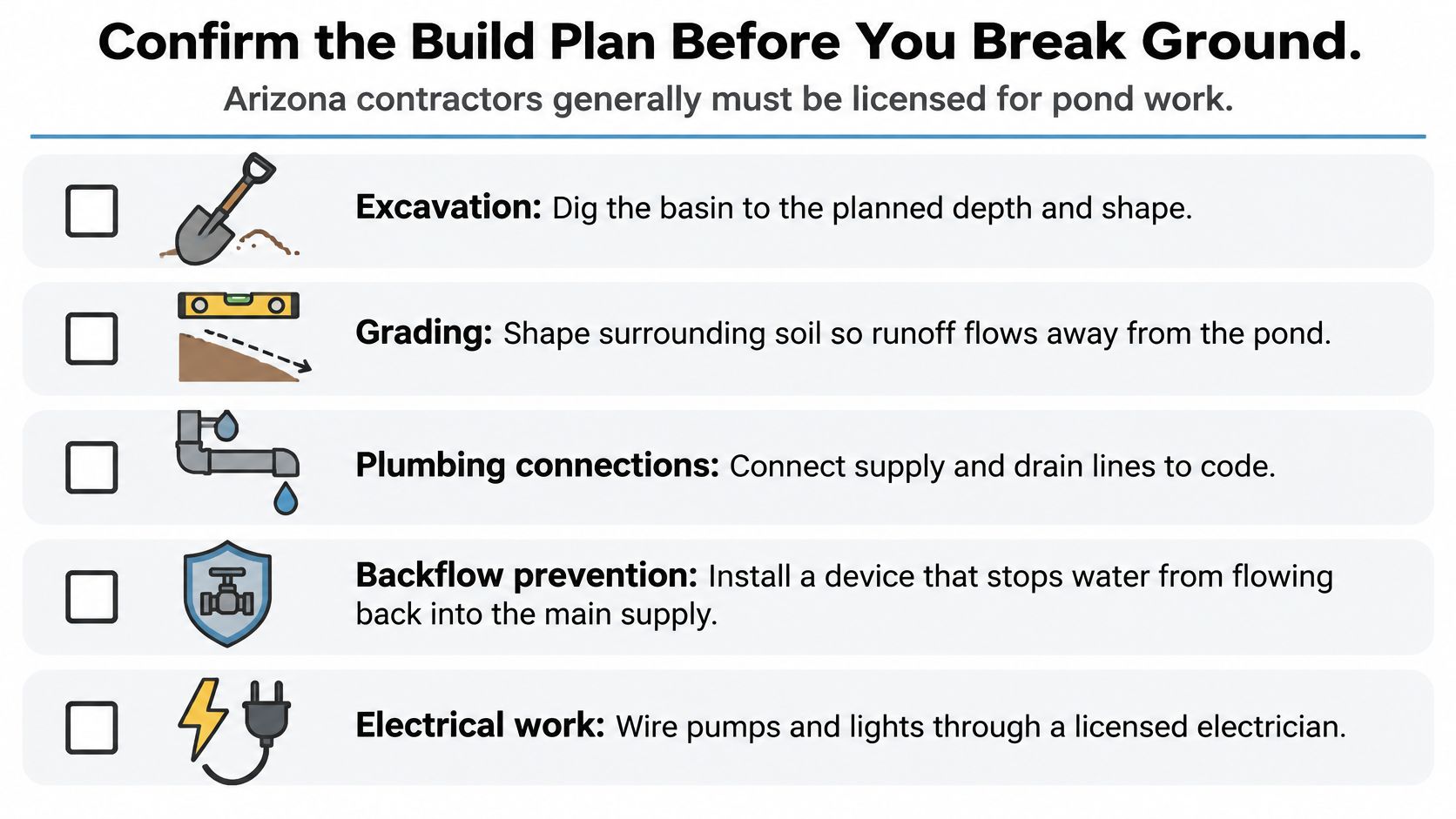
A pond is an engineered water system, not a feature to fit in after the yard is built. Before excavation, settle how the design handles water supply, runoff, access, and regulated work. Clear responsibilities on paper help prevent field changes that compromise overflow routes or backflow protection.
Under Arizona law cited by the Arizona Registrar of Contractors, contractors generally must be licensed when a project exceeds $1,000 in total labor and materials or requires a building permit, and must be properly licensed before submitting bids. Confirm with the Registrar of Contractors which parts of a pond build fall within a contractor's license scope, and make sure any electrical or plumbing work is done by a properly licensed trade professional.
The checklist below shows the build components to confirm in writing before excavation starts.
What should be settled before you sign
Bring six items to the pre-build review: the siting sketch, water-source decision, plant-zone plan, safety features, written maintenance scope, and drainage map with a budget. Each should be specific enough to guide the build. If any item is left as “we'll figure it out in the field,” pause and clarify it before work begins. Monsoon runoff needs a defined route, and the plan should show how pond overflow moves away from the basin and nearby structures.
R.E. and Sons Landscaping identifies itself as licensed, bonded, and insured, lists Arizona ROC #300642, and serves Prescott, Prescott Valley, and Northern Arizona. Verify the license number with the Registrar before signing. If the design includes electrical or plumbing work, ask which licensed trade professional will handle it.
R.E. and Sons Landscaping's process has four steps: consultation, design approval, transformation, and enjoyment. The company offers complimentary garden design, with consultations available online or by phone Monday through Friday, 8am to 4pm. Bring lot measurements, photos taken after rain if available, and questions about the water source. Those details help the team assess the yard's drainage and discuss a pond plan suited to local conditions.
Frequently Asked Questions About Landscape Design with a Pond
Is a backyard pond useful for stormwater, or only decorative
It can do real work when it's engineered for runoff. The Minnesota Pollution Control Agency synthesis of BMP studies reports median total suspended solids removal of 88% and 80% and median total phosphorus removal of 48% and 51% in stormwater ponds. Your ornamental pond won't match a municipal basin automatically, but settling time, a forebay and controlled outflow move you in that direction.
What is a sediment forebay and why does it matter
It's a small settling pocket where runoff enters, so grit drops out before it reaches the main basin. The EPA wet pond guidance identifies a typical forebay volume of about 10% of the water-treatment volume. You clean that pocket first, which keeps the main pond deeper and clearer longer.
Can a pond help cut irrigation waste
It can, if the whole yard is zoned around it. The EPA WaterSense action page estimates as much as 50 percent of outdoor water use may be wasted through overwatering and inefficient irrigation. Put water-demanding plants near the pond, drought-tolerant plants farther away, and run them on separate irrigation zones.
Are ponds becoming more common
Yes. Houzz's study as reported in This Old House's outdoor trends summary found 19% of homeowners renovating their outdoor spaces purchased a water feature in 2024. For a Prescott area lot, ask R.E. and Sons Landscaping whether a forebay and legal make-up water source fit your site before you follow that trend.
If you want a pond that survives Prescott summers, winter freezes and monsoon runoff, start with a measured site plan, a legal water source and a written maintenance scope from R.E. and Sons Landscaping. Book a consultation to review your lot, drainage and depth options before any digging begins, and visit R.E. and Sons Landscaping to schedule your complimentary design.
Comments