
Best Base for Artificial Grass in Northern Arizona
A 3- to 4-inch compacted base is typical for pet areas and busier family yards. Lighter-use lawns on stable ground can need less. The base must support the turf while allowing water to drain; making it as hard as possible can still leave a failed surface if water gets trapped beneath it.
In Prescott, Prescott Valley, Chino Valley, and nearby Northern Arizona communities, local soil and runoff affect how the base should be prepared. Pets, sloped ground, and water flowing off surrounding paving all change the drainage demands. Treat the base as a drainage system, not just a leveling layer.
R.E. and Sons Landscaping installs artificial turf with proper base preparation and precision seaming. Its turf can help reduce mud, worn patches, and routine lawn upkeep in family yards, pet areas, and putting greens.
Best Base Materials Compared at a Glance
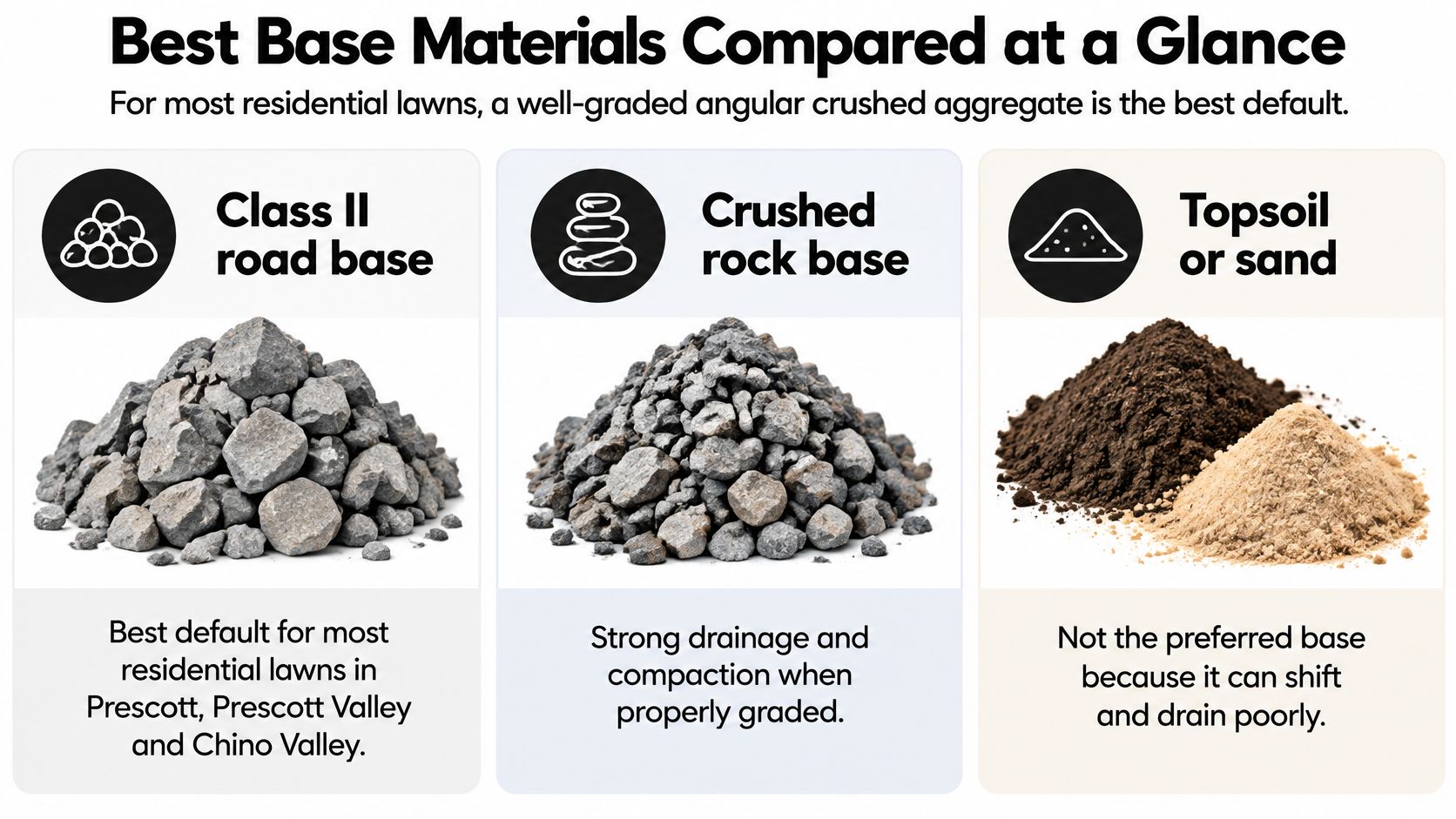
Well-graded angular crushed aggregate is the best default for most residential lawns in Prescott, Prescott Valley, and Chino Valley. The Anvil Field installation guide describes a typical residential assembly using 3 to 4 inches of compacted aggregate, with Class II road base and 3/4-inch-minus crushed rock among the common choices.
Angular particles interlock under compaction. Rounded stone can move underfoot, leaving depressions and ripples rather than a firm surface for the turf backing.
Base materials compared for artificial grass
Base material | Holds under foot traffic | Drainage risk | Best fit |
|---|---|---|---|
Class II road base | Locks well when moisture-conditioned and compacted | Low when gradation and installed drainage are verified | Most residential lawns, pets, and kids |
3/4-inch-minus crushed rock | Angular particles interlock tightly | Low to moderate; excessive fines restrict flow | Vehicle edges, heavy use, unstable areas |
Decomposed granite | Packs hard and can crust over | Moderate; fines can slow water flow | Courtyards and accent areas |
Crusher fines | Very stable once compacted | High risk of ponding without drainage design | Only inside a designed system with an outlet |
Sand | Shifts under foot traffic | Can drain quickly but gives poor stability | Not recommended as the main base |
These are selection guidelines, not guarantees attached to a material name. The SUNY synthetic-turf directive emphasizes gradation, infiltration, and both minimum and maximum compaction limits rather than treating the hardest possible base as the goal.
This comparison illustrates the basic material choices.
Which material would I choose for a family yard?
I'd start with Class II road base for a standard lawn used by pets and kids. At vehicle edges or heavily traveled access points, I'd evaluate a properly graded crushed-rock section with the depth matched to the load.
For a sloped or clay lot, the priority becomes a well-graded base with a tested drainage route. Crusher fines belong within a designed assembly, not as a shortcut around drainage work.
Decomposed granite has many practical applications, but these don't automatically make it the right turf foundation. Our guide to what decomposed granite is used for helps distinguish decorative uses from structural preparation.
For early layout ideas, OutdoorBrite's ai generated backyard design can help you visualize turf beside patios and planting beds. Treat that visualization as a layout aid, not a grading or drainage specification.
The best material is the one that stays stable and still drains, not the hardest one.
Why the Base Matters More Than the Turf
Artificial grass follows the surface beneath it. Better blades, denser stitching, and careful seams can't hide a depression in the foundation or prevent poorly compacted aggregate from settling.
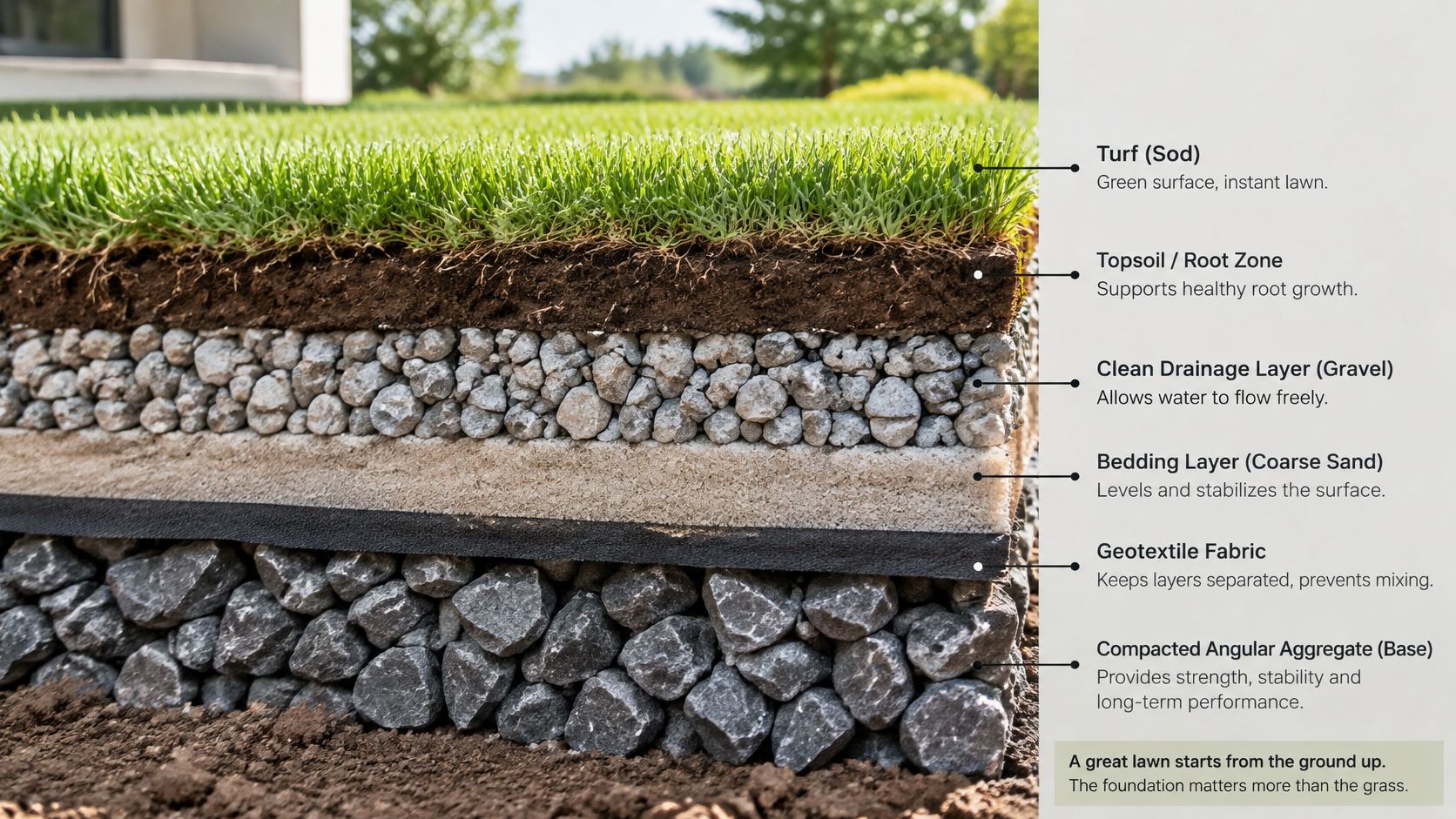
A proper base is a compacted, free-draining aggregate system, not ordinary topsoil with gravel scattered over it. The cross-section below shows why the underlying layers deserve as much attention as the visible grass.
What do professional specifications control?
The federal turf-field installation specification calls for a minimum 4-inch compacted base plus approximately 2 inches of topping stone, with aggregate lifts limited to 6 inches under heavy compaction equipment or 4 inches with hand-operated tampers. It also uses compaction targets of 92% to 95% of Modified Proctor density and limits surface variation to 1/4 inch over 10 feet, with a maximum 1/2-inch deviation from design grade.
Modified Proctor density is a laboratory reference used to compare field compaction against a controlled benchmark. An installer can't confirm it just by saying the surface feels firm.
Those field specifications illustrate the controls involved, but they aren't a universal residential recipe. A backyard lawn, vehicle-access edge, playground, patio conversion, and putting green require different assemblies.
What does a weak base look like after installation?
Say an installer leaves a shallow depression beside a patio and covers it with turf. The grass may initially disguise the edge, but the backing still follows that low area, and rinse water collects there.
If the aggregate underneath is loose, repeated foot traffic can deepen the depression. Adding infill above it doesn't repair the structural problem.
The installation sequence matters: remove unsuitable material, establish the subgrade, place the specified aggregate, and compact it mechanically in controlled lifts. Check the finished plane with a straightedge and grade measurements before covering it.
The installation video provides another view of the work beneath the finished lawn.
Base Depth and Compaction by Use
The hardest base is not automatically the best. Depth should suit the use, ground conditions, and water route. For a light-use lawn on stable ground, 2 to 3 inches is a minimum. Most Prescott-area residential lawns, especially those used by pets or children, need 3 to 4 inches of compacted aggregate.
Compacted base depth by use
Use | Compacted base depth | What changes the number |
|---|---|---|
Light-use residential lawn on stable ground | 2 to 3 inches minimum | Limited foot traffic and firm subgrade |
Most residential lawns, including pet areas | 3 to 4 inches | Pet traffic, rinse water, and drainage demand |
HOA common areas and busy corridors | About 4 inches | Higher traffic and maintenance access |
Driveway edges or unstable soil | Thicker than standard | Loading and weak subgrade, confirmed after a soil test |
Playgrounds and sports fields | Set by safety or performance specification | Governing specification, not a rule of thumb |
The residential, pet-area, and common-area ranges follow AE Outdoor Living's Arizona base-preparation guidance, which lists approximately 2 to 3 inches for standard residential lawns, 3 to 4 inches for pet areas and higher-traffic applications, and about 4 inches for HOA common areas and busy corridors.
Why doesn't every lawn need the same depth?
A lightly used lawn on firm ground has different support needs from a narrow passage where dogs repeatedly run along a fence. Common areas also need a base suited to concentrated foot traffic and anticipated maintenance access.
At driveway edges, determine whether tires will cross or turn on the turf, or stay on the paving. A pedestrian-use assembly should not be assumed to support vehicle loading.
Playgrounds and sports fields require the specified safety or performance assembly. Residential depth recommendations do not replace those requirements.
The base distributes loads, limits rutting, and provides a stable plane for seams and perimeter attachment. Excavation may need to go deeper to remove unsuitable soil or make room for drainage construction.
More stone will not solve every wet area. Northern Arizona's local soil and monsoon runoff affect how water moves through the base. Where underlying ground holds water, the design may need underdrains, soil replacement, or a suitable outlet rather than additional aggregate depth.
What should the installation scope show?
For homes on residential fill, native ground, or sloped lots, ask for a written scope that identifies:
Compacted depth, measured after compaction, not as loose delivery thickness.
Aggregate type, identified by product or gradation.
Lift thickness and equipment, including how confined edges will be compacted.
Finished slope, coordinated with paving, thresholds, and drainage.
Unusual-ground provisions, explaining how soft spots or unsuitable soil will be addressed.
These details make bids easier to compare. A deeper loose layer does not necessarily perform like a shallower, properly compacted assembly.
What a Base Costs and How Long It Lasts
Base cost depends more on the work beneath the lawn than on the aggregate's name. Access, excavation, disposal, and drainage construction can change the scope substantially before the turf itself enters the calculation.
A flat, accessible yard with firm ground is a different project from a sloped Prescott property where equipment access is narrow and excavated soil must be hauled out through a side gate. Comparing only the finished turf area misses those differences.
What actually drives the preparation cost?
Excavation and hauling include removing the old lawn, unsuitable soil, and material needed to reach the design elevation.
Delivered aggregate reflects the required compacted section and the supplier's material.
Compaction labor and equipment include staged placement, moisture conditioning, and work around edges.
Drainage or soil correction can involve an outlet, collection pipe, replacement material, or changes beside existing hardscape.
Our explanation of artificial turf installation cost per square foot helps place foundation work within the overall installation budget. For an actual comparison, keep the base scope beside the price rather than treating every proposal labeled gravel base as equivalent.
How long should the base last?
There isn't a defensible universal lifespan for an unspecified aggregate assembly. Its condition depends on whether the subgrade remains supported, the perimeter stays contained, and water can leave without carrying material away.
A stable base doesn't need routine replacement just because the turf above it ages. Conversely, a foundation that ponds or settles may require lifting the grass to reach the problem.
Budget rule: Compare the cost of a complete, drainable foundation, not the price of delivered gravel alone.
Fine-rich decomposed granite can develop a hard surface crust, while loose sand can move under repeated loading. Neither condition is solved by selecting a more expensive turf product.
Maintenance planning should identify what can really be accessed. Drain cleanouts, accessible discharge points, and visible perimeter conditions are more useful than a vague promise that the base can be flushed.
Ask what happens if a depression develops and whether correction requires lifting a localized area or disturbing a larger section. A clear answer helps you understand the consequences of the proposed assembly without relying on an unsupported lifespan claim.
How to Test Drainage Before the Turf Goes Down
Check the base as a system, not by its label. A supplier's road-base designation doesn't establish how that material will perform after compaction over your particular soil.
The Penn State review of synthetic-turf systems identifies poor grading and inadequate internal drainage as the main construction problems and discusses laboratory permeability testing of compacted drainage materials. That's a stronger basis for approval than pouring a bucket onto loose stone.
What should the drainage check include?
Request documented permeability or drainage performance. The result should describe the material and its compacted condition. A test on loose aggregate doesn't prove the installed base will behave the same way.
Check gradation and in-place density. Particle-size distribution explains the balance between coarse stone and fines. Density testing helps establish whether the field installation matches the intended compaction condition.
Test the prepared subgrade. Water passing through the aggregate still needs somewhere to go. Check infiltration before the stone conceals clay, dense fill, or other restrictive ground.
Use a controlled field test where appropriate. ASTM's description of F2898 explains a non-confined flood test using known water flow, water migration, and elapsed time to assess synthetic-turf surfaces or their underlying stone bases. Have the test performed and interpreted for the actual assembly rather than treating an informal hose check as equivalent.
Confirm the discharge route. The base must drain at least as effectively as the selected turf system and fall toward an appropriate outlet. Check that edging, retaining walls, or adjacent paving won't trap water at the perimeter.
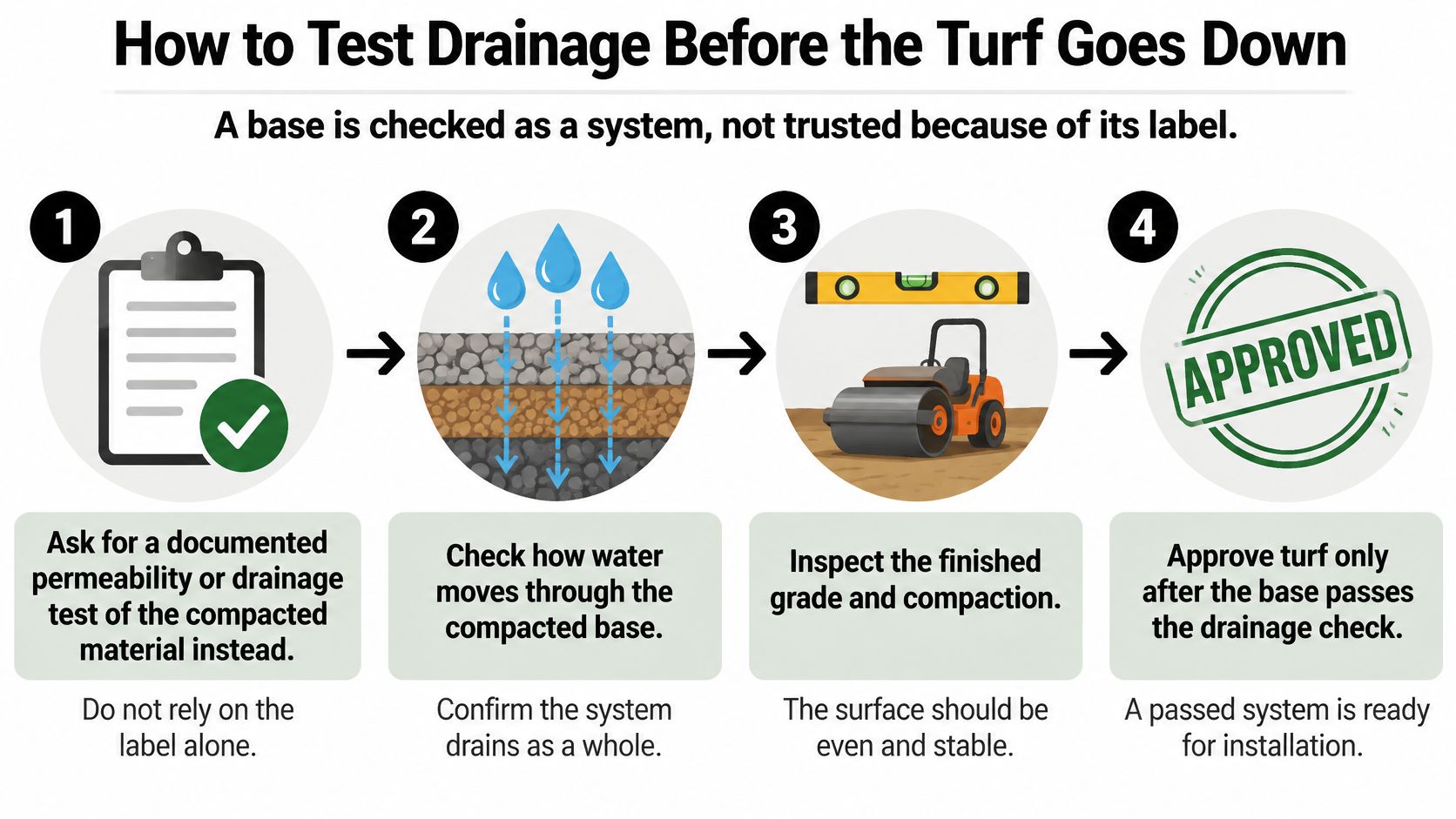
Use this visual checklist when discussing approval of the prepared foundation.
What counts as a passing result?
Approve the foundation only when its drainage performance matches the project specification and the discharge route works. Excess fines can improve interlock while restricting water movement, so firmness alone isn't a pass.
Our guide to artificial turf drainage explains how the layers and outlet work together. We also handle excavation, base preparation, drainage systems, block or stone installation, and backfill for retaining walls, which matters when turf meets a terraced yard.
If the base can't drain at the rate required by the turf system, correct the assembly or outlet before installing the grass.
Northern Arizona Conditions That Change the Base Choice
Prescott, Prescott Valley, Chino Valley, and Williamson Valley yards shouldn't receive identical foundation designs just because they're in the same region. Clay, caliche, decomposed granite, imported fill, and hillside drainage can create very different conditions within a small installation area.
Monsoon planning also needs to account for water entering from outside the turf footprint. Roof runoff, uphill paving, and neighboring grades can send water toward a lawn that otherwise has adequate infiltration.
How would different local sites change the design?
Consider a sloped Prescott lot with clay beneath the proposed lawn. That site may need deeper excavation, interception of uphill runoff, and a daylight outlet rather than an aggregate layer expected to absorb everything.
A flat Chino Valley yard with sandy fill may need only a satisfactory infiltration check and a properly specified road base. But sandy-looking material at the surface isn't proof that the underlying fill drains, so test the exposed subgrade.
For Chino Valley projects, we use low-water plants, drought-tolerant turf, and base preparation designed to withstand local freeze-thaw cycles. Removing trapped-water conditions is part of thinking beyond the appearance of the finished lawn.
What changes when dogs and summer heat are involved?
The New Jersey Department of Environmental Protection's synthetic-turf report discusses recommended minimum drainage rates of 14 inches per hour for base and finish stone and 10 inches per hour for turf, backing, and infill. Those recommendations illustrate why the foundation needs its own hydraulic evaluation, rather than borrowing a drainage claim from the turf packaging.
Component | Recommended minimum drainage rate in the review |
|---|---|
Base and finish stone | 14 inches per hour |
Turf, backing, and infill | 10 inches per hour |
For pet areas, plan where urine and rinse water will travel. Remove solid waste promptly, rinse appropriately, and keep sediment from washing onto the turf instead of assuming permeability will remain unchanged without upkeep.
Heat requires a separate decision. A well-drained lawn can still have a hot surface in Arizona sunshine, so consider shade, suitable cooling practices, and an alternative surface where pets can rest.
No advertised drainage number proves the installed yard performs at that rate. The compacted foundation, underlying soil, and actual outlet must work together.
Common Questions About Artificial Grass Bases
Can artificial grass go directly on dirt?
No, not on unprepared native soil if you want a stable residential lawn. Remove unsuitable material and build the compacted aggregate foundation before laying the grass, rather than expecting the backing to bridge soft spots or uneven ground.
Is decomposed granite good for artificial grass?
It can suit courtyards and accent areas when the complete assembly supports its use. Fine-rich decomposed granite can pack hard and restrict drainage, so confirm compacted permeability before choosing it as a structural base.
How deep should the base be in Prescott?
Use a depth matched to the soil, loading, and drainage design rather than selecting one number for every Prescott property. A lightly used lawn on stable ground can need a different section from a pet run, vehicle edge, or yard built on questionable fill.
Do I need a drain outlet?
An outlet is often necessary where clay, restrictive ground, slopes, or recurring ponding prevent water from leaving through the soil. Porous aggregate provides space for water to move, but it doesn't guarantee that water can leave the installation.
Is sand the same as turf infill?
No, the structural base sits beneath the turf backing, while infill is brushed into the grass above it. A product suitable for infill doesn't automatically provide the load-bearing stability needed beneath the lawn.
Can a putting green use the same base as a lawn?
Not automatically, because putting greens need controlled contours and a finish suited to ball roll. We offer turf and custom putting greens, and the intended use belongs in the design discussion before excavation begins.
Confirm the Base Specs Before You Hire an Installer
I'd request the base specification in writing before comparing the final price. A verbal promise of good compaction or excellent drainage leaves too much room for different interpretations.
The useful document is specific enough that you can compare what was proposed with what gets installed. It should also distinguish planned work from conditions that can only be confirmed after excavation.
What should you request with the bid?
Proposed compacted depth, including any separate finishing layer.
Aggregate identification, named by product or documented gradation.
Lift thickness and compaction method, suited to the material and equipment.
Finished slope and outlet, coordinated with the house, paving, and neighboring grades.
Drainage verification, identifying the proposed test and acceptance criteria.
Unusual-soil handling, explaining how unsuitable ground will be evaluated and addressed.
This isn't paperwork for its own sake. It helps prevent a homeowner from comparing a shallow overlay against a complete excavation and drainage scope as though they're the same service.
How does our turf planning process begin?
R.E. and Sons Landscaping is a licensed, bonded, and insured design-build team serving Prescott, Prescott Valley, and Northern Arizona. Our artificial turf projects begin with a guided consultation based on your vision, followed by a custom design for your approval.
We offer a free turf consultation, and our artificial turf team handles the process from planning and site preparation through final installation. That lets the proposed lawn, existing hardscape, and yard grade be considered together rather than as unrelated decisions.
If you're comparing landscaping providers, our free downloadable Easy 4 Step Guide to Choosing A Trusted Landscaper gives you another practical checklist. Use it alongside the written base scope, not instead of the site evaluation.
The useful next step is a yard visit to discuss use, examine drainage constraints, measure grade, and establish the proposed foundation before installation starts.
R.E. and Sons Landscaping offers a free turf consultation to connect your lawn plans with the base preparation and drainage your Northern Arizona yard needs. Visit R.E. and Sons Landscaping to book your consultation and discuss the foundation specification before your artificial grass goes down.
Comments