
Outdoor Kitchen Materials for Prescott Homes: What Lasts
Ask a Prescott homeowner which countertop belongs in an outdoor kitchen and the answer is usually granite. Ask which cabinet material lasts and it's stainless steel. Both answers are reasonable, and neither one tells you whether the kitchen will still look right after five winters of freezing nights, a decade of high-altitude sun, and a dry June with embers in the air.
R.E. and Sons Landscaping designs and builds custom outdoor kitchens in Prescott, Prescott Valley, Chino Valley and the surrounding Northern Arizona communities, and the material question that comes up most isn't the one the generic guides answer. It's not "what's the best outdoor kitchen material." It's "which of these will survive my yard, and what does it take to keep it working."
That's the gap worth closing. Most material lists rank products by a broad climate label, then stop. High-desert conditions don't deliver one hazard at a time. They stack, and the material that fails is usually the one chosen for how it looked under showroom lighting.
Which Outdoor Kitchen Materials Hold Up in Prescott
For most yards here, the working specification is straightforward. Use 304 stainless steel or better for cabinet bodies and appliances, dense exterior-rated porcelain or a properly sealed dense stone for counters, and noncombustible masonry or galvanized steel framing underneath. That combination handles sun, temperature swing and freezing better than any single "best material" claim, because each layer meets a different stress.
Component | Material | Prescott verdict | Watch for |
|---|---|---|---|
Cabinet frame | Galvanized steel or aluminum | Strong fit for dry heat | Powder-coat chips can expose bare metal |
Cabinet body | 304 stainless steel | Reliable for sheltered inland sites | Upgrade to 316 near pools or de-icing salt |
Countertop | Exterior-rated porcelain or dense, sealed stone | Handles UV and freezing when edges and drainage are detailed well | Overhangs, joints and standing water |
Countertop | Indoor-rated quartz | Not recommended outdoors | Fades or yellows in direct sun |
Patio flooring | Pavers or concrete on a sloped base | Good freeze-thaw performance with drainage | Sealed stone needs periodic resealing |
Structural base | Masonry, concrete block or steel studs with cement board | Noncombustible near heat | Wood framing near the grill is a fire risk |
Appliances | Outdoor-rated commercial units | Designed for outdoor weather | Confirm the listing matches the installed location |
Builders in other regions compare the same components and reach different conclusions, which is why the details of a cold-climate enclosure differ so much from ours. If you want to see how another market handles framing and enclosure, outdoor kitchen services from Kay2 Contracting show the layer-by-layer approach applied to a much harsher winter.
Why one label doesn't cover Prescott
Ultraviolet exposure at this elevation breaks down resins, chalks powder coatings and fades anything pigmented with an organic dye. A surface rated for "outdoor use" in a coastal climate may see half the UV dose it gets on a south-facing patio in Yavapai County.
Day-to-night temperature swings move materials against each other. Sealant joints, countertop seams and mortar lines take that movement twice a day, and the failure shows up as a hairline crack in year three rather than year one.
Freeze-thaw nights are the quiet killer. Water that soaks into a pore or a joint expands when it freezes, and repeated cycles widen what started as a pinhole.
Windblown dust is abrasive and it packs into crevices, where it holds moisture against metal and stone long after the surface has dried.
Wildfire embers add a hazard that has nothing to do with appearance. Fine fuel, vents and combustible trim near the cooking zone decide whether an ember finds something to burn.
The rule to apply to any sample: choose each component for its harshest exposure, not its showroom appearance, and ask the manufacturer which exposure the product was actually rated for. If the answer is vague, the rating probably is too.
Choosing Between 304 and 316 Stainless Steel
Here's the rule in one line: 304 works for sheltered inland cabinets with routine cleaning, and 316 or 316L is the stronger choice wherever chloride stays on the metal. Grade should follow chloride exposure, not the brightness of a sample under a showroom light.
Grade | Chromium | Nickel | Molybdenum | PREN | Best fit |
|---|---|---|---|---|---|
304 | 18-20% | 8-10.5% | None added | 18-20 | Sheltered inland sites with routine cleaning |
316/316L | 16-18% | 10-14% | 2-3% | 24-26 | Persistent chloride: pools, de-icing salt, salt spray |
A stainless steel grade comparison from ExtCabinets lays out those typical compositions and explains what the alloying buys you. The molybdenum in 316 is the difference. It substantially improves resistance to chloride-induced pitting and crevice corrosion, which is why 316 is the specification for coastal sites, pool areas, locations exposed to de-icing salts, and installations that receive salt-laden spray.
What PREN actually measures
Pitting Resistance Equivalent Number is a calculated score, and it rises with chromium, molybdenum and nitrogen. The same comparison reports typical values of roughly 18 to 20 for 304 and 24 to 26 for 316/316L. Higher means greater pitting resistance. That's the whole point of the number: it turns a metallurgy argument into something you can compare on a spec sheet in ten seconds.
Three details that defeat a good alloy
A correct grade is necessary, not sufficient. These three items undo it every time:
Fasteners. Specify corrosion-resistant screws, hinges and drawer slides. The hardware is smaller and more exposed than the panel it holds, and it usually fails first.
Carbon-steel contamination. Grinding dust, a wire brush or a steel tool used during fabrication can embed free iron in the surface, and that iron rusts while the stainless around it stays clean. Keep stainless work separate.
Deposits left on horizontal surfaces. Salt, dust and food residue sit in crevices and under the lip of a counter. Rinse them off. Crevices and salt accumulation can defeat even a suitable alloy.
Most Prescott yards are inland, so the grade question usually turns on winter de-icing, road salt drift, and any pool, spa or spray exposure on the property. Before you order, list every stainless part on the plan, from grill hood to drawer slides, and mark the ones that sit within salt exposure. Those get 316. The rest can stay 304. When you're weighing equipment, our guide to the best outdoor kitchen appliances covers how grade shows up inside a grill, not just on the front panel.
How Countertops Handle Water, Freezing and Heat
Dense exterior-rated porcelain and properly selected dense stone are the strongest outdoor countertop choices for Prescott because water absorption drives so much of the risk. Water that soaks into pores freezes and expands. In a high-desert setting, the same slab also faces strong UV, sharp day-to-night temperature swings, blowing dust, and the possibility of wildfire embers. Durability here means surviving that combination, then being easy to clean and maintain without trapping moisture at edges or joints.
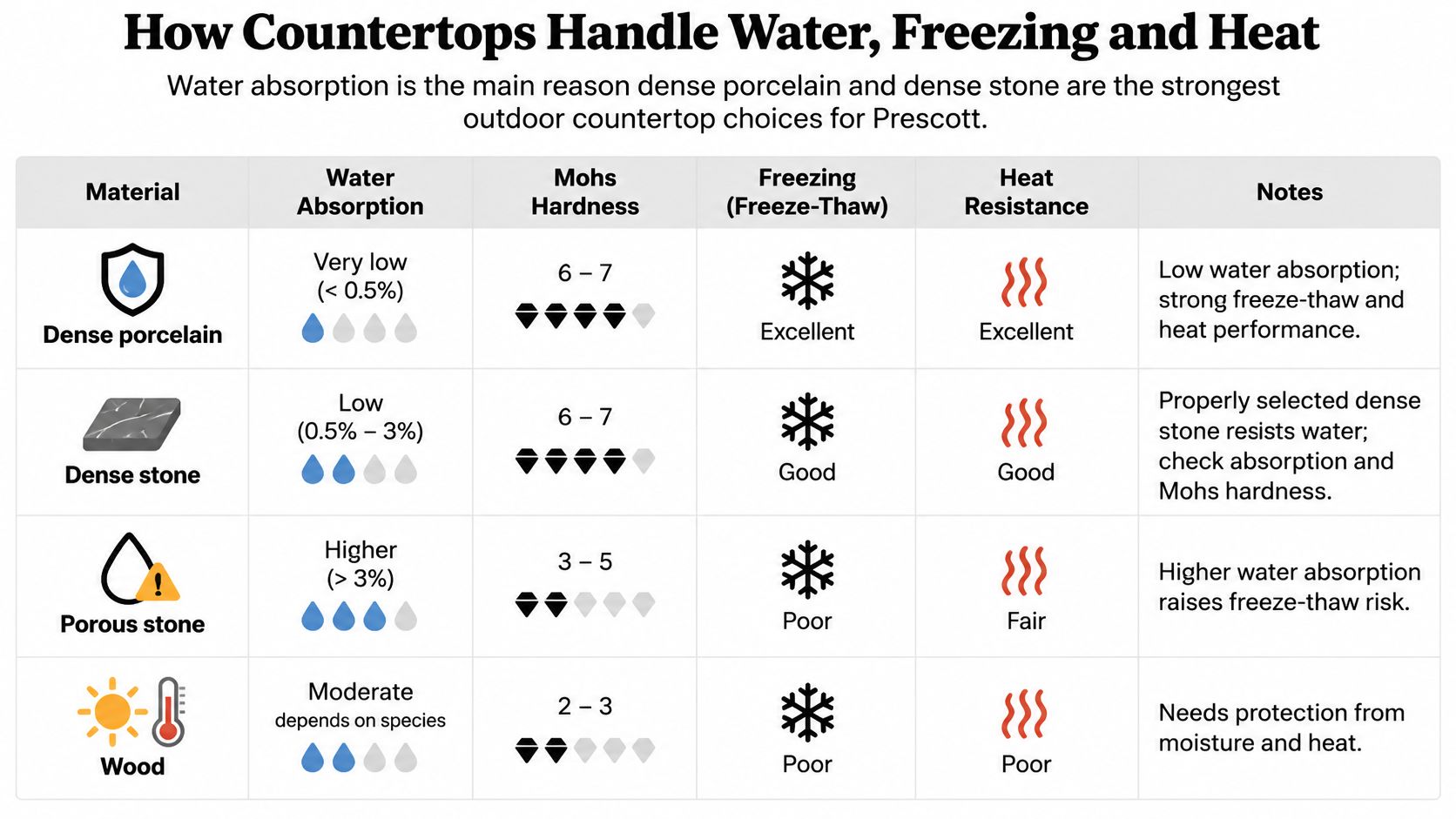
The spread between surfaces is real. A countertop material comparison from Construction Flux lists vitrified porcelain at less than 0.05% water absorption, against roughly 0.2 to 0.6% for granite. That difference matters when a cold night follows a wet day, especially on horizontal surfaces where dust and meltwater sit against the slab. A low-absorption top gives water fewer places to enter, and a dense finish gives you less to scrub back into shape.
Material | Water absorption | Scratch hardness (Mohs) | Rapid temperature change | Outdoor note |
|---|---|---|---|---|
Vitrified porcelain | Under 0.05% | 7-8 | About 150°F | Exterior-rated product; moderate impact resistance |
Granite | 0.2-0.6% | 6-7 | 300°F or more | Dense stone; seal per manufacturer guidance |
Reinforced concrete | Under 0.05% to 0.6% | 5-7 | About 120°F | Needs sealing and positive drainage |
Indoor-rated quartz | Under 0.05% to 0.6% | 7 | About 150°F | Can fade or yellow in direct sun |
Those concrete and quartz entries are typical ranges for screening outdoor candidates, not a substitute for the exact slab data. I would use them to narrow the shortlist, then require the manufacturer sheet for the actual product being installed. Porcelain and granite are the easier choices here because their published figures are clearer and their outdoor behavior is more predictable.
Hardness is not toughness
Porcelain scores around Mohs 7 to 8 for scratch resistance, with granite around 6 to 7, which sounds like a clean win for porcelain. It isn't quite that simple. The same comparison notes that porcelain has more moderate impact resistance, so a chip at a corner is the realistic failure, not a scratch across the field.
That has a design consequence. Exposed corners need reinforced or carefully detailed edges, and thin unsupported overhangs are asking for trouble. A 12-inch overhang on a bar top is fine when it's built up properly underneath. The same overhang on a thin slab with nothing under the front edge is a future repair. Dust and grit also work against the surface. A countersink of fine sand under a stool or near a planter can turn a routine wipe-down into light abrasion, so choose edge details that can be cleaned without catching debris.
Thermal shock is a separate test
Rapid temperature change tolerance runs roughly 150°F for porcelain, 300°F or more for granite, and 120°F for reinforced concrete in the same comparison. A hot pan set down on a cool morning, or the radiant heat beside a side burner, can exceed those limits locally. Trivets and a thermal break next to the grill are still worth specifying. They cost almost nothing during a build and prevent a permanent scorch mark.
Practical rule: put the heat where the heat belongs. A landing zone of stone or stainless beside the grill, with a trivet habit attached to it, protects the counter better than any sealer.
Two buyer traps are worth naming. Reinforced concrete needs sealing and positive drainage, not occasional attention. In this climate, a slab that holds water at a seam or against a cabinet base turns maintenance into a recurring job. Indoor-rated quartz resists stains well inside a house but can fade or yellow in full sun, which turns a premium surface into a replacement cost.
Ember exposure changes the maintenance calculation, too. A counter itself may shrug off a hot ember better than nearby trim, caulk, or cabinet edges, but ash and fine debris still collect under lip details and behind fixed seating. Smooth junctions, sealed penetrations, and accessible cleaning points keep that residue from sitting against the surface. That is part of durability, not cosmetic fussing.
Three checks before the slab goes down
Confirm the product is exterior-rated by the manufacturer, not just "suitable for outdoor use" in a brochure. Confirm positive drainage moves water off and away from the counter rather than pooling at a joint. Get written freeze-thaw and UV ratings for the exact slab being installed, because performance varies within a material category.
If you're still narrowing the look, The Cabinet Coach's countertop ideas are useful for shape and edge detail, though the ratings question still decides what goes outdoors. Choose the profile after the material is vetted for UV, freeze-thaw, water, heat, and the cleaning routine the surface will get.
Fire-Safe Cabinet Builds and Gas Safety Basics
Cabinet bodies near cooking equipment should be noncombustible, and that's a structural requirement, not a style preference. A construction field guide on outdoor kitchen installation identifies masonry, concrete masonry units, or galvanized-steel studs covered with cement board as appropriate cabinet assemblies, and it specifically warns against using wood near heat.
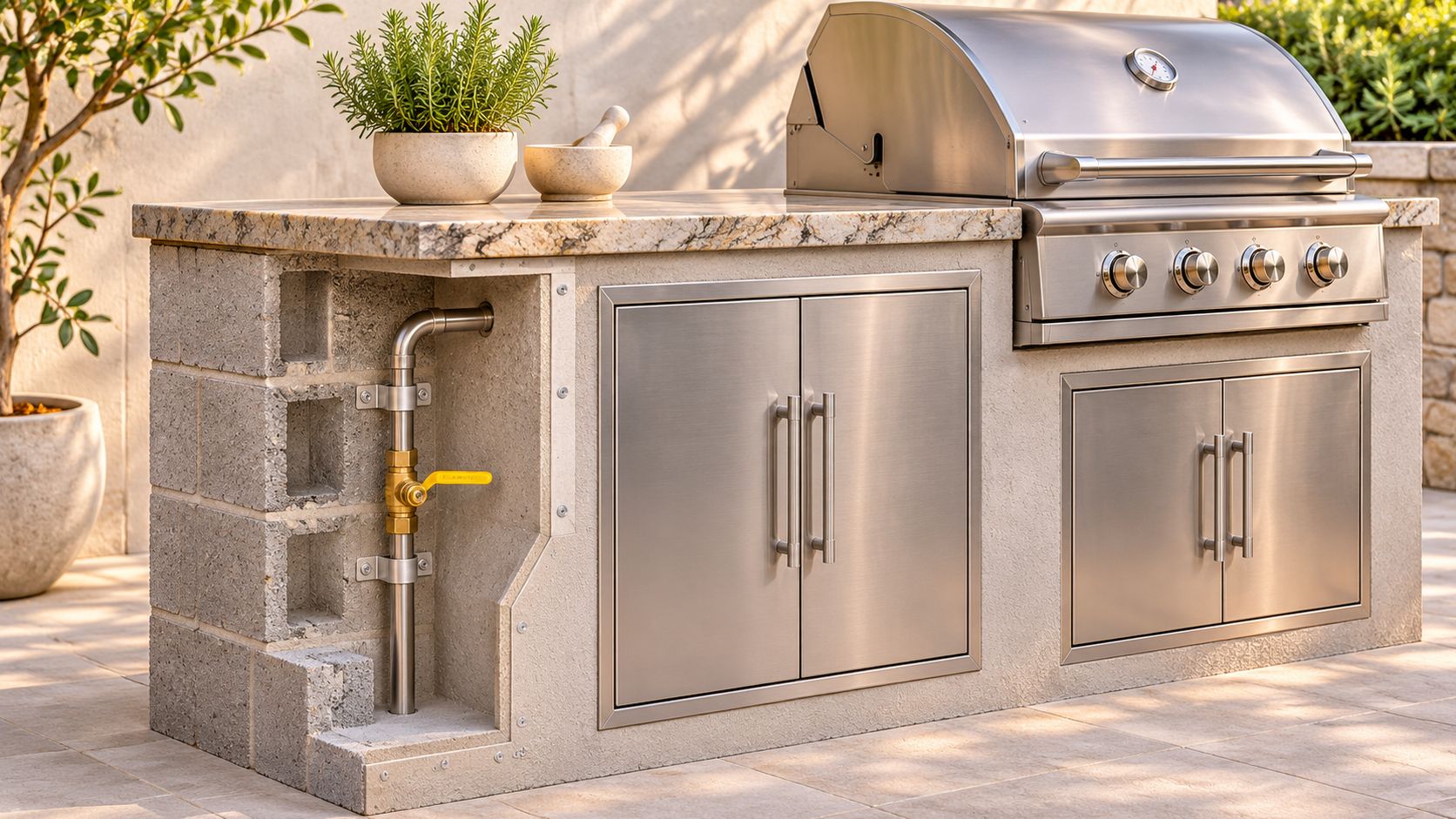
The wood problem doesn't go away with a good finish. Paint, stain and sealant protect against moisture, not against radiant heat from a grill body or a grease fire. Framing a grill surround in lumber and hiding it behind stone veneer puts fuel exactly where you least want it, and nobody sees the problem until the veneer cracks.
Embers change the details, not just the materials
Northern Arizona fire seasons add an exposure most material guides ignore. Ember-resistant detailing means choosing vents, trim and nearby finishes with embers in mind, and keeping dry leaves, debris and combustible decor out of the grill zone. A cabinet vent that draws air is also a cabinet vent that can collect fine fuel. Screen it, and clear it.
The utility rules are not optional
Gas and electrical work follows code, and the code decides layout. Natural gas systems follow NFPA 54, liquefied petroleum gas follows NFPA 58, and electrical installations follow the National Electrical Code, including GFCI protection and wet-location devices, per the same field guide. The International Code Council's guidance on outdoor kitchen code requirements adds a detail worth planning around: the International Residential Code requires a gas pipe to extend through the finished floor with at least 2 inches of unthreaded pipe exposed.
That two inches is why finish planning matters. Stone veneer and tile can bury a gas shutoff or an outlet that will need service later, so access panels and clearances have to be laid out before the finish goes on, not discovered afterward. Propane users should also browse propane safety recommendations before deciding where a cylinder or tank connection sits relative to the heat zone.
Three questions to ask any builder
Ask which assembly sits directly behind the grill and what it's made of. Ask who pulls the gas and electrical permits, and get a name. Ask where the access panels and shutoffs will be, and look at the drawing rather than the verbal answer. A builder who can answer all three without leaving the table has done this before.
Annual Upkeep That Keeps Materials Performing
Run this checklist each spring and again after the first hard freeze. Maintenance is part of durability here, not a separate chore, and fifteen minutes twice a year is what separates a ten-year finish from a five-year one.
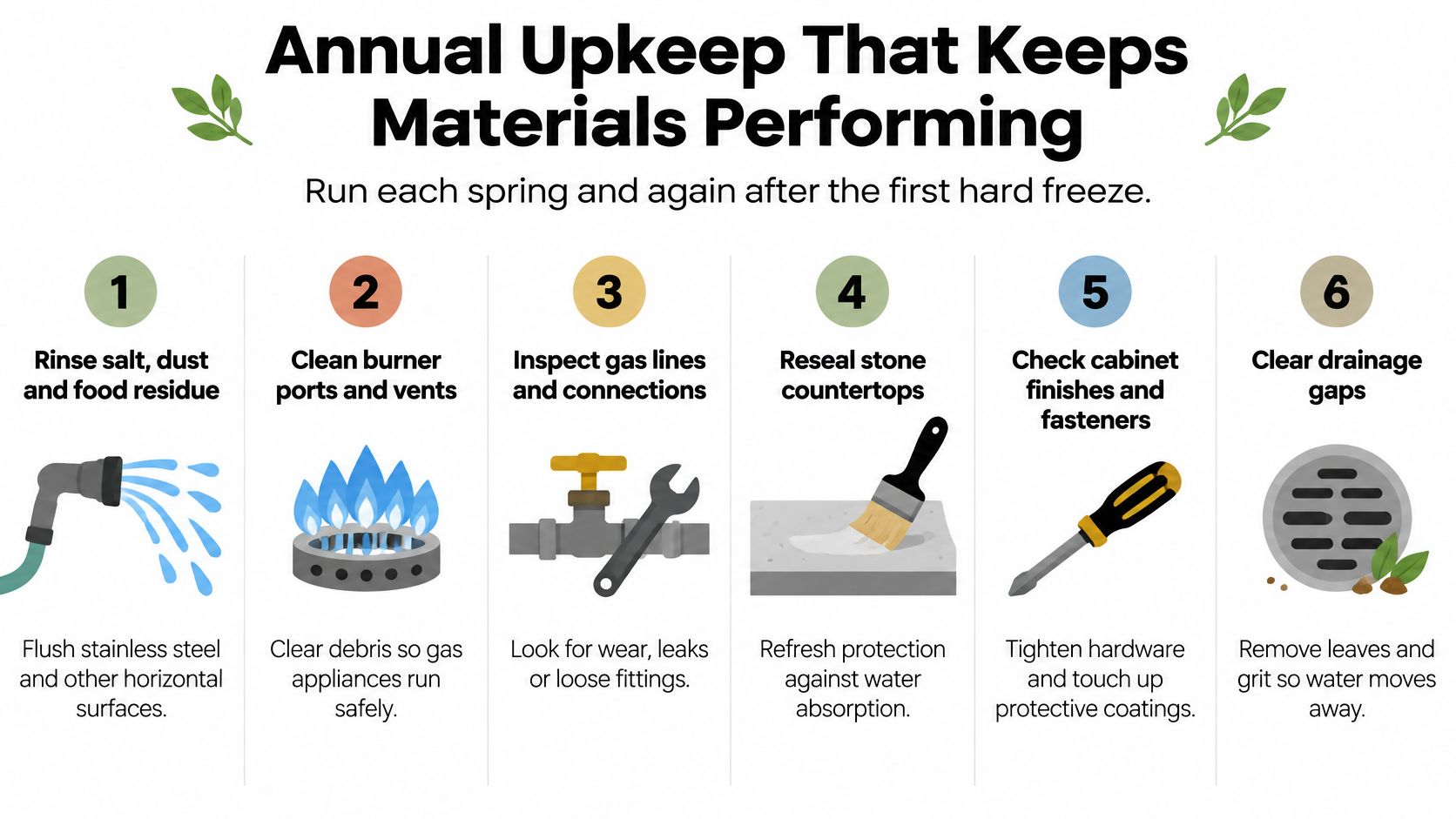
Rinse the horizontal surfaces. Flush stainless, stone and tile with fresh water to remove dust, salt and food residue before it settles into crevices.
Inspect sealant on stone and concrete. Reseal on the manufacturer's schedule, which varies by product and by how porous the slab is.
Check counter joints and edges for hairline cracks after freezing nights. Catch them while they're cosmetic.
Confirm patio drainage still moves water away from the cabinet base, especially where pavers have settled.
Look for chipped powder coat on frames and touch it up before rust starts. A chip the size of a coin becomes a rust bloom in one wet season.
Clear dry leaves and combustible debris from the grill zone and vents before fire season.
Check exposed fasteners and cover fit. Tighten what's loose and replace what's corroding.
Does stainless steel rust in Prescott
Properly selected 304 holds up well inland with regular rinsing, and 316 suits persistent salt exposure. When you do find a rust spot, it usually points to an embedded deposit or contamination from a carbon-steel tool rather than a failed alloy, so clean it and find the source.
How often should stone be sealed
Follow the product maker's schedule. Intervals differ widely by stone type and sealer chemistry, so the label on the sealer you bought is the only reliable answer. A simple water-bead test on an inconspicuous spot tells you when it's due.
Do outdoor kitchens need covers
Covers help with dust and sun, and they're worth using through the off-season. Use a breathable cover and let the kitchen dry before you put it on, because trapping moisture under a tight cover does more damage than the dust it keeps out.
Ten, Twenty and Thirty Year Costs by Material
The cheapest material at purchase is often not the cheapest by year 20. An industry materials guide from Grills.co puts 304-grade stainless steel as the standard for outdoor appliances with an estimated service life of 8 to 15 years, while full natural stone is listed at more than 50 years when properly installed.
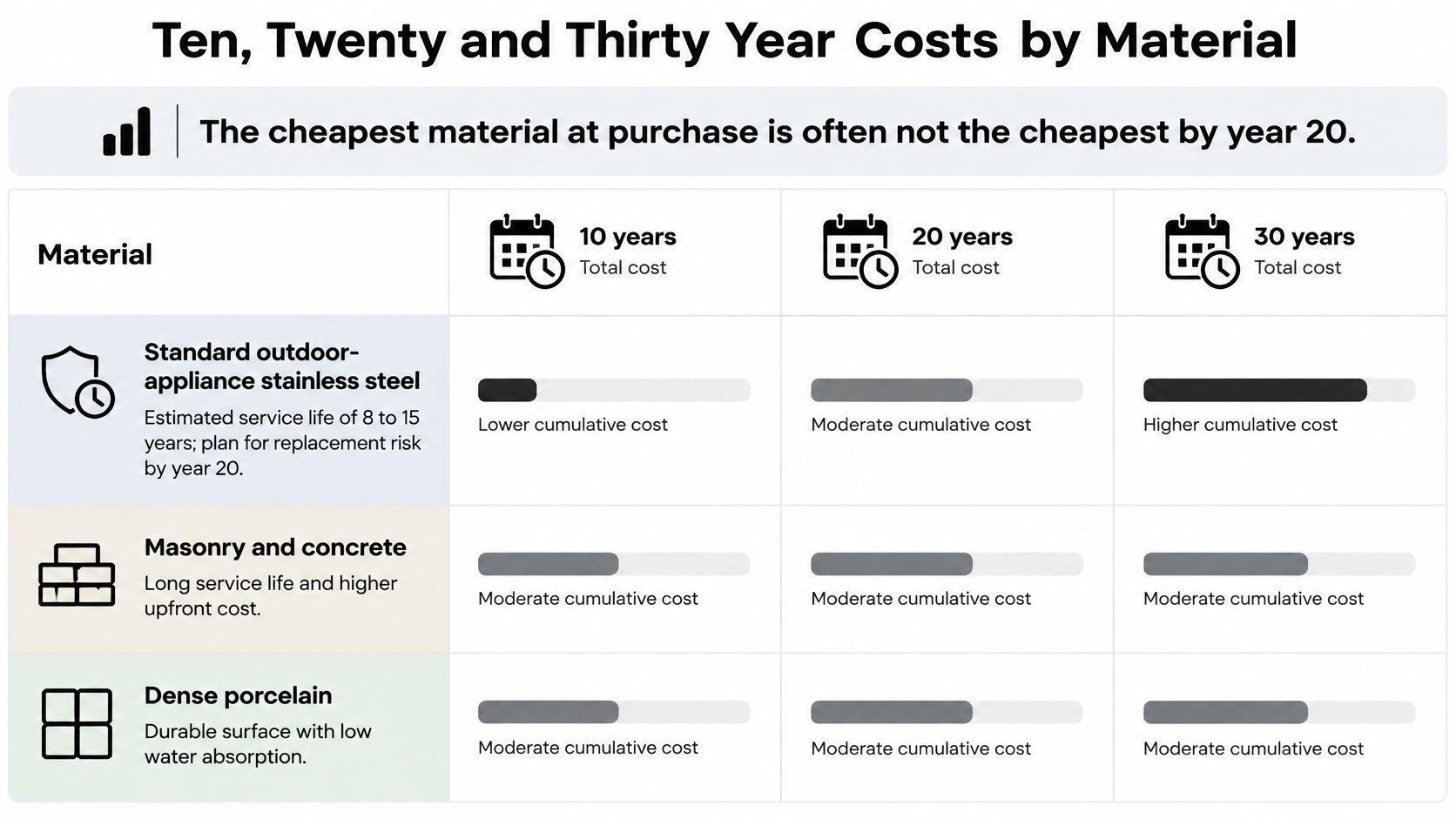
Material | Estimated service life | Ownership note |
|---|---|---|
Outdoor-appliance stainless steel (304) | 8 to 15 years | Plan for one replacement inside a 20-year ownership window |
Full natural stone | More than 50 years | Estimated when properly installed; heavier and needs deeper footings and sealing |
Galvanized steel cabinet frame | Roughly 10 to 20 years, depending on powder-coat condition | Inspect the coating annually and touch up chips before corrosion reaches the steel |
Exterior-rated porcelain countertop | Roughly 15 to 25 years with intact edges and joints | Get the maker's outdoor rating in writing before ordering |
The frame and porcelain figures above are working estimates, not guarantees. Prescott's UV exposure and freeze-thaw nights push materials toward the low end of any range, while shade cover and consistent upkeep push them the other way. Treat every service-life number as a planning tool for a well-drained, sheltered installation, and ask for product-specific ratings before you commit.
What each horizon actually contains
Ten years covers installation, cleaning, sealing and minor repairs. Most of the cost here is maintenance labor and sealer, plus a powder-coat touch-up or two.
Twenty years adds one replacement of appliances or a finish. The 8 to 15 year appliance estimate lands inside this window, and it's the cost most budgets miss.
Thirty years adds cover replacement, repeated resealing, and any surface that failed early. Painted or wood systems typically get replaced sooner, and mixed-material parts are harder to recycle locally, which is a real cost if disposal fees apply.
Buying for the lower lifetime number
Choose parts that can be swapped. Modular doors and replaceable appliance modules keep one failure from becoming a rebuild.
Pick finishes you'll maintain. A sealer you never reapply is worse than a surface that never needed one.
Ask for a written upkeep schedule with the quote. If it isn't in the document, it won't happen.
The arithmetic favors materials that survive this climate without constant intervention. Stone costs more upfront and rarely asks for anything beyond sealing. Stainless appliances cost less and reliably need replacing once in a long ownership window. Neither is wrong; the mistake is pricing only the install day. For a fuller picture of how the numbers stack up on a local project, our breakdown of outdoor kitchen installation cost walks through where the money goes.
Outdoor Kitchen Material Questions Answered
Can quartz countertops go outdoors in Prescott
Indoor-rated quartz is not recommended outdoors, because the resin can fade or yellow under direct sun even though the surface resists stains well inside a house. For any counter exposed to sun and freezing, choose exterior-rated porcelain or a dense, properly sealed stone.
Is wood ever safe in an outdoor kitchen
Not near heat. Wood framing behind or beside the grill is a fire risk regardless of the finish over it, so the cabinet base should use masonry, concrete masonry units, or galvanized steel studs covered with cement board. Wood is fine for a pergola or a decorative accent well away from the cooking zone.
Is natural stone worth its weight for a Northern Arizona patio
Natural stone carries the longest estimated service life of the counter options here, and it earns that estimate only when it's properly installed. It's heavy, so the structure and footings have to be designed for the load, and it needs periodic sealing. If you'd rather have lower-maintenance equipment on a shorter replacement cycle, outdoor-rated 304 stainless is the typical choice for appliances and cabinet bodies.
Bring Your Material List to a Prescott Consultation
The next step is concrete. Bring your component list from the materials table to a consultation with R.E. and Sons Landscaping, which designs and builds custom outdoor kitchens across Prescott, Prescott Valley, Chino Valley and the surrounding Northern Arizona communities. The consultation is free, and most builds run two to four weeks from start to finish depending on complexity, material lead times and permitting.
Come ready to confirm five things: the stainless grade for each part and the chloride exposure behind that choice, the countertop product with its written freeze-thaw and UV ratings, the cabinet assembly behind the grill, the drainage plan for patio and counters, and the sealing schedule for any stone. Ask who pulls the gas, plumbing and electrical permits, since permanent connections typically require them and the layout has to leave access to shutoffs and outlets. We handle that permitting as part of project management, and the crew covers foundation, framing, masonry, utility connections, appliances and finishing.
Request an itemized quote so each material choice is priced separately and can be compared side by side, then keep the component list with the project file so future resealing and part replacement follow the same specification. If you want to understand the build sequence before you sit down, our guide to how to build an outdoor kitchen covers it step by step. Call the office or book online to schedule a consultation for your site.
R.E. and Sons Landscaping builds custom outdoor kitchens across Prescott, Prescott Valley and Chino Valley, from the masonry base and gas rough-in to the countertop, cabinetry and appliance installation. We can take your component list and match each layer to the exposure it will face in your yard, rather than to a generic climate label. Visit R.E. and Sons Landscaping to schedule a free consultation and get an itemized quote for your project.
Comments