
River Rock vs Pea Gravel: Which Works in Northern Arizona
The most repeated advice about river rock vs pea gravel is that pea gravel drains faster, river rock looks better, so pick a favorite and cover the whole yard with it. That advice is why so many high-desert yards end up with pea gravel raked into the lawn after a monsoon and a downspout that still carves a trench every July.
Stone doesn't have one winner. It has zones, and the zones on a Prescott, Prescott Valley or Chino Valley lot behave nothing alike: a flat path behind the house, a slope at the property line above a neighbor's wall, a dry creek bed that only runs during the summer storms. R.E. and Sons Landscaping is a licensed, bonded and insured design-build company (ROC #300642) that plans rock and gravel zone by zone for homeowners across the Prescott area, and that's the work behind this guide. The core problem isn't choosing a favorite stone. It's getting water away from the foundation, keeping the path comfortable underfoot, and not reordering stone every spring.
Here's the premise that changes every answer: stone doesn't manage water, the base and grade under it do. A washed river rock laid flat over hard caliche can pond. Pea gravel on a modest slope, held inside good edging, can drain cleanly for years. Choose for the zone and most yards end up with both stones, which is exactly how our crews build them.
River Rock and Pea Gravel Side by Side
River rock is the larger, naturally rounded stone, and you choose it for visual weight and for staying put where water moves. Pea gravel is the smaller, uniformly rounded gravel, and you choose it for an even, walkable surface inside edging.
Our crews specify both in yard design and installation work, from paver patios and walkways to decorative rock and gravel, shade trees and drought-tolerant plants built for the high desert, and the conversation usually starts with what each part of the yard has to do rather than which stone looks better in a photo.
Both names are trade labels, not specifications. The U.S. Geological Survey classifies gravel as granular material predominantly retained on the No. 4 sieve, which has openings of 4.75 millimeters, and notes that major deposits form in river channels, terraces and mountain-flank settings where abrasion rounds the stone. That geology is why river rock usually shows more color and size variation than screened pea gravel, and why your supplier's actual dimensions, gradation and washed status matter more than the label on the bin.
Criteria | River rock | Pea gravel |
|---|---|---|
Typical size | 2 to 5 inches, rounded stones | About 3/8 inch, rounded and uniform |
Feel underfoot | Uneven and awkward to walk on | Comfortable for paths, patios and play areas |
Stability in moving water | Heavier per stone, resists displacement | Light stones wash out on grades and in concentrated flow |
Drainage role | Slows and spreads runoff at outlets, swales and dry creek beds | Permeable surface layer or filter layer above an underdrain |
Appearance | Mixed color and size, strong visual weight | Even, consistent, softer finish |
Maintenance | Occasional debris removal and re-leveling after storms | Raking, edge clean-up and top-ups in traffic zones |
Best uses | Downspouts, dry creek beds, borders and slope toes | Flat paths, play areas and decorative beds inside edging |
Cost | Higher price per ton, fewer yards needed | Lower price per ton, more yards over time through top-ups |
Fines and washed status | Ask for washed; dust and fines cut drainage | Washed pea gravel is typically clean, but confirm it |
Where it fails first | Very high flows bury it when the outlet is undersized | Edges and slopes where stones migrate |
Two rows deserve a plain-language translation. Feel underfoot and stability pull in opposite directions, so the stone that's nicer to walk on is the one that wanders, and the stone that holds its ground is the one you don't want to cross barefoot. Cost works the same way: pea gravel wins at the register and often loses over five years, because a thin edge and a low spot mean another half yard every spring.
The rule I give homeowners: buy the stone for the job it will do for the next decade, not the price on the scoop today.
Scan the rows that match your project first, then read the drainage and placement sections for the parts of your yard that collect water.
How River Rock and Pea Gravel Handle Water and Local Runoff
River rock is the better choice where water concentrates. Pea gravel is the better choice on flat, walkable ground. Neither one fixes a grading problem, and that is the sentence most comparison pages leave out. The difference sits in particle-size distribution and fines content, not in the name on the invoice.
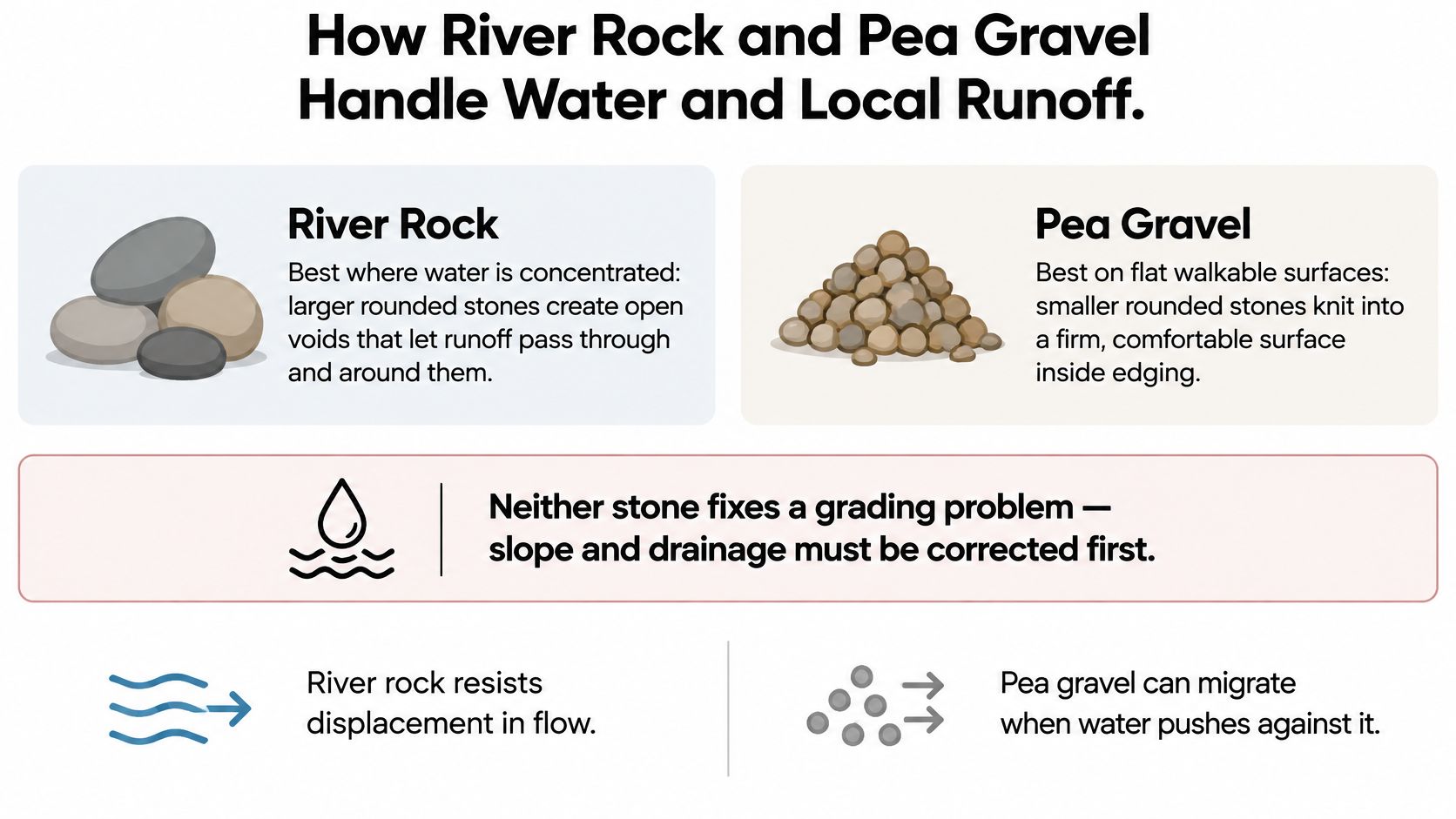
Washed pea gravel is uniformly graded. It carries high void content and high permeability but low interparticle stability, which makes it hard to compact and prone to migration under foot traffic or concentrated runoff. Permeability climbs as the coarse fraction rises and fines fall, and the FHWA gravel roads manual sets out specifications that commonly hold fines to about 6 to 10 percent where free drainage is required. Larger rounded river rock creates bigger flow passages and carries more mass per stone, so it resists casual displacement, though its round shape interlocks less than angular crushed stone.
What the layer under the stone does to runoff
What sits under the rock changes the result as much as the rock itself. The Mile High Flood District xeriscape runoff memo assigns uncompacted gravel and planting beds an estimated imperviousness of about 20 percent, while gravel in low-traffic areas is listed at 60 percent. Those figures come from a Colorado flood district's modeling, so read them as a warning rather than a prediction for your lot. Lay an impermeable sheet such as plastic weed barrier beneath either stone and infiltration drops further, which is how water ends up pooling where you never planned for it. Fabric keeps stone from sinking, and the wrong underlayment turns a permeable surface into a runoff source.
For a French drain or a foundation system, decorative stone is the wrong conversation entirely. One comparison of the two stones for drainage points to angular #57 crushed stone as the common standard, because it forms a stable, load-bearing drainage zone while rounded stones shift under pressure. The answer most homeowners haven't heard is that "river rock drains better" is incomplete, and a below-grade system wants a graded aggregate design.
Four checks before you order a single yard
Surface or subsurface. Is this water running across the surface, or is it a foundation and underdrain problem? Surface flow gets large river rock at the discharge point. Subsurface water gets a designed drainage system.
Grade. Walk the path water takes. If the low spot is uphill of the outlet, stone won't move it.
Washed and clean. Ask the supplier for washed material and the actual gradation. Dust and fines plug the voids you paid for.
Geotextile and edging. Both keep the stone where you put it, and both belong in the bid rather than in a later repair.
Monsoon flow is what tests a Prescott or Chino Valley slope, and it arrives fast enough to move small stone across a flat pad. On sloped lots where loose gravel fails first, R.E. and Sons Landscaping builds retaining walls with engineered block systems, geogrid reinforcement and drainage aggregate, so the finished grade holds before any decorative stone goes down. If water is already crossing a patio or pooling at a wall, start with landscape drainage installation and let the stone be the last decision. Slope stabilization beyond the rock itself is covered well in this guide on ways to stop soil erosion in your yard, which pairs grading and planting with the stone instead of leaning on the stone alone.
Practical rule: if water arrives faster than it leaves, no stone in the bin will help. Fix the outlet, then choose the rock.
Where Each Stone Belongs in Your Yard
Match the location first, then the size. Most stone failures trace back to placement: a pea gravel path survives for years, while the same bag dumped at a downspout outlet washes into the lawn after one hard storm.
Location | Stone | Size | Base or fabric |
|---|---|---|---|
Downspout outlet | River rock | 3 to 5 inches | Over fabric or aggregate base |
Dry creek bed or drainage swale | River rock | 2 to 4 inches | Geotextile beneath to limit soil migration |
Steep grade with concentrated flow | Large river rock | 3 to 5 inches | Fabric plus grade control |
Flat pedestrian path | Pea gravel | 3/8 to 1/2 inch | Compacted base, edging and geotextile |
Underdrain filter layer | Pea gravel | 3/8 inch | 3 to 4 inch layer separating soil above the underdrain |
Patio or play area border | Pea gravel within edging | 3/8 to 1/2 inch | Contained by edging |
The sizing logic comes from runoff research rather than preference. A University of Maryland rain-garden specification summarizes FHWA guidance naming gravel size, density and gradation as the principal properties governing flow resistance and erosion-control performance, with coarse gravel commonly spanning roughly 15 to 64 millimeters, or 0.6 to 2.5 inches. That same specification places 3 to 5 inch washed river rock at inlets, outlets and hardscape edges to dissipate runoff, and a 3 to 4 inch layer of pea gravel above an underdrain where the job is filtering soil rather than moving water. The stone stays 3/8 inch. The depth is what changes.
Translated into a two-material rule: large river rock goes everywhere runoff is concentrated, which means downspout outlets, swales, discharge points and steep grades. Pea gravel goes on flatter pedestrian and decorative areas where a tight, uniform surface matters more than hydraulic resistance.
Published garden guidance lands in the same range, placing 2 to 4 inch river rock in drainage channels and 3 to 5 inch material at downspout extensions when it sits over appropriate fabric or aggregate base, per this river rock ordering guide. The Phoenix green stormwater handbook treats gravel and crushed-stone pathways as permeable hardscape, and it tells designers to weigh slope, drainage patterns, utilities and nearby structures, then use rock placement or other grade controls to keep erosion down (Phoenix Green Stormwater Infrastructure Handbook).
Where I'd spend the money first: the downspout outlet and the steepest ten feet of the lot. Get those two right and the rest of the yard gets easier.
What the rock does is dissipate energy. It spreads and slows concentrated runoff before that water reaches bare soil, which is why a shallow rock apron beats a bare splash block every time. The limit matters too: very high flows can bury or move even large river rock, so grading and a properly sized outlet have to come with the stone rather than after it. Here is the test I would run before ordering anything. After the next hard rain, stand at the downspout and watch where the water goes for two minutes. If it crosses a path, hits a wall, or ponds within a few feet, the fix starts at the outlet location, and stone size comes second.
Maintenance, Shifting and Upkeep Over Time
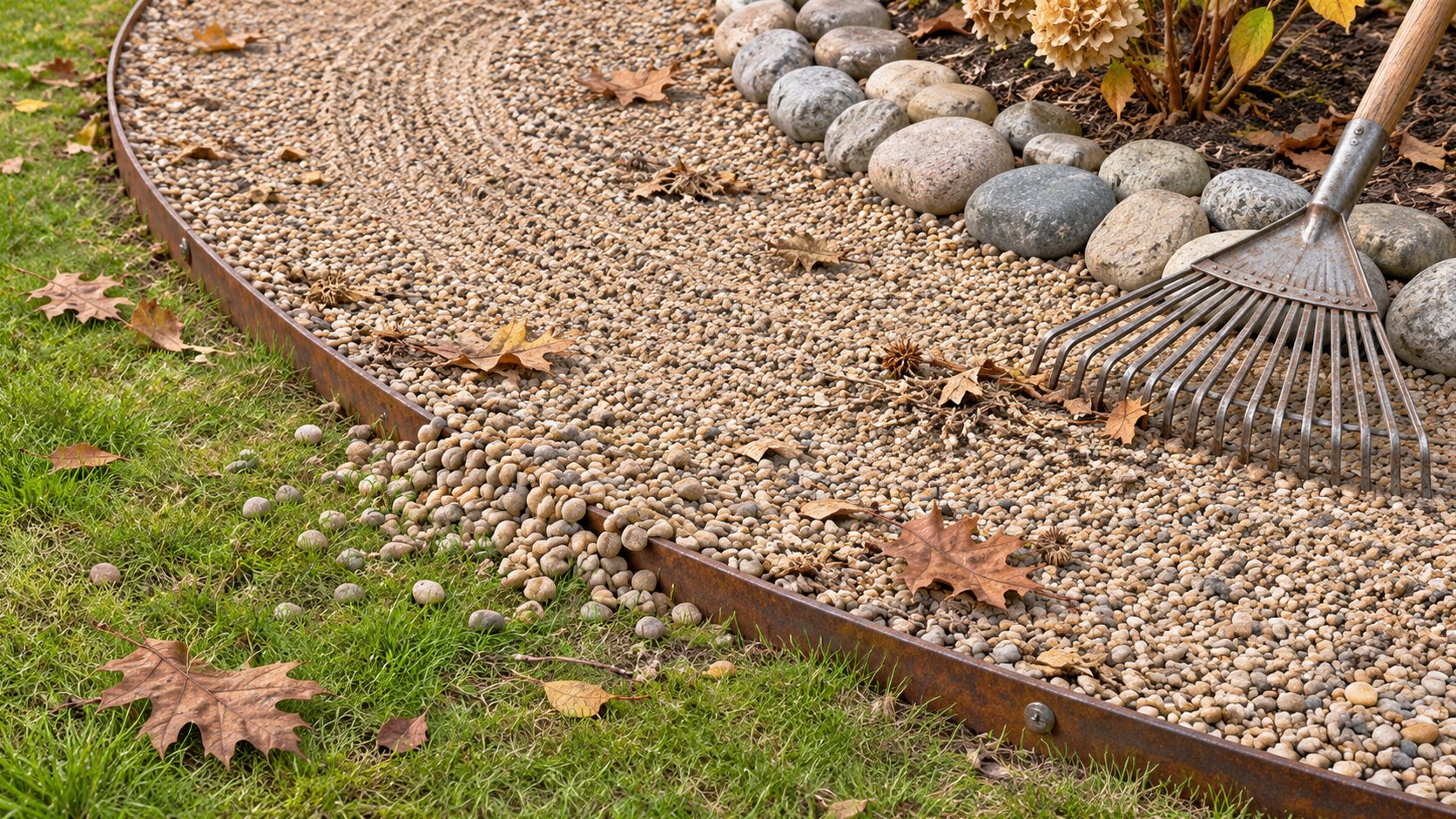
Edging does most of the maintenance work before you ever pick up a rake. Without it, no stone stays put.
Pea gravel earns its reputation as the comfortable surface, and that's about all it earns. It shifts in high-traffic areas, migrates against edges, collects leaves and organic debris, and needs raking plus periodic top-ups. River rock generally stays where it lands, but it makes an uneven walking surface, so it belongs at borders and drainage runs rather than on the path to the grill. Comfort and stability are different goals, and this pea gravel and river rock comparison frames the trade-off: the question isn't which stone wins, it's whether the area needs a walkable surface, a stable visual border, or runoff resistance.
Here's the routine I'd hand a homeowner, in order:
Rake pea gravel back into the bed each spring. Stone drifts to the edges and low spots all winter, and pulling it back costs nothing but an hour.
Check edging twice a year for gaps. Reset any section that has heaved or separated, because a two-inch gap drains a whole bed's worth of stone into the lawn.
Clear leaves and debris before they break down. Organic material turns into a silt layer that plugs the voids and grows weeds in the gravel.
Top up pea gravel to its original depth where it has thinned. Those thin spots are where the fabric shows through and the surface starts to fail.
Re-level river rock after runoff scatters it. A dry creek bed should read as a channel, and a scattered one reads as debris.
In Chino Valley and the colder Prescott-area yards, freeze-thaw cycles heave loose surfaces when the base is thin or poorly compacted, which is why our base prep is built to withstand those cycles rather than just to look finished on handover day. Thin base, weak edge, and stone on top is the combination that fails in February.
If you'd rather not rake and top up, our maintenance department handles ongoing care after installation, and the steps for setting stone correctly in the first place are laid out in this guide on how to install landscape rock. Stone is low maintenance, not no maintenance. Budget a couple of hours in spring and one pass after monsoon season, and either material will outlast the mulch you replaced.
Combining Both Stones With Patios and Turf
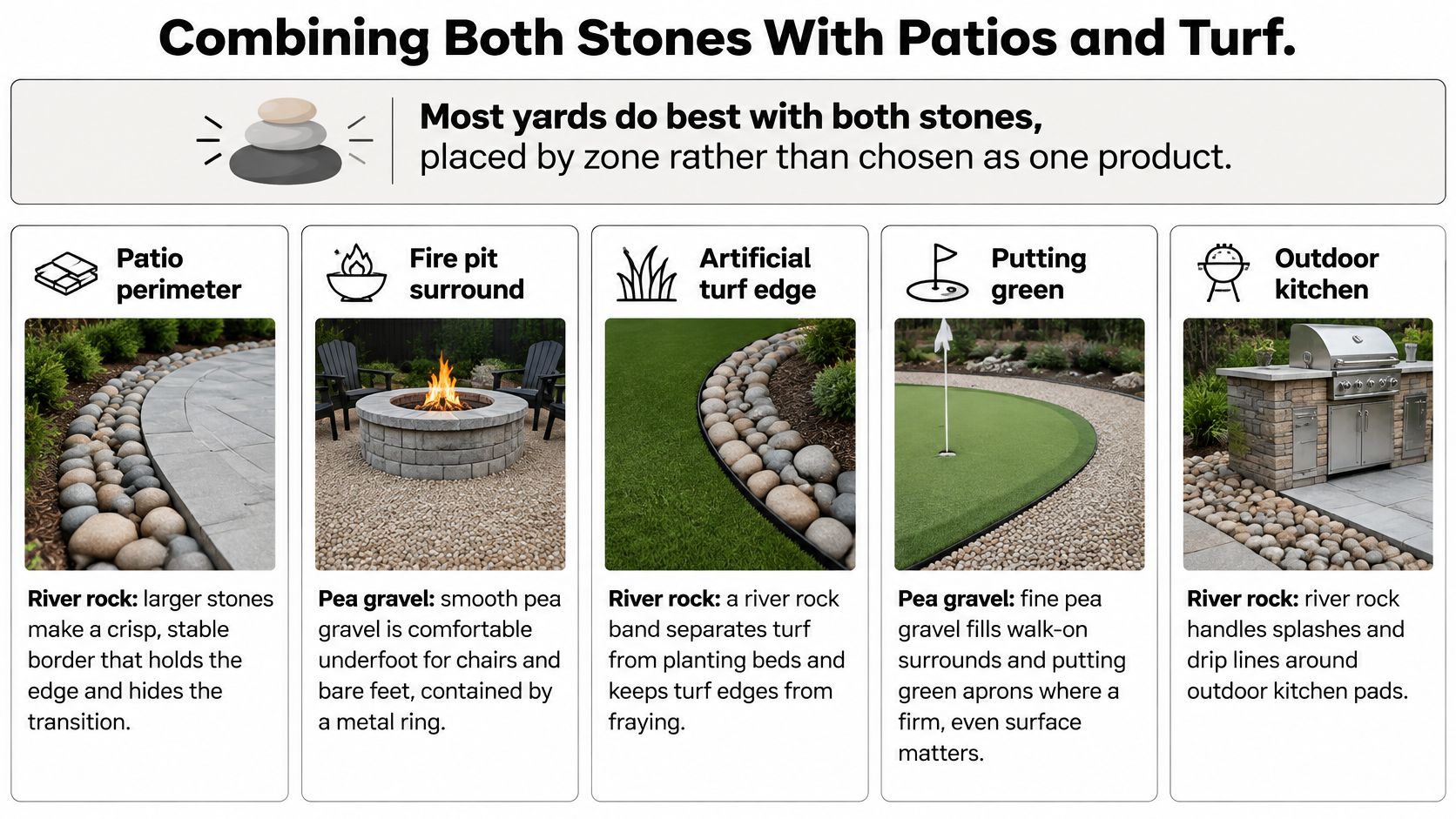
Most yards do best with both stones, placed by zone instead of chosen as one product. The places where loose aggregate causes trouble are almost always transitions: beside a patio slab, along artificial turf, around a fire pit ring, at the edge of a putting green apron. Stone migrates into joints and onto turf because nothing is holding it, not because it's the wrong stone.
Here's the zoning method, in the order I'd walk a property:
Map where roof and driveway water collects. Follow the drip line and the driveway fall before you look at a single stone sample.
Mark the high-traffic zones. Where people walk barefoot, set chairs, or send the dog out after dark.
Set edging around every pea gravel zone. Steel, concrete curb or block, tall enough to hold the installed depth.
Place larger river rock at transitions, outlets and slopes. Anywhere runoff gathers or the grade changes.
Keep a clean border between the two stones. A strip of edging or a row of larger rock stops the small stones from working their way into the coarse ones.
Our design step develops a layout that fits the yard's grade, uses natural stone placement and integrates with existing hardscape, so the stone plan gets drawn alongside the patio or pond edge instead of being ordered after everything else is finished. That sequencing is the difference between a border that reads as intentional and one that reads as leftover material.
A concrete example from the kind of yard that works: a pea gravel path runs from the back door to a paver patio, both inside steel edging. At the downspout that discharges beside the patio, a river rock swale takes the roof water and carries it toward the garden, and a band of 3 to 4 inch rock separates the turf edge from the planting bed so the turf doesn't fray. Same yard, two stones, no mixing.
Where the detail gets decided: put a sample board of both stones against the patio and the turf before ordering. Sun angle changes both more than photos do.
Once the hardscape is in, the follow-up work shifts to the pavers, and this paver care guide for local homeowners covers the cleaning routine that keeps the border looking sharp. For the patio-and-stone pairing specifically, our notes on pavers and river rock show how the two edges meet.
What Each Stone Costs and Which to Order
River rock where water concentrates and for visual borders, pea gravel for an even walkable surface inside edging, a combined layout for most mixed-use yards.
That's the short version, and the cost conversation is where bids diverge most. Price depends on stone type and size, washed versus unwashed, volume in cubic yards, delivery distance to a Prescott or Chino Valley address, base preparation, fabric, edging and labor. Small loads often carry a minimum charge, which is how a lower price per ton still costs more over time once top-ups and extra yards are counted.
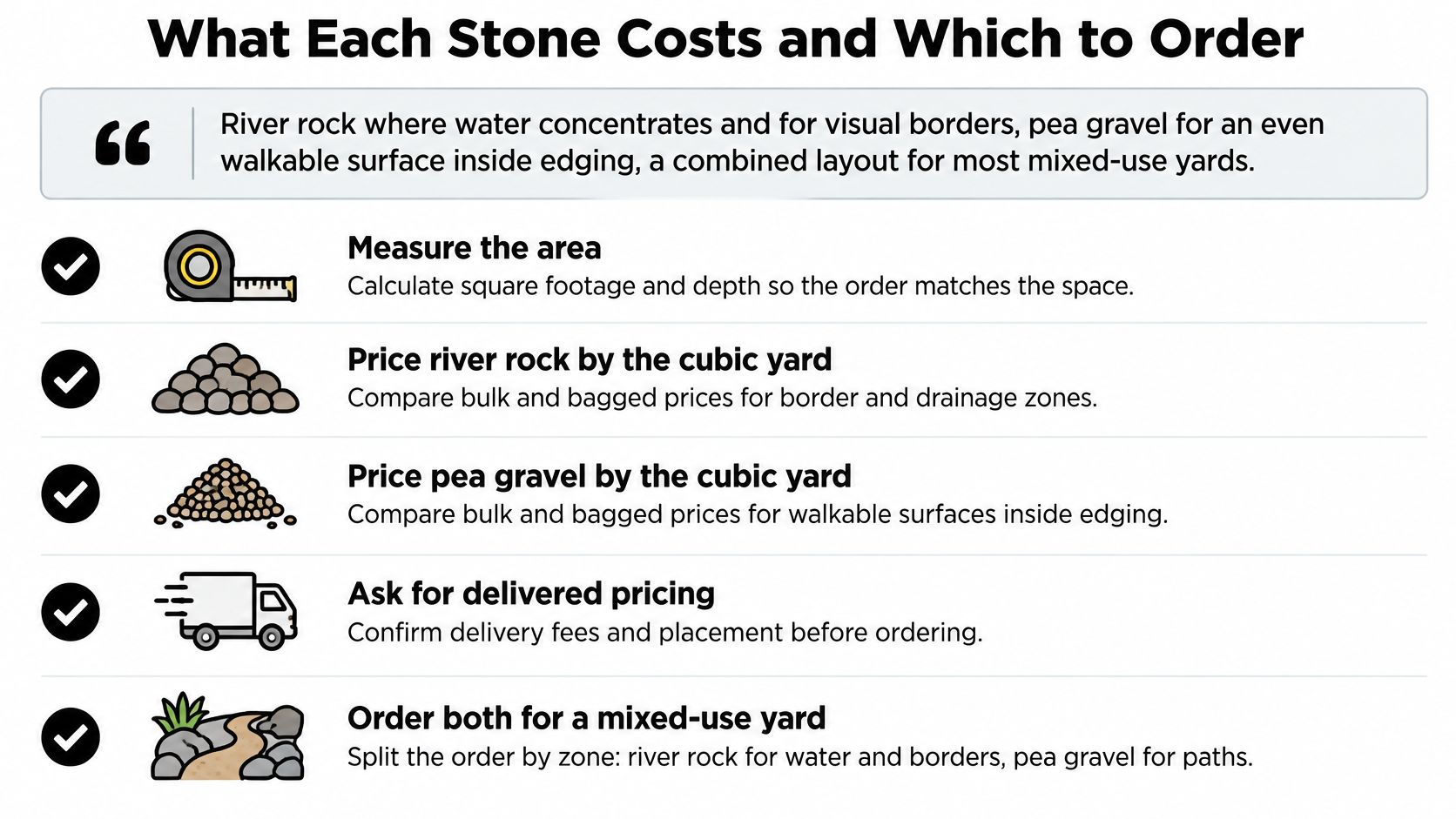
Compare two quotes on one specification, not on one lump total. Ask each bidder to list actual size and gradation, washed status, delivered yards, base, fabric, edging, delivery and installation as separate lines. A quote that says "river rock, 12 yards, installed" tells you nothing about whether the base was compacted, whether fabric is included, or whether the stone is washed. When those lines are separate, the cheaper quote usually stops being cheaper.
The pre-order checklist I'd take to the supplier:
Note any slope steeper than its surroundings. Say the grade out loud so the yardage and size reflect it.
Locate every downspout and driveway drain. Count them, then decide which ones get river rock.
Count how many people and pets cross the area daily. High traffic pushes you toward edging and a larger stone at the perimeter.
Confirm edging type and height. The stone depth should be held by the edge, not piled against it.
Ask the supplier for real size and washed status. Get it in writing on the ticket.
Request delivered volume with base and fabric priced separately. That's the only way to compare bids.
When you're ready to compare a plan rather than a price, we offer a free, no-obligation consultation. We work through four steps with customers, Consultation, Design, Transformation and Enjoy, and for a stone plan that means walking the grade, checking where water leaves the roof and driveway, then specifying each zone before a yard is delivered. The office is open Monday to Friday, 8am to 4pm, and consultations can be booked online or by phone.
Questions Homeowners Ask About River Rock and Pea Gravel
How much stone do I need for my yard
Measure length times width for square feet, multiply that by the depth in feet, then divide by 27 for cubic yards. Add about 10 percent extra for settling and touch-ups, and remember that decorative beds commonly run 2 to 3 inches deep while a drainage run needs more. Bring the square footage and the intended depth to the yard and let them check your math.
Does river rock get hot in Arizona sun
Yes, and darker stone is the bigger offender because it absorbs and then radiates heat back at ankle height. Lighter-colored stone runs cooler, so keep the darkest material away from pet paths, barefoot routes and the seating edge of a patio. If a dark stone is the look you want, use it in borders and view lines rather than where people walk.
Can I mix pea gravel and river rock in one bed
Yes when edging separates them, and no when they're blended loose in the same bed. Mixed together, water sorts the smaller stones downslope over a season or two, so you end up with a coarse top and a pea gravel band at the low edge. Keep each zone contained and the contrast stays deliberate.
Is pea gravel safe for dogs
Small rounded stones can be chewed or swallowed, so treat pea gravel as a supervised surface for paths and contained play areas rather than an open dog run. In an active run, larger river rock is the safer choice because it's harder to pick up. Either way, keep the area raked so debris doesn't build up where pets nose around.
A stone plan built by zone is the difference between a yard that drains and one that gets re-graveled every spring. R.E. and Sons Landscaping designs and installs river rock, pea gravel and the base, fabric and edging that make each of them work, for homeowners in Prescott, Prescott Valley, Chino Valley and the surrounding Northern Arizona communities. The team offers a free, no-obligation consultation and can walk your grade, watch where the water goes, and specify the right stone for each part of the yard. Visit R.E. and Sons Landscaping to book a consultation online or by phone.
Comments