
Water Feature for Front Yard: Options, Water Use and Rules
Water loss, footprint and upkeep decide whether a front yard feature works in Northern Arizona. A fountain can look sharp on day one and still be a poor fit if it sits in full sun, eats space near the walkway, or needs more attention than the household wants to give it. In Prescott's dry climate, the water-use decision comes before the style decision.
R.E. and Sons Landscaping builds custom fountains and water features for homeowners in Prescott, Prescott Valley, Chino Valley and nearby Northern Arizona communities. A practical front yard design recirculates water, fits the entry area and stays within local conservation rules. That means choosing the feature size, water surface and surrounding planting before rock color or finish details.
The best front yard water feature is usually the smallest one that finishes the entry and that the homeowner will keep running. A bubbling boulder or small pondless waterfall can work in tight yard spaces. Larger open basins and ponds create more visible water, more evaporation and more routine work. Grade, access and existing hardscape also shape the design, especially where a feature has to fit beside a walkway, patio, pond or pool.
Front Yard Water Feature Options Compared
Six feature types cover nearly every front yard in Northern Arizona, and they differ far more in water loss, footprint and upkeep than they do in looks. The table sorts them by those three pressures, because those are what decide whether you're still running the thing in three years.
Feature | Footprint | Open water surface | Water loss risk | Best fit |
|---|---|---|---|---|
Bubbling boulder fountain | Small, fits tight spaces | Minimal, recirculating | Low | Entryways and narrow side yards |
Pondless waterfall | Small to medium | None, hidden reservoir | Low | Front yards wanting moving water without an open pond |
Small sealed bubbler or wall spillway | Compact | Minimal | Low | Shaded walls and tight planting beds |
Recirculating fountain basin | Compact to medium | Visible basin | Moderate, depends on shade and wind | Focal point beside a walkway |
Open pond with waterfall | Medium to large | Large open surface | Highest, from evaporation and refill | Larger yards with a maintenance plan |
Stream or rock waterfall | Medium to large | Shallow moving water along the full run, plus any pooling spots | Moderate | Yards with a sloped grade |
What each option actually asks of you
Bubbling boulder fountain: A drilled boulder over a buried basin gives you sound and movement in a footprint small enough for a narrow entry strip or side yard. Materials for a simple one typically start in the mid-hundreds of dollars, with the total installed cost depending on the specific design.
Pondless waterfall: Water recirculates through a hidden underground reservoir, so there's no open pond to skim, treat or refill on a schedule. You get the sound of a waterfall with the water exposure of a closed system.
Small sealed bubbler or wall spillway: Keeping the water compact and against a shaded wall cuts the exposed surface that sun and wind work on.
Recirculating fountain basin: You get a visible sheet of water as a walkway focal point, and your losses track directly with how much afternoon sun and wind that spot gets.
Open pond with waterfall: This carries the heaviest evaporation and refill load of anything on the list, and it only makes sense if you've committed to the maintenance.
Stream or rock waterfall: A sloped front yard is an asset here, because a stream can be laid out to follow the existing grade instead of fighting it. Every foot of channel is exposed surface, though, so a longer run means more loss than the sound alone would suggest.
Stone choice matters more than people expect on the compact options. A boulder's drill hole, cap shape and surface texture decide whether water sheets down the face or spits sideways onto the walkway, and our guide to water feature rocks and stone selection walks through what to look for before you buy.
Practical rule: treat open water surface as the real price tag. The bigger the exposed surface, the more water, treatment and attention the feature asks for every week it's running, so match the surface area to the upkeep you'll actually do.
R.E. and Sons Landscaping builds each of these across Prescott, Prescott Valley, Chino Valley and the wider Northern Arizona region, and most residential installs are completed in two to five days depending on size and site conditions. If two options look equal on paper, the deciding factor is almost always which one loses less water in your yard's specific sun and wind exposure.
Scale and Placement in Your Front Yard
Scale isn't a single measurement. It's a relationship: the feature should read as a finished accent beside the entry, not a second focal point competing with the front door or the roofline.

Three checks you can do from the curb
Stand at the street. Note what your eye lands on first. If it's the fountain instead of the front door, the feature is too big or too central.
Stand at the front door. The water should sit in a natural sightline from where you greet people, without pushing anyone off the walk.
Measure against the walkway. Leave enough clearance that a guest carrying packages, or a kid stepping backward, can't put a foot into an open basin.
Grade decides the form. A flat pad next to the entry wants a level basin or boulder; a yard that falls toward the street can carry a stream or a stepped rock waterfall that uses the slope instead of hiding it. Sun and wind decide the operating cost, so a corner sheltered by a wall or shaded through the afternoon will hold water far better than an exposed strip near the driveway. Power is the constraint people forget: the pump needs a reachable, code-compliant GFCI-protected circuit installed by a qualified electrician, not an extension cord run through a planting bed.
We build water features in yards of almost any size, and many projects fold a waterfall into an existing patio, pool or pond, so the assessment starts with the structure, grade and access already on site. Say a Prescott bungalow has a narrow entry walk with a small planting bed on one side. A compact boulder fountain beside that walk reads well from the street and takes almost no room, while a pond in the same spot would crowd the path and force guests to edge around it.
Here's a walkthrough of how placement and proportion play out in a real front yard layout.
Before you commit to a spot, confirm six things: sightline from the street, clearance from the walk, afternoon sun exposure, prevailing wind, power within reach, and access for cleaning the pump.
How Much Water a Front Yard Feature Uses
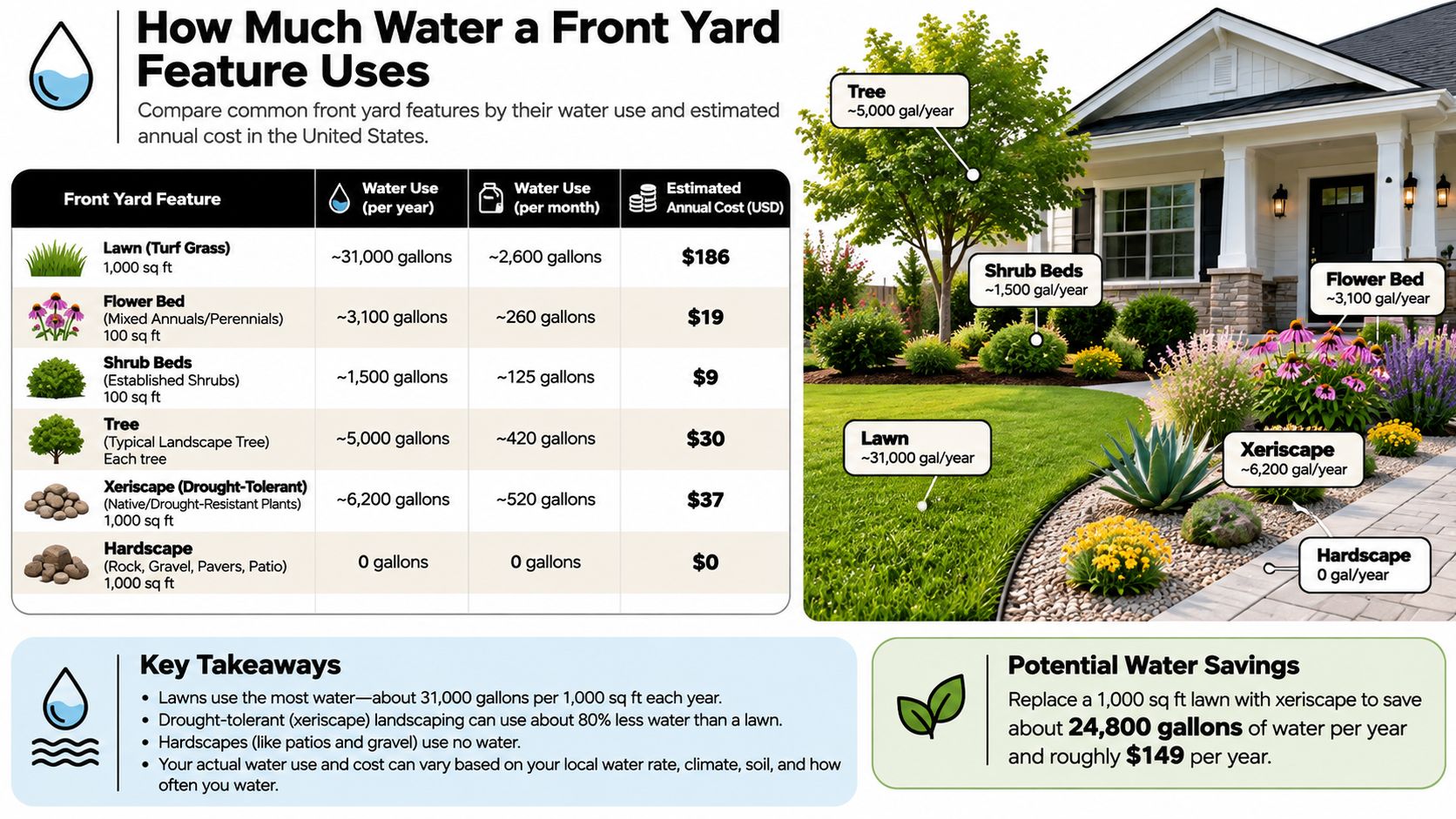
Outdoor water is the big number in a dry climate, not the fountain. The U.S. Environmental Protection Agency's WaterSense outdoor guidance reports that residential outdoor water use totals nearly 8 billion gallons per day nationwide, with yard irrigation as the primary use, and that outdoor use accounts for more than 30% of household water consumption on average, rising to approximately 60% in arid regions. EPA also estimates that as much as 50% of outdoor water can be lost through evaporation, wind, runoff and inefficient irrigation systems.
Judge the feature by its losses, not its surface
A decorative pond or fountain isn't evaluated by how much water you can see. What decides its long-term footprint is evaporation exposure, splash loss, pump efficiency, automatic filling, leak prevention and the irrigation demand of the plants around it. Each of those translates into a decision you can make at design time:
Evaporation exposure: Put the basin where a wall, fence or tree canopy blocks afternoon sun and prevailing wind rather than in the hottest corner of the yard.
Splash loss: Lower the drop height and keep the spill inside the basin lip. Water landing on pavers is water you replace.
Pump efficiency and run time: A pump matched to the lift and pipe run moves the same water with less heat and less strain than an oversized one throttled back.
Automatic filling: Use a discreet autofill or a clearly defined manual fill point, with backflow protection where local code requires it, so topping up never becomes a hose left running.
A closed-loop recirculating system is the foundation. The water goes around instead of being continuously replaced with potable water, and the reservoir is sized to keep the pump submerged through normal evaporation between top-ups. Put a debris screen or pre-filter at the intake, slope basin surfaces toward a cleanout, and use UV-resistant liner and fittings, because intense Northern Arizona sun, wind and low humidity accelerate both evaporation and material failure.
Pressure-test the liner before anything covers it. Fill the basin, mark the level, and let it sit with the pump off so you can tell a leak from evaporation.
None of this makes a feature water-free. It makes the difference between a basin you top up on a predictable schedule and one you refill by hose every week, which is where outdoor water budgets can blow up.
Planting Around the Feature to Cut Water Use
A water feature doesn't save water by itself. What surrounds it usually decides whether your total outdoor use goes up or down.
EPA's WaterSense turfgrass report found that turf-dominated yards used 54% more water than yards dominated by water-conserving trees, plants and shrubs, and that 81% of the variation in total outdoor water use was explained by the amount of turfgrass at a site. The same report cites regional benchmarks putting outdoor use at about 60% of residential water use in Phoenix and 70% in Las Vegas.
Read that as a design instruction. A compact recirculating fountain set in gravel or decomposed granite, framed by native or adapted shrubs and shade-tolerant groundcovers with minimal lawn, adds interest without adding irrigated turf. The same fountain dropped into the middle of a new grass panel does the opposite: you've now paid for the water in the basin and the water to keep the lawn around it green.
Three moves make the planting work for the feature instead of against it:
Keep turf to walkable areas only. If nobody walks, plays or picnics on it, it doesn't need to be grass.
Group plants by water need. Put the lowest-demand zone closest to the basin, where splash and humidity already help, and keep thirstier plants in their own separate zone.
Keep irrigation out of the splash zone. Aim drip lines and sprinkler heads away from the basin so you're not spraying irrigation water into water you already paid for, and so overspray doesn't feed algae on the surrounding stone.
For plant palettes that hold up here, our list of drought-resistant plants for Northern Arizona yards is a good starting point for the beds around an entry feature.
Then apply one test to the whole design: if you removed the feature tomorrow, would the rest of the yard still need the same irrigation? If the answer is yes, the planting plan is doing its job.
Mosquito Control and Routine Upkeep
Will a front yard water feature attract mosquitoes? A moving one is the lower-risk choice; a stagnant or poorly maintained one is not. The water itself isn't the problem, the stillness is.
EPA's mosquito control guidance states that fountains can deter mosquito breeding when aerators agitate the water, but the equipment must be checked regularly to confirm it's still operating, and CDC guidance recommends installing a pump to circulate water when standing water in a fountain or pond can't be drained. Larvae develop in calm water. Surface agitation breaks up the still conditions adults look for when laying eggs and improves oxygen exchange at the same time.
Where a decorative feature turns into a breeding site
The failures are mechanical, not mysterious. A power outage stops the pump and nobody notices for a week. A clogged intake starves the pump until it barely moves water. Evaporation drops the level until shallow edges go quiet. An abandoned basin, left full after a move or a season of disuse, is the worst case of all. Recessed shelves and dead pockets behind boulders hold still water even while the main basin circulates, so avoid them in the layout, and clear out nearby pots, buckets and tarps that collect rain. The Pestless guide to mosquito breeding grounds is a useful companion read for spotting the small standing-water sources around a yard that people overlook.
The routine to follow
Basic water feature maintenance comes down to checking water levels, keeping the pump clear of debris, and periodically cleaning the filtration system. Our water feature maintenance guide covers the routine in more detail, and this is the schedule we hand over at the final walkthrough.
Task | How often | Why it matters |
|---|---|---|
Confirm the pump runs and the surface visibly moves | Weekly | Still water is where mosquito larvae develop |
Check the water level and top up as needed | Weekly | Low water makes pumps run dry and exposes shallow edges |
Remove leaves, sediment and algae from the basin | Weekly, and after storms | Debris clogs the pump and feeds breeding sites |
Clean the intake screen and filtration system | Periodically, per the equipment guidance | Prevents clogging and pump failure |
Check the pump and water after any power outage | After each outage | Stops an idle basin from going stagnant unnoticed |
Shut down or drain a seasonal feature properly | Before the off-season | Stops a dormant basin from holding standing water |
A weekly walk-around takes two minutes: listen for the pump, look for visible surface movement, glance at the water level. If any of the three is off, fix it that day.
Prescott Rules That Shape Your Design
The rule that most often kills a design concept is the simplest one: Prescott's water conservation code prohibits spray-type fountains except small decorative types, and it allows additional restrictions on ornamental fountains during declared water shortages. If your inspiration photo shows a tall jet spraying into the air, that concept needs to change before you spend money on it.
The same code expects ornamental fountains, ponds and similar installations to run on recirculating pumps rather than continuously replacing water, and it limits outdoor watering to the hours between 8 p.m. and 8 a.m. from April 15 through November 1 under Prescott City Code 3-10-14. Any irrigation around the feature has to be timed inside that window, which shapes the planting plan as much as the feature itself.
Rule | What it requires | What it means for your design |
|---|---|---|
Ornamental fountains and ponds | Recirculating pumps, not continuous replacement | Design a closed loop with a sealed reservoir |
Spray-type fountains | Prohibited except small decorative types | Choose a bubbler or low-spray design |
Outdoor watering window | 8 p.m. to 8 a.m., April 15 to November 1 | Time surrounding irrigation inside this window |
Water shortage declarations | Extra restrictions can apply to ornamental fountains | Plan a feature you can drain or shut off on short notice |
A pondless waterfall or bubbling boulder fits these rules naturally. Both recirculate through a hidden underground reservoir, both lose little water to wind because nothing sprays, and both can be shut down fast if a shortage declaration tightens restrictions. A tall spray jet fails on all three counts.
Arizona guidance adds that moving-water features should prevent leakage and be designed for conservation in an arid climate. Treat that as a performance standard. Practically, it means a leak-tested basin, a pump you can reach without dismantling rockwork, and a shutoff you can get to quickly.
Before installation, settle seven items: water source, evaporation and refill plan, leak testing, electrical requirements, drainage, permits and HOA review. We use these local requirements when planning water movement, pump placement and nearby planting for homeowners in Prescott and surrounding Northern Arizona communities, so the design that gets approved is the design that gets built.
Front Yard Water Feature Questions and Next Steps
Does a front yard water feature need a fence?
Sometimes, and the dimensions decide it. Under Arizona's residential pool safety notice, a swimming pool or other contained body of water that is at least 18 inches deep at any point and wider than 8 feet at any point, when intended for swimming, must have an enclosure at least 5 feet high that prevents passage of a 4-inch-diameter sphere, has no climbable openings or exterior footholds, and stands at least 20 inches from the water's edge. Local jurisdictions apply their own codes, so confirm depth, width, intended use and location with the applicable Prescott-area authority before construction, not after.
That one phone call can save a redesign. A shallow pondless reservoir and a deep open pond sit in entirely different regulatory positions, and the difference is measured in inches.
How long does installation take?
Most residential water features are completed in two to five days, depending on size and site conditions. A boulder fountain on an accessible flat pad sits at the short end. A stream on a slope, with rockwork, grading and an electrical run, sits at the long end.
What does a front yard water feature cost?
Water feature pricing varies based on size, type and complexity, so the honest next step is a written quote tied to an approved design rather than a number pulled off a page. A custom waterfall scope includes basin and reservoir construction, rockwork and boulder placement, site excavation and grading, full consultation and custom design, plumbing and electrical rough-in, pump, filtration and lighting installation, and a final walkthrough and system orientation. Ask for that scope line by line so you can compare bids on the same work. A simple bubbling boulder or pondless waterfall typically starts in the mid-hundreds of dollars for materials, and the total installed cost depends on the specific design.
Six steps to get from idea to running water
Pick the type that matches your yard size and your tolerance for an open basin.
Mark the location against sightlines, walkway clearance, sun, wind and power.
Check Prescott rules and barrier thresholds for the specific dimensions you've drawn.
Map the water source, refill plan and irrigation timing so nothing sprays outside the permitted window.
Confirm HOA review and permits before any excavation.
Book the consultation with a design that already answers the first five.
R.E. and Sons is a licensed, bonded and insured design-build team serving Prescott, Prescott Valley and Northern Arizona. We offer complimentary outdoor design and work through a four-step process: consultation, design approval, transformation and enjoyment. Consultations can be scheduled online or by phone, Monday through Friday, 8 a.m. to 4 p.m.
If you want moving water at your entry without a refill habit you'll resent by August, start with a design that solves evaporation, planting and Prescott's code first. R.E. and Sons builds custom waterfalls, bubbling boulders and pondless features for Prescott-area front yards, with complimentary garden design and a walkthrough that shows you exactly how to run and maintain the system. Visit R.E. and Sons Landscaping to book your consultation and get a written scope for the feature that fits your entry.
Comments