
Water Feature Rocks: 7 Top Stone Choices Compared
Which rocks work best in a Prescott water feature, and will the stone that looks good dry still perform when it's wet, frozen, or exposed to high-desert sun? The best water feature rocks are river rock, granite boulders, flagstone, lava rock, slate, travertine, and Mexican beach pebble, each suited to a different feature style and job.
R.E. and Sons Landscaping is the licensed design-build team, Arizona ROC #300642, helping homeowners in Prescott, Prescott Valley, Chino Valley, and across Northern Arizona choose and install stone for ponds, pondless waterfalls, fountains, and water walls. The practical challenge is matching the appearance you want with stable construction, manageable cleaning, and stone that suits repeated wetting and winter freezing.
Stone choice affects stability, water sound, liner concealment, and whether the feature belongs in its surroundings. Color alone won't tell you how it will perform.
Think about the adjoining patio, too. As you explore outdoor entertaining layouts, leave room to walk around the feature and reach its pump without dismantling the rockwork.
1. River Rock
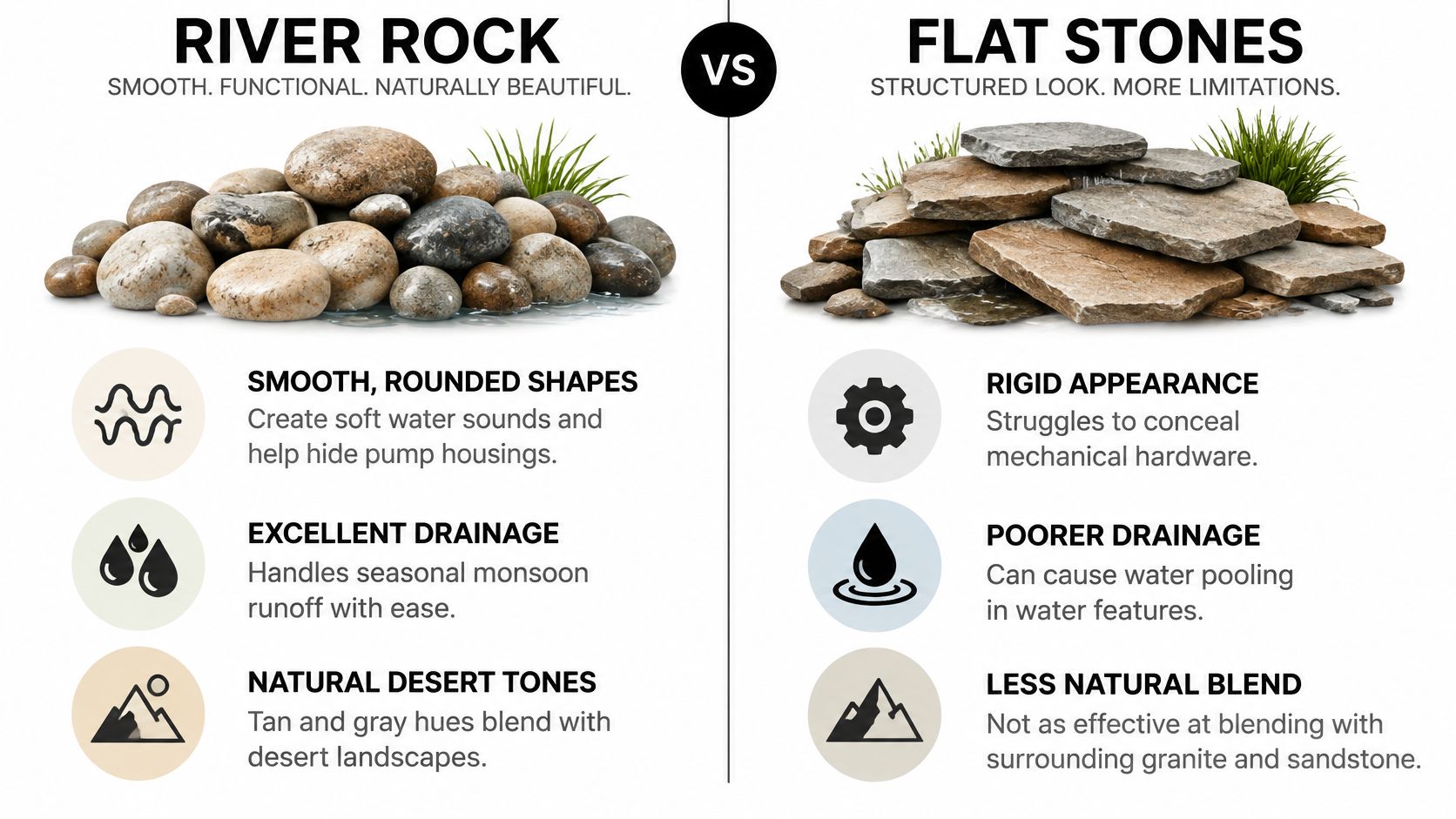
River rock works best for natural-looking pond margins, streambeds, and concealed reservoir surfaces. Its rounded, water-worn shapes soften transitions between larger boulders, planting beds, and exposed water. Available material ranges from small gravel to substantial cobbles, so the name describes shape rather than a single stone size or mineral composition.
For a Prescott Valley yard, a dry creek bed can create visual continuity with a nearby pondless waterfall. Keep their functions distinct, though. Dirty monsoon runoff shouldn't flow directly into a decorative recirculating reservoir unless the system is specifically designed to receive it.
The EPA's stormwater guidance explains how site practices can slow, detain, or filter runoff. A scattering of decorative river rock doesn't automatically provide those benefits, channel grading, rock sizing, vegetation, and a safe outlet still matter.
How Do You Keep River Rock in Place?
Prepare the right base. Use a compacted base and suitable geotextile beneath an unlined drainage channel where appropriate. Inside a water feature, use protective underlayment and a waterproof liner instead.
Mix sizes deliberately. Set larger stones at transitions and channel edges, then use smaller material to conceal gaps without blocking circulation.
Preserve service access. Keep the pump-vault lid identifiable and removable. Don't bury it beneath an awkward pile of loose cobbles.
Loose river rock is easy to reposition, but small pieces can migrate during cleaning or strong runoff. Keep matching material for touch-ups, rinse sediment away, and choose color from wet samples, not assumptions about which shade hides staining.
2. Granite Boulders
A bubbling boulder in a Prescott courtyard can look more convincing than an elaborate waterfall built from mismatched stone. Granite boulders are the strongest visual fit when you want the feature to echo the rounded forms of Granite Dells, rather than resemble a freestanding garden ornament.
Their mass creates a substantial focal point, but it also dictates construction. Equipment access, lifting clearance, foundation support, and liner protection must be resolved before delivery, not after a boulder arrives beside a narrow gate.
The U.S. Geological Survey's dimension stone guidance identifies mineral composition, strength, weathering, and durability as relevant stone-selection criteria. Granite's reputation for toughness doesn't remove the need to inspect individual pieces for fractures or unstable weathered surfaces.
What Makes a Boulder Waterfall Look Natural?
Set the primary boulders first, with part of each stone visually embedded in the surrounding grade. Align their weathering and contours, then introduce smaller stone as supporting material rather than surrounding every boulder with an identical gravel ring.
Placement rule: Waterfall foam can guide water, but it isn't a structural footing or a substitute for a continuous waterproof liner.
Use compatible joint waterproofing where the design requires it, and avoid coating entire boulders merely to make them shiny. Compare surrounding groundcover and accent materials with this guide to different types of landscaping rock.
For a visual reference while considering rock placement and water movement, watch the following video.
3. Flagstone
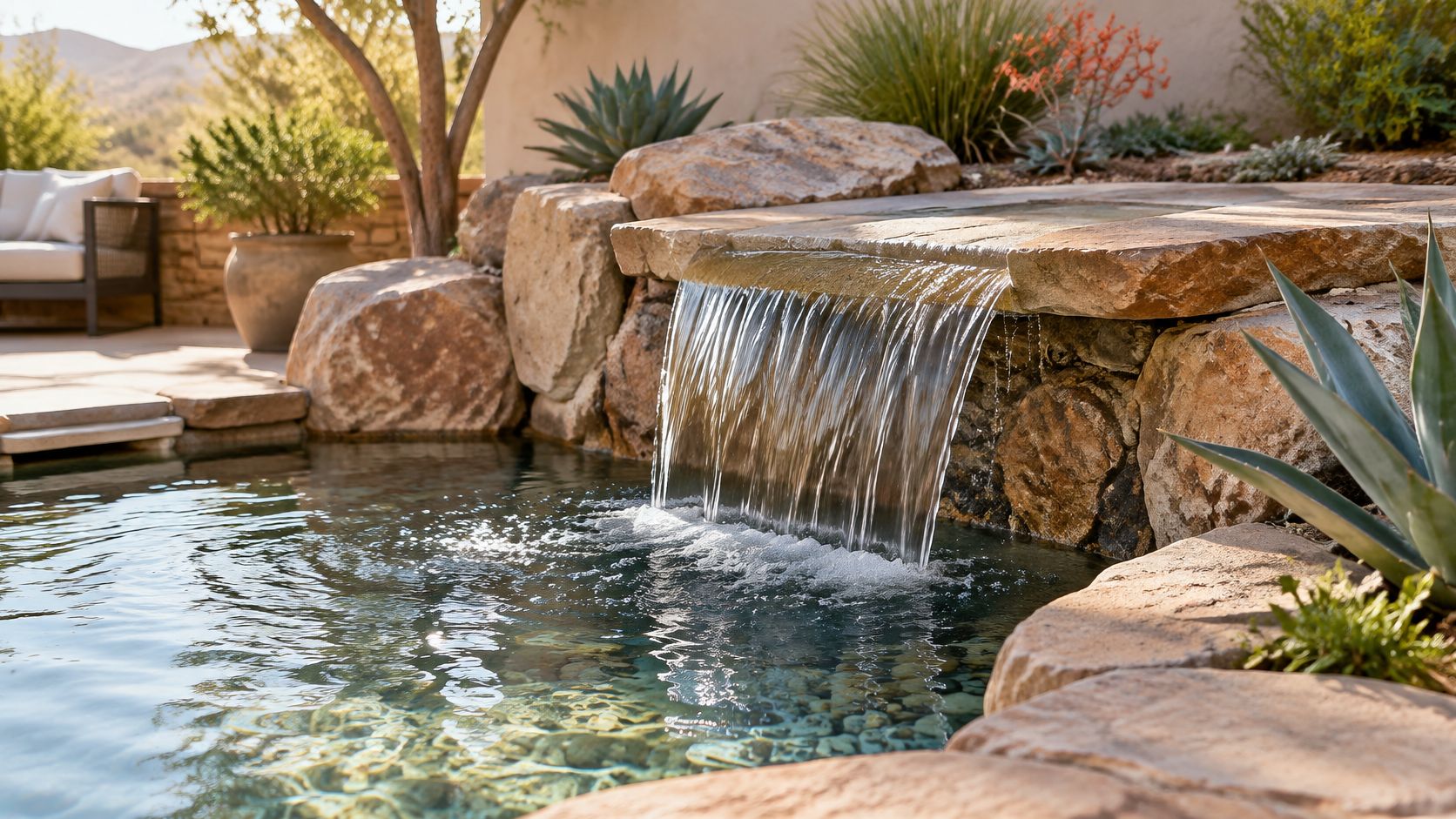
Flagstone is the practical choice for spillway shelves, pond coping, and a coordinated patio-to-water transition. It describes flat slabs rather than a single geology, so sandstone flagstone and quartzite flagstone shouldn't be treated as interchangeable.
Warm sandstone can complement Northern Arizona's tan and red palette. A denser quartzite may be the better candidate for a continuously wetted spillway, depending on the specific quarry material and its test results.
The Natural Stone Institute's water-application examples emphasize low porosity and resistance to erosion and freeze-thaw cycling. Those properties matter more than a flagstone's color when water will repeatedly cross its surface.
Can Flagstone Be Used Beside a Walking Surface?
Yes, provided the slabs have adequate support and a suitable finish. Natural-cleft texture is preferable to a polished walking edge, but algae can still make textured stone slippery.
Support the slab. Use an appropriate setting bed and avoid unsupported overhangs where someone might step or sit.
Check winter suitability. Obtain absorption and freeze-thaw information for the actual stone being purchased.
Specify sealing selectively. Use a compatible treatment only where appropriate, and confirm suitability for constant wetting or immersion.
For a Chino Valley courtyard, a flagstone wall cap can connect a recessed fountain with nearby paving. Review flagstone patio cost considerations when budgeting that larger hardscape connection; if you're comparing surface styles, you can also find residential decorative concrete services for a different architectural approach.
4. Lava Rock
Lava rock belongs in selected filtration and accent zones, not automatically across every wetted surface. The lightweight, vesicular material commonly sold under this name is often scoria. Not every volcanic rock has the same open texture or durability.
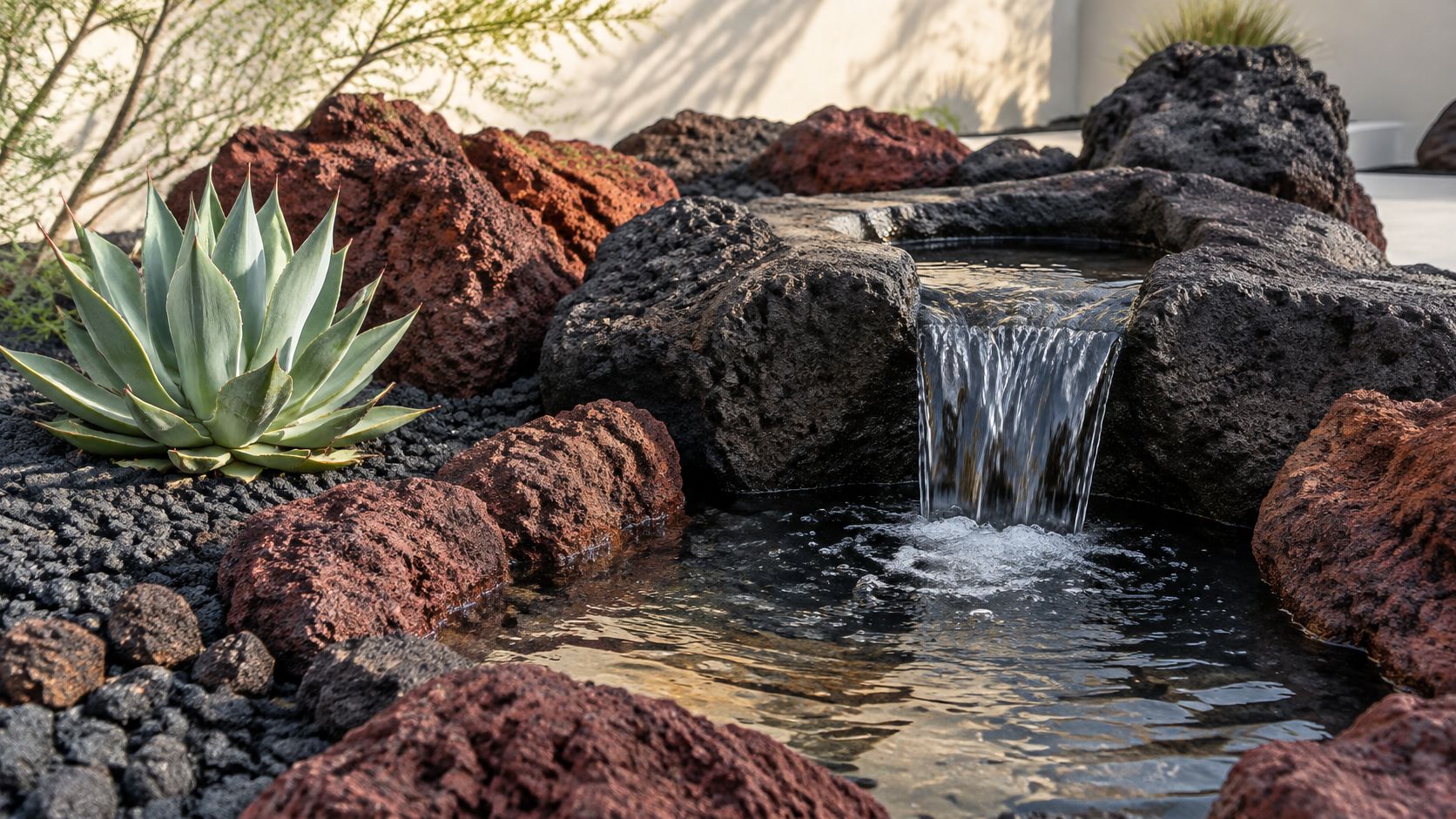
Its dark red, black, and reddish-brown colors suit desert planting beds and modern water bowls. In a Prescott Valley pondless feature, it can serve as specified filter media or a decorative accent, provided the design allows sediment removal and pump access.
Porous surfaces can support microbial growth, but rock alone doesn't establish effective biological filtration. Water movement, oxygen, loading, and cleaning access determine whether the filter remains useful or becomes a sediment trap.
Where Should You Avoid Lava Rock?
Keep rough lava rock away from barefoot routes, play areas, and unprotected liner contact points. Don't place loose fragments against a pump intake unless they're contained within a designed filtration assembly.
A materials study published in Sustainability emphasizes evaluating absorption, permeability, strength, and frost resistance together. Its tested material was sandstone, not lava rock, so it supports the selection principle rather than a performance claim for every volcanic product.
Rinse before placement. Remove dust and loose fragments before introducing material into circulating water.
Contain filter media. Use accessible baskets or compartments instead of burying plumbing beneath loose rock.
Inspect after storms. Remove accumulated sediment and replace material that has become friable or persistently clogged.
A dark volcanic accent beside agave can look appropriate without becoming the waterfall's structural core. That distinction keeps the visual benefit while limiting maintenance complications.
5. Slate
Slate works well for contemporary water walls, fountain cladding, and crisp coping details. Its fine-grained texture and layered appearance create a different effect from rounded granite or mixed river cobbles.
Charcoal, green, purple, and rust tones can coordinate with modern Prescott home exteriors. A slate-clad fountain beside a Prescott Valley entertaining patio is a useful example, especially where the homeowner wants water movement without a mountain-stream aesthetic.
The trade-off is that slate quality varies. Some products remain sound outdoors, while others split or shed layers under repeated wetting and freezing. Select material explicitly suitable for the exposure rather than assuming all slate is dense and waterproof.
How Do You Detail a Slate Water Wall?
Support the stone with an appropriate exterior assembly, waterproof behind it, and keep joints consistent. Thin cladding shouldn't be expected to contain water by itself, and fountain plumbing must remain accessible without removing the finished wall.
Choose texture near feet. Natural-cleft slate offers more surface texture than polished material, but still requires algae control.
Test the sun exposure. Compare sample temperatures where people may touch or sit on the coping.
Use compatible treatments. Select sealers for the actual exposure and test them for unwanted darkening.
Electrical access deserves equal attention. The Consumer Product Safety Commission's GFCI guidance reinforces the need for protected outdoor power and accessible safety devices; a qualified electrician should determine applicable requirements for the installation.
Hide plumbing and wiring thoughtfully, but don't conceal connections so completely that servicing requires dismantling the stonework.
6. Travertine
Choose travertine for a warm, architectural fountain or coping detail, particularly where cream and tan stone complement stucco, tile, and desert planting. It's a limestone deposited from mineral-rich water, with characteristic pores that distinguish it from granite and slate.
A tumbled travertine surround can suit a Chino Valley entry fountain. Honed or filled pieces may provide a smoother contact surface, but finish selection doesn't replace the need to verify exterior and freeze-thaw suitability.
Travertine is softer than granite and sensitive to acidic cleaners. Its pores, fillers, and surface treatments also need consideration where water repeatedly wets the same area.
Is Travertine a Low-Maintenance Choice?
It can be manageable in an accessible fountain, but it isn't the first choice for a neglected, constantly splashed installation. Use stone-safe, pH-neutral cleaning products and avoid vinegar or acidic scale removers that can etch limestone.
The Arizona Department of Environmental Quality's xeriscaping guidance warns that rock mulch can radiate heat and promote water loss. Adding more decorative stone around a fountain therefore shouldn't be mistaken for a water-conservation strategy.
A compact basin, controlled splash, shade, and wind protection can matter more to water use than whether the surrounding stone looks natural.
Specify compatible sealing before and after installation where the stone and setting system warrant it. Keep sealer off bonding surfaces unless the installation specification allows it, and don't assume sealing makes porous stone freeze-proof.
For a coordinated courtyard, these stone patio design ideas can help connect the fountain surround with seating areas. Keep barefoot comfort and summer sun exposure part of that material decision.
7. Mexican Beach Pebble
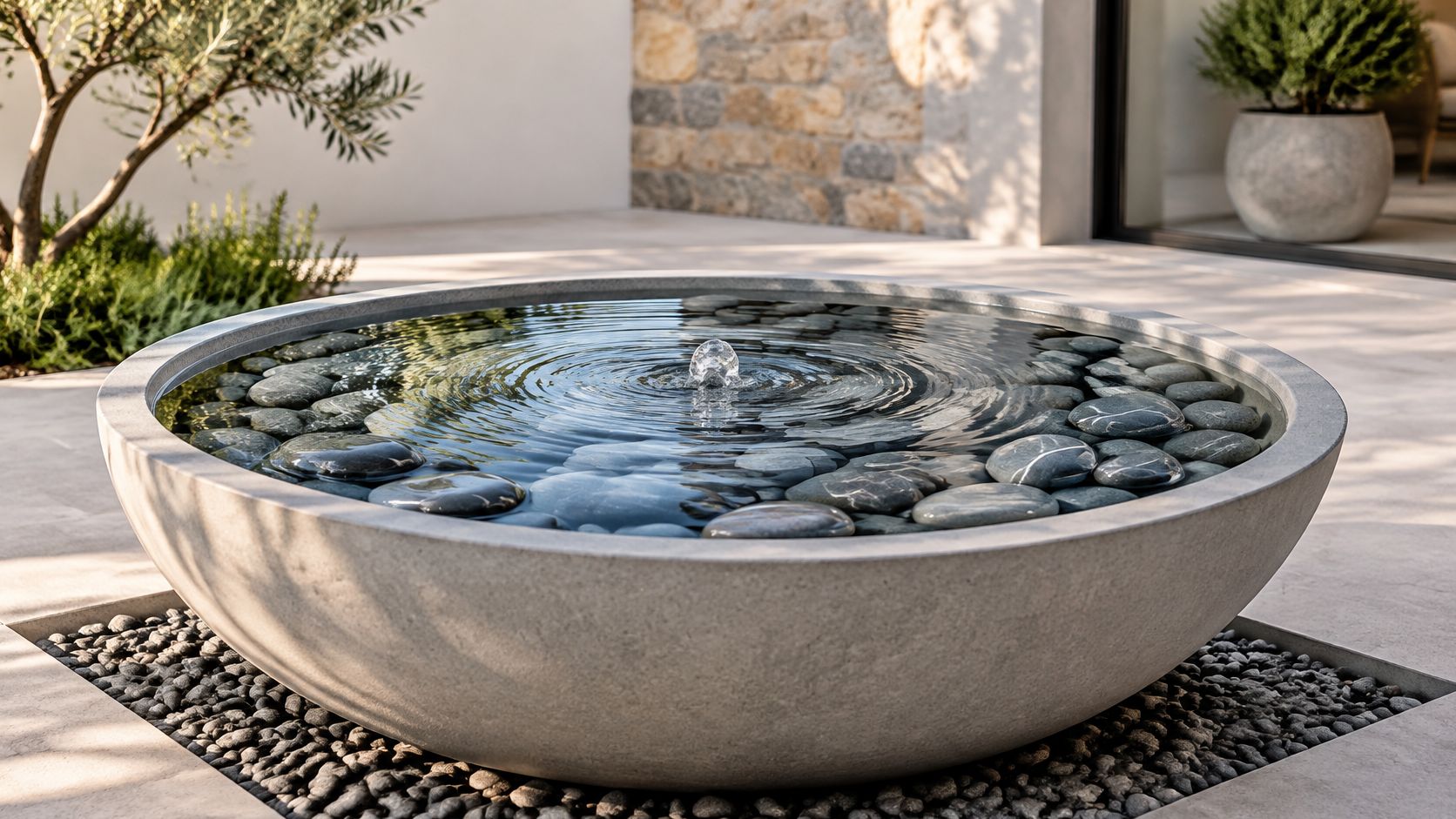
Mexican beach pebble is best used as a refined accent in fountain bowls, shallow decorative trays, and restrained courtyard features. Its smooth, rounded appearance and relatively consistent grading create a tidier surface than a mixed river-rock blend.
The name is a commercial description, not a guarantee of mineral composition or finish. Some pebbles are naturally water-worn, while others receive polishing or enhancement, so inspect the actual product wet and dry.
A gray pebble layer in a Prescott Valley fountain can complement concrete and stucco without competing with surrounding planting. Pale pebbles make debris easier to see; dark pebbles create stronger contrast with flowing water but can make pale mineral deposits conspicuous.
How Do You Keep Pebble Features Practical?
Contain the pebbles with a bowl lip or recessed edge so they don't roll onto walking surfaces. Keep the decorative layer removable, and provide a secure reservoir cover rather than relying on loose stone to prevent access.
Arizona water-feature guidance from KTAR's Rosie on the House identifies maintenance and household safety advantages of pondless designs. They still need stable stone, protected equipment, and supervision around children and pets.
Preserve circulation. Don't pack pebbles into intake openings or create stagnant pockets.
Clean gently. Lift removable material for rinsing and use stone-compatible products for deposits.
Keep the palette restrained. Mix colors only when the pattern serves the overall design.
Smooth pebbles aren't a slip-resistant walking surface. Keep them in the feature, not across the route people use to approach it.
Water Feature Rocks at a Glance
Best Use | Look & Color | Durability | Maintenance Level |
|---|---|---|---|
River Rock, dry creek beds, streambeds, and pondless waterfalls | Smooth, rounded stones in natural tans, grays, and browns | Durable, but loose stones may shift or wash out | Moderate; periodic rinsing and repositioning |
Granite Boulders, dramatic waterfalls, spillways, and focal points | Rugged, irregular forms in gray, pink, or speckled tones | Extremely durable and weather-resistant | Low; minimal upkeep after proper installation |
Flagstone, pond edges, spillways, and walkable surrounds | Flat, layered slabs in buff, rust, red, gray, or mixed tones | Varies by stone; some types may chip or delaminate | Moderate; sealing and occasional checks for wear |
Lava Rock, filtration beds, planters, and decorative accents | Lightweight, porous, angular pieces in red, black, and rust | Long-lasting, but may clog or fade over time | Moderate to high; rinse and clear trapped debris |
Slate, contemporary water-feature edges, caps, and cladding | Sleek, layered finish in charcoal, gray, green, or purple | Dense and water-resistant when properly installed | Low to moderate; sealing and joint upkeep |
Travertine, fountains, water bowls, and pool coping | Classic, porous stone in cream, tan, and golden tones | Softer than granite; can chip or stain without protection | High; periodic sealing and careful cleaning |
Mexican Beach Pebble, shallow bowls, basins, and decorative accents | Smooth, polished, uniform pebbles in blues, grays, whites, and tans | Durable, but loose pebbles can shift or spill | Moderate; periodic rinsing and containment checks |
Ready to Choose Your Water Feature Rocks? Talk to Prescott's Local Experts
Match stone to feature type first, then consider foot traffic, sun exposure, and maintenance access. Granite suits substantial focal points; river rock softens naturalistic edges; flagstone shapes spillways; slate and travertine suit architectural details; lava rock and beach pebbles work best in carefully chosen supporting roles.
Water conservation belongs in that decision. EPA WaterSense guidance recommends recirculation, appropriate pumping rates, shady and less windy placement, and leak inspections. Attractive rockwork shouldn't require excessive spraying or hide a persistent leak.
How Much Does a Rock Water Feature Cost?
A simple bubbling boulder or pondless waterfall typically starts in the mid-hundreds of dollars for materials, not a complete installed project. Total cost depends on design, excavation, access, basin construction, rock placement, plumbing and electrical rough-in, pump, filtration, lighting, and final walkthrough.
How Long Does Installation Take?
There isn't a reliable universal timeline. Equipment access, excavation conditions, stone availability, electrical coordination, and project complexity need to be assessed before establishing a schedule.
What Maintenance Will I Need to Do?
Check water levels, keep the pump clear of debris, and clean filtration as needed. Inspect after monsoon storms, watch for splash escaping the basin, and address mineral deposits with a cleaner compatible with the stone.
Our installations finish with a walkthrough and maintenance briefing covering water levels, pump care, and filtration cleaning. If you're comparing contractors, find local landscaping professionals and evaluate their credentials, scope, and service access details rather than appearance alone.
R.E. and Sons Landscaping is licensed, bonded, and insured, Arizona ROC #300642, serving Prescott, Prescott Valley, Chino Valley, Mayer, and Williamson Valley. Bring yard photos, access measurements, and your preferred stone styles to a complimentary consultation, scheduled online or by phone during Monday–Friday, 8am–4pm office hours.
R.E. and Sons Landscaping designs and builds custom fountains, ponds, pondless waterfalls, bubbling boulders, and multi-tier rock waterfalls with commercial-grade pumps, reinforced liners, and natural stone finishes, plus optional native planting and LED lighting. Visit R.E. and Sons Landscaping to schedule a complimentary consultation and choose water feature rocks that suit your yard, maintenance preferences, and Northern Arizona's climate.
Comments