
Environmentally Friendly Landscaping: Prescott Yard Guide
Your summer water bill climbs, the lawn still has dry patches, and the gravel beside the patio feels too hot to enjoy. Environmentally friendly landscaping addresses those problems together, using soil, plants, irrigation and shade as a connected system rather than swapping grass for another surface and hoping for the best.
R.E. and Sons Landscaping helps homeowners in Prescott, Prescott Valley, Chino Valley and nearby Northern Arizona communities plan yards suited to high-desert conditions. A useful design starts with how you use the property, where water travels and which areas need living plants, shade or durable outdoor surfaces.
Five Principles Behind Environmentally Friendly Landscaping
An environmentally friendly yard uses less water, needs fewer inputs, supports wildlife and manages rainfall on the property wherever practical. It should remain usable and attractive without requiring constant correction with irrigation, fertilizer or replacement plants.
Think of your yard as a sponge with a faucet. The faucet represents irrigation, but the sponge matters just as much: soil and roots should help water soak in rather than allowing it to run into the street.
Five principles of environmentally friendly landscaping
Principle | What It Means | Why It Matters in Northern Arizona | First Step |
|---|---|---|---|
Water-efficient irrigation | Water each plant zone by its need | Outdoor watering can dominate household water use in arid areas | Audit the controller and sprinkler heads |
Healthy soil | Use appropriate compost and aeration so water soaks in | Compacted soil sheds water instead of absorbing it | Test soil and assess amendments before planting |
Regionally adapted plants | Choose species suited to local elevation, frost and water supply | Well-matched plants don't require heavy irrigation to compensate for unsuitable conditions | Compare plant choices against the state low-water list |
Mulch and reduced turf | Cover exposed soil and retain lawn for functional areas | Suitable mulch limits evaporation and erosion | Replenish mulch as needed and mark useful turf areas |
Shade and stormwater design | Position trees for shade and manage runoff through grading | Shade improves comfort while planned drainage protects planting beds | Map where rain flows during a storm |
How do these principles work together?
In Prescott, intense sun and low humidity make exposed soil difficult to manage. Episodic storms create the opposite challenge: water arrives faster than compacted ground can absorb it.
Better irrigation can't fully compensate for poor soil, and drought-tolerant plants won't solve an overloaded drainage path. Each decision should support the others.
For broader gardening practices that complement this approach, the resource on eco-friendly growing with Leaves & Soul offers a useful companion to site-specific outdoor planning.
Start with the cheapest diagnostic step, usually an irrigation audit or soil test. Don't purchase a yard full of plants before identifying why the existing planting struggles.
Why Water Use Comes First in Northern Arizona Yards
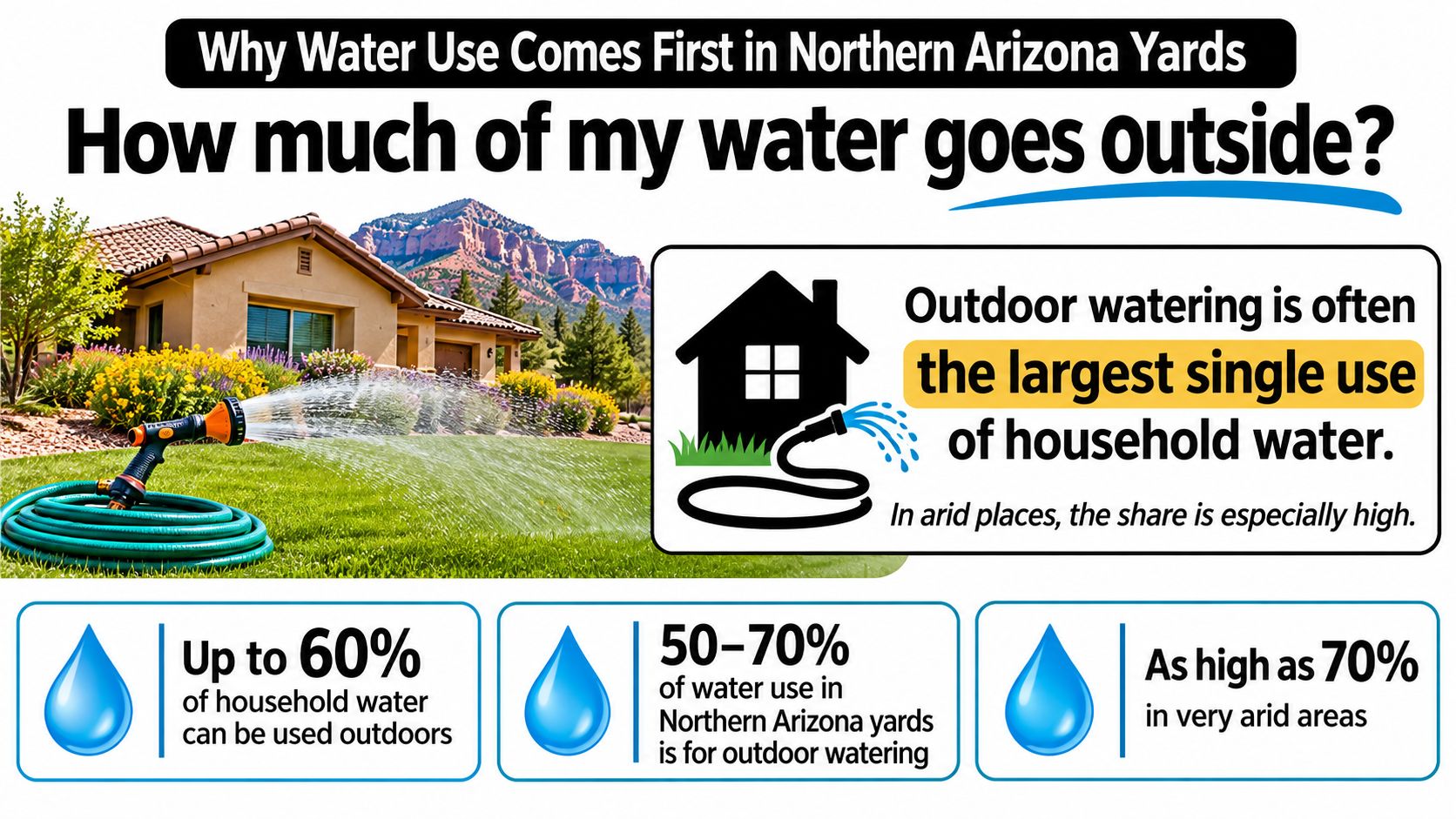
A summer storm can soak a Prescott yard overnight, and the sprinkler clock still runs at dawn because nothing told it otherwise. In a dry climate, outdoor watering can account for more household consumption than anything happening inside. The exact share shifts with lawn area, weather, plant maturity and how closely the irrigation system is managed.
The following outdoor-water figures come from the EPA's WaterSense statistics and facts: nationwide outdoor consumption above 30%, arid-region shares reaching 60%, and shares as high as 70% in hotter, drier locations.
Outdoor water figures every homeowner should know
Figure | Value | Context |
|---|---|---|
Outdoor share of household water, nationwide | More than 30% | Average across U.S. homes |
Outdoor share of household water, arid regions | Up to 60% | Arid-region benchmark, not a Prescott household measurement |
Outdoor share of household water, hotter and drier locations | As much as 70% | EPA estimate for hot, dry locations |
Outdoor water lost to wind, evaporation and runoff | As much as 50% | Potential losses from inefficient irrigation |
Annual waste from a poorly maintained automatic system | Up to 25,000 gallons | Household with a poorly maintained or operated automatic irrigation system |
Irrigation savings from a WaterSense-labeled controller | Up to 30%, as much as 15,000 gallons per year | Replacing a clock-based controller at an average home |
That 50% loss row deserves a second look. Wind drift off a spray head, water sheeting off a sloped bed and evaporation between nozzle and root all count toward it. None of those show up as a broken part; the system keeps running while the water never reaches a plant.
Does automatic irrigation automatically save water?
No. Automation repeats a schedule, including a bad one.
According to the EPA's guidance on watering during hot weather, homeowners may use two to four times more water in summer, while homes with automatic sprinkler systems may use about 50% more outdoor water than homes without them. The savings come from programming and maintenance, not from the controller alone. A weather-responsive unit can't repair a leaking fitting or correct mismatched sprinkler coverage, so equipment selection and installation have to work together, as covered in our guide to irrigation and landscape planning.
Practical rule: Before replacing an entire landscape, establish whether you're paying to water plants, pavement or a buried leak.
Freeze-thaw movement is one reason buried fittings start leaking in this area, which is why R.E. and Sons Landscaping builds base prep designed to withstand Chino Valley's freeze-thaw cycles. To catch the symptom early, compare a summer bill with a winter bill and account for guests or other changes in indoor use. A sharp seasonal gap is a reason to inspect the system using step 6 of the build guide below, not just shorten every watering cycle.
Is Artificial Turf Greener Than Natural Grass?
Artificial turf needs less watering than natural grass, but it isn't automatically the greenest choice. Its benefits must be weighed against heat, plastic materials, drainage, maintenance and eventual replacement.
A 2025 artificial-turf review from the National Collaborating Centre for Environmental Health found surface temperatures approximately 9.4 to 33.7°C higher than natural turf and surrounding-air temperatures 0.5 to 1.2°C higher. The review also identifies concerns involving microplastics from fibers and infill, stormwater pollution and reduced permeability.
Artificial turf and the main alternatives compared
Option | Water Need | Heat Impact | Microplastic or Runoff Concern | Best Use |
|---|---|---|---|---|
Artificial turf | Lower than natural grass | Surface 9.4 to 33.7°C hotter than natural turf; surrounding air 0.5 to 1.2°C hotter in the review | Fibers and infill can shed microplastics; permeability requires scrutiny | Small, heavily used play area |
Native or drought-tolerant planting | Low once established | Living cover shades soil; trees can shade occupied areas | Roots help stabilize soil; establishment watering still needs control | Beds and borders matched to local conditions |
Decomposed granite or gravel | No irrigation for the surface itself | Exposed mineral surfaces can become hot | Fines can move with runoff; compacted bases can restrict infiltration | Paths and open areas with low foot traffic |
Small living lawn | High compared with low-water planted beds | Cooler than artificial turf in the review | Overwatering can create runoff; avoid unnecessary chemical inputs | Compact functional lawn area |
Which option fits your yard?
A compact play space may justify synthetic turf when use is intensive and maintaining living grass would be difficult. A broad sunny strip beside a seating area is a less convincing application because surface heat can undermine outdoor comfort.
For decorative areas nobody walks on, regionally adapted planting usually offers more ecological value than a plastic lawn. Gravel can provide access and visual contrast, but an all-gravel yard isn't a substitute for shade or habitat.
Answer these questions before choosing:
Use: Will children play here, pets use it, or will people mostly view it?
Shade: Is the surface shaded during the hours you'll use it?
Drainage: Where will water go after passing through or across the surface?
Service life: What maintenance and replacement does the proposed material require?
Disposal: How will worn material and infill be removed and handled?
The verdict is site-specific: retain living lawn where it earns its water use, consider artificial turf for a defined high-use purpose, and use planted areas where habitat and shade matter most.
Native Plants and Habitat That Suit Prescott
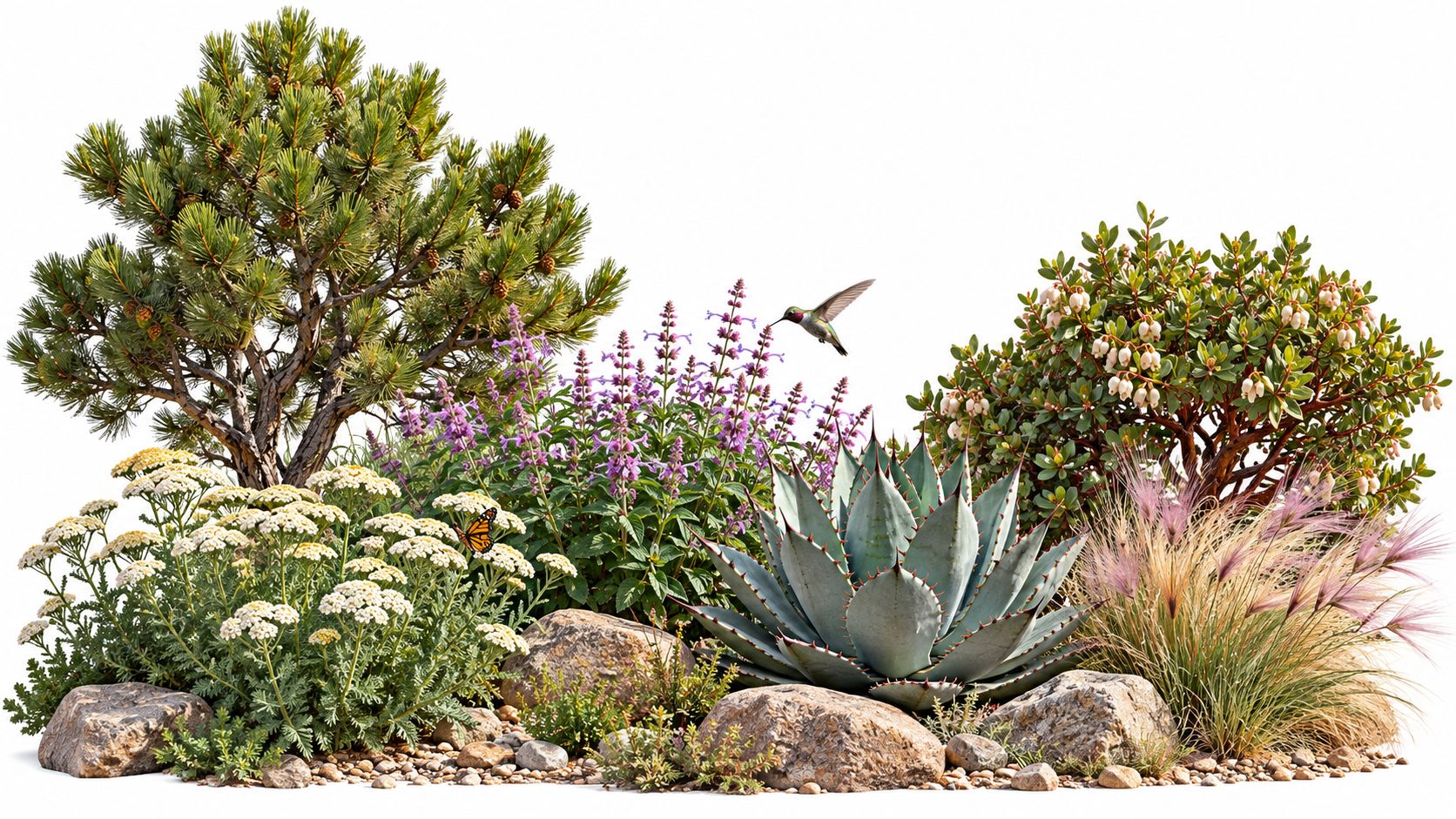
Low-water plants listed for the Prescott area
Plant | Check Before Planting |
|---|---|
Singleleaf pinyon pine | Confirm elevation and frost tolerance |
Common yarrow | Confirm soil type and sun exposure |
Texas hummingbird mint | Confirm frost exposure and bloom timing |
Parry's agave | Confirm drainage and winter cold |
Manzanita | Confirm mature space and soil fit |
Purple three-awn grass | Confirm water supply and establishment needs |
These plants appear in the Prescott-area low-water plant resources published by the Arizona Department of Water Resources, which identifies landscaping as Arizona's largest use of potable water. Treat the list as a starting palette, not a guarantee that every listed plant belongs in every yard.
A layered planting can combine trees, flowering perennials, grasses and structural accents.
How do I verify a plant for my property?
Check the exact species, mature dimensions, winter exposure and drainage requirements before buying. A sheltered Prescott courtyard and an exposed Chino Valley lot can require different choices even when both homeowners want native plants.
Don't assume everything labeled native belongs to Northern Arizona or tolerates your elevation. Our guide to native plants in Northern Arizona helps frame those local selection decisions.
The USDA's pollinator guidance explains the value of native vegetation as food and shelter for wildlife, alongside its generally drought-tolerant, relatively pest-resistant characteristics. Build variety into the planting rather than repeating a single flowering species throughout the yard.
Can habitat planting still look tidy?
Yes. Use biodiversity with boundaries: designate habitat beds, repeat a limited plant palette and maintain clear edges beside patios and walkways.
Choose plants with sequential flowering periods and include host plants that support immature insects, not just nectar for adults. Retain some leaf litter and undisturbed nesting areas away from frequently used spaces, and avoid blanket pesticide applications.
A 2025 landscape analysis emphasizes that biodiversity benefits and homeowner preferences involve trade-offs; associated experimental findings described in the source notes include greater beetle richness with native ground-cover forbs and declining activity with increasing pine-straw coverage. The practical lesson is to avoid treating every open patch as a place that needs more mulch.
A tidy border and a habitat-rich interior can coexist. Ecological value doesn't require letting plants spread into every path.
Keep habitat materials separate from fire features and follow applicable defensible-space requirements. If you want a birdhouse as part of the layout, Farmhouse World's rustic birdhouse guide offers design inspiration; choose nesting dimensions and placement for the birds you're trying to support.
For another visual reference while planning the planting layout, watch the accompanying video.
Monitor plant survival and pollinator use each season. Replace unsuitable choices rather than increasing irrigation indefinitely to keep them alive.
How to Build a Low-Water Yard Step by Step
Build the water-management system before concentrating on decorative finishes. The EPA's water-efficient landscaping guidance recommends combining appropriate grading, healthy soil, adapted plants, hydrozones and approximately 3 inches of mulch, replenished annually to maintain coverage.
What should happen before planting?
A measured sketch is enough to begin. Mark buildings, existing trees, utilities, irrigation valves, paved areas and the routes people use through the yard.
For help choosing a planning tool, mnml.ai's comparison of CAD suites versus photo-based landscape visualizers clarifies the difference between dimensioned design and appearance previews. A convincing image doesn't verify drainage elevations or irrigation capacity.
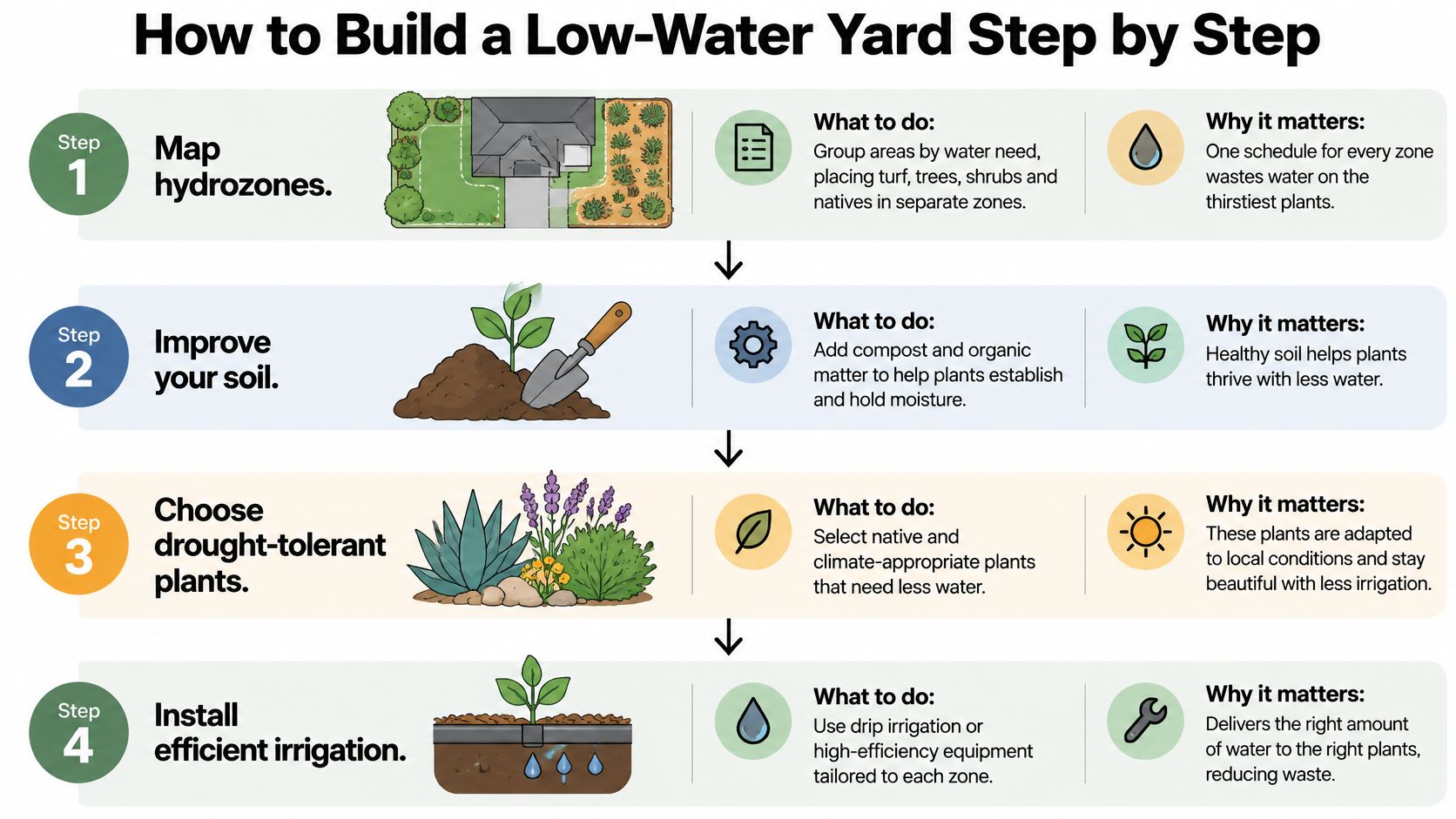
Use the following sequence to turn the concept into a workable installation.
Map hydrozones. Group plants by similar water requirements and distinguish turf, trees, shrubs and low-water native beds on the sketch. Avoid forcing every area onto a schedule designed for the thirstiest planting, which overwaters some plants while leaving others inadequately supplied.
Check the grade and soil before digging planting holes. Observe infiltration, test the soil and relieve compaction with suitable aeration or cultivation; add compost where the soil assessment and intended plants justify it. Direct water toward appropriate infiltration areas, not foundations, paving or neighboring properties.
Choose regionally adapted plants for each exposure and soil condition. Confirm mature size and cold tolerance, and leave enough room that pruning won't become a permanent correction for overcrowding. The common mistake is buying a plant because its label says native without checking where it naturally grows.
Give irrigation groups their own valves and appropriate delivery methods wherever their requirements differ. Turf generally needs sprinkler coverage, while beds can use appropriately placed drip emitters; trees need delivery positioned for their developing root zones. Don't assume installing drip makes a shared, poorly matched zone efficient.
Apply suitable mulch using the EPA depth above as the general planting-bed specification, then replenish coverage as it breaks down or moves. Keep mulch away from trunks and crowns, preserve intentional habitat patches, and choose materials with plant requirements and fire exposure in mind.
Audit each season. Run the system and inspect for broken heads, leaks, overspray onto paving, uneven distribution, excessive run times and watering during high-evaporation periods. Adjust scheduling for weather and establishment, and check soil moisture before assuming a stressed plant needs more water.
The process begins with zoning, not with selecting a controller or ordering gravel.
How will I know the yard is working?
Look for healthy new growth, moisture reaching the root zone and no routine runoff during irrigation. Establishment starts during the initial growing season, but trees and larger shrubs can need continued establishment care beyond it.
Success isn't a shorter controller setting. It's a yard with purposeful lawn areas, suitable plants, and irrigation that can be reduced as roots develop without sacrificing plant health.
Shade Trees and Stormwater Control That Save Money
A properly located 25-foot-tall tree can reduce annual heating and cooling costs for a typical residence by approximately 8% to 12%, about $10 to $25 annually in the study's estimates, according to a U.S. Forest Service research summary. Those are study estimates, not a current Prescott utility-bill guarantee.
The useful principle is placement. A tree should shade a meaningful part of the building or occupied outdoor space while leaving room for its mature canopy and roots.
Where should shade trees go?
Identify the windows, walls and seating areas exposed during the hottest part of your normal outdoor-use period. Then consider winter sunlight, roof clearance, utilities and the tree's eventual size.
Planting more trees isn't automatically better. A crowded canopy, unsuitable species or tree placed too close to hardscape can create expensive maintenance obligations.
Design priority: Choose the mature tree location first, then arrange paths and smaller planting around the space it needs.
Stormwater deserves the same deliberate planning. The EPA's natural landscaping guidance describes how natural plantings can accommodate stormwater and how native vegetation helps stabilize erodible soil.
What should I inspect during a storm?
Observe from a safe location, and inspect the yard afterward rather than walking into flowing water. Look for sediment trails, exposed roots, pooling near structures and runoff crossing paths.
Grading, rooted planting, mulch and stone can work together to slow water and protect soil. However, decorative rock placed in a drainage channel won't solve an undersized outlet, and compacted decomposed granite shouldn't be assumed to absorb runoff.
Walk your Prescott-area property with this checklist:
Tree locations: Which building surfaces or seating areas could receive useful shade?
Bare-soil patches: Where are raindrops and concentrated flow moving sediment?
Drainage paths: Does runoff reach a safe outlet without crossing neighboring property?
Grade changes: Are slopes concentrating water toward a wall, foundation or walkway?
For persistent pooling or concentrated flow, our landscape drainage installation guide explains the role of a coordinated drainage layout. Preserve safe overflow routes rather than trying to capture every drop beside the house.
Common Questions About Eco-Friendly Landscaping in Northern Arizona
Will I have to give up my lawn?
No. Keep lawn that serves a clear purpose, such as play or pets, and convert unused edges into separately irrigated planting. A small turf area people use makes more sense than a large one nobody walks on.
Does a low-water yard need less maintenance?
Usually, once suitable plants establish. It still needs weed control, pruning where appropriate and irrigation checks, especially during the first seasons of establishment when roots are developing.
Is a rock yard the same as xeriscaping?
No. Xeriscaping combines water-conscious planting, soil management and irrigation. An all-stone yard offers little habitat, can become hot under summer sun, and sheds water differently than planting does. Runoff behavior also depends on the base and grading underneath the rock, so gravel alone does not fix a drainage problem.
What does a project cost?
Yard size, grade, existing hardscape, plant palette and the amount of lawn replaced all shape the cost, so a free, no-obligation consultation is the best place to discuss the specifics of your project.
Which communities do you serve?
We serve Prescott, Prescott Valley, Chino Valley and nearby Northern Arizona communities. The design should reflect each property's exposure, soil and intended use.
Book a Free Design for Your Low-Water Yard
A good first conversation starts with what you can show, not what you can name. Bring a few practical observations to the design discussion:
Water bills: Compare summer and winter use and note unexplained changes.
Yard photos or a sketch: Show sun, shade, slope, existing paving and exposed soil.
Your main goal: Identify whether water use, maintenance, habitat, heat or drainage matters most.
Daily use: Mark where children play, pets travel, people gather and access must remain clear.
You don't need a finished plan or a plant shopping list. Knowing which problems limit your enjoyment of the yard is more useful than arriving with a preferred surface for every square foot. Water, soil, shade and daily use work as one system in a high-desert yard, and the design has to treat them that way.
What happens during the design process?
R.E. and Sons offers xeriscaping using native, drought-resistant plants, a free garden design and a free, no-obligation consultation. The free downloadable Easy 4 Step Guide to Choosing A Trusted Contractor can also help you prepare for choosing a contractor.
Our process moves through consultation, design, transformation and enjoyment. During design, we develop a layout fitted to your yard's grade, natural stone placement and existing hardscape, with your approval at every stage before installation begins.
What should the proposal account for?
A useful proposal distinguishes necessary corrections from optional upgrades. Repairing an irrigation problem, replacing unused lawn and creating shade serve different purposes and should be evaluated accordingly. A turf area that gets real daily use may justify low-water turf rather than removal, while a patch nobody walks on is a better candidate for conversion.
The cost depends on the property's size, access, grade, existing surfaces, plant choices and scope of lawn replacement, and the free consultation is where those details get reviewed. The aim is an outdoor area that fits the site's exposure and soil, handles the heat, and stays easy to maintain rather than becoming another chore.
R.E. and Sons Landscaping offers free design and a no-obligation consultation for a low-water yard that balances planting, irrigation, shade and outdoor use. Visit R.E. and Sons Landscaping to book your consultation, and bring your water-bill comparison, yard photos and priorities.
Comments