
9 Backyard Water Features Ideas for Prescott Yards in 2026
It's a hot July evening in Prescott. You want the sound of water off the patio, but you also know a still basin will cook in the sun, and a hard freeze will show up before the holidays. That tension is the decision in front of you.
R.E. and Sons Landscaping is the licensed, bonded, and insured design-build team serving Prescott, Prescott Valley, Chino Valley, and Northern Arizona. We help homeowners pick a feature that fits the yard, the upkeep they'll manage, and a climate of summer evaporation, monsoon runoff, and winter ice.
The best backyard water features ideas are the ones matched to scale, maintenance tolerance, and seasonal conditions. The nine options below cover ponds, fountains, waterfalls, streams, and misting systems, each with a straight trade-off. Tight courtyards can borrow scale from small garden water feature ideas and then stop before the feature outgrows the space.
The EPA WaterSense statistics and facts put outdoor use at more than 30% of average household water nationwide, and as high as 60% in dry climates. As much as 50% of outdoor water can be lost to evaporation, wind, runoff, or inefficient irrigation. A closed loop, shade, and a basin that doesn't throw water onto the gravel are how you keep the sound without watering the air.
1. Backyard Pond with Aquatic Plants
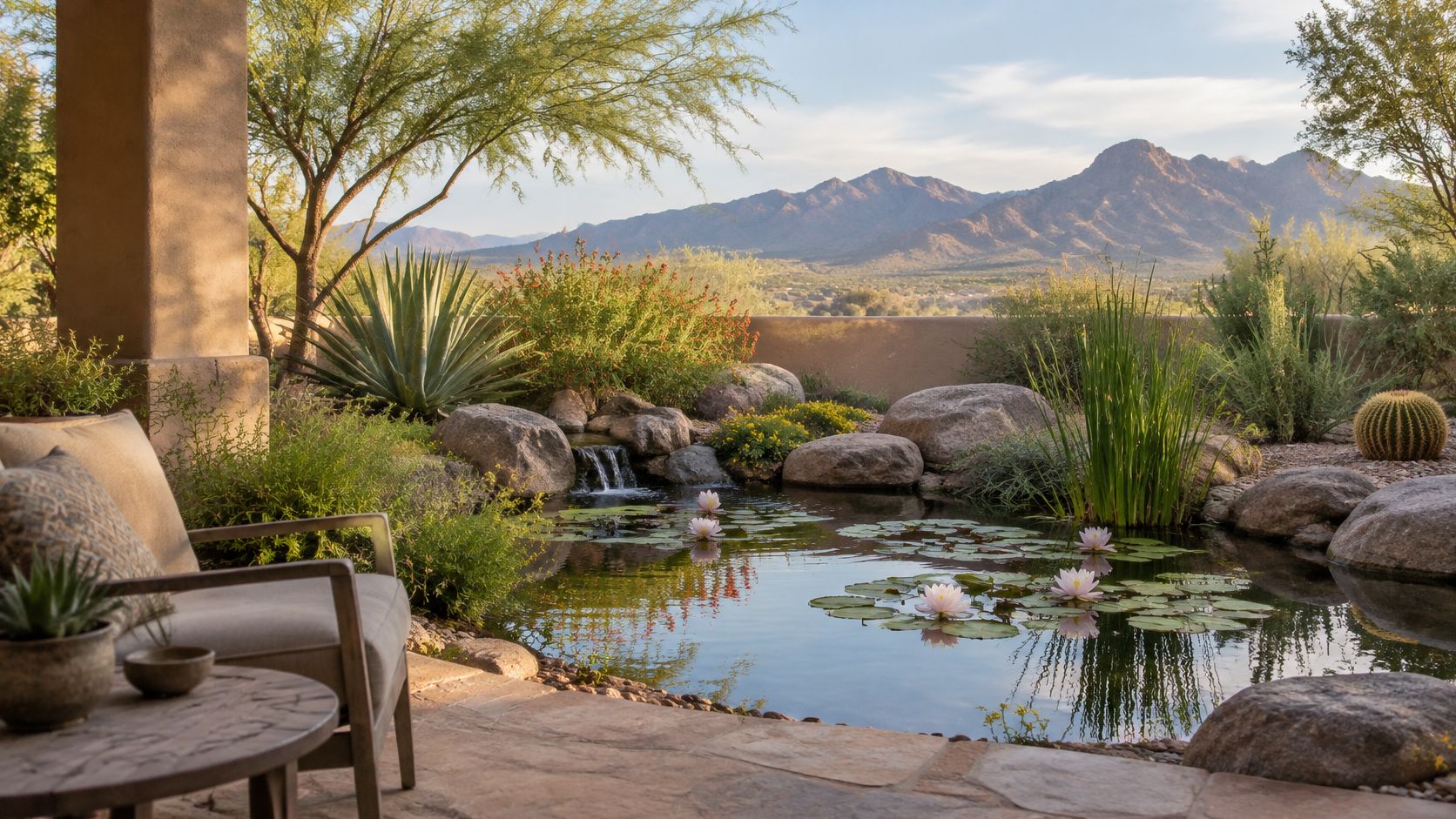
A backyard pond is a lined basin with a pump and filter, built for aquatic plants and sometimes fish. It gives you a calm focal point and draws birds. It also asks more of you than any fountain on this list.
Say the yard is a covered patio in Prescott Valley with morning sun on one edge. A small shade pond can look settled by the second summer. A koi pond on an open slope is a different job: more depth, more filter, and a winter plan.
Will a backyard pond attract mosquitoes
Moving water is the control. The CDC home mosquito guidance says to empty and scrub water-holding items weekly, and to keep fountains and ponds circulating, filtered, and chemically balanced. A dead corner is the risk, not a pond that keeps turning over. If the pump is down, treat that like a leak and fix it before the week is out.
Practical rule: Morning sun and afternoon shade beat all-day exposure. Algae and evaporation both climb when the surface bakes through the afternoon.
Clear water is a habit, not a product. The steps that hold up here are in our note on how to keep pond water clear.
Match the pump to volume: Size it for the pond, not the box rating, and use a skimmer so needles and cottonwood fluff don't choke the intake.
Plant in pots: Water lilies or cattails in containers shade the surface without taking over the liner.
Book two checks: One before the first hard freeze, one after monsoon silt shows up in the basket.
I wouldn't put an open pond where toddlers play unless barriers and covers are settled before the liner goes in.
2. Waterfall or Cascading Water Feature
In a quiet Prescott Valley or Chino Valley cul-de-sac, the value of a cascade is the sound. Water drops over stacked rock into a basin, then a pump sends it back up. You hear it from the chairs, not only from the kitchen window.
A sheet that falls down loses less water than a jet shot into the wind. Hide the pipe in the stone so the fall looks like it belongs on the grade. A wall of water beside an outdoor kitchen works on a flat patio. A multi-tier fall into a lower pond needs room and a clean path for the crew to set boulders.
The Penn State Extension guide on backyard ponds notes that gallons per hour depend on volume, vertical lift, horizontal run, and filtration. It also cites a residential target of circulating the volume about one to four times per hour, plus about 100 to 150 gallons per hour per inch of weir for a low sheet. Those are flow-at-head targets. Elbows, filters, and elevation steal output, so an oversized pump label can still trickle.
Set the fall where the seating area hears it. Use local stone so it matches the high desert, not a river that doesn't exist here. Check the basin and pump at least twice a year, and pull the electrical plan before the rock goes in. Power added later means torn stone.
3. Boulder Fountain
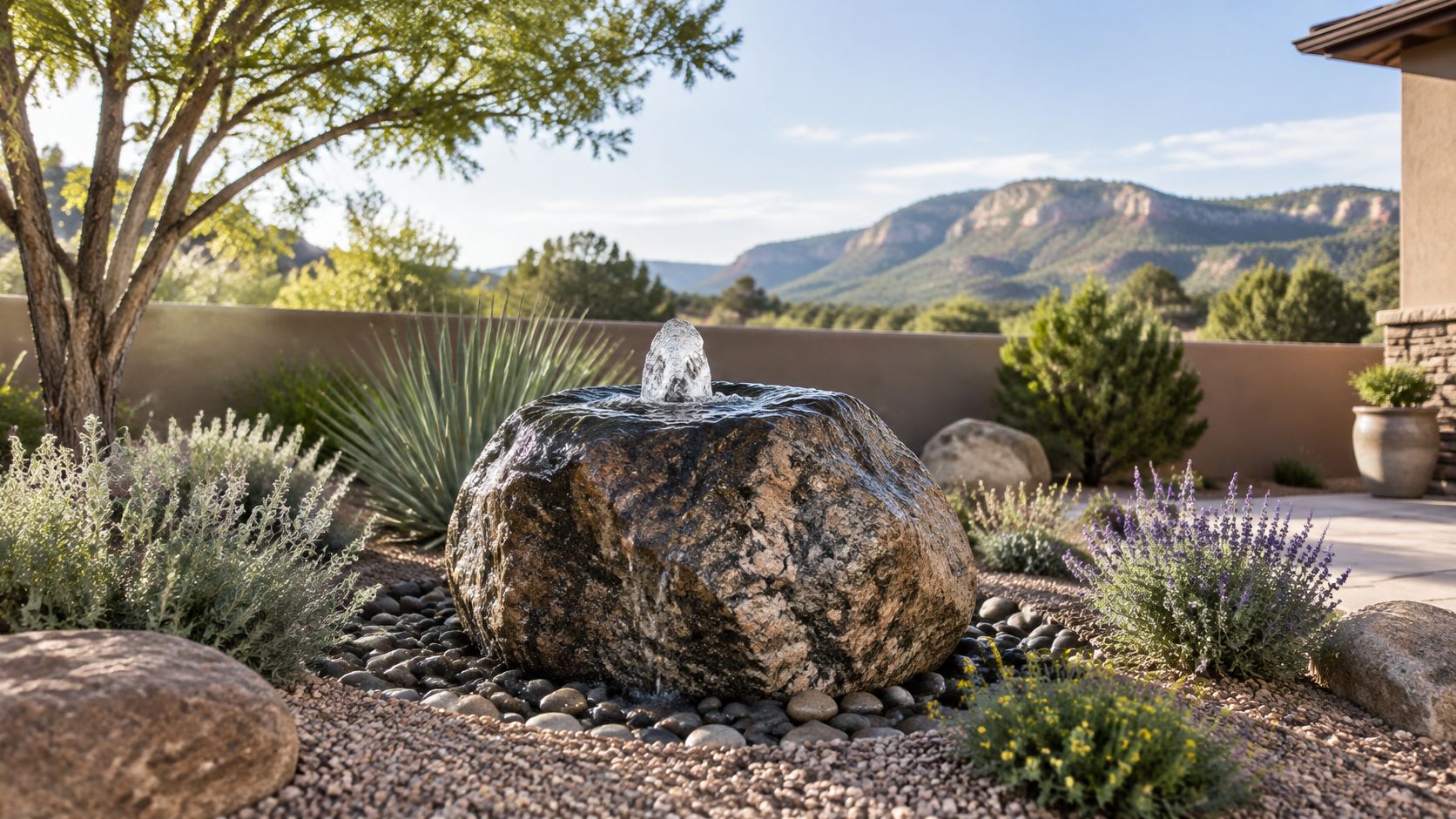
A boulder fountain is one rock, or a small group, with water welling through a drilled hole and sliding back into a buried basin. A submersible pump does the work. The stone reads as part of the granite and boulder ground that already covers much of the region.
Picture a front walk in a Prescott neighborhood where native rock is the hardscape. A single bubbling boulder at the entry gives you moving water in about the footprint of a patio chair. The same idea sits in a gravel backyard among desert plants, as long as feet aren't brushing the wet face all day.
What pump setup actually holds up
The EPA WaterSense homes technical manual recommends a smaller pump or a lower rate because higher flow increases evaporation, and it treats submersible pumps as the usual choice for small features. Shade the rock. A screened intake and a vault you can reach save a Saturday when grit packs the impeller.
Scale the stone: If it dwarfs the wall and the plants, it looks dropped in.
Keep it off the path: Wet granite is slick, and a bumped basin spills.
Pair it with low-water plants: Gravel and desert shrubs keep the wet spot from becoming a lawn.
A simple bubbling boulder can go into a tight side yard. What doesn't work is a tall splash on a windy ridge. The water leaves, the basin runs dry, and the pump burns up.
4. Wall-Mounted Fountain
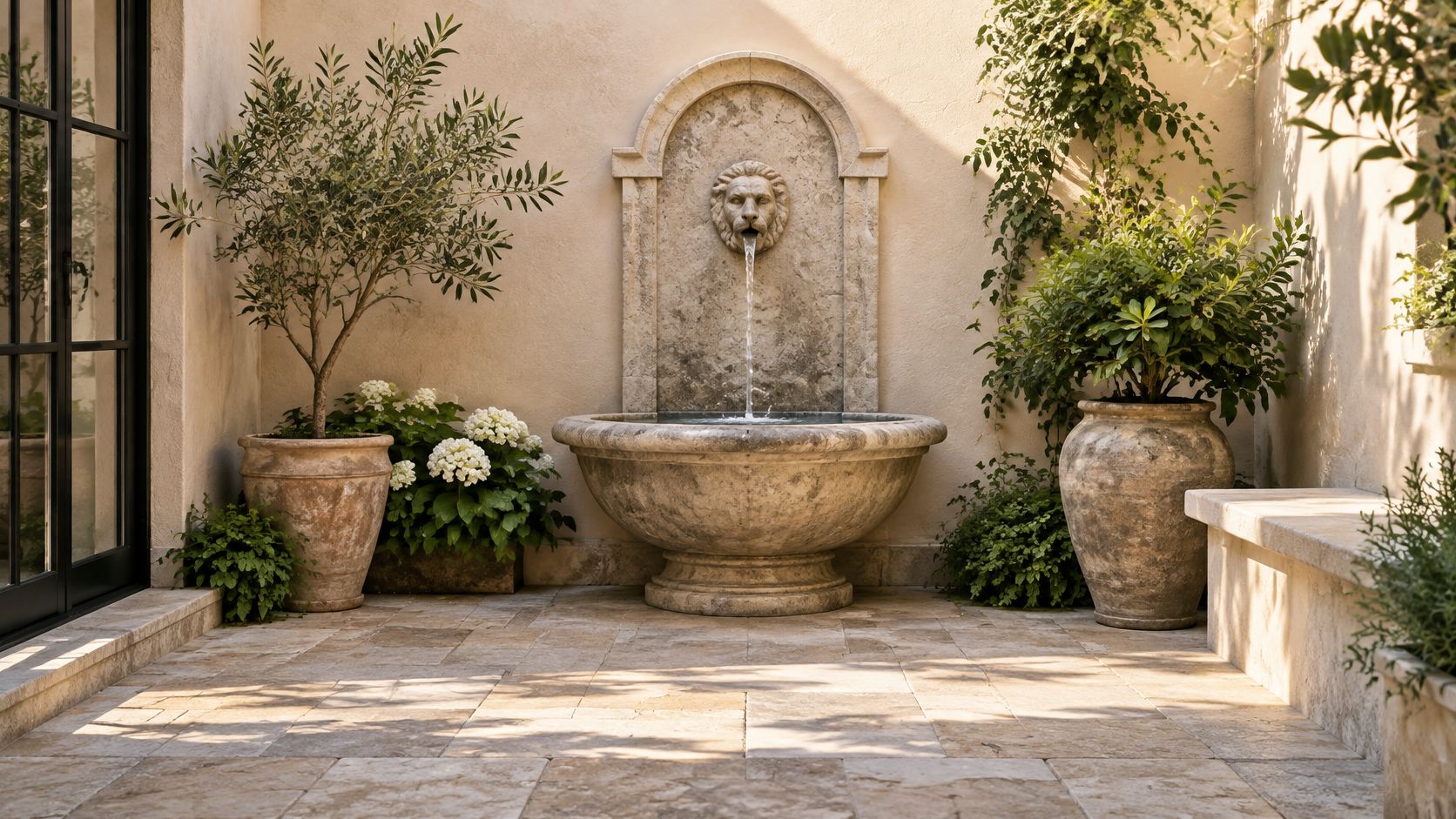
A wall fountain is a spout, scupper, or carved face on a fence, privacy wall, or house wall, spilling into a basin. It uses almost no ground, which is why it shows up in small Prescott Valley and Chino Valley yards that still want a retreat.
A stucco courtyard with a stone scupper beside the fireplace is the usual fit. The water is close to the chairs, the equipment is short, and the wall does the architecture. We tie these into paver patios and outdoor kitchens so the basin isn't an afterthought bolted on later. More layout notes sit in our piece on a water feature wall outdoors.
Can the wall carry it
Confirm the wall can hold the wet basin, not just the empty face. Use a basin deep enough that the pump doesn't suck air when the sheet is running. Set the spout back, or add a splash lip, so monsoon gusts don't paint the patio.
Plan a GFCI outlet while the wall is open. A cord draped across flagstone is how these get unplugged and forgotten. In a freeze, drain the basin and the short riser. A wall full of ice cracks tile and pushes the scupper off its anchors.
5. Bowl or Urn Fountain
A bowl or urn is a ceramic, cast-stone, or metal vessel with water spilling over the rim or rising from the center. It's the most movable option, and it fits a formal court, a modern patio, or a casual seat wall.
A tiered urn in the middle of a paver patio is the showpiece version. A single bowl by the entry, framed with desert plants, is the one most Prescott yards need. You get a focal point without excavation.
Frost will split a pretty pot that was only rated for a covered porch. If the label isn't outdoor and freeze-rated, don't leave it full through a Prescott winter.
How much upkeep is honest
Set it dead level or the sheet runs to one side and the pump gulps air. In summer, wipe the bowl weekly. Minerals and algae film a small volume fast. In a deep freeze, drain it or bring it in. A self-contained urn is a fair test of whether you like water noise before you cut into the yard. It is not a wildlife pond, and it won't mask a busy street.
6. Reflecting Pool
A reflecting pool is shallow and mostly still, meant to mirror sky, walls, and plants. It adds depth to a modern patio, an outdoor kitchen, or a fire feature. It does not give you waterfall sound, and it won't stay pretty if you ignore the surface.
A long linear pool lined up with a covered patio is the clean version in newer desert houses. Dark interior color makes the reflection stronger. A circulation pump or skimmer keeps dust and cottonwood off the mirror. Shade or a cover cuts summer loss. Put it where it reflects the house, a tree, or the view you sit for, not the neighbor's roof.
Does Arizona treat it like a pool
Sometimes. Under Arizona guidance on A.R.S. § 36-1681, a contained body of water that qualifies generally needs a barrier at least 5 feet high, with no opening a 4-inch sphere can pass, no exterior climb holds, and the barrier not less than 20 inches from the water's edge. If the house is part of the enclosure, the state allows alternatives such as a qualifying barrier at least 4 feet high or a motorized safety cover on a key switch that meets the cited ASTM standards. Confirm classification and permits in Prescott or Prescott Valley before you pour. A decorative sheet can still land in the statute once depth and design qualify.
I treat a reflecting pool as a finish element, not a low-care one. Still water shows every leaf.
7. Dry Creek Bed with Recirculating Stream
A dry creek is rock, gravel, and boulders shaped like a wash. Leave it dry and it still moves stormwater. Add a recirculating pump and the channel runs when you want the sound, then shuts off when you don't.
That split matters in Prescott and Prescott Valley yards that already sheet water toward the house in July. One channel can steer rainfall away from the foundation and, on dry weeks, connect an upper basin to a lower garden. The EPA WaterSense outdoors guidance for homes notes that households with poorly maintained automatic irrigation can waste up to 25,000 gallons a year. A creek planted with thirsty lawn on both banks undoes the savings. Native or drought-tolerant plants on the edges do not.
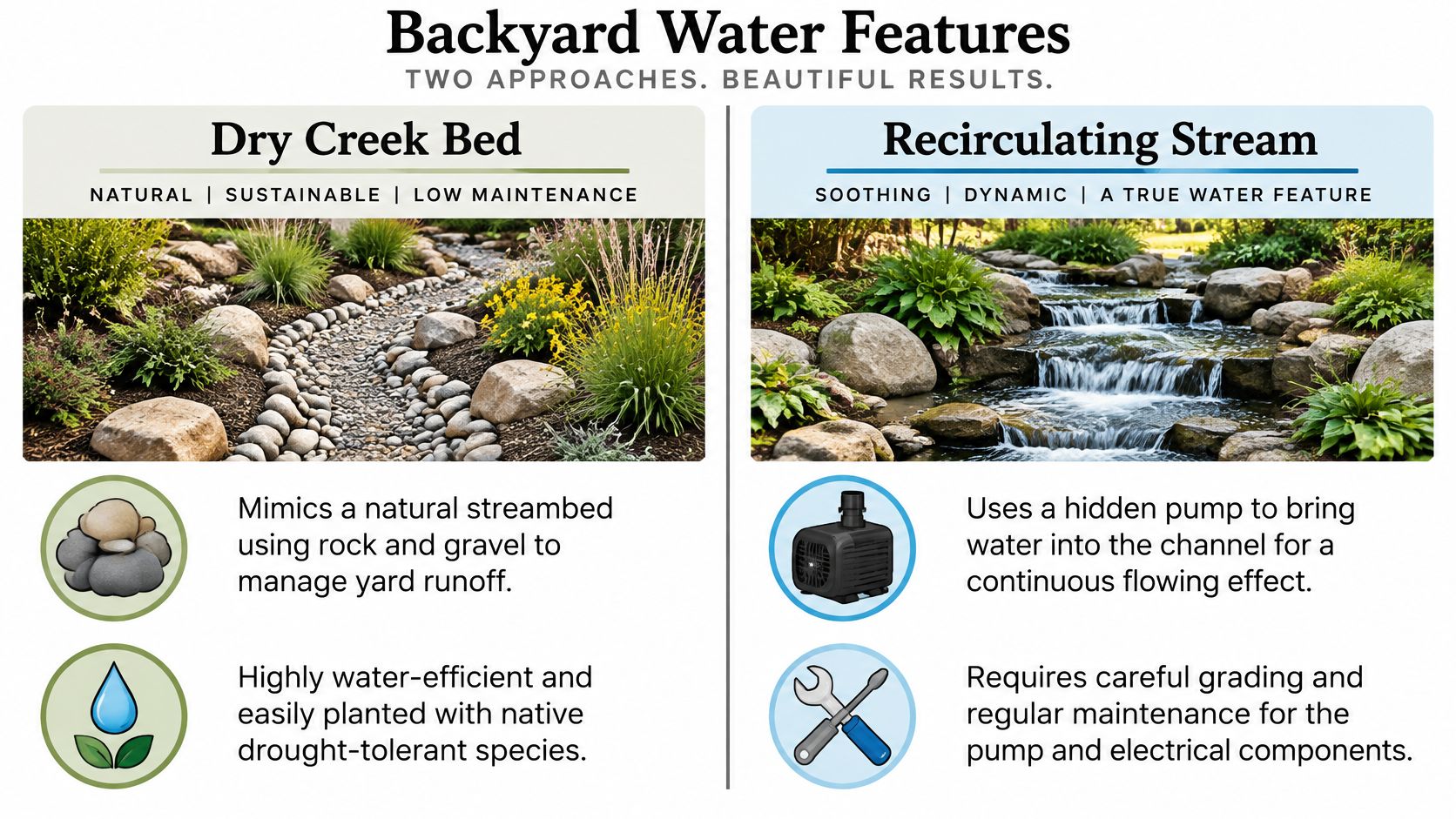
Follow the yard's slope. Mix river rock with larger boulders so it doesn't look like a gravel trench. Layout patterns that hold up are in our dry creek bed landscaping ideas. Size the channel for a real monsoon, not a garden-hose trickle. If the wash is too small, the first hard storm jumps the bank and dumps silt on the patio.
8. Tsukubai Stone Basin
A tsukubai is a traditional Japanese stone basin, originally for rinsing hands, set where a path slows you down. The point isn't volume. It's a pause.
Along a Prescott garden path, or in a small desert meditation court, a low basin with a gentle spill does that job. You should see it as you walk, not hunt for it behind shrubs. A tiny pump is enough. A gravity feed works if you've got the height and you're willing to refill by hand.
What fails in this climate
A basin hidden in full afternoon sun turns green and empty. Clean it on a short cycle so the little volume stays fresh. Pair it with native grasses and gravel, not a ring of high-water annuals. In a hard freeze, empty it. Stone that holds a ice plug can crack, and a seized pump is a poor surprise in March.
This feature is for someone who wants quiet, not a show. If you need sound that masks the street, choose a waterfall instead.
9. Misting and Fog Water Feature
Misting is a different tool. Nozzles on a pergola, wall, or kitchen cover throw a fine spray that cools the air so a patio gets used on a July afternoon. Families in Prescott Valley and Chino Valley add it beside outdoor kitchens and fire pits for the hours before sunset.
It is not a recirculating fountain. It consumes supply water the whole time it runs, so it belongs on a timer for the hottest stretch, not all evening. The Verde River local planning toolbox is a reminder to check city, HOA, and water-quality rules before you tie any feature, including mist, to harvested or reclaimed water.
Set nozzles high: Mist should evaporate in the air, not soak cushions or make pavers slick.
Filter or soften the feed: Local minerals clog fine nozzles fast.
Give the water somewhere to go: A covered patio still needs a dry path and a drain that doesn't pond at the step.
A pergola line over the dining side, with the fire pit just outside the wet zone, is the setup that gets used. A mist head aimed at the sofa does not.
How the nine backyard water features compare on yard size, upkeep, water use, and Prescott suitability
Item | Typical Yard Size | Maintenance Level | Water Use | Prescott Suitability |
|---|---|---|---|---|
Backyard Pond with Aquatic Plants | Small patio to large backyard | High; algae, top-offs, and seasonal care | High top-offs due to evaporation | Suitable with depth, shade, and freeze protection |
Waterfall or Cascading Water Feature | Small to large yard | Moderate; pump and basin upkeep | Low to moderate; recirculates, with splash and evaporation loss | Suitable with winter planning and a stable base |
Boulder Fountain | Small to medium yard; also works as a larger-yard accent | Low; periodic cleaning and pump checks | Moderate; small basins can evaporate quickly | Well suited to local rock landscapes |
Wall-Mounted Fountain | Small courtyards and tight spaces | Moderate; cleaning and winter protection | Low to moderate; recirculates, with some evaporation | Suitable with a sound, waterproofed wall and freeze protection |
Bowl or Urn Fountain | Small patios to courtyards | Moderate; regular cleaning and winter care | Moderate; small volume evaporates quickly | Suitable with frost-resistant materials and winter drain-down |
Reflecting Pool | Patios and formal outdoor spaces | Moderate; circulation and debris care | High evaporation in hot, dry weather | Suitable with shade and circulation to limit evaporation and algae |
Dry Creek Bed with Recirculating Stream | Small to large yards | Moderate; grading and pump upkeep | Low; water-efficient recirculating option | Well suited to native planting and runoff management |
Tsukubai Stone Basin | Small yards, paths, and courtyards | Low to moderate; regular cleaning | Low compared with larger features | Suitable for compact, reflective garden spaces |
Misting and Fog Water Feature | Patios, pergolas, and outdoor kitchens | Moderate; nozzle and mineral-buildup care | Moderate; requires a reliable water supply | Suitable for summer cooling with careful placement and drainage |
Picking the Right Water Feature for Your Prescott Yard
Match the feature to three things you already know. How big is the usable yard? How many minutes a week will you really spend on it? What happens to it in July heat and a January freeze?
A pond or reflecting pool is a living or architectural piece, and it wants weekly attention plus a winter plan. A waterfall, boulder, wall spout, urn, creek, or tsukubai can stay simpler if the water keeps moving, the splash stays in the basin, and you can reach the pump. Misting cools a patio and spends supply water, so it is a comfort add-on, not a water-saving one.
We build in yards of almost any size. Most residential water features are done in two to five days, depending on size and site conditions. At the end we walk you through basic care, which is checking the water level, keeping the pump clear of debris, and cleaning the filter on a schedule. After that we're available by phone when something sounds off.
The EPA WaterSense outdoors page reports that residential outdoor water use in the United States totals nearly 8 billion gallons a day, primarily for irrigation, and suggests watering in the early morning or evening. Coordinate the feature and the irrigation on the same plan. Direct water away from the house, keep spray out of the basin, and avoid placing a careful fountain next to a thirsty lawn.
Before you sign, verify the license. The Arizona Registrar of Contractors is the state's process for contractor licensing. We are licensed, bonded, and insured under Arizona ROC #300642, and you should confirm that current status yourself. We build custom fountains, ponds, and water walls, including a pondless waterfall that recirculates through a hidden reservoir so there is no open pond to skim. Pricing still moves with size, type, and complexity.
If you're in Prescott, Prescott Valley, Chino Valley, or elsewhere in Northern Arizona, schedule a complimentary design consultation online or by phone. Office hours are Monday through Friday, 8am to 4pm. Treat the last site walk the way you'd prepare for your renovation's final walkthrough: look at drainage, listen to the pump, and ask every maintenance question while we're still standing there.
R.E. and Sons Landscaping designs and builds backyard ponds, waterfalls, fountains, creeks, and misting for Prescott-area yards, with the pump, drainage, and winter plan settled before the rock goes in. If you want a feature you'll still enjoy after the first July and the first freeze, visit R.E. and Sons Landscaping and set a weekday consultation.
Comments