
Commercial Landscape Contractors: The Northern Arizona Guide
A property manager in Prescott can spot a weak grounds vendor quickly: missed visits, stressed turf, broken irrigation, overgrown paths, and a site that looks acceptable only after someone complains. Commercial grounds contractors should do more than protect curb appeal. They should keep the property safe, functional, water-conscious, and predictable to operate.
R.E. and Sons Landscaping helps property managers, HOA boards, commercial builders, and new home developers manage those demands across Prescott, Prescott Valley, Chino Valley, and surrounding Northern Arizona communities. The practical problem is vendor reliability. A dependable contractor turns an under-maintained or inefficient site into a professional environment with clear service standards, documented work, and maintenance that continues after the initial improvement.
Who We Help as Your Trusted Commercial Contractors
Commercial landscaping contractors serve more than office entrances. They support the people responsible for buildings, communities, construction schedules, tenant experience, and property risk.
Property managers need consistent mowing, pruning, irrigation inspections, weed control, cleanup, and response when a site develops a safety issue. Their concern isn't merely whether the property looks good on the day of a visit. They need a vendor that follows the agreed schedule, communicates exceptions, and documents conditions before small defects become owner complaints.
Commercial builders and general contractors need outdoor design and installation partners who can coordinate with site schedules, understand finish requirements, and complete work without creating avoidable delays. New home developers and HOA boards have a different concern. They need common areas, streetscapes, entrances, and amenity spaces to remain presentable while protecting long-term maintenance budgets.
Practical rule: Hire for dependable site performance, not for a polished proposal alone.
In Prescott and Prescott Valley, contractors must work with high-desert conditions, intense sun, seasonal freezes, wind, slopes, native soils, and water-conscious design decisions. Chino Valley and nearby Northern Arizona communities bring their own access, grading, plant-selection, and irrigation considerations. A vendor that understands the region can identify problems that a generic appearance-first maintenance plan may miss.
What a reliable commercial partner should solve
A sound program addresses four operating problems:
Site appearance: Entrances, turf, planting beds, walls, and hardscape remain orderly and aligned with the property's use.
Safety: Crews identify obstructed paths, unstable branches, irrigation leaks, damaged surfaces, and conditions that could create hazards.
Function: Irrigation, drainage, stormwater features, and outdoor areas work as intended instead of requiring repeated emergency repairs.
Communication: Managers receive clear updates, service records, and practical recommendations rather than vague assurances.
The right contractor also understands that a large commercial property cannot be maintained through isolated cosmetic fixes. Recurring service creates familiarity with the site. Crews learn where water collects, which controllers drift, which plants fail, and where traffic affects turf or hardscape. That knowledge helps the contractor prioritize work before a problem becomes expensive or disruptive.
R.E. and Sons Landscaping works with commercial builders, property managers, HOA boards, and businesses seeking site installation or ongoing maintenance in the Prescott area. The appropriate scope depends on the property, its users, its budget, and the performance standards the owner needs to maintain.
Scope of Services and Maintenance Business Models
Commercial grounds maintenance often produces stronger margins than installation. Composite maintenance gross margin is around 50–53%, with top-quartile performance above 58%, while install work is roughly 22–28%, according to commercial landscape industry benchmark reporting. Those economics shape how contractors staff routes, price service, and manage follow-up work.
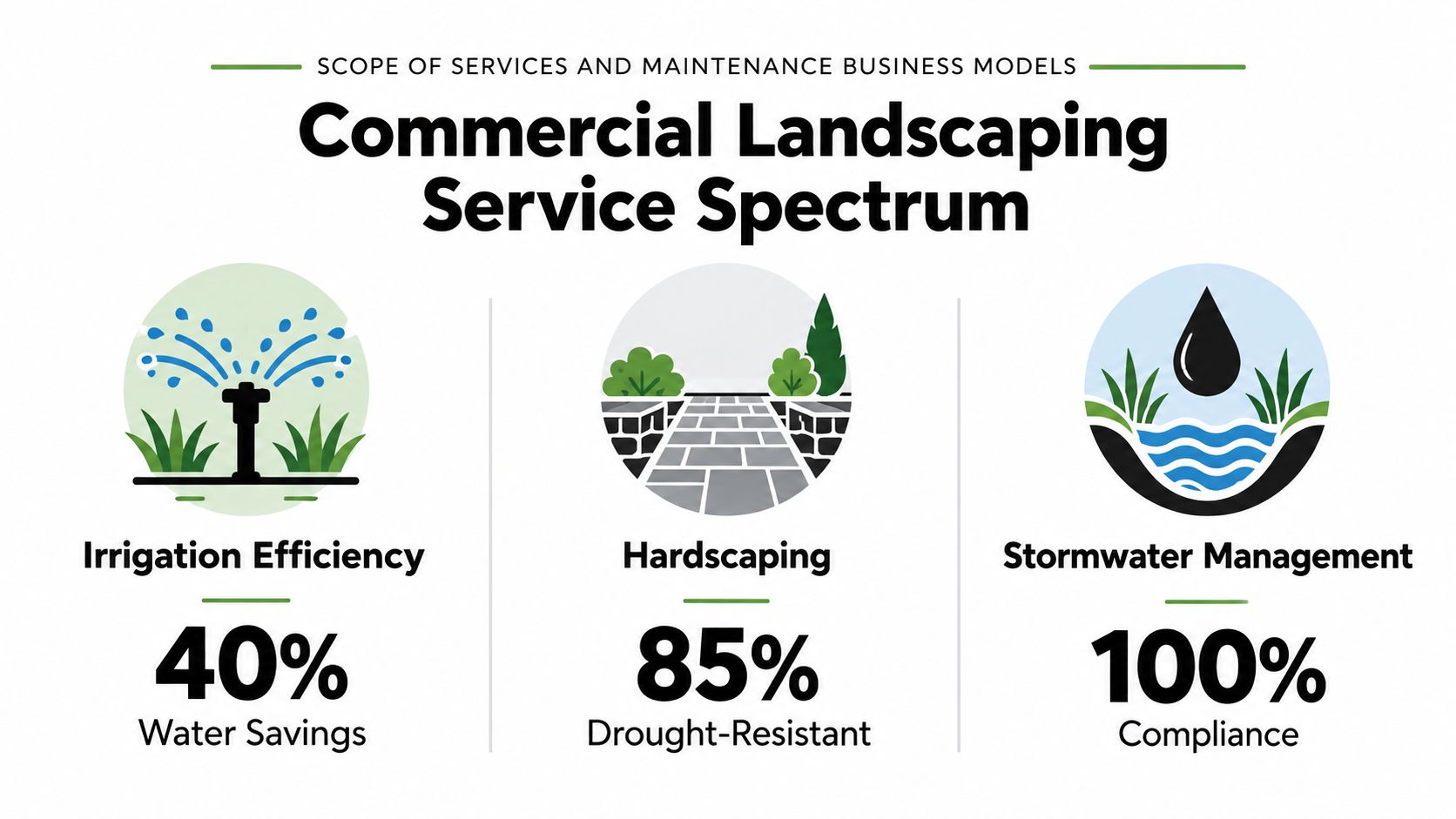
A recurring contract can cover horticultural care, irrigation management, tree and shrub work, seasonal cleanup, drainage, stormwater control, hardscaping, artificial turf, planting renovations, and site reporting. The best scope starts with how the property operates and tailors tasks to actual site demands.
Routine maintenance may include mowing, edging, pruning, weed management, litter removal, bed care, turf health, and seasonal adjustments. Enhancement work can address drought-tolerant planting, rock and stone features, pavers, pedestrian areas, retaining elements, or artificial turf when lower water and mowing demand supports the property's operating goals. Stormwater work requires separate specifications for runoff paths, erosion, drainage inlets, grading, and surface conditions after weather events.
A contractor with a healthy recurring maintenance operation has a reason to protect route consistency, retain trained crews, and keep service predictable. Installation remains important for new construction and major renovations, but it carries different scheduling, material, estimating, and cash-flow pressures. Those differences make the contract model relevant to buyers evaluating ongoing site performance.
Industry benchmarks place direct labor near 31% of net revenue and cost of goods sold near 47%. Route density, labor productivity, and accurate job costing therefore affect pricing. A property manager should expect costs to vary with access, service frequency, travel, site complexity, labor requirements, irrigation condition, and included enhancement work.
Write the agreement so routine services are separate from additional work. Confirm whether irrigation repairs, storm cleanup, tree work, seasonal color, materials, and after-hours response are included or billed separately. Define response times, visit frequency, inspection records, measurable site standards, and approval limits for extra work. These terms show whether the bid supports predictable upkeep and defensible ROI, such as fewer emergency repairs, lower water demand, or reduced replacement work.
For practical service components, review landscape maintenance services. Compare bids by the resources assigned to the property and the results the contract requires.
Licensing, Bonding, and Insurance Requirements
A commercial site can look finished while its contract leaves the owner exposed. A contractor's license, bond, and insurance answer different questions and each addresses a distinct risk a commercial client faces. Verify all three before evaluating appearance standards or projected savings.
In Arizona, an entity must hold a contractor license to perform contractor work, and the Arizona Registrar of Contractors requires a bond for licensing. Apart from workers' compensation insurance, the Registrar does not require insurance for licensing, according to this overview of Arizona landscaper licensing requirements. A valid license therefore represents only one part of the vendor review. Request current insurance documents separately before the owner, manager, builder, or HOA signs.
What each safeguard does
Safeguard | What it demonstrates | What to verify |
|---|---|---|
State license | The business meets Arizona contractor licensing requirements for its work | License number, classification, status, and expiration |
Surety bond | A financial protection mechanism tied to licensing obligations | Bond status and any project-specific bonding requirements |
General liability | Coverage for qualifying third-party bodily injury or property damage claims | Certificate, limits, policy dates, and additional-insured requirements |
Workers' compensation | Protection related to covered employee workplace injuries | Current certificate and confirmation that the contractor carries required coverage |
Commercial auto | Protection associated with business vehicles used at the property | Vehicle coverage and policy dates |
Other project coverage | Possible protection for specific contractual or construction risks | Whether the contract requires additional endorsements or surety instruments |
Commercial clients commonly request general liability, workers' compensation, commercial auto, and, in some projects, surety bonds. One industry overview places general liability minimums between $300,000 and $1 million, depending on the state and requirement. The contract and jurisdiction determine the appropriate limit, rather than a universal standard. This resource on general liability for 1099 workers can help when subcontractors or independent crews are part of the service model.
Verify before signing
Ask the carrier or broker to send the certificate of insurance directly. Check policy dates, coverage limits, and any additional-insured requirement for the property owner, manager, builder, or HOA. Confirm that coverage remains active through the anticipated work period, then specify renewal documentation and notice procedures in the agreement.
Verify the contractor's license through Arizona contractor license verification guidance. Both license and insurance checks provide useful risk information. Request references, sample service reports, emergency procedures, and the name of the person responsible for route communication. Those records help evaluate staffing and communication directly, while contract metrics such as irrigation failures, emergency callouts, and replacement work connect compliance checks to operating performance and ROI.
Navigating Procurement and RFPs
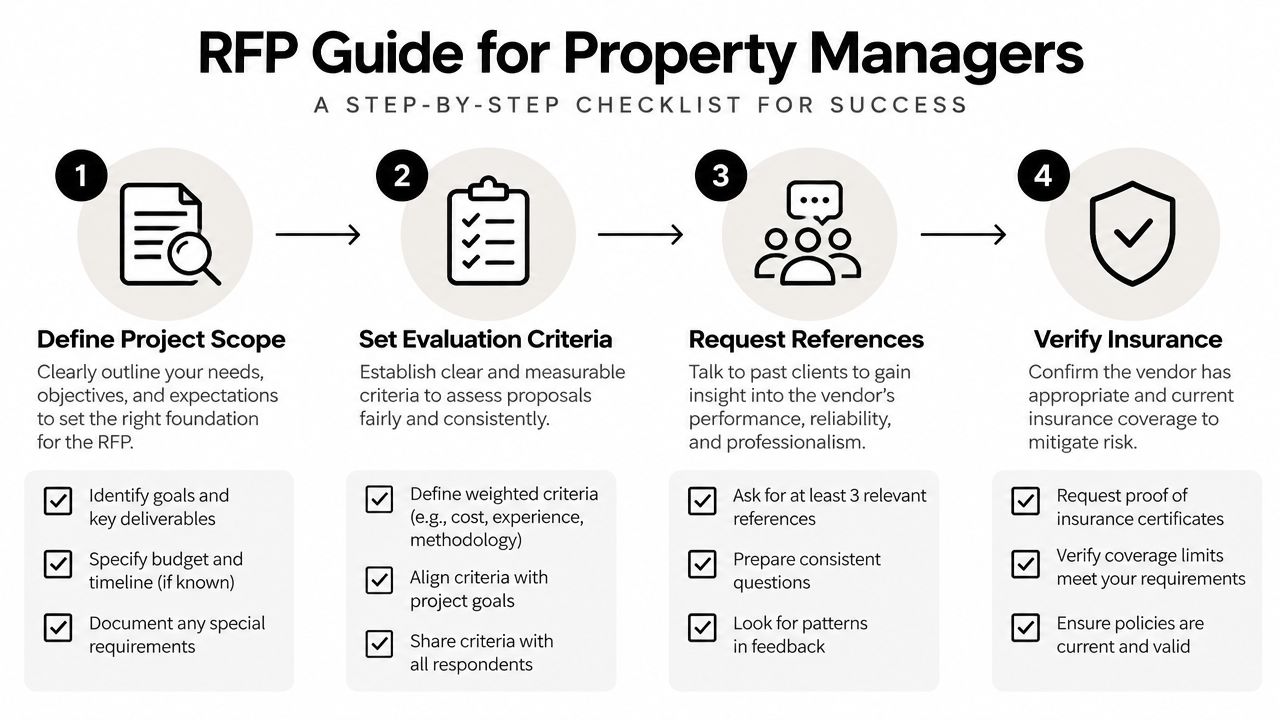
A strong request for proposal gives property managers a fair basis for comparing commercial site contractors. Define the site standard, visit expectations, exclusions, response process, reporting format, and approval rules before requesting prices. Clear wording reduces pricing gaps and makes later performance disputes easier to resolve.
Start with a usable scope
Walk the property before writing the RFP. Mark turf, planting beds, trees, irrigation zones, drainage structures, sidewalks, parking areas, walls, slopes, entrances, and high-use spaces. Include photographs and identify known trouble areas openly. Bidders can then price the existing condition instead of building unknown repairs into a vague allowance.
State the required work and the evidence expected at each visit. Specify acceptable conditions for beds, turf, pruning, litter, and edging, then identify inspection duties, reporting deadlines, escalation contacts, and exclusions. Include who owns corrective work when irrigation failures, drainage defects, storm debris, or access problems fall outside routine maintenance.
Build a bid evaluation matrix
Price should be one column, not the entire decision. Score each proposal against scope alignment, staffing plan, supervision, documentation, insurance, communication, emergency coverage, and projected operating risk. Require bidders to identify assumptions, exclusions, restoration work, material markups, overtime rates, and services billed outside the base agreement.
Ask for sample service reports and a description of how the contractor will track missed visits, open work orders, irrigation observations, emergency callouts, and replacement work. These records connect the contract to measurable operating results, including fewer avoidable failures, controlled water use, safer circulation, and more predictable maintenance costs.
Set terms that protect performance
Useful contract provisions include:
Service-level guarantees: Define the remedy for a missed visit, unresolved complaint, or failed inspection.
Crew continuity standards: Require notice when the assigned crew changes and name the supervisor responsible for replacement coverage.
Digital reporting standards: Request dated photos, completed tasks, open issues, and recommended actions.
Response procedures: Set expectations for urgent leaks, storm damage, blocked access, and safety concerns.
Approval controls: Require written authorization for enhancements, materials, overtime, and work outside the base scope.
Review meetings: Tie regular reviews to documented site conditions and agreed measures, rather than personal impressions.
Labor shortages and crew turnover make staffing provisions practical risk controls. Trade coverage describes seasonal labor shortages and H-2B constraints that can force contractors to reduce spring workloads. Ask how each bidder covers absences, trains replacements, and preserves service quality when staffing changes.
The lowest bid can become the highest operating cost after missed visits, emergency repairs, and unclear extras are added. Choose the proposal that makes performance visible and gives the property manager control over scope changes.
Local Climate and Irrigation Efficiency Strategies
Northern Arizona outdoor spaces punish generic maintenance plans. Prescott-area properties face intense sun, dry periods, freeze events, elevation changes, wind, and uneven site exposure. A planting palette and irrigation schedule that works in a different region may waste water or stress plants here.
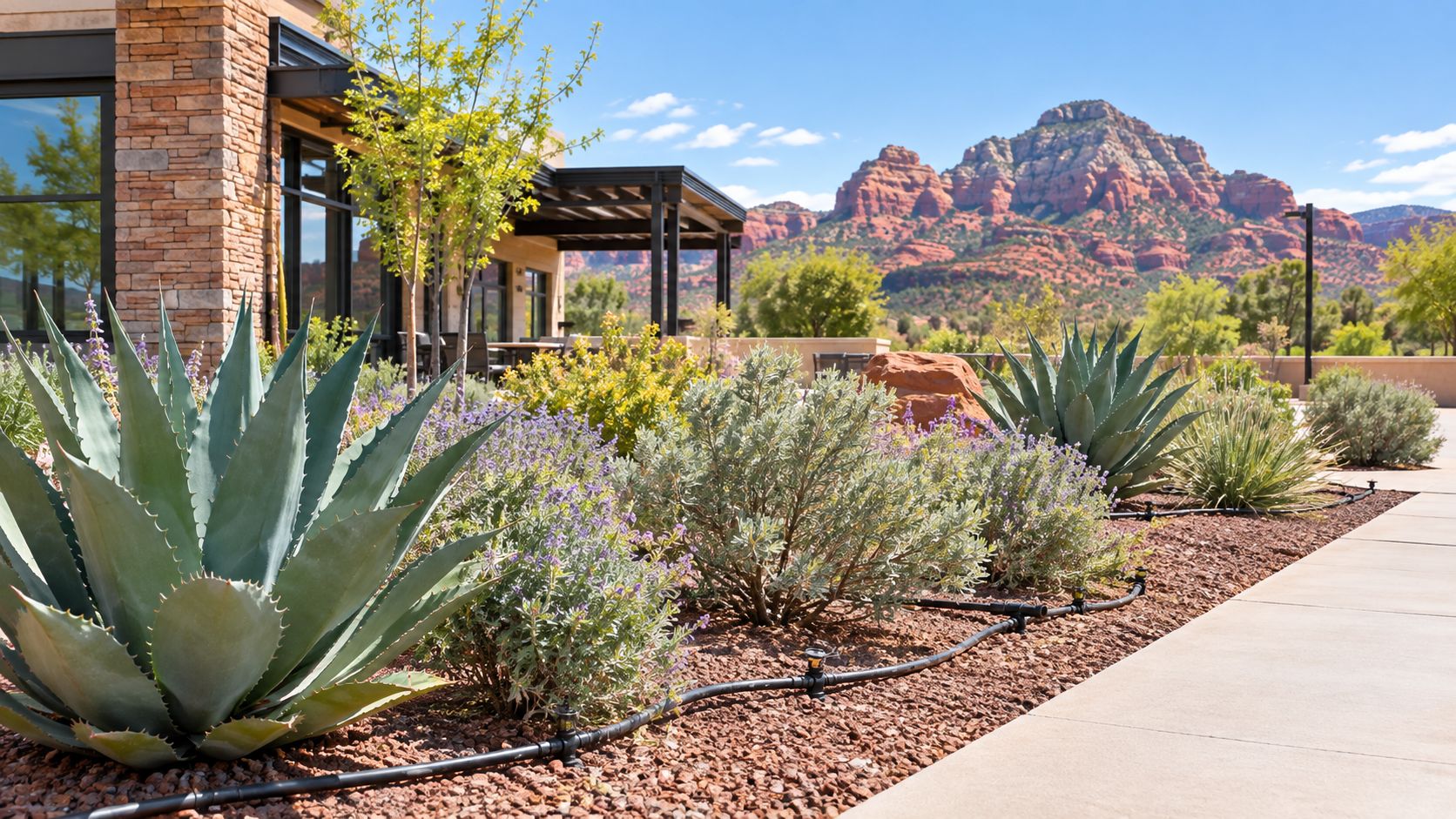
A commercial contractor should begin with the site, not a catalog. Check soil, slope, exposure, existing irrigation coverage, plant maturity, pedestrian use, and the maintenance team's ability to keep the system calibrated. Native and drought-tolerant plants can reduce dependency on intensive irrigation, but they still need correct establishment, spacing, drainage, and seasonal care.
Water is often a controllable operating load. The U.S. EPA reports that commercial and institutional grounds can represent about 7% of total water use in hospitals, 22% in office buildings, and up to 30% in schools, as documented in WaterSense guidance for commercial landscaping. Those figures make irrigation inspection relevant to facilities budgets, not just horticultural preferences.
Build the irrigation plan around weather
Evapotranspiration, rainfall offsets, soil conditions, and controller calibration should guide scheduling. A properly installed WaterSense-labeled weather-based irrigation controller may reduce irrigation water use by 15%, according to the same EPA guidance. The controller isn't a substitute for field inspection. Misaligned heads, broken valves, pressure problems, clogged filters, and leaks can defeat a well-designed schedule.
For a Prescott commercial property, ask the contractor to document:
Which zones are overwatering or missing coverage.
How seasonal adjustments are made.
Whether rainfall and weather data affect runtime.
How leaks and broken components are escalated.
Which plant areas should be converted or redesigned.
How water performance is reported to the owner.
A practical program may combine targeted repairs, drip irrigation where appropriate, hydrozoning, native or adapted plantings, mulch, rock, permeable surfaces, and controller updates. The right choice depends on the property's use and budget. Replacing every planted area isn't automatically efficient if a focused repair and scheduling program solves the main waste.
This irrigation and landscape resource can help owners frame the discussion before requesting proposals.
A well-written irrigation scope should connect work to a measurable operating objective, such as fewer leaks, better coverage, documented runtime changes, or progress toward a water budget. The contractor should explain what will be changed, how it will be verified, and what ongoing maintenance the system requires.
Hiring Checklist and Vendor Vetting Guide
Use the following checklist before awarding work to commercial landscaping contractors in Prescott, Prescott Valley, Chino Valley, or nearby Northern Arizona communities. The goal isn't to create paperwork for its own sake. Each question reduces a specific operational, financial, or safety risk.
Confirm the business first
License: Verify the Arizona contractor license, classification, status, and expiration.
Bond: Confirm the required bond is active and ask whether the project requires additional bonding.
Insurance: Request current certificates for general liability, workers' compensation, and commercial auto.
Contract identity: Make sure the legal entity on the proposal matches the entity on the license and insurance documents.
References: Speak with comparable commercial clients, not only residential customers.
Test the operating plan
Ask who supervises the site, how crew changes are communicated, and what happens when the regular team is unavailable. For seasonal staffing questions, this overview of what the H-2B program is provides useful background, but the vendor still needs to explain its own staffing and continuity plan.
Request a sample service report. It should show completed work, open issues, photos where useful, irrigation observations, safety concerns, and recommended follow-up. If the contractor can't describe how a manager will know what happened at the property, the proposal is incomplete.
Read the commercial terms
Check the service frequency, seasonal adjustments, exclusions, emergency response, approval limits, invoicing, cancellation terms, warranty language, and responsibility for damage. Ask how the contractor handles irrigation repairs, storm cleanup, tree hazards, vandalism, and work outside the base scope.
R.E. and Sons is a licensed, bonded, and insured design-build company serving Prescott, Prescott Valley, and Northern Arizona, with outdoor installation, outdoor improvements, and a dedicated maintenance department. For commercial buyers, the relevant evaluation points remain the same: clear scope, documented credentials, realistic scheduling, local site knowledge, and a written process for ongoing service.
A trustworthy proposal makes it easy to understand what will happen, who is responsible, and how performance will be reviewed.
Finish by comparing total risk, not just the quoted price. Choose the contractor that can explain the work clearly, support the property consistently, and document whether the property grounds are meeting the standard your tenants, residents, owners, or construction clients expect.
If your Prescott-area property needs a dependable maintenance plan, irrigation review, property enhancement, or commercial installation partner, R.E. and Sons Landscaping can help define the scope and build a practical service path for the site. Visit R.E. and Sons Landscaping to discuss your property, project requirements, and next steps.
Comments