
Water Fountain Installation Cost: A 2026 Prescott Guide
Installed costs for a water fountain vary widely, and the scope of the install, not the fountain's retail price, sets the final number. In Prescott, local water and permit rules can rule a design out before any price is even quoted.
R.E. and Sons Landscaping helps homeowners in Prescott, Prescott Valley, Chino Valley and surrounding Northern Arizona communities pin down that scope through a free consultation and a detailed, itemized quote, so excavation, power, plumbing, permits and water rules are priced before you sign rather than discovered after.
How Much Water Fountain Installation Costs Today
A U.S. cost survey from HomeAdvisor reports an average installed price of $2,847, with observed projects ranging from $150 to $12,000. Those figures are planning benchmarks, not quotes. For professionally installed residential work, expect a narrower national band around the middle, with larger custom features moving well above it.
The spread isn't mysterious. You're rarely paying only for a basin. You're paying for everything that makes water move safely in your yard and keeps doing so after the crew leaves.
What's included in an installed price
Equipment: The fountain body, pump, reservoir or basin, and plumbing parts.
Site work: Excavation, leveling, drainage planning and a base that won't settle or crack.
Utilities: Water connections where needed, plus electrical work with proper protection.
Finishes: Stone, masonry, gravel, planting edges and the final grade around the feature.
Labor and approvals: Installation time, startup testing and permitting where your scope requires it.
Say you place a small prefabricated unit beside an existing compliant outdoor outlet on flat ground. That project sits near the low end because the crew isn't trenching power, running new water lines or building a masonry basin. Put a large feature across a sloped yard in rocky Northern Arizona soil, far from utilities, and the same looking fountain can land near the top.
If one bid lists only the fountain and another lists excavation, utilities, base and finish work, they aren't bidding the same project.
We're a licensed, bonded and insured design-build company, and we price water fountain installation cost the way it should be compared, line by line. Homeowners budgeting filtration for a house system face the same trap, which is why a homeowner's guide to filtration budgets is useful context for separating equipment price from installed price. Below, you'll see ranges by type, the component math, Prescott's local rules, sample budgets with five year running costs, and the questions to ask before accepting any quote.
Installed Cost Ranges by Fountain Type
Start with material, because material decides weight, base depth, delivery access and labor before it decides looks. The Lawn Love cost guide puts a professionally installed residential fountain at approximately $1,100 to $7,500 nationally, with a survey average near $4,300. That average runs higher than the $2,847 HomeAdvisor reports for the same measure, and the gap comes down to sample. Each guide pools a different mix of fountain types, regions and project scopes, so read each figure as a benchmark for its own dataset rather than a single national price. Large custom builds can exceed the Lawn Love range entirely.
Fountain type | Installed cost range | Why it sits there |
|---|---|---|
Fiberglass or resin fountain | $120 to $2,800 | Lighter, easier to place near existing utilities |
Concrete fountain | $600 to $7,000 | Needs a stronger base and delivery access |
Natural stone fountain | $500 to $25,000 | Heavy material, larger base, more labor |
Professionally installed residential fountain (benchmark) | $1,100 to $7,500 | Lawn Love survey average near $4,300; custom features can exceed this |
How to read these ranges
Fiberglass and resin sit lowest because one or two people can often carry and level the unit without heavy equipment. If power is already nearby and the pad is simple, installation stays contained. The compromise is feel and longevity. Lightweight units can look fine, but they don't carry the weight or permanence of stone in a front courtyard.
Concrete costs more to install even when the unit itself is modest. It needs a base that supports real weight, room for a truck or cart to reach the spot, and careful leveling so tiers spill evenly. On a tight Prescott lot with a narrow gate, access alone can add labor.
Natural stone has the widest band for a reason. A single drilled boulder is a relatively simple build. A multi piece stone feature with a buried reservoir, boulder placement and finish rockwork is a small construction project. A simple bubbling boulder or pondless waterfall typically starts in the mid hundreds of dollars for materials, and the total installed cost depends on the specific design.
In Northern Arizona, rocky soil and slope push concrete and stone jobs toward the upper end of their bands. Digging a reservoir into decomposed granite is different work than digging into caliche laced ground with embedded rock, and correcting grade so water drains away from the basin takes time either way.
Two fountains with the same shelf price can land several thousand dollars apart once access, base depth, and reservoir work are priced in. Water feature pricing varies based on size, type, and complexity, so use the table to find your material first, then let your yard tell you where inside the band the project sits.
Where Labor and Materials Take Your Budget
For custom or integrated systems, labor commonly represents about 40% to 60% of the project total, according to the Design Transition Studio cost guide. That number makes more sense once you price the installed scope instead of the fountain's retail tag. The crew excavates, sets the basin or liner, conceals plumbing, wires pump and lights, places stone, commissions the system and finishes the grade. Setting the decorative piece is usually the shortest task.
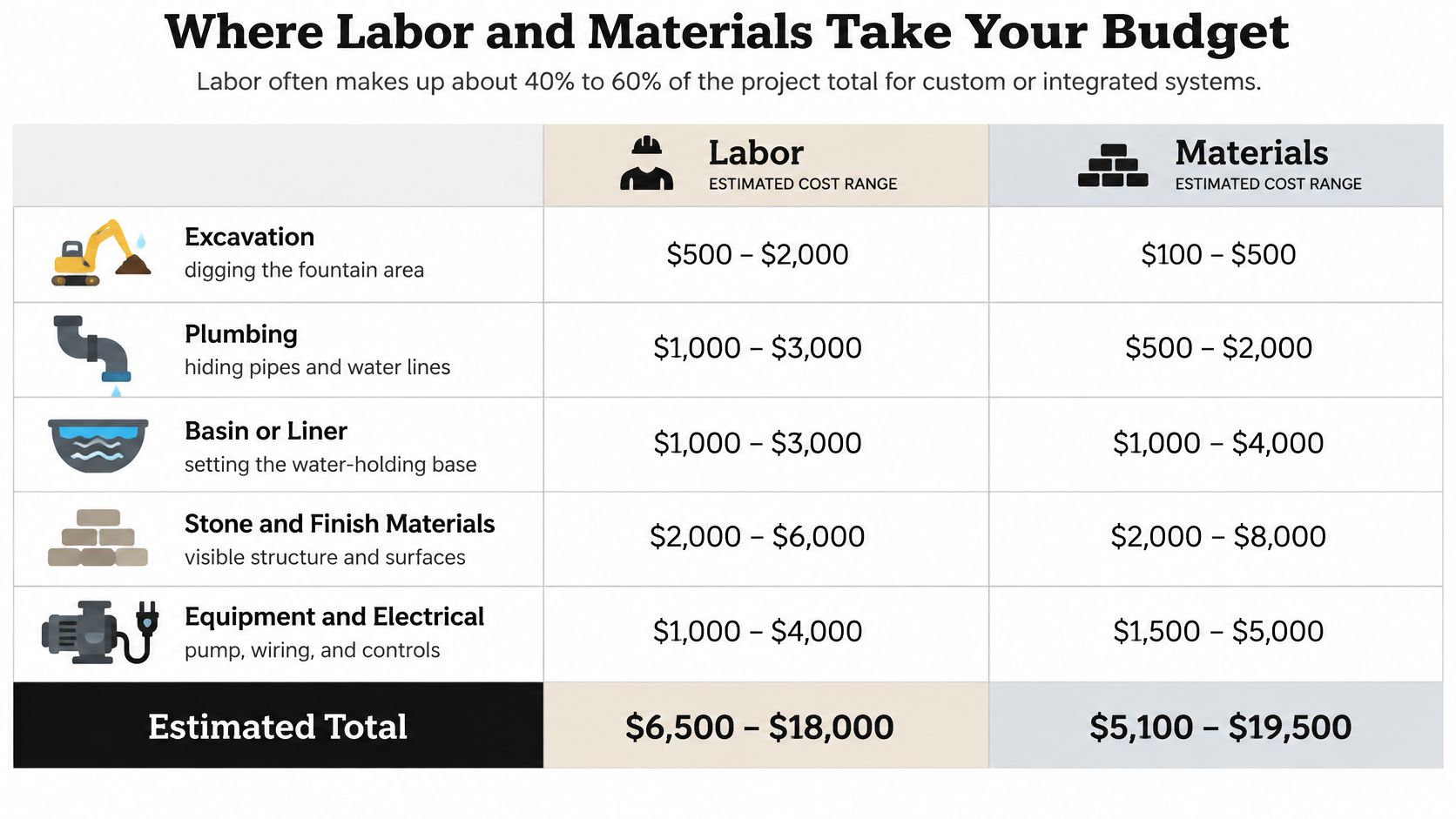
Component | Typical range | What it covers |
|---|---|---|
Excavation and reservoir | $300 to $800 | Site digging, basin or liner |
Pump and plumbing | $400 to $800 | Concealed lines and pump commissioning |
GFCI outlet | $175 to $500 | Required protection for outlets near water |
Decorative rock, stone or feature elements | $800 to $2,000 or more | Stone setting and feature placement |
Professional LED lighting | $400 to $1,400 added | Optional nighttime lighting |
Automatic fill valve | $300 to $600 or more added | Optional, reduces manual topping off |
Why the basin price misleads
A low-priced basin can still produce a high bid once stone delivery, a long pump run and difficult access are added. A packaged feature with simple rockwork can come in lower even when the fixture itself costs more. Pipe is part of that hidden math: material markets vary enough that a page built to compare PVC pipe prices in Dubai can be a reminder to check assumptions, while the local drivers are run length, fittings, and whether lines are buried, sleeved and reachable for service later.
LED lighting and an automatic fill valve both earn their keep when you'll use the feature at night or travel often. They also add wiring, controls, valves and new maintenance points. I'd add them when they solve a real problem, not because they were on a showroom display.
Our waterfall packages typically cover basin and reservoir construction, rockwork and boulder placement, site excavation and grading, full consultation and custom design, plumbing and electrical rough in, pump, filtration, and lighting installation, and a final walkthrough and system orientation. For waterfalls, the spec matters as much as the line count: high-efficiency pumps, reinforced liners and natural stone finishes that don't fade change both cost and lifespan. Compare every bid against that list. If you're weighing stone choices, our guide to selecting rocks for water features explains how rock type affects both look and placement effort. Ask exactly how excavation and stone delivery are priced, because long runs and hard access move those two lines first.
What Moves Your Fountain Quote Up or Down
Five levers explain most of the gap between two quotes for what looks like the same fountain. Walk them in order and you'll know which questions to ask.
A short planning conversation on site catches most of these before they become change orders.
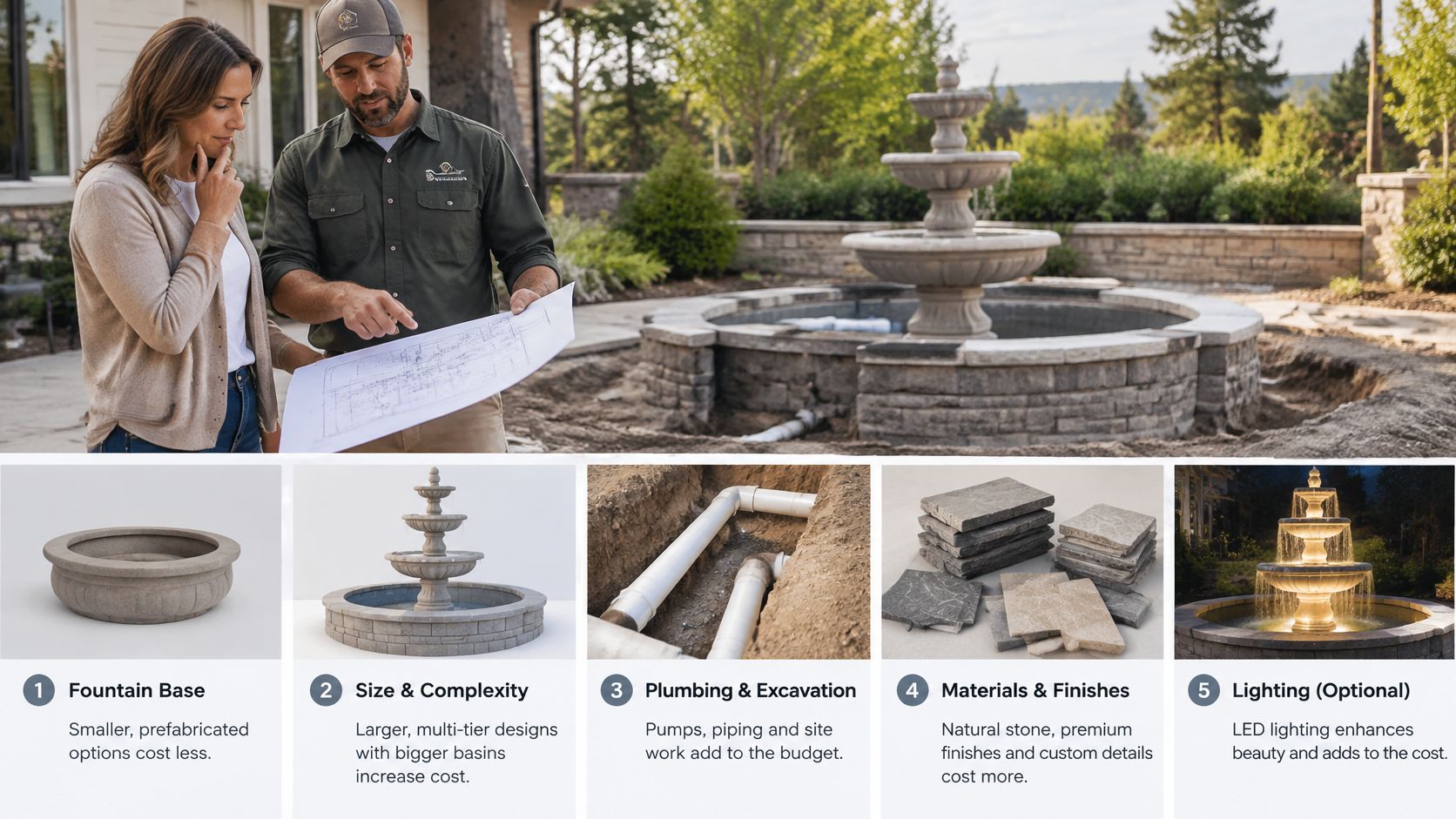
Size and complexity
A small prefabricated feature needs a pad, a pump and an outlet. A multi tier cascade needs a larger basin, more rockwork, a stronger pump and careful leveling at every spill point. Each added tier multiplies adjustment time, because water finds every error. Check whether your quote prices the feature you drew or a simpler version of it.
Plumbing and equipment
Distance to existing water lines matters, as does pump type. Surface pumps may cost more than submersible pumps and may require additional plumbing under the EPA and Pacific Northwest National Laboratory guidance on ornamental water features, which raises installation complexity. A permanent feature needs liner, pump and filtration installed together, sized as one system rather than matched at the store by guesswork. Our installations use high-efficiency pumps and reinforced liners, and any bid worth signing should name the liner and pump spec the same way it names the stone.
The installation sequence in this video shows why concealed work takes longer than the visible finish.
Electrical distance and protection
A standalone fountain usually needs a nearby outdoor receptacle. The farther the feature sits from one, the more trenching, conduit and wiring the quote has to include. Under the 2021 International Residential Code electrical provisions, fountain lighting in a nonmetallic raceway may use a minimum cover depth of 6 inches when it's limited to no more than 30 volts and part of a listed low voltage system. Ordinary receptacles near the water need GFCI or SPGFCI protection, so a fountain beside an existing compliant outlet costs less than one needing a new circuit run from the panel.
Excavation, grade and finishes
Rocky soil, slope correction and long utility runs raise labor before materials even arrive. Concrete and stone then require stronger bases and sometimes lifting equipment. Many of our projects integrate a waterfall into an existing pool, patio or pond, and that assessment depends on existing structure, grade and access. Tying into finished hardscape protects what's already built, but it also means cutting, patching and matching surfaces. Natural stone finishes that don't fade cost more up front, yet they spare you the replacement cycle cheaper coatings create after a few seasons of sun and freeze-thaw.
Ask this directly: Which of these five levers does your quote actually price, and which ones did you assume away?
Prescott Rules and Permits That Affect Your Budget
Most national cost guides never ask whether your design is allowed where you live. In Prescott, that question comes first. The Prescott city code on water conservation provides that spray type fountains connected to the city water system are prohibited, although small decorative fountains are excluded, and the city may restrict ornamental fountain water use during shortages.
That single rule can flip your budget. A cheap looking spray fountain that needs redesigning after the quote becomes the expensive option. A smaller closed loop bubbler that recirculates its own water usually carries less regulatory risk and far lower water demand.
What recirculating means in plain terms
The same water cycles from basin to pump to filter and back. You top off only what evaporation and splash remove. There's no continuous draw on city water, which is exactly why this design fits drought prone Northern Arizona yards.
When a permit enters the price
Permit treatment depends on permanence, electrical connection and construction scope, not on the word fountain. A general fountain permit guide estimates combined building and electrical fees commonly total about $200 to $400 when permits are required, with building permits around $100 to $250 and electrical subpermits around $50 to $150, and some jurisdictions calculate fees as approximately 1.5% to 2% of project valuation. Treat those as general benchmarks, not Prescott guarantees, and confirm the current local fee schedule before you budget.
A portable unit sitting on a patio with no plumbing or structural connection is treated differently from a feature bolted down, built into hardscape, or tied into a pond. Excavation, masonry and new electrical work all push a project toward permit and inspection territory.
We build custom waterfalls for Prescott homeowners and flag these questions during design, not after materials are ordered. If you're in Prescott Valley or Chino Valley, confirm your own jurisdiction's requirements rather than assuming Prescott's rules travel with you.
Design check: Does the feature qualify as small or decorative, and is it recirculating?
Water check: How is it replenished, and is an automatic fill tied to city water?
Drainage check: Where does overflow go during a monsoon storm?
Permit check: Which building, electrical or plumbing approvals does this scope trigger?
Sample Budgets and Five-Year Running Costs
Sample budgets help if you know what they are. These totals are sums of published component ranges, not quotes, and they exclude permits. Your yard's soil, access and utility distances will move each line.
Sample project | What is included | Basis |
|---|---|---|
Small fiberglass fountain near an existing compliant outlet, roughly $520 to $3,600 | Fiberglass unit, pump and plumbing | Sum of published ranges, excludes permits |
Concrete fountain with new GFCI outlet and excavation, $1,475 to $9,100 | Concrete unit, excavation and reservoir, pump and plumbing, GFCI outlet | Sum of published ranges, excludes permits |
Custom stone waterfall with LED and fill valve, $2,375 to $6,100 | Stone feature, excavation, pump and plumbing, GFCI outlet, LED lighting, fill valve | Sum of component ranges; heavy rockwork can exceed this |
What ownership actually costs
Headline quotes rarely show running costs. A recent consumer feature on backyard water features describes routine maintenance as checking water levels, cleaning filters and pumps, removing debris, managing water chemistry where needed, and winterizing seasonal systems. In the Prescott area, evaporation, wind blown dust, freezing nights and mineral buildup decide how often you do each task.
Build a five year model instead of trusting the install price. Add pump electricity, top off water, filter cleaning, seasonal shutdown and at least one pump service or replacement to the upfront number. Before putting dollars on electricity and water lines, confirm your current local rates and label every figure as an assumption with its basis stated, because a model with unnamed rates is just a guess in a spreadsheet.
We install recirculating pump and filtration systems in our waterfalls because a closed loop uses far less water than a fresh water feature, and lower flow with shaded placement reduces evaporation further. For broader upkeep planning beyond fountains, water system advice from Facility Management Insights covers the inspection habits that keep any water system cheap to own. Our own guide to water feature maintenance walks through seasonal care for local conditions.
A higher priced, low splash recirculating design can cost less over five years than a cheaper feature losing water daily.
In Chino Valley, freeze thaw cycles make base preparation and winterization part of the price, and we use base prep designed to withstand those cycles along with low water plantings around the feature. Ask whether winterization is included, who performs it, and whether the pump circuit and drainage were priced separately or buried inside a lump sum.
Water Fountain Installation Cost FAQs
Is a water fountain worth the installation cost
It can be, when the design recirculates and the scope fits your yard. A well planned closed loop feature keeps water use and service costs predictable for years, which is where the value shows up.
Can I install a fountain myself
A portable decorative unit on a patio is a reasonable weekend project. A permanent feature with buried plumbing, a new outlet or hardscape work usually needs licensed trades and possibly a permit, and mistakes underground are expensive to revisit.
Why are two quotes for similar fountains so different
The scope usually differs, not the fountain. One bid may include excavation, GFCI protection, pump commissioning and winterization while the other prices only the basin and a pump.
Do I need a permit for a fountain in Prescott
It depends on whether the feature is portable or permanent, electrically connected, or built into hardscape. Spray type fountains tied to Prescott city water are prohibited, though small decorative fountains are excluded.
How long does a fountain installation take
Most of our waterfall projects run one to three weeks depending on complexity, materials and permits. Stone lead times and inspections set the pace more often than the digging does.
What does a fountain cost to run each year
Expect pump electricity, top off water, cleaning and seasonal shutdown. A recirculating, low splash design in a sheltered spot keeps every one of those lines at the low end.
Confirm the Quote Before You Sign
We offer a free consultation for waterfall projects, followed by a detailed, itemized quote. That sequence matters. You can't compare bids fairly until each one itemizes the same scope, and you can't itemize accurately before someone walks your yard.
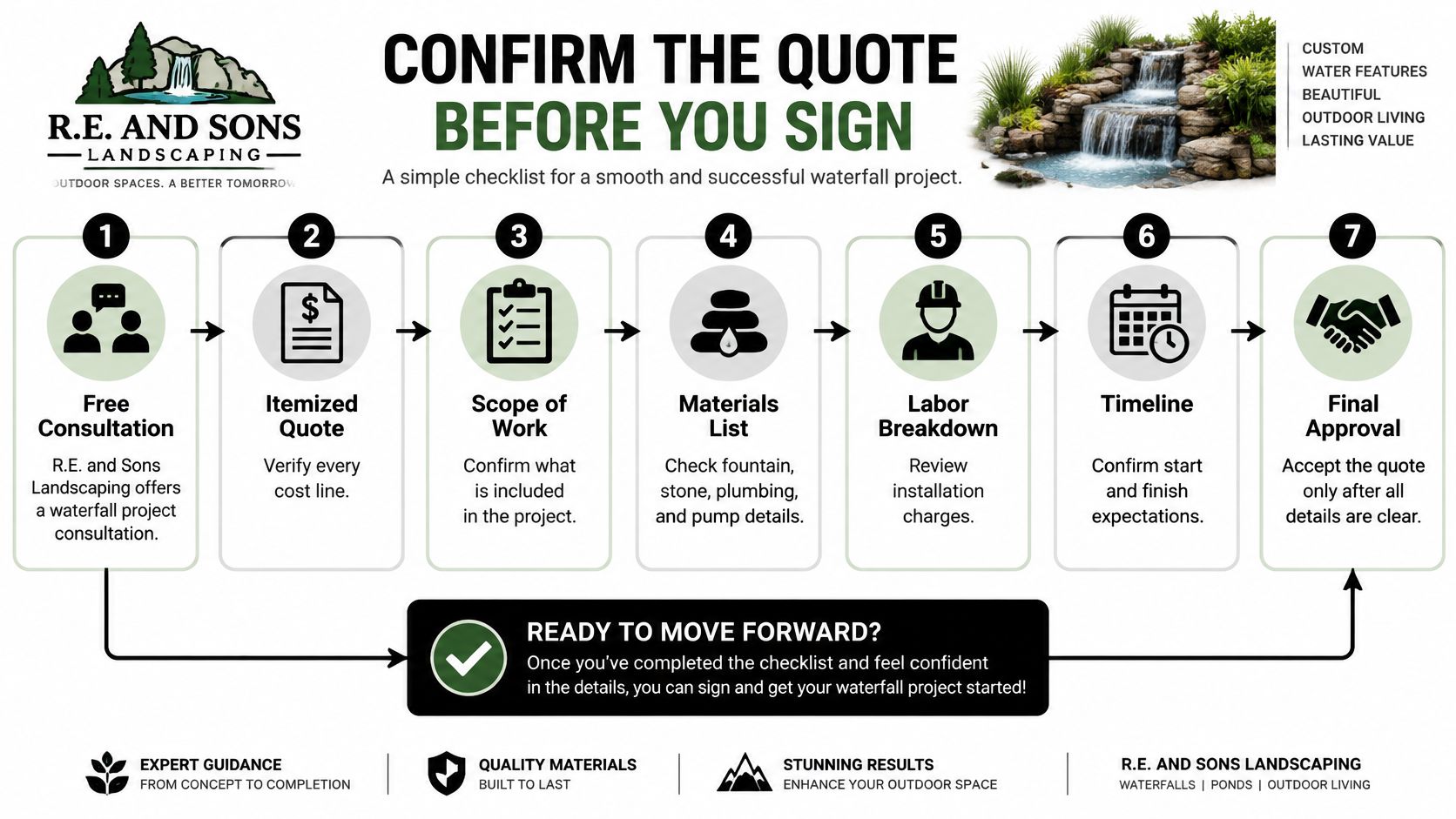
Use one checklist against every proposal you receive.
Equipment and excavation: Fountain body, basin or reservoir, digging and grading.
Utilities and protection: Water connections, electrical work and GFCI protection.
Finishes and labor: Stone, masonry, planting edges and installation time.
Permitting: Which approvals are included, and who files them.
Service access: Pump access for cleaning, drainage around the basin and overflow control.
Water loss and winterization: How evaporation is managed and how the system shuts down.
Then ask three questions out loud. Is maintenance covered under the warranty? Who handles winterization? Are the pump circuit and drainage priced separately, or assumed? Vague answers here predict change orders later. Before you hire anyone, follow the steps to verify a contractor license so the company behind the quote is properly credentialed.
Most of our waterfall installations take one to three weeks from start to finish, depending on complexity, material lead times and permitting. Every installation ends with a final walkthrough and maintenance briefing, so you know how to run, clean and shut down your system before we leave.
If you're ready to price a fountain or waterfall for your Prescott area yard, we offer a free consultation followed by a detailed, itemized quote that separates equipment, excavation, utilities, finishes and permitting. Visit R.E. and Sons Landscaping to schedule online, or call during office hours, Monday through Friday, 8am to 4pm, and we'll walk your property and price the full installed scope before you commit to anything.
Comments