
Best Backyard Putting Greens in Prescott
A putting green can look perfect from the patio and still play poorly after the first heavy storm or hot afternoon. In Prescott, the best backyard putting greens are designed around more than turf color and cup placement. They need a stable base, deliberate drainage, playable contours, and a surface that suits the amount of maintenance and heat exposure your household can manage.
R.E. and Sons Landscaping helps homeowners in Prescott, Prescott Valley, Chino Valley, and surrounding Northern Arizona communities create custom putting greens and complete outdoor living spaces. The team coordinates consultation, design approval, construction, and long-term care, solving the problems that generic kits and rushed installations often overlook. The central choice is straightforward: natural grass can provide a living, responsive surface, while synthetic turf offers more predictable use with less routine turf care. Neither option works well if the site beneath it is poorly engineered.
Designing the Perfect Practice Space at Home
You finish dinner, walk through the back door, and see a short putt waiting beside the patio. There's no drive to the course, no tee time to protect, and no need to turn practice into a major event. You pick up a few balls, work on distance control, and return inside before the evening gets away from you.
That convenience is the core appeal of a backyard green. The best backyard putting greens aren't merely the largest or most elaborate. They're the ones homeowners use regularly because the surface is consistent, the design fits the yard, and the practice area connects naturally to everyday outdoor living.
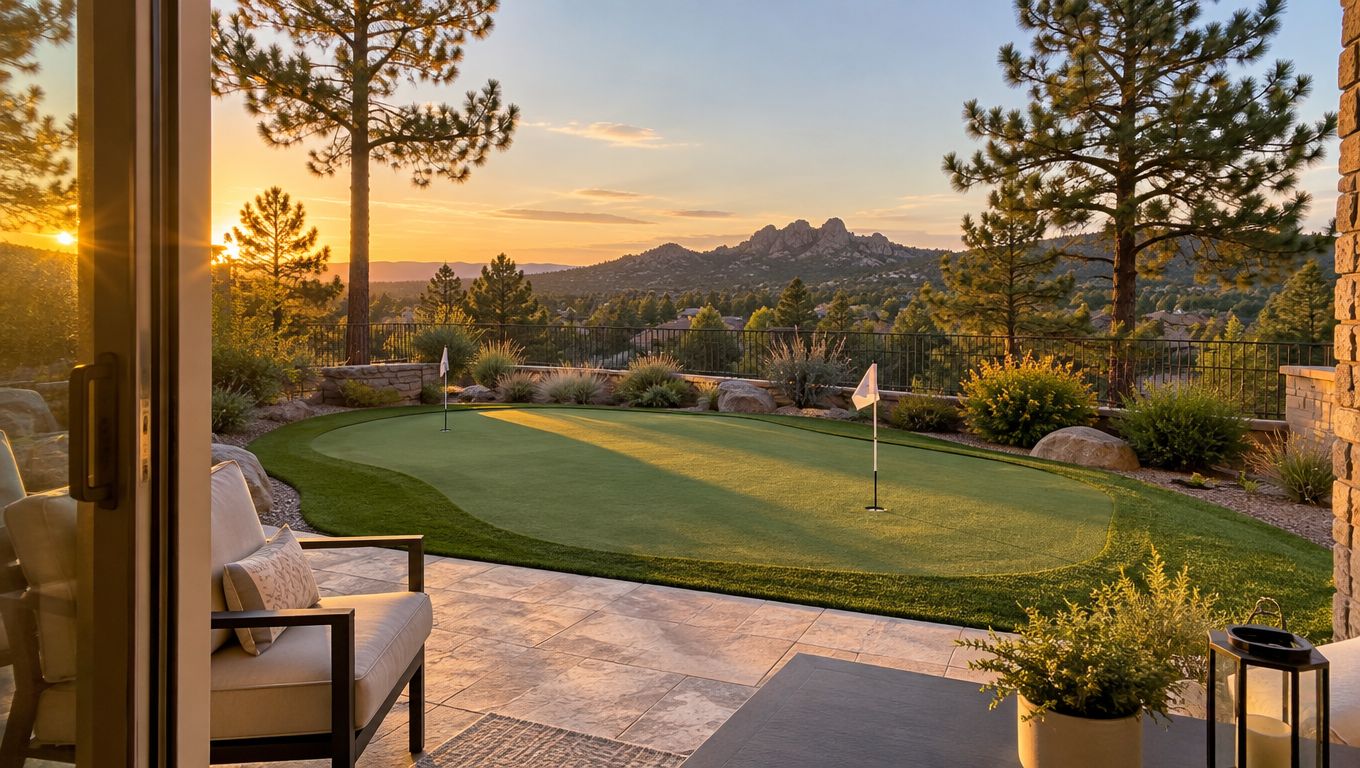
What makes a backyard green worth building
A useful green should answer three questions before construction begins:
What do you want to practice? Straight putts, breaking putts, distance control, or a mixture of all three will affect the shape and contours.
Who will use it? A serious golfer may want a demanding practice surface, while a family may prefer a forgiving area that also works for casual games.
How much care will it receive? Natural turf requires a genuine maintenance commitment. Synthetic turf reduces mowing but still needs cleaning, brushing, infill attention, and drainage checks.
Golf has also moved beyond the traditional course. The National Golf Foundation reported that 48.1 million Americans age six and older played golf in 2025 when on-course and off-course participation were combined, and participation grew 41% from 2019 through 2025. The same National Golf Foundation participation research recorded more than 29 million traditional green-grass participants in 2025, showing why convenient home practice and informal golf spaces appeal to more than dedicated tournament players.
A custom layout can include a compact practice zone, several cup positions, a fringe for short-game work, seating, lighting, or a direct connection to a patio. Homeowners who want structured ideas for using the space can also review these golf drills for home before deciding which putts the design needs to support.
R.E. and Sons Landscaping approaches the project as a design-build feature, not as a patch of green installed in isolation. The putting green design service coordinates the green with grading, surrounding turf, patios, stonework, and the way people move through the backyard. That early coordination matters because the best-looking outline on paper can become frustrating if the usable cup locations are too steep or if runoff is directed toward the playing surface.
Comparing Natural Grass and Synthetic Turf Options
Natural creeping bentgrass and synthetic putting turf can both produce a satisfying practice surface, but they demand different commitments. In Northern Arizona, the choice should be based on maintenance capacity, water management, heat exposure, and desired playability, not on appearance alone.
Natural grass offers the feel of living turf and changes subtly with mowing, moisture, growth, and health. That variation can feel authentic, but it also means the homeowner must manage the growing surface carefully. Penn State Extension explains that shorter mowing generally increases ball roll and may improve uniformity, but cutting below a grass variety's tolerance can reduce shoot density and root growth while increasing environmental and disease stress. For bentgrass or bentgrass and annual bluegrass greens, the cited acceptable mowing range is approximately 5/32 to 3/16 inch, as summarized in the USGA putting-green construction guidance.
Synthetic turf removes mowing and living-turf disease pressure, but it isn't maintenance-free. Debris still needs to be removed, fibers may need brushing, infill requires inspection, and drainage should be checked after major weather. The surface can also retain substantial heat, which makes site orientation and shade essential in Prescott and Prescott Valley.
Feature | Natural Bentgrass | Synthetic Turf |
|---|---|---|
Surface character | Living, responsive turf with changing moisture and growth conditions | Consistent manufactured surface when the base, turf, and infill are properly installed |
Routine care | Precise mowing, irrigation management, turf-health monitoring, and disease prevention | Debris removal, brushing, spot cleaning, infill management, edge weed control, and drainage inspection |
Water demand | Requires regular irrigation to maintain active turf in an arid climate | Doesn't need irrigation for growth, although occasional rinsing and temporary cooling may be useful |
Speed control | Influenced by mowing height, smoothness, moisture, turf density, and health | Influenced by turf construction, infill, fiber behavior, and base consistency |
Climate concern | Heat, drought stress, salts, and maintenance pressure can weaken the grass | Surface heat can make an unshaded green uncomfortable or unsafe |
Best fit | Owners who want living turf and can support intensive care | Owners who prioritize convenient, repeatable practice and lower routine turf labor |
Natural grass also needs the right construction profile. It can't perform consistently in ordinary native soil because the surface has been graded into a green shape. Synthetic turf has a different weakness. It may appear easy to install, but an inadequate base can cause settling, ripples, poor drainage, and inconsistent roll.
For an arid property, a smaller synthetic green surrounded by drought-tolerant planting can be a more thoughtful choice than covering a large area with heat-retaining material. The difference between artificial grass and turf is useful to review when comparing products, because a general turf isn't automatically appropriate for putting.
Practical rule: Choose natural grass only if you want to manage living turf. Choose synthetic turf only if you're prepared to manage the surface system beneath and around it.
Engineering the Subsurface for Consistent Ball Roll
The ball rolls on the surface, but the surface performs because of what lies underneath. Native Prescott soil may contain compacted construction material, rock, abrupt grade changes, or layers that drain at different rates. Shaping that soil and covering it with turf doesn't create a stable putting base.
A USGA-style construction model uses a stable subgrade, drainage piping, a gravel layer, and a specialized sand-based root-zone profile. The model calls for approximately 12 inches of engineered sand-based root-zone mix, plus or minus 1 inch, over at least 4 inches of gravel, with subsurface drainpipes beneath the playing area. Drain lines should generally be no more than 15 feet apart, and pipes should be at least 4 inches in diameter, according to the USGA construction model for putting greens.
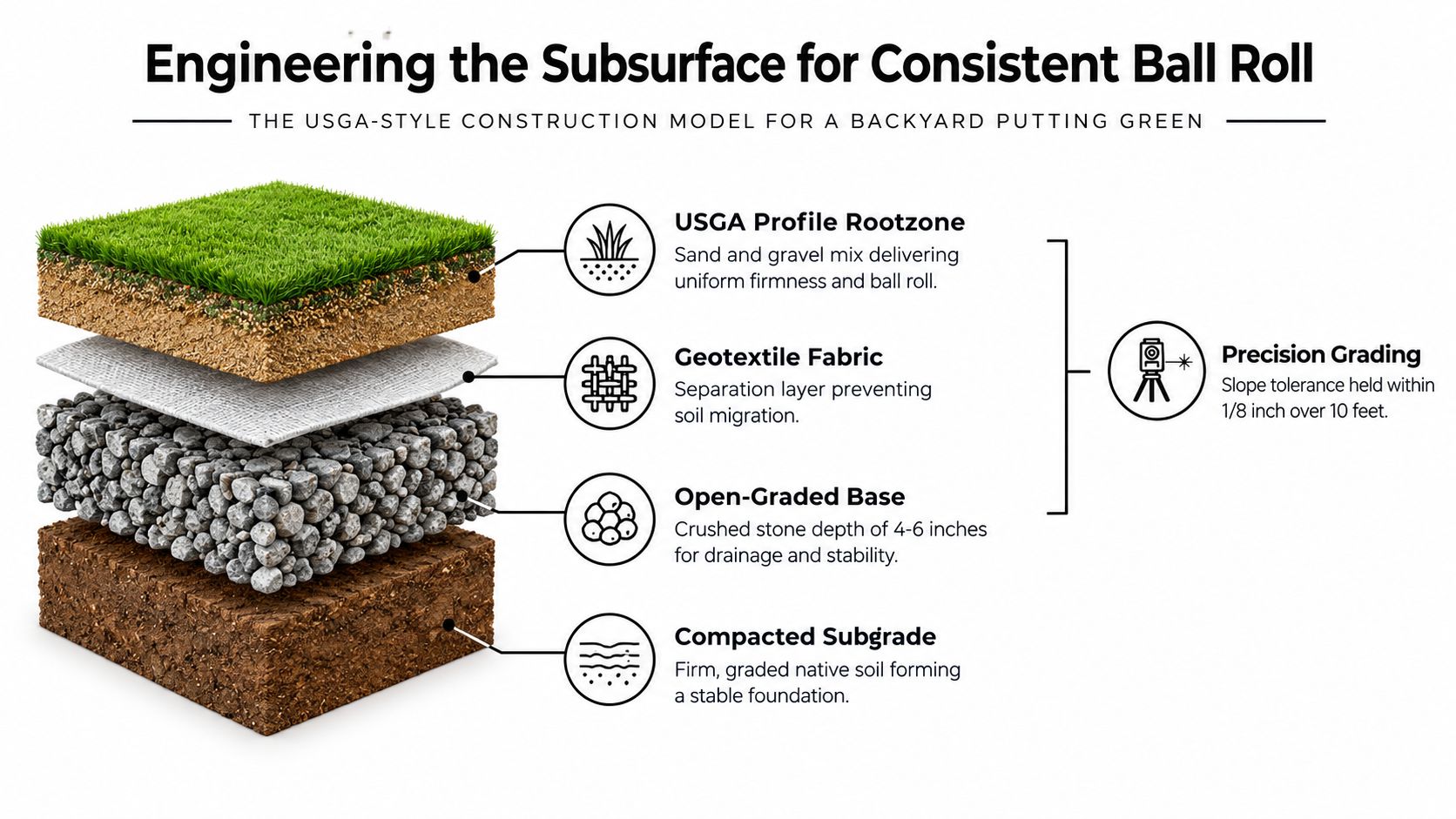
What the layers accomplish
Water should move through the root zone, enter the gravel, and reach the drainage network instead of remaining trapped near the surface. That layered pathway protects firmness, reduces prolonged saturation, and helps limit the localized soft spots that change ball speed and direction.
A professional proposal should identify:
Subgrade preparation: The excavated soil must be smooth, firm, and shaped to the approved contours before aggregate is placed.
Drainage layout: Ask where lateral pipes will run, how they will reach an outlet, and how the contractor will protect the green from runoff generated elsewhere in the yard.
Material depth: A vague promise of “sand-based construction” isn't enough. The proposal should identify the root-zone blend and intended thickness.
Compaction control: Each base layer needs consistent compaction. Weak areas can settle while the rest of the green remains firm.
Infiltration performance: A USGA reference identifies an infiltration rate of 6 or more inches per hour as a desirable drainage characteristic that also helps flush salts from the root zone. The USGA construction reference on root-zone success gives homeowners a concrete performance question to raise during the consultation.
Northern Arizona monsoon storms expose poor preparation quickly. Low areas collect water, poorly directed outlets send runoff toward patios, and inconsistent material depths create different firmness zones. A green can look flawless on installation day and still fail as a practice surface if the subgrade and drainage weren't treated as part of the design.
The accompanying video provides a visual introduction to the layered approach:
When comparing bids, don't focus only on the visible turf. Ask who handles excavation, how the drainage outlet will be coordinated, what material forms the root zone, and how final grading will be checked. Those answers reveal far more about expected performance than a turf sample alone.
Managing Surface Heat in the Arizona Sun
By mid-afternoon in Prescott, a synthetic putting green can be too hot for bare feet, pets, or children even when the surrounding yard feels manageable. Morning play may be comfortable, while the same surface becomes unpleasant later if the design provides no shade or recovery area.
A 2025 systematic review of 23 studies found artificial turf surfaces were consistently 9.4 to 33.7°C hotter than natural turf, while surrounding air temperatures were 0.5 to 1.2°C higher. A separate 2025 field experiment recorded artificial turf reaching 72°C, compared with a maximum of 39°C for real turf, and reported that the artificial surface could cause irreversible skin burns after roughly 10 seconds of contact. These findings are summarized in the 2025 evidence review of artificial turf heat and health considerations.
Synthetic turf can still work well in Prescott. The surface needs to be treated as a microclimate, with heat exposure planned alongside drainage, ball roll, and maintenance. Orientation, surrounding materials, and the locations where people stand often determine whether the green remains useful through the afternoon.
Start by identifying the hours when the green will see the most use. Morning exposure or filtered sunlight can extend comfortable play, while a pergola, shade sail, covered seating area, or carefully placed planting can give golfers, children, and pets somewhere cooler to stand.
A practical heat plan should address the following:
Shade the waiting areas: Covering every square foot is unnecessary, but players need a cooler place to gather, store equipment, and step off the turf.
Keep the green appropriately sized: A dedicated putting area can provide the intended practice function without creating a large, heat-retaining field.
Specify infill carefully: Cooling infills and alternative systems may reduce temperatures compared with conventional crumb rubber. Current evidence does not establish every human heat-stress outcome.
Build a cooler perimeter: Drought-tolerant planting, decomposed granite, stone, and shaded paths can reduce direct contact with the hottest turf.
Use water only as short-term relief: Rinsing may cool synthetic turf for a limited period. It does not make the surface behave like living grass or correct poor orientation.
The guidance on keeping artificial turf cool offers practical ideas for shade, rinsing, and surface planning before construction. The useful design question is straightforward: how will this specific yard remain comfortable during the hours your family plans to play?
Designing Contours for Realistic Practice
A putting green can look impressive from the patio and still produce poor practice. In Northern Arizona, the shape also has to work with monsoon runoff, compacted native soil, and intense heat that can expose weak transitions in the base. A golfer should be able to choose a cup, read a believable break, and finish near the target without turning every putt into a trick shot.
Hole locations generally should not exceed slopes of approximately 4 to 5 percent, according to turf-management guidance summarized by Michigan State University. Steeper areas make short putts overly sensitive to small errors, reduce the number of useful approach angles, and can keep the ball from stopping near the cup. The guidance on putting-green design and hole locations supports judging the playable zones rather than approving a shape because it looks interesting from above.
Begin with the fixed features around the proposed green. A patio, pool deck, retaining wall, fire feature, or outdoor kitchen sets hard boundaries. Grade the surrounding area so monsoon water moves away from those features and does not collect at the green's low edge. The contour plan still needs enough usable surface for practice after drainage paths, access routes, and safety clearances are accounted for.
Review the shape from the golfer's position
Mark the practice goals before finalizing the curves. Straight putts test alignment and stroke mechanics. Breaking putts develop green reading, while longer attempts test distance control. Each intended cup should have usable approach lines from more than one direction.
Check every proposed location for slope, stopping distance, and sightline. A gentle contour adds realistic movement. A steep pocket limits cup placement and can make the green frustrating rather than useful. Review the edge as well. Fringe, stone, patio, or planting should meet the surface cleanly, without a trip hazard or a grade that sends water across the putting area.
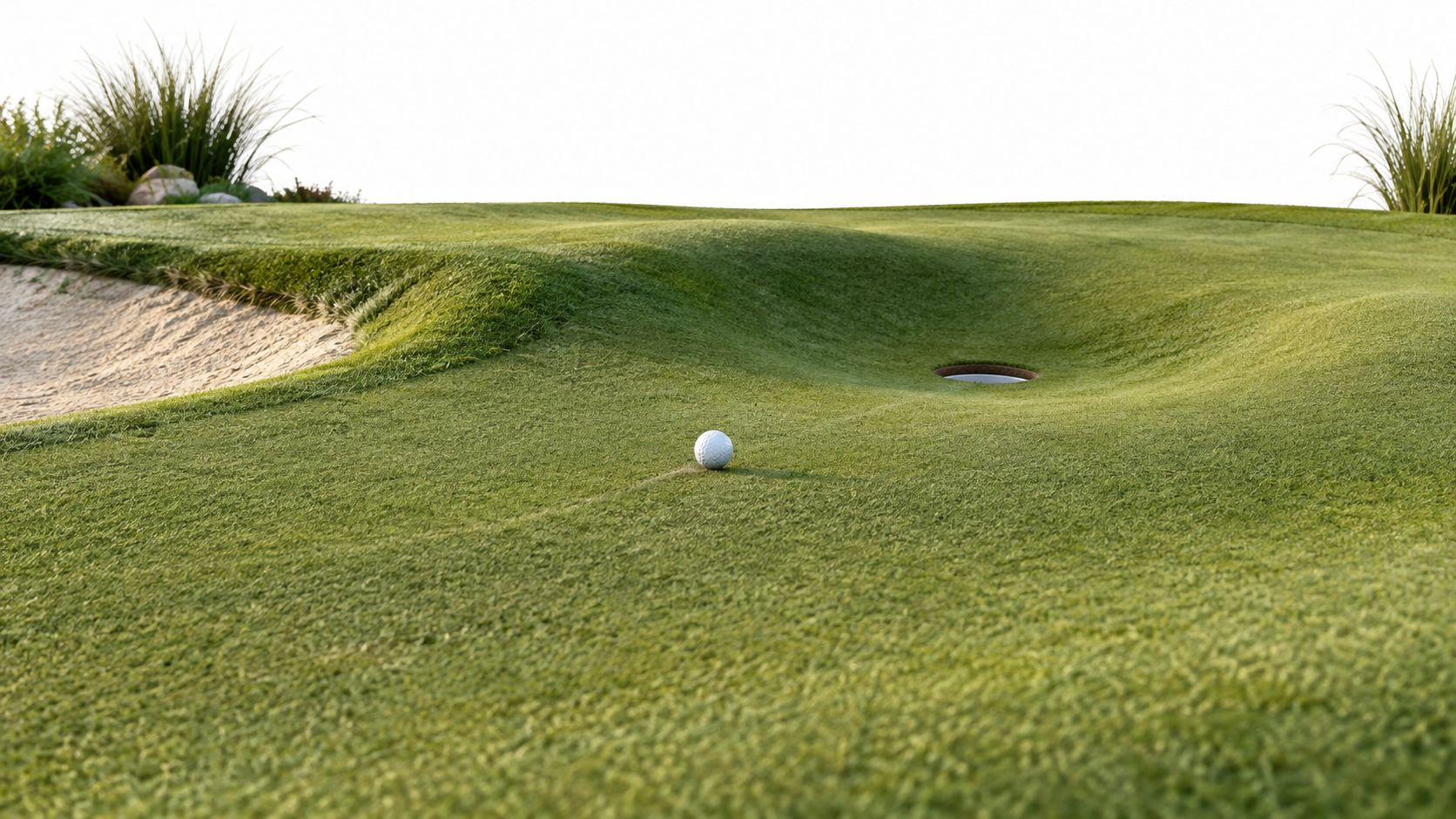
Walk the design from the house and from the main outdoor routes. The green should look natural through the windows and remain easy to reach, while its contour and drainage work from ground level rather than only on a plan.
One relatively flat zone supports stroke mechanics and confidence. A second zone with controlled movement adds green-reading practice. Ask the contractor to mark the intended hole locations and explain the slope at each one before approving the final shape. That review distinguishes a green built for regular practice from an attractive turf feature with limited playability.
Integrating the Green into Your Outdoor Living Space
A backyard putting green should support how the yard is used every day. Place it where golfers can reach it without crossing the planting beds, while keeping it visible from the house, patio, or seating area. Aligning the edge with nearby paving, paths, and planting makes the green feel intentional rather than inserted into an empty space.
Northern Arizona adds engineering concerns that are easy to miss during a visual design review. Monsoon rain can expose a poor grade or an undersized drainage path quickly. The green, patio, pool deck, and planting areas need coordinated elevations so runoff moves away from the putting surface instead of collecting at its edge. Synthetic turf also holds heat in direct sun, so the plan should consider shade, nearby seating, and surface comfort before the installation begins.
Coordinate the green with the whole yard
Plan the green alongside the patio, fire pit, outdoor kitchen, bar, and circulation routes, not after those features are fixed. A paver patio may require a different base and drainage path. A fire pit needs safe clearances and a durable surface around it. An outdoor kitchen creates service traffic that should not cross the putting area.
A licensed, bonded, and insured contractor can coordinate these scopes through one project plan. R.E. and Sons Landscaping identifies its Arizona ROC license as #300642 and provides design-build services for custom putting greens, artificial turf, paver patios, stonework, fireplaces, fire pits, outdoor kitchens, and bars.
Ask for the following decisions in writing before excavation:
Finished elevations: Confirm how the green meets doors, patios, pool decks, and planting beds.
Runoff routes: Identify where water travels during a heavy monsoon event, including discharge points beyond the green.
Material transitions: Check that stone, pavers, artificial turf, and putting turf meet without abrupt edges or trip hazards.
Access and maintenance: Keep routes open for players, cleaning, brushing, infill work, and repairs without sending traffic through planted areas.
Future care: Establish who handles surrounding greenery, edge repairs, debris removal, and surface adjustments after installation.
The surrounding setting affects use. Seating gives others a place to watch, while lighting supports evening practice. Shade can make breaks more comfortable and reduce exposure to a hot synthetic surface. Drought-tolerant plants soften the perimeter, but species that shed heavily above the green can add constant cleanup.
Before approving the finished design, walk it from the house and the main outdoor routes. The contractor should explain what maintenance includes and how drainage issues will be identified before they require major repairs. That follow-through matters when the green is part of a larger outdoor living project.
Frequently Asked Questions About Custom Greens
How long does a custom backyard putting green take to install?
The timeline depends on the design, access, excavation, drainage requirements, surrounding hardscape, and surface choice. A simple synthetic green may move faster than a project that includes extensive grading, patios, shade structures, planting, or drainage improvements. A reputable contractor should provide a dependable schedule after inspecting the site, rather than promising a fixed timeframe without seeing the yard.
Can a putting green improve property value?
A well-designed green can improve a property's outdoor appeal and provide a distinctive recreational feature, but no contractor should guarantee a specific resale increase. Buyers respond differently to golf amenities, and the feature is most defensible when it looks integrated, performs reliably, and doesn't create drainage, heat, or maintenance problems. Good construction protects the investment better than a novelty shape or inexpensive surface.
What happens to natural grass during winter in Prescott?
Natural grass may slow its growth or become dormant depending on the turf type, exposure, irrigation, and seasonal conditions. The surface still needs appropriate care during dormancy, and winter weather can expose drainage or grading issues. Synthetic turf doesn't enter dormancy, but it still needs debris removal, edge inspection, and careful snow or ice handling if those conditions occur.
Can an existing irrigation system be reused?
Parts of an irrigation system may be repurposed for nearby planting, cooling strategies, or other garden zones, but a putting green shouldn't automatically retain lawn irrigation. Natural grass requires irrigation designed for turf health. Synthetic turf has different needs, and its drainage should be planned independently rather than assuming existing sprinkler coverage solves water movement.
How should homeowners handle leaves and debris?
Remove leaves promptly with a leaf blower, soft rake, or suitable broom that won't disturb fibers or infill. Organic debris left in corners can hold moisture, stain the surface, or encourage unwanted growth. Trees near the green may provide shade, but they also increase cleanup and root-management demands, so placement deserves careful consideration before installation.
What should homeowners ask before approving a proposal?
Ask for the surface specification, base materials, root-zone or aggregate depth, drainage layout, outlet plan, contour drawings, cup locations, edging details, and maintenance expectations. Also ask who is responsible for final grading and how the contractor will handle transitions to patios, planting, pools, and existing turf. Clear answers are more valuable than a low price based on unspecified materials.
R.E. and Sons Landscaping offers complimentary design and custom backyard putting green installation for homeowners in Prescott, Prescott Valley, Chino Valley, and nearby Northern Arizona communities. Visit R.E. and Sons Landscaping to discuss surface selection, drainage, heat management, contours, and the outdoor living features that should work with your new green.
Comments