
Putting Green Design: A Prescott Homeowner's Guide
A Prescott homeowner usually doesn't need another patch of thirsty lawn. They need a way to use the awkward, sun-baked part of the yard that sits below the patio, catches runoff, and turns brown before anyone enjoys it. A properly planned putting green design can convert that space into a consistent practice surface without pretending Northern Arizona has the soil, water, or climate of a coastal golf course.
R.E. and Sons Landscaping helps homeowners in Prescott, Prescott Valley, Chino Valley, and nearby Northern Arizona communities plan and build custom putting greens, artificial turf areas, and complete outdoor living spaces. The problem we solve is bigger than choosing turf. It's coordinating grade, caliche, drainage, heat, playability, and the surrounding outdoor environment so the green still works after monsoon storms, winter freezes, and years of intense sun.
Why Prescott Homeowners Are Adding Putting Greens to Their Yards
A homeowner in Prescott may have spectacular views, mature pines, and a backyard that looks promising from the kitchen window. Walk down the slope, though, and the truth appears: decomposed granite, exposed rock, compacted caliche, and a section nobody uses because it's too steep for furniture and too expensive to maintain as lawn.
That's where a residential green earns its space. A single practice cup beside a patio can give a golfer a convenient place to work on pace and alignment. A larger installation can include several cups, subtle breaks, a fringe, and a chipping apron that makes the area useful for more than straight putts. The right scale depends on how the family uses the yard, not on how impressive the finished photograph looks.
Prescott and Prescott Valley homeowners also face practical pressure that changes the design conversation. Water-wise landscaping matters, summer heat can be severe, and traditional turf requires a level of irrigation and care that many residents don't want. Natural putting surfaces can demand frequent mowing, feeding, irrigation, and seasonal attention. Synthetic turf removes much of that routine, although it doesn't remove the need for a well-built base and heat-conscious planning.
A green should solve a yard problem
The most successful projects usually occupy space that already has limited value. Instead of forcing a flat rectangle into the center of a usable lawn, the builder can work with a side yard, a difficult grade, or an underused area near an outdoor living space. The finished surface then supports practice, entertaining, and a smoother garden transition.
Resale appeal is possible, but it shouldn't be oversold. A green may attract buyers who value golf and low-maintenance outdoor space, while another buyer may prefer a different use. Good construction and a design that fits the property matter more than adding holes for appearance.
Golfers who enjoy comparing equipment and planning their time on the course may also find a resource such as compare electric trolleys UK useful when evaluating broader golf habits. At home, the same principle applies: build around how you'll practice.
Realism has limits in this climate
A realistic green isn't necessarily the one with the most dramatic contour. In Northern Arizona, realism means a dependable ball roll, sensible drainage, comfortable access, and a surface that doesn't become unusable in summer heat. A smaller shaded green can be more valuable than a large exposed showpiece if the homeowner uses it regularly.
Reading Your Yard Before You Design
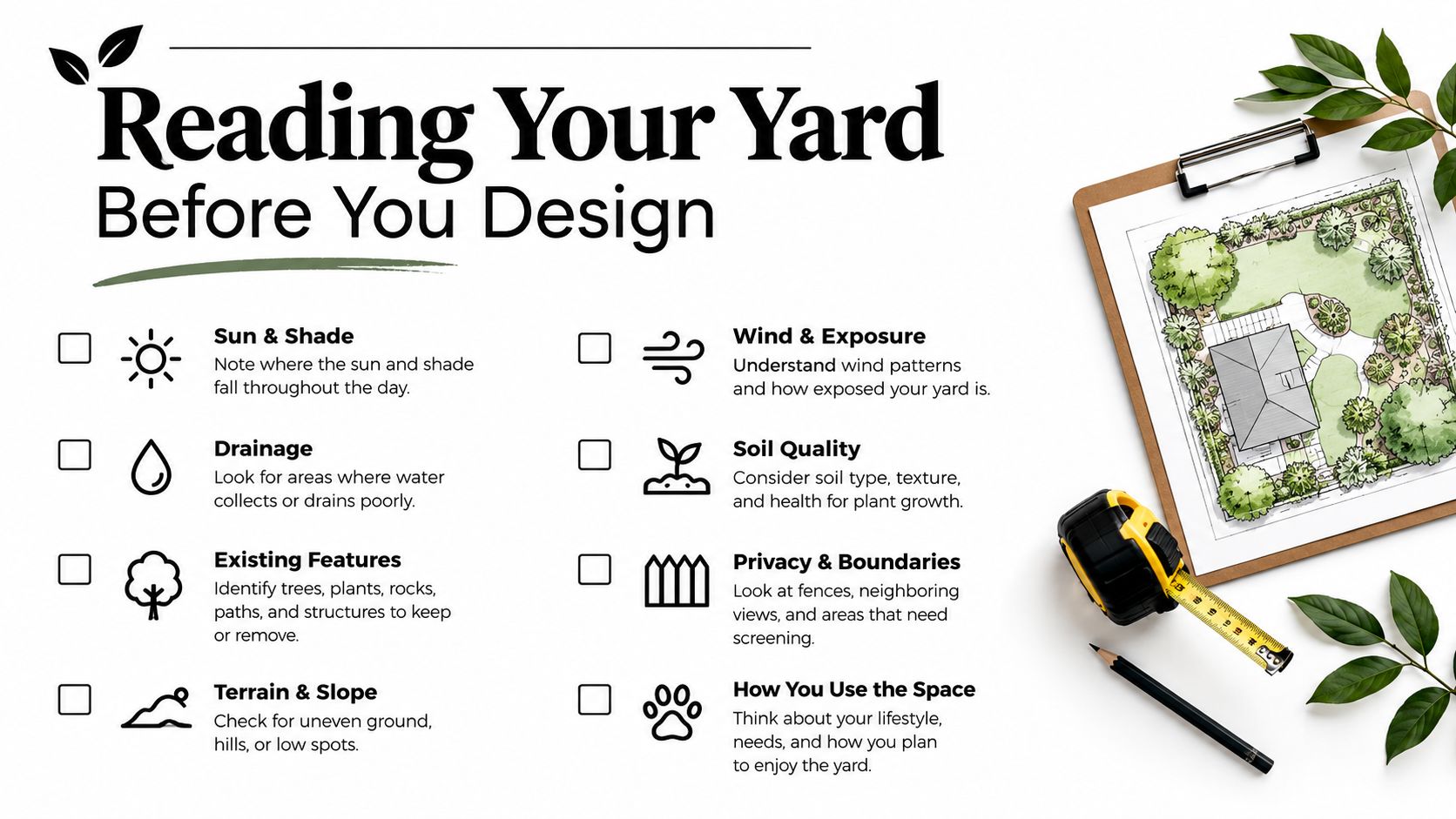
A putting green lives or dies beneath the visible turf. Before choosing cup locations or drawing a kidney-shaped outline, inspect the yard as a drainage and construction site.
Start with sun and heat
South- and west-facing yards around Prescott receive strong ultraviolet exposure, especially on properties above 5,000 feet. That exposure affects turf color, surface temperature, furniture comfort, and the amount of shade available during the afternoon. A cheap product can fade or flatten sooner than expected, while a premium product still benefits from thoughtful placement.
Look at shade from the house, pergolas, mature trees, and neighboring structures. Don't assume a tree is automatically a good answer. Roots can complicate excavation, needles can collect on the surface, and future growth may change the light pattern. Shade planning should balance heat relief with debris, root, and maintenance concerns.
Measure the fall instead of guessing
Gentle grades can often be incorporated into the design, but a fall steeper than 3% usually calls for re-grading, a terraced approach, or a carefully engineered transition. A slope that looks modest from the patio can create a pronounced ball break and force water toward one edge.
Survey the high and low points, then identify where stormwater naturally travels. The final green needs enough grade to shed water, but not so much contour that ordinary putts become unfair. Pin areas require particular restraint because a surface can be visually attractive and still be frustrating to use.
Find caliche before excavation begins
Caliche is a calcium-cemented soil layer common in Yavapai County. It can behave like hard, dense concrete during excavation and can block drainage beneath otherwise permeable materials. A shallow visual inspection won't always reveal where it begins, so probing and test excavation are worthwhile before final pricing.
If caliche sits beneath the proposed green, the plan may require ripping, trenching, underdrains, or a revised location. Covering it with aggregate without addressing the blockage can leave water trapped in low areas.
Confirm constraints and intended use
Mark property lines, easements, irrigation routes, gas and electrical utilities, retaining walls, and access routes for equipment. Established Prescott neighborhoods can have narrow gates and limited staging space, which affects excavation and material delivery.
Then decide whether the green is for putting only or for short pitches and wedge work too. Chipping demands a different surrounding apron, safer ball containment, and more room outside the primary putting surface. If you're still testing ideas, a tool that lets you design your backyard online free can help you compare broad layout concepts before a site consultation.
Choosing the Right Turf for a Northern Arizona Backyard
Natural bentgrass can deliver an exceptionally familiar playing experience, but it asks for a level of irrigation and maintenance that doesn't suit every Prescott property. Bermuda may handle heat more comfortably in some settings, yet it still needs mowing, seasonal management, irrigation, and attention to dormancy. Under restrictive water conditions, a natural putting surface can become a responsibility rather than a convenience.
Artificial turf offers consistent color and ball roll with far less routine water use. The quality range is wide, however. A decorative lawn turf may look convincing from a distance and perform poorly under a golf ball. Putting turf needs an appropriate pile, stable backing, dense construction, and infill selected for the intended speed.
Compare the main options
Premium nylon generally provides a crisp, responsive feel and can suit golfers who prioritize a course-like surface. It also costs more and can become uncomfortably hot in direct July sun. Polyethylene, often called poly, tends to feel softer and may be more comfortable for family use, although the roll can feel slightly less precise depending on the product and installation.
For a residential green, a pile height around 0.5 to 0.75 inches, a stitch rate above 10 per inch, UV-stabilized yarn, and rounded silica infill are practical specifications to discuss with an installer. These figures should be matched to the manufacturer's system rather than treated as a substitute for product testing. A dense putting construction may drain around 12 to 20 inches of rain per hour, while quality artificial turf systems can be rated around 30 to 100 inches of rain per hour, according to artificial turf drainage guidance for heavy rain.
Turf Type | Water Needs | Maintenance | Heat Performance | Realism | Typical Cost |
|---|---|---|---|---|---|
Natural bentgrass | High and regular | Mowing, irrigation, feeding, seasonal care | Can struggle in exposed heat | Very high when healthy | Higher ongoing commitment |
Natural Bermuda | Regular irrigation and seasonal care | Mowing and turf management | Better suited to heat than bentgrass | High in the right conditions | Ongoing maintenance cost |
Polyethylene artificial turf | Minimal routine water use | Brushing, cleaning, infill care | Softer, but still heats in direct sun | Good to very good | Moderate |
Nylon artificial putting turf | Minimal routine water use | Brushing, cleaning, infill care | Can become hot in full sun | Very good | Higher upfront cost |
A useful comparison of environmentally focused turf choices is available in this artificial turf resource. The key decision is not whether a sample looks like golf-course grass. It's whether the system supports the skill level, comfort, maintenance tolerance, and shade conditions of the property.
Grading, Base, and Drainage That Actually Work in Monsoon Country
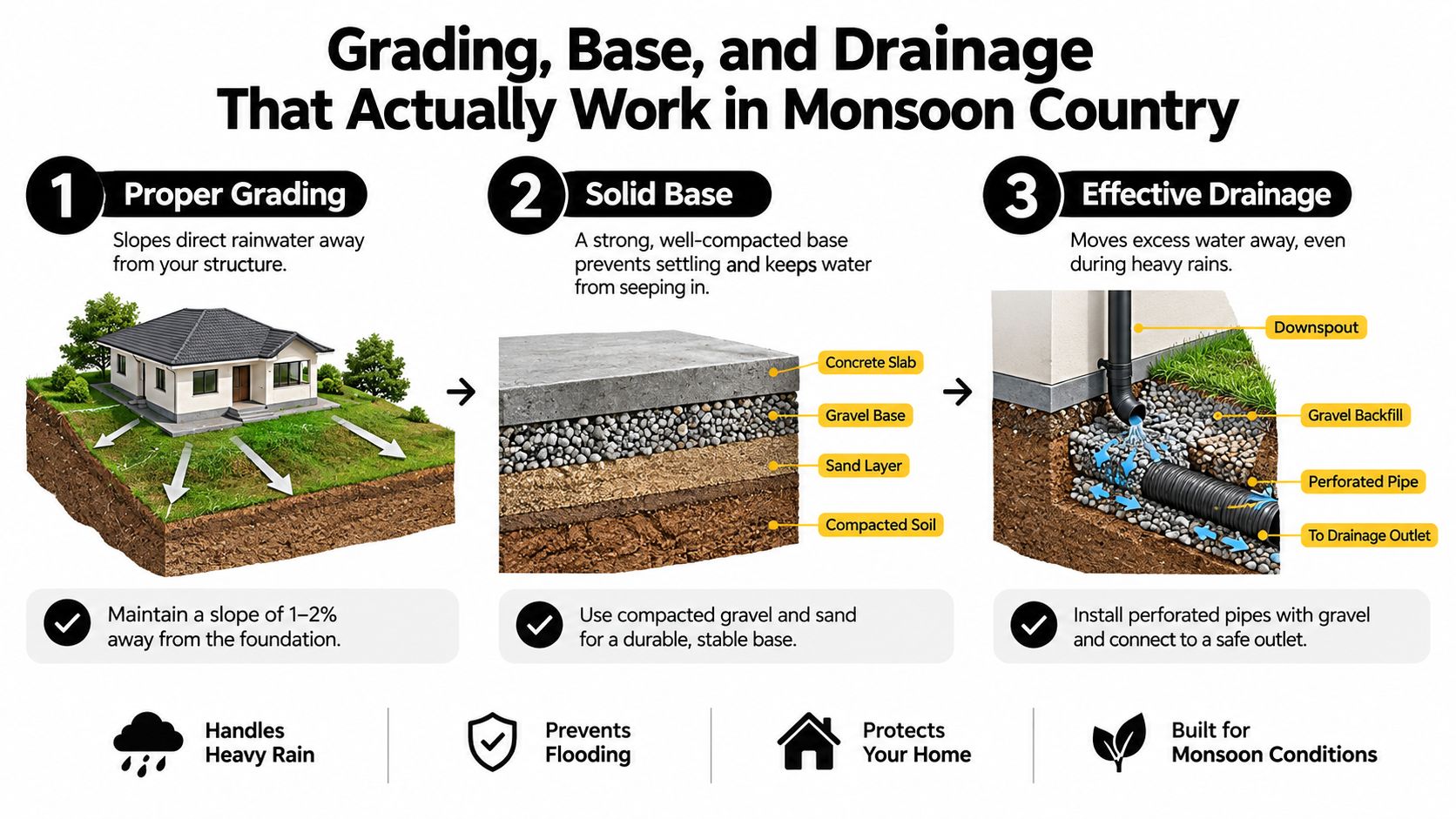
A putting green isn't installed by spreading turf over dirt. It's built as a layered drainage system, and every layer has a job in Prescott's monsoon climate.
Establish the grade first
Begin with the subgrade and establish a controlled fall across the area. A practical residential surface may use a finished slope of roughly 1% to 2%, enough to move water without creating obvious ball-roll distortion, as described in residential putting green design guidance. The USGA construction guidance also calls for drain pipes to follow the line of maximum fall, with a continuous slope of at least 0.5%.
A perfectly flat green is a common mistake. During a monsoon storm, sheet flow from an adjacent lot or a roof downspout can overwhelm a shallow depression. Water then carries fine sediment into low spots, fills the infill, and leaves the surface soft or uneven.
Build a stable base
After excavation, inspect the exposed soil for caliche, clay pockets, roots, and loose fill. A geotextile separator can help keep the aggregate from mixing with unstable soil. The base commonly consists of 4 to 6 inches of compacted decomposed granite or crushed miscellaneous base, followed by a finer leveling material.
The installer should compact in controlled lifts and verify the grade rather than relying on visual smoothness. Above 5,500 feet, freeze-thaw movement can lift edges or create small depressions when the subgrade holds water. Stable compaction and positive drainage reduce that risk.
A homeowner researching preparation for other outdoor structures may find this explanation of gravel pad installation for homeowners helpful because the same principle applies: the finished surface is only as stable as the prepared foundation.
Give runoff a deliberate exit
Where the site requires it, a 4-inch perforated drain line in a gravel envelope can collect water along the lower edge and direct it toward a suitable outlet. USGA guidance recommends lateral drains no more than 15 feet apart, with each pipe maintaining at least a 0.5% continuous slope toward the main drain line. Perimeter drains also matter where water could collect beside the cavity wall, not only at the front.
The layered approach is the difference between turf that looks good at installation and a green that stays firm after several seasons. More detail on the relationship between grade, runoff, and landscaping construction is available in this grading and drainage guide.
Practical rule: If the base and drainage cannot handle the runoff, the turf specification won't rescue the green.
Sizing the Green and Laying Out Holes That Make Sense
A useful green gives you enough space to practice different lines without taking over the yard. The right footprint depends on whether the homeowner wants quiet putting practice, short-pitch work, or a more complete practice area.
Green Size | Hole Count | Best Use | Yard Requirement |
|---|---|---|---|
Around 200 sq. ft. | One | Short putting practice beside a patio | A compact, accessible area |
Around 400 to 600 sq. ft. | Two to three | Varied putts and limited approach work | A moderate side or rear yard |
Around 800 to 1,200 sq. ft. | Several practice positions | Broader short-game practice and multiple breaks | A larger, dedicated yard zone |
These are planning ranges, not rules. A compact three-hole layout can feel more useful than a larger installation with poor pin positions. The holes should create different lines, such as a relatively straight putt, a moderate break, and a longer roll across a controlled contour.
Choose a shape that serves the property
Rectangles are efficient to excavate and easy to edge, but they can look formal in rocky Prescott terrain. Kidney shapes soften the transition into planting beds and patios, while freeform contours can make the green look more integrated. Every curve adds layout and installation complexity, so an irregular outline should improve the yard rather than exist merely for visual drama.
Allow at least 12 to 15 feet between cups when the footprint supports it. Tight spacing forces golfers to reuse the same approach zones and can make multiple holes feel like one small target. If the yard is limited, fewer holes with better spacing usually outperform a crowded plan.
Add practice variety outside the pin area
A fringe gives the eye a finished transition and protects the putting surface from surrounding gravel. A chipping apron can expand the practice value without turning the entire yard into turf. A small bunker may add visual interest and short-game practice, but it also introduces sand movement, cleanup, and additional edge detailing.
The common failure is trying to fit every feature into a small footprint. Extra holes, steep breaks, bunkers, and chipping zones can leave no comfortable place to stand or retrieve balls. The green should feel open enough for the intended stroke, not like a collection of features competing for space.
Installation Process, Timeline, and What It Really Costs
A residential installation usually begins with a site meeting, measurements, utility awareness, and a layout that shows the proposed green against patios, planting, walls, and access routes. Once the design is approved, the crew marks the work area, excavates unsuitable material, addresses caliche or drainage, installs and compacts the base, and checks grade before turf arrives.
The surface work follows the foundation. The installer fits and secures the turf, completes seams, installs cups, adds infill, grooms the fibers, and checks ball roll from multiple directions. Material access can change the schedule in established neighborhoods, especially where a mini-loader or delivery vehicle can't reach the backyard directly.
A realistic Prescott schedule
Most residential projects take about 5 to 10 working days, although heavy caliche removal, difficult access, drainage complications, or extensive surrounding site work can extend the schedule. HOA approval should be started before materials are ordered, since exterior improvements may need drawings, color information, or drainage details.
A finished green may also need a one- to two-week curing window before full use, depending on the base materials, infill, weather, and surrounding construction. The contractor should explain when light walking, putting, furniture placement, and regular play are appropriate.
Budget according to the construction, not just the turf
The turf is only one part of the cost. Excavation, haul-off, aggregate, compaction, drainage, edging, cups, contours, access, and surrounding finishes can matter more than the visible grass. The following planning bands are useful for early conversations, while a site-specific proposal should account for the actual Prescott property. Additional context is available in this putting green installation cost guide.
Tier | Price Range | Includes | Typical Yard Size |
|---|---|---|---|
Entry level | Around $4,000 to $7,000 | Single hole, basic shape, prepared base, turf, cup, and finish work | Compact area |
Mid-range | Around $8,000 to $15,000 | Two to three holes, shaped contours, upgraded drainage, and expanded finish details | Moderate yard |
Premium | $16,000 upward | Multiple practice features, complex contours, chipping areas, bunkers, and integrated landscape work | Larger dedicated area |
Artificial turf can reduce ongoing irrigation and mowing obligations, but that doesn't make the installation free to maintain. Brushing, debris removal, infill management, and occasional cleaning still protect the surface. Property value is also market-dependent. A well-integrated green can improve buyer appeal, but homeowners should choose a design they'll enjoy rather than relying on a guaranteed resale return.
Caring for Your Green Year-Round and Common Questions
Northern Arizona maintenance is seasonal, even for synthetic turf. Spring is the time to remove windblown debris, brush flattened fibers, inspect seams, and check whether infill needs attention. In July and August, shade becomes a comfort issue, so rinse the surface when appropriate and keep nearby hardscape from adding unnecessary reflected heat.
Monsoon preparation means clearing leaves, pine needles, and sediment from edges, drains, and low points. After major storms, look for displaced infill, standing water, softened edges, or runoff entering from a neighboring property. Winter checks should focus on cups, seams, edging, and any area where freeze-thaw movement could affect the base.
How long will residential turf last in strong sun?
No responsible installer should promise a universal lifespan without knowing the product, exposure, use, maintenance, and installation quality. UV-stabilized yarn, a suitable backing, correct infill, and a stable base all matter. A shaded, lightly used green will behave differently from a fully exposed surface used daily above 5,500 feet.
Can dogs damage a putting green?
Dogs can flatten fibers, move infill, dig at edges, and introduce odor if the system lacks proper drainage. A pet-friendly design should separate the main putting surface from regular pet traffic where possible, use secure edging, and provide a practical cleaning route. Waste should be removed promptly, and the surface should be rinsed with care.
Does a green increase a Prescott home's value?
It can improve lifestyle appeal and help a property stand out to golfers, but the effect depends on workmanship, neighborhood expectations, yard usability, and buyer demand. A green that blocks drainage or consumes the best family-use space may hurt more than it helps. Integration with patios, planting, paths, and water-wise materials usually matters more than the number of cups.
Do permits or HOA approval apply?
Rules vary by jurisdiction, neighborhood, grading changes, retaining walls, drainage outlets, and HOA documents. Confirm requirements before excavation. Utility locating, property setbacks, and runoff management should be treated as essential planning tasks even when a project doesn't require a formal building permit.
Can an existing lawn be converted?
Often, yes. The lawn must still be removed or excavated, the soil evaluated, the grade corrected, and the base rebuilt. Laying turf over grass usually creates settlement, drainage, and ball-roll problems. The strongest retrofit is treated as a new engineered surface, while preserving compatible surrounding plants and hardscape where they remain sound.
Smart putting green design makes maintenance predictable because it deals with heat, water, soil, and use before the turf is installed. That's the standard applied by a licensed, bonded, and insured local design-build contractor serving Prescott and Northern Arizona.
If you're ready to turn an underused Prescott or Prescott Valley yard into a durable practice area, R.E. and Sons Landscaping can help with site evaluation, grading, drainage, base preparation, custom turf, cup placement, and surrounding area design. Schedule a consultation to build a putting green that fits your property, your game, and Northern Arizona's real conditions.
Comments