
Fire Pit Cover Guide: How to Choose, Measure and Install
You know the moment. The fire burned down an hour ago, everyone's gone inside, there's a cover folded over the back of a chair, a bowl full of ash, and rain in Thursday's forecast. Do you wrestle it on now, or wait until morning?
That small decision sits on top of bigger ones, and this guide covers both. R.E. and Sons Landscaping designs and builds fire pits for homeowners across Prescott, Prescott Valley, Chino Valley and the surrounding Northern Arizona communities, and the cover question comes up on nearly every project. The pit is the easy part. Matching a cover to the fuel type, the surround, the clearances, the monsoon and whatever fire stage the forest is in that month takes a bit more thought.
What follows answers the questions people ask out loud. Which cover goes on while the fire is burning, which one only goes on when the pit is cold, how to measure an uneven stone rim without guessing, which fabrics survive high-desert sun, and the cases where covering the pit does more harm than good.
Fire Pit Cover Types and Which One You Need
Cover type | Best for | Used while fire burns? | Key rule |
|---|---|---|---|
Metal mesh spark screen | Wood-burning pits with active flames | Yes | Hold it over the fire to contain sparks and embers, but never leave the fire unattended |
Weather cover (vinyl or fabric) | Cooled pits kept outdoors year-round | No | Install only after the fire is fully out and the bowl has cooled |
Fitted gas pit cover | Gas pits with burner controls | No | Must not block vents, the valve box or drainage |
Custom enclosure or lid | Built-in masonry pits | No | Fit to the approved pit design, not a generic size |
Spark Screens and Weather Covers Do Different Jobs
Only the mesh screen belongs over a burning fire. The Travelers fire pit safety tips say to use a metal screen cover with wood-burning fires and to extinguish the fire until there are no glowing embers or smoke before leaving the area. That guidance earns its place. NFPA figures cited in a 2016 report on fire pit safety estimated that outdoor fireplaces and fire pits caused nearly 3,700 grass and brush fires, and injuries tied to outdoor patio heaters or fire pits rose from 1,330 in 2006 to 3,608 in 2012, an increase of roughly 171%.
This is the row homeowners underestimate. A screen over a wood fire near a cedar fence, artificial turf or a bed of dry ornamental grass is the difference between a contained fire and a stray ember landing somewhere it can smolder for an hour before anyone notices.
A weather cover is a completely different object. Vinyl and fabric go on only after the fire is out and the bowl or burner is cold, because they hold heat instead of releasing it. A fitted gas cover has one extra job: clearing the vents, valve box and drainage paths that keep the enclosure breathing. A custom lid on a masonry pit is sized to the finished stone, which is rarely a stock dimension.
Two Questions Settle It Before You Buy
Is the pit wood-burning or gas? Is it built in or portable? Those two answers pick your cover.
During the consultation we assess the yard, talk through gas versus wood-burning, and look at the seating area around the pit, because a screen that has to be lifted off every twenty minutes gets abandoned fast. If your pit is a freestanding concrete bowl rather than a built-in, the outdoor fire bowl safety guide from Lucas Furniture & Mattress covers placement and clearance basics for that style.
Quick decision. A wood-burning pit used often needs the spark screen plus a weather cover for the cold months. A gas pit built into the patio usually needs one fitted cover sized to its enclosure. For layout questions before you buy anything, our notes on fire pit design ideas walk through placement, surround and seating.
Custom Versus Off-the-Shelf Fire Pit Covers
Off-the-shelf covers fit standard round bowls and ring pits. Custom covers exist for the pits that don't match a stock size: built into masonry, set inside a stone surround with an uneven top, or housing a gas burner box and valve that need clearance.
Three yes or no questions decide it.
Is the pit a standard size or built in place? A portable 36-inch steel bowl on a flat patio is a stock-size job. A flagstone circle set by hand is not.
Does it have gas controls that need clearance? Burner controls, a valve box and enclosure vents all have to stay reachable and unobstructed.
Will it sit fully exposed to afternoon sun and monsoon wind? Exposure pushes you toward heavier fabric, better anchoring and a custom fit that won't flap.
If two of those come back yes, buy custom. The cost difference is real, but a cheap cover that flaps loose in a gust and leaves the burner exposed is money spent twice.
Off-the-shelf wins on the simple cases. It ships in days, costs less, and a top-only cover over a metal bowl does most of the work of keeping leaves and rain out. Where it falls apart is an irregular rim: a stock cover will bridge the high corner and hover over the low one, and that gap is exactly where wind-driven rain enters.
For built-in pits, the design step settles the pit and its lid together. We provide a custom design showing fire pit placement, surround material and seating configuration for approval, and the cover is specified against those finished dimensions rather than guessed at afterward. Never order a custom cover from the drawing, either. Hand-set stone and masonry rarely match the plan exactly, so the tape measure decides, not the drawing.
Materials That Hold Up in Northern Arizona Weather
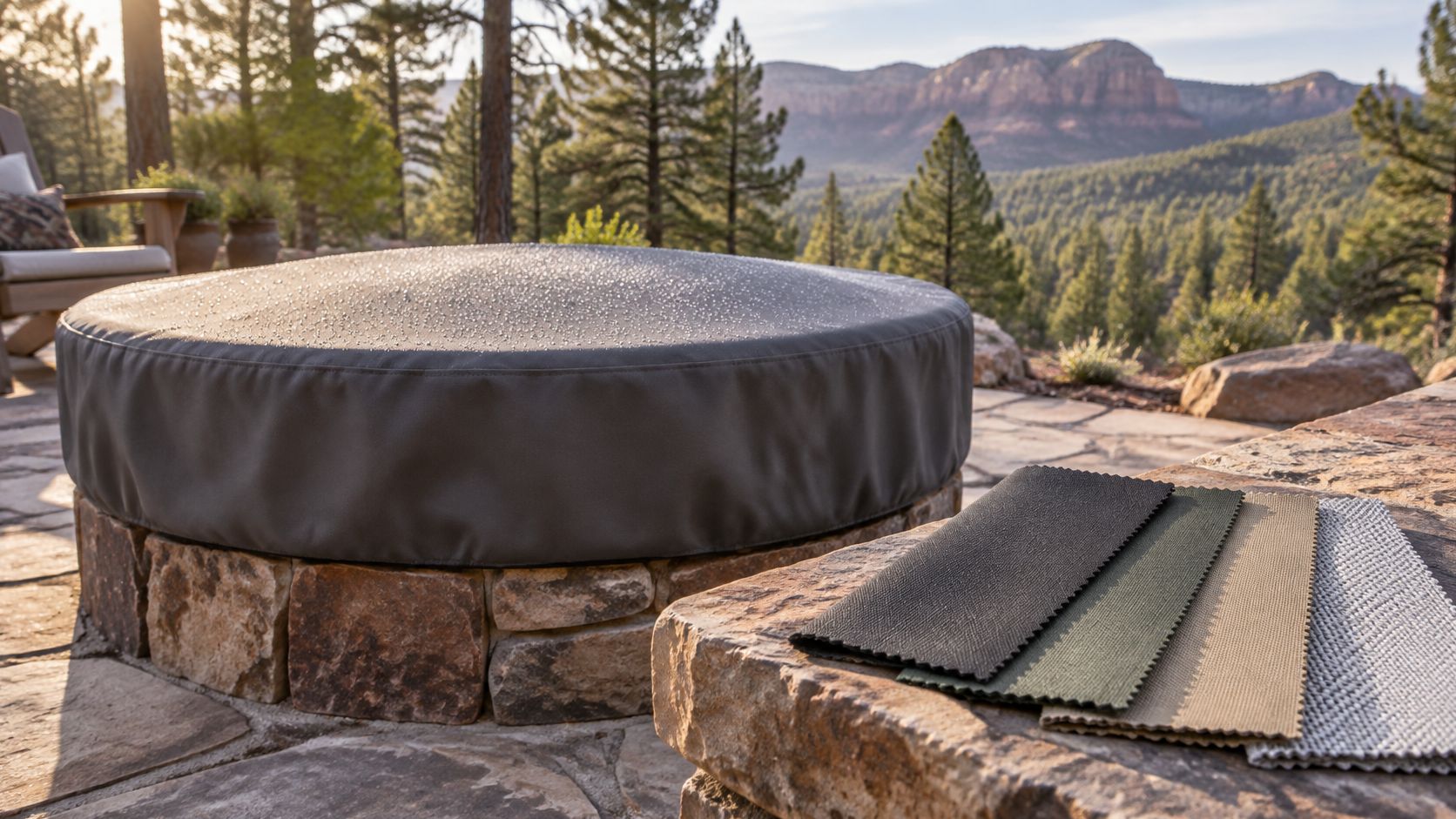
In the high desert, a cover is a moisture and sun system, not a dust sheet. Four materials cover most of what's sold, and each fails in a different season.
Material | Strength | Weak spot in high desert | Best fit |
|---|---|---|---|
Solution-dyed acrylic | Resists UV fading and breathes | Heavier and costlier than basic covers | Exposed patios with strong afternoon sun |
Vinyl-coated polyester | Water-repellent and affordable | Can stiffen and crack in deep winter cold | Semi-sheltered pits under a pergola or overhang |
Heavy-duty PVC | Fully waterproof | Traps moisture without vents and can stiffen in cold | Vented designs where drainage is well planned |
Treated canvas | Natural look | Absorbs water and can mildew | Short-term storage only, not permanent outdoor use |
Where Each Material Fails in the High Desert
UV is the slow killer. A thin cover left on a south-facing patio through a Prescott summer goes chalky and brittle at the folds long before the seams give out, and the first place it tears is where the fabric drapes over a stone corner.
Monsoon rain is the fast one. An inch of rain in twenty minutes finds every gap: a sagging center, a hem that stops above the rim, a corner where the cover pulls tight and lifts. Vinyl-coated polyester handles that water well, but the same fabric turns stiff in a January cold snap and cracks when you peel it off.
That's why the features matter more than the label.
UV-resistant, water-repellent fabric with double-stitched or bound seams, because a single-stitch seam is the first thing to open.
Integrated vents to reduce wind lift and condensation, so the cover doesn't balloon in a gust or sweat against the steel underneath.
A drawcord, buckles or a weighted hem, not just an elastic edge that slackens with age.
A pad or spacer under the hem wherever it crosses a sharp stone edge.
The venting point is not cosmetic. Manufacturer safety documentation for a match-lit fire pit insert calls for adequate drainage and ventilation around the enclosure and valve box, and warns that pooled water can freeze or corrode hardware, while an undersized cover leaves the burner area exposed. That same installation documentation for the fire pit insert.pdf) notes some listed gas products specify 36 inches of clearance at the sides and 84 inches overhead, with greater distances for higher-output burners.
A practical rule for Prescott yards: solution-dyed acrylic for a fully exposed patio, vinyl-coated polyester for a pit under a pergola or roof overhang, and never untreated canvas for a permanent outdoor install. Canvas soaks, mildews, and then sits wet against metal for a season.
Measure, Fit and Install Your Fire Pit Cover
The costliest measuring mistake isn't a miscalculation, it's measuring the wrong surface. Measuring the inside of the bowl gives you a cover that's too small, and a cover that's too small lets rain run straight down to the burner. You measure the outside, at the widest point, every time.
Pit type | What to measure | Overlap to add | Common error |
|---|---|---|---|
Round bowl or ring | Outside diameter at the widest point | 4-6 in (10-15 cm) | Measuring the inside of the bowl |
Square or rectangular | Length and width at the top edge | 4-6 in (10-15 cm) | Assuming corners are square |
Stone or masonry surround | Outside dimensions at several points | 4-6 in (10-15 cm) beyond the largest reading | Using the average of an irregular top |
Built-in gas pit | Burner box and surround footprint | Manufacturer-specified clearance | Covering the controls or vents |
How to Measure an Uneven Surround
Take three or more readings across the top, because hand-set stone is rarely square and a mortar joint can throw a rim off by an inch. Height comes next, from the base to the top rim, including any cap or raised edge that the cover has to clear.
Use the largest reading, not the average. A cover built to the average will bridge the high corner and hang loose over the low one. Then add enough overlap that the hem drops below the rim, which is what stops wind-driven rain from running back into the bowl. Finally, check the footprint against anything the cover must clear: a gas valve box, the control panel, the enclosure vents.
The NFPA wildfire prevention guidance for fire pits and outdoor fires puts contained outdoor fires at least 10 feet (3 meters) from combustible materials, and it flags the mistake that ruins more covers than any other: treating a weather cover as a fire screen. Fabric and vinyl don't contain sparks, and neither belongs over an operating or warm fire. On gas units, don't seal or obstruct the required enclosure vents. One municipal specification referenced in that guidance requires opposing vents totaling at least 18 square inches each, and manufacturer documentation requires drainage and ventilation beneath the valve-box area.
The Installation Sequence
Confirm the burner, pan, lava rock and enclosure are completely cool. Lava rock holds heat for hours after the flame dies.
Clear the ash and debris, cold only. Check that drainage paths and vent openings stay open and that no water is pooling in the base.
Inspect the cover before it goes on. Look for tears, failed seams, soft spots and loose hardware.
Center it and check the overlap. The hem should drop below the rim on every side, not just the front.
Secure every side. Drawcord, buckles or weights. In an exposed spot, all four corners, every time.
Keep the hem off sharp stone. A strip of foam or a piece of pipe insulation under the fabric saves the cover.
One side fastened is the failure you'll see most often around here. The cover rides up on the windward edge, water sheets under it, and the next thing you know there's a puddle sitting on the burner. If your pit is part of a larger build, the outdoor fire pit installation process shows where the surround and clearances get set before a cover is ever ordered.
The acceptance test: after the first real rain, water should shed outward, the cover should still be exactly where you left it after a gust, and there should be no standing water near the controls, burner ports or the enclosure base.
When Covering a Fire Pit Makes Things Worse
A cover is the one accessory that can turn a safe, cooling pit into a hazard if it goes on at the wrong moment, and most cover guides skip that entirely.
Residual heat is the first problem. Live coals under a vinyl cover trap warmth against the bowl, scorch the fabric and create a genuine fire hazard. The smell of hot vinyl is a warning you don't want to learn firsthand.
Practical rule: if the back of your hand feels warmth above the bowl, the cover stays off until morning.
Moisture is the second problem. Cover a pit while the masonry is still damp and you get condensation on the underside, water spots on the steel, corrosion on the hardware and, in a cold snap, ice in the valve box. Prescott's freeze-thaw weeks amplify this: water trapped under a cover freezes and expands night after night.
The third problem is timing your burn against restrictions. Fire restrictions around Prescott tighten and ease with conditions. The Prescott National Forest's restriction announcement records Stage 1 restrictions lifting in September after conditions improved, and a dry spring can bring them right back. A cover changes nothing about what you're allowed to burn, so confirm the current stage before you light, not after.
What covering does change is the maintenance rhythm.
After a monsoon storm, lift the cover and look for standing water, grit washed into the bowl and water trapped underneath the fabric.
After a freeze-thaw week, check the masonry for hairline cracks and the hardware for rust bloom.
During a long dry spell, leave the pit uncovered for a day so the base can dry out completely.
Fuel type sets its own rules. On a gas pit, a cover must never block vents, controls, drainage or the clearances the unit was installed with. On a wood burner, the bowl has to be cold and empty before anything goes over it.
Loose covers cause their own damage. A cover that lifts in the wind drops dust, leaves and grit straight into the burner area, which leaves the pit dirtier than a week uncovered would have. If the cover keeps billowing toward the seating, the fix is usually layout rather than a heavier cover: guidance on arranging chairs around the fire pit helps you place seating outside the cover's swing radius and the pit's heat zone. Our fire pit safety guidelines cover the rest of the routine.
Match the cover to the fuel, the clearance, the drainage, the weather and the current restriction stage. Thickness alone won't do that for you.
Fire Pit Cover FAQs
Do I need to cover my fire pit every night
No. Cover it when the pit is cold and dry and rain, dust or wind-blown debris is on the way. A pit left open collects leaves, pollen and ash that clog burner ports. If the bowl is still warm at bedtime, leave it open and cover it in the morning.
Can I put a cover on a fire pit while it's still warm
No. Fabric and vinyl hold heat against the bowl. With live coals underneath, that's a fire hazard, and even a warm metal pan can scorch the underside and leave a permanent mark.
What size fire pit cover do I need
Order by the outside footprint, not the bowl opening. Measure the widest outside dimension, the height to the top rim, and any control panel or ledge that sticks out. For irregular stone, use your largest reading.
Will a cover keep rain out of a gas fire pit
A fitted, vented cover sheds most of it, but water still reaches the base through vents and drainage openings. The goal is drainage and airflow, not a perfect seal. A cover that seals tight traps condensation against the burner box.
How do I stop a cover blowing off in Prescott wind
Use a drawcord, buckles or a weighted hem, and fasten every side on an exposed patio. Vented covers lift less because air passes through instead of ballooning underneath.
Do I need a permit for a built-in fire pit in Prescott
Permanent built-in pits, especially gas models, typically require a permit. We walk customers through the local requirements during the consultation so the pit and its cover are planned against the same approved design.
Check Restrictions and Book Your Consultation
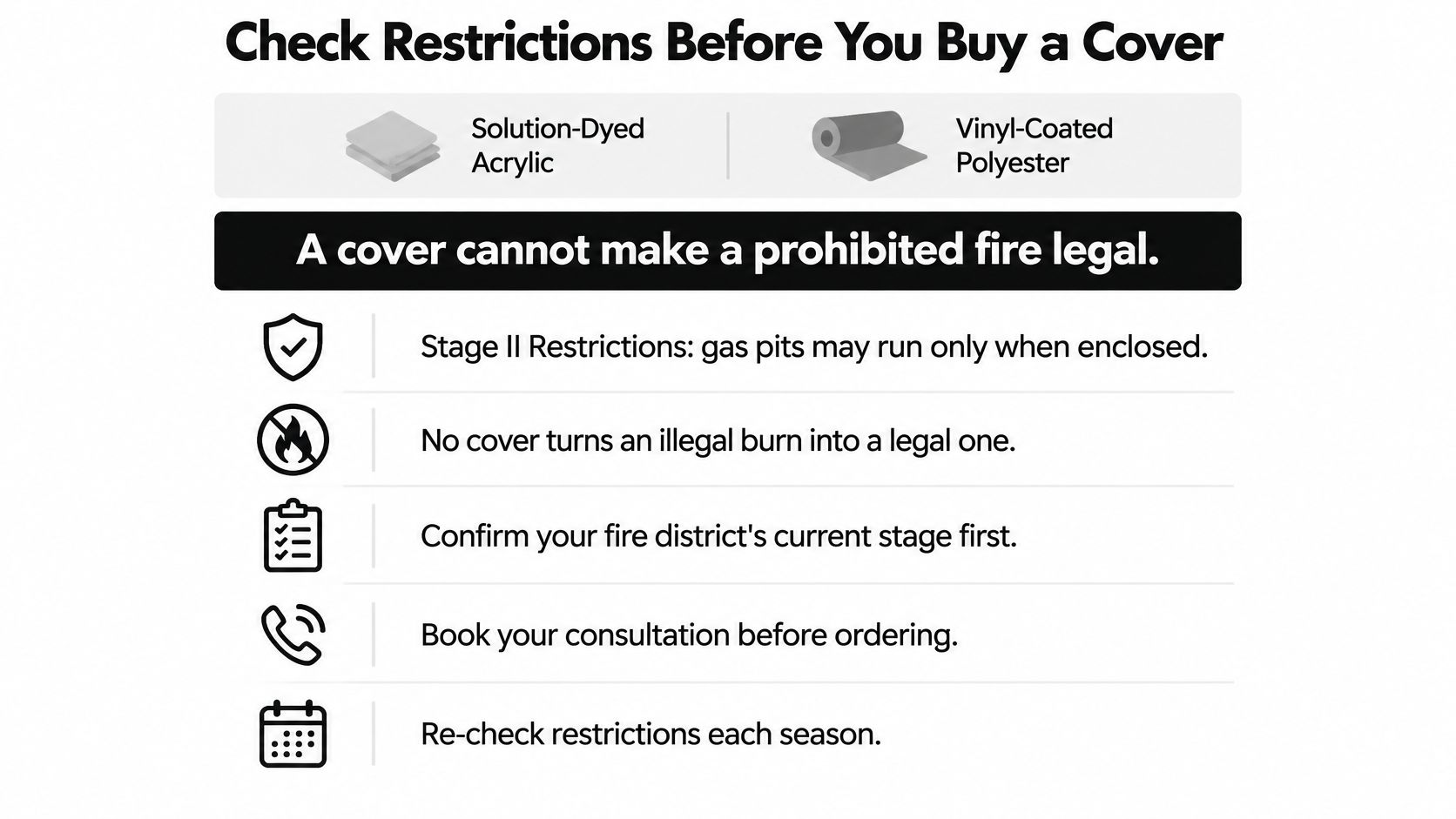
A cover cannot make a prohibited fire legal. That is the sentence to remember before you unroll anything or strike a match.
Central Arizona Fire and Medical states that during Stage II restrictions, propane, natural-gas or other gas-flame fire pits may be allowed only when they're in an enclosed device, can be turned off, and are constantly attended, per Central Arizona Fire and Medical's wildland fire guidance. Prescott National Forest Stage I restrictions are stricter for wood and charcoal: building, maintaining, attending or using those fires is prohibited outside designated Forest Service fire structures.
The rules exist because outdoor fire is a real risk, not a theoretical one. U.S. fire departments responded to an estimated 706,000 outside and other fires in 2024, and outside and other fires represented 52% of all reported fires that year, according to the NFPA fire loss report for the United States.
The Four Checks Before You Light Anything
Check the current stage with your city, your fire district and the forest office. They don't always match.
Confirm whether your gas pit needs a permit. Permanent built-ins usually do, and an unpermitted burner is a problem at resale.
Keep the clearances the pit was designed around, and confirm nothing combustible has crept into that zone since last season.
Put the fire out completely before you leave it, every time.
The authority having jurisdiction makes the final call. A product label, a neighbor's setup and a blog post can all be wrong for your parcel on a specific day. If the forest is at Stage I, no cover changes that, and if your district is at Stage II, an enclosed, attended, switchable gas pit may be acceptable while a wood fire is off the table.
Treat the cover as part of the same safety check. A covered pit that still holds heat should stay open until morning. A lid that traps monsoon moisture against a burner box creates a maintenance problem even when the fire itself was legal. Overhead shade matters too: if a seating area beside the feature needs sun control, some homeowners ask about commercial window awnings while they confirm clearances and keep combustibles out of the pit zone.
R.E. and Sons is a licensed, bonded and insured design-build contractor (Arizona ROC #300642) serving Prescott, Prescott Valley and the surrounding Northern Arizona communities. We handle site preparation and excavation, on-site consultation and design, the stone, concrete or masonry surround, integrated seating walls, basin and bowl construction, safety clearances and placement per code, plus a gas line stub-out on gas models. Most fire pit projects finish in one to three days depending on complexity, and a pit with a surrounding seating wall takes longer. Consultations run Monday through Friday, 8am to 4pm, and you can book online or by phone.
If you're planning a fire pit, or you've inherited one that never had a proper cover, R.E. and Sons Landscaping can size the lid to the finished surround, set the clearances and drainage correctly, and walk you through the permit requirements before anything gets built. Our crew builds permanent, safe fire pits for Prescott-area homeowners, from wood-burning pits with built-in spark screens to gas pits set in stone surrounds with integrated bench seating. Visit R.E. and Sons Landscaping to schedule a consultation and get a custom design in hand before you order a cover.
Comments