
In Ground Fire Pit Construction: A Northern AZ Guide
A Prescott homeowner often starts with a simple idea: a circle of stone, a few chairs, and a fire on a cool evening. Then the practical questions arrive. Can the pit legally burn during fire restrictions? Will smoke drift toward the house? Will the ring settle, crack, or collect water after the first winter?
In-ground fire pit construction needs to answer those questions before excavation begins. R.E. and Sons Landscaping helps homeowners in Prescott, Prescott Valley, Chino Valley, and nearby Northern Arizona communities turn an uncertain DIY project into a durable outdoor feature planned around fuel choice, drainage, clearances, local rules, and the way the space will be used. The company is licensed, bonded, and insured under Arizona ROC #300642, with more than 2,500 satisfied customers, and handles outdoor living projects ranging from paver patios and stonework to fire pits, fireplaces, kitchens, and bars.
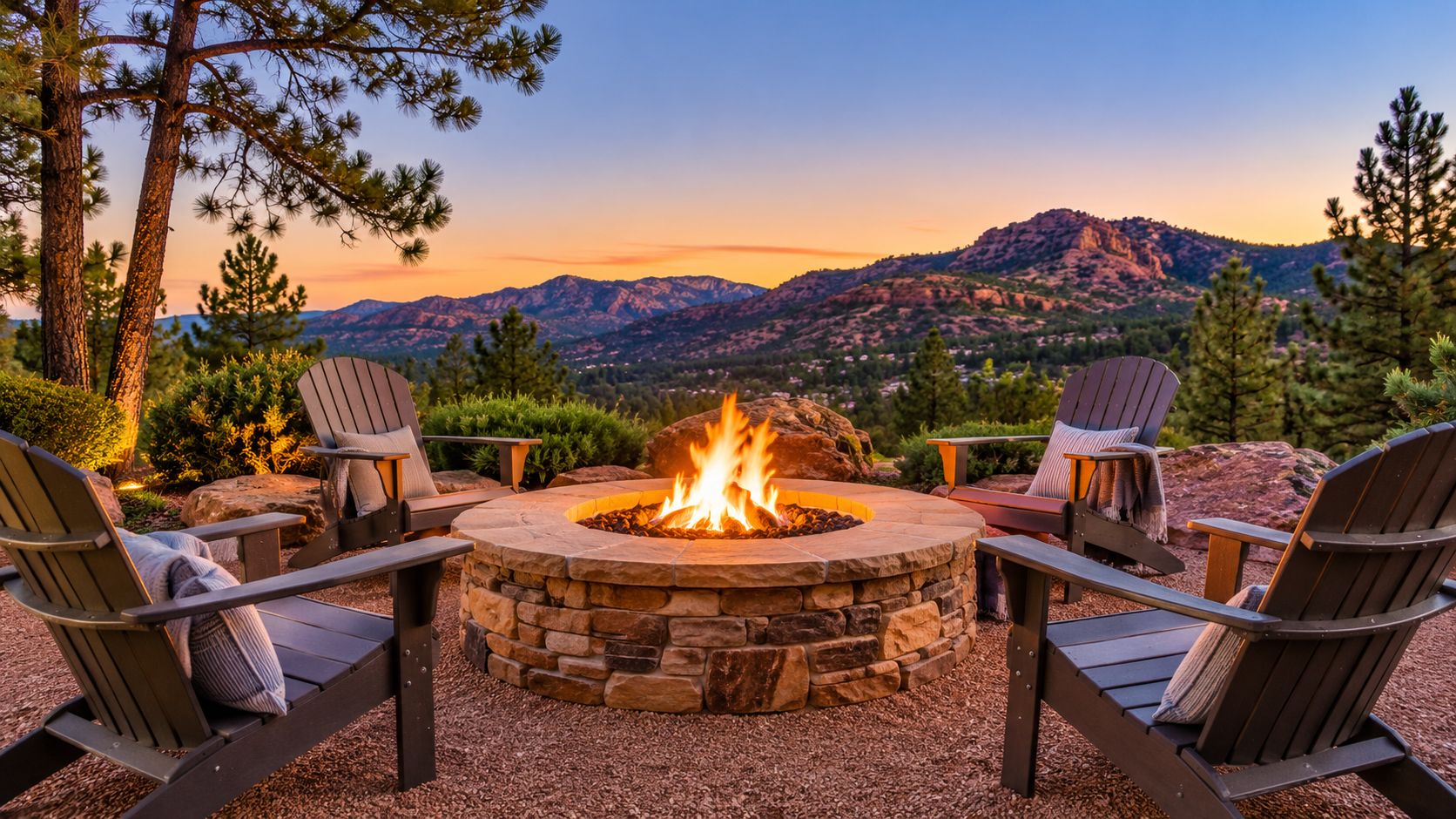
A well-built fire pit should feel like it belongs in the yard, not like a temporary ring dropped onto it. If the surrounding area also needs a deck or raised entertaining surface, homeowners may find deck services from Wildlife Control Services, LLC useful as a separate planning resource. The important point is to design the entire gathering area together, including access, seating, combustible materials, and the fire feature's operating needs.
Why In Ground Fire Pits Belong in Northern Arizona Backyards
Prescott evenings make outdoor gathering spaces especially appealing. A fire feature can anchor Adirondack chairs, connect a patio to an outdoor kitchen, or give a sloped backyard a clear destination. But in Northern Arizona, an attractive pit isn't automatically a usable pit. Seasonal restrictions, dry vegetation, wind, smoke, and changing jurisdictional rules all influence the design.
R.E. and Sons Landscaping serves homeowners who want more than a metal bowl on bare ground. The company's design-build process begins with a consultation, moves through design approval, and continues through installation and final enjoyment. That approach matters because the fire pit rarely exists alone. It usually sits beside a paver patio, retaining wall, outdoor kitchen, bar, garden lighting, or planting area that must work safely around heat and sparks.
The local problem is larger than digging a circle
A basic ring may look straightforward, but several hidden failures can follow a rushed installation:
Unstable masonry: Poor compaction can leave the ring leaning, settling, or cracking.
Standing water: Without drainage, water can collect below the liner and weaken the base.
Smoke exposure: Seating placed downwind can turn a relaxing evening into a smoky one.
Restricted use: A wood-burning pit may be built correctly but unusable during seasonal fire restrictions.
Unsafe surroundings: Dry grasses, branches, decks, and loose rocks can create fire or trip hazards.
The design needs to account for the property's grade, nearby vegetation, fuel system, ash handling, spark control, and current enforcement. That's why local knowledge is more valuable than copying a generic backyard plan from another state.
Practical rule: Build the fire feature around the way Northern Arizona allows you to operate it, not only around the way you want it to look.
For homeowners who want a permanent gathering area in Prescott, Prescott Valley, Chino Valley, and the surrounding region, the right project combines construction discipline with an operating plan. A beautiful wood fire pit that sits unused during high-fire-danger periods may deliver less value than a properly designed gas feature or a dual-fuel layout with accessible controls and safe conversion options.
Planning and Permitting Your Fire Pit Project
Before a shovel touches the ground, confirm which jurisdiction controls the property and which fuel type you intend to use. A city, county, fire district, HOA, state agency, or federal land manager may impose different requirements. Construction approval also doesn't mean burning is allowed every day.
Arizona's official fire restrictions system shows current restrictions on federal and state-managed lands. County and municipal restrictions must be checked through the applicable county or city website, and restrictions remain active until they're rescinded. Around Prescott, that distinction matters because a property may be close to the Prescott National Forest while still falling under separate municipal or county rules.
Start with the site, not the materials
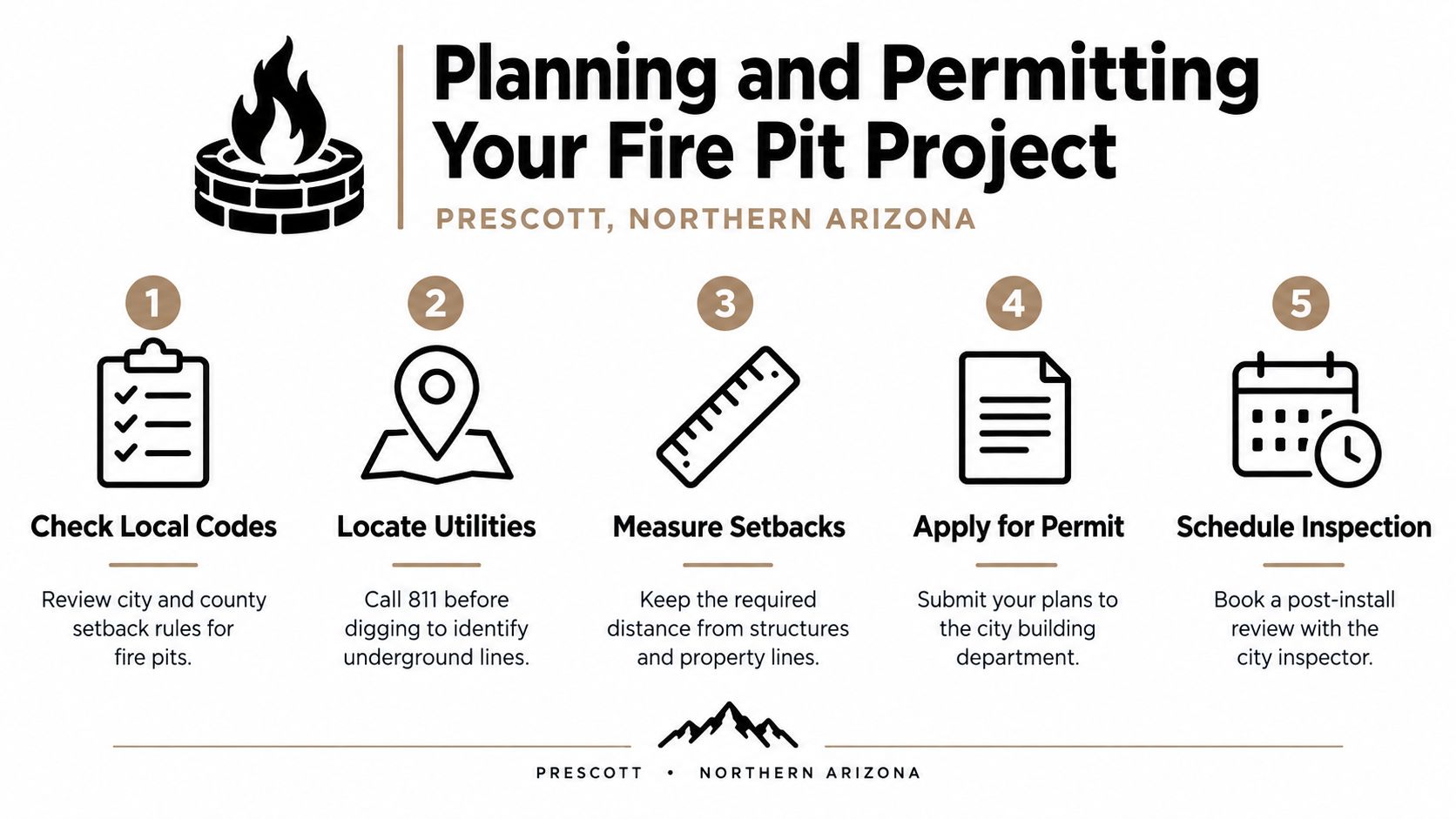
A sound planning sequence looks like this:
Check local codes: Ask the city, county, fire department, and HOA whether a built-in pit is treated differently from a portable fireplace or recreational fire.
Locate utilities: Contact 811 before digging. Mark gas, electric, water, communications, and irrigation lines.
Measure setbacks: Identify the required separation from structures, property lines, decks, fences, vegetation, eaves, and overhanging branches.
Apply for permits: Submit the design and fuel-system information to the appropriate building or fire authority when required.
Schedule inspection: Arrange any required post-installation or gas-system inspection before operating the pit.
The fireplace building codes guidance from R.E. and Sons Landscaping can help homeowners identify the questions to ask during early planning. The final answer still comes from the authority having jurisdiction for the property.
NFPA guidance calls for outdoor fire pits to sit at least 10 feet, or 3 meters, from anything combustible, including siding, decks, vegetation, eaves, and overhanging branches. The pit should rest on an even, noncombustible surface such as concrete, brick, or patio blocks, with loose rocks and trip hazards removed from the surrounding area. Treat that distance as a baseline to verify, not as a universal substitute for local requirements.
Prescott-area conditions add practical concerns. Dry grasses and pine debris can carry embers, wind can change smoke direction quickly, and restrictions can change with weather and fire danger. A professional design should document the fuel type, clearances, spark-control method, shutoff access, drainage plan, and any permit or inspection steps before construction begins.
Excavation, Base Preparation, and Drainage
The visible stonework gets attention, but the base determines whether the fire pit stays level. Northern Arizona soils can drain well in some locations while still allowing settlement, movement, or water concentration in others. Higher-elevation sites also need a base that tolerates seasonal temperature changes and freeze-thaw movement.
Begin by laying out the finished ring, the surrounding noncombustible surface, and the seating area. Remove organic soil, roots, loose debris, and any material that can decompose beneath the structure. The excavation must provide room for the retaining ring, liner, compacted aggregate, and drainage strategy. Exact depth depends on the selected system, the existing grade, and whether the pit connects to a patio or retaining wall.
Build a stable platform
A reliable installation generally follows this order:
Shape the excavation: Cut a clean, level ring and keep the bottom even rather than following small surface dips.
Address water: Grade the surrounding surface so runoff moves away from the pit. Where site conditions require it, use suitable drainage aggregate or a drainage path that prevents water from collecting under the base.
Install aggregate: Place a stable, compactable sub-base in controlled lifts. A hand tamper may work for a small project, while a plate compactor produces more consistent results across a larger patio or seating area.
Check the level repeatedly: Verify the base in multiple directions before setting the first masonry course.
Protect circulation: Remove loose rocks and leave a clear walking route around chairs, tools, and the fire screen.
An in-ground pit also needs adequate combustion air and safe access for ash removal. Avoid burying a fire chamber in a way that traps water or restricts the air needed for clean burning. If the pit connects to a patio, the grade and base should be coordinated so the hardscape doesn't push water toward the liner.
A compacted foundation costs more effort at the beginning, but it prevents the common repair cycle of lifting settled blocks, re-leveling the ring, and replacing cracked finishes. Homeowners planning a complete entertaining area can review related paver patio installation principles before deciding how the pit and surrounding paving should meet.
Choosing Between Wood-Burning and Gas Fire Pits
The most important design decision isn't the color of the stone. It's the fuel. In Northern Arizona, a wood-burning pit can deliver the sound, smell, and changing flame people want, but seasonal restrictions may make it unavailable for extended periods. Gas usually costs more to install, yet the ability to start and stop the flame gives it a practical advantage when rules allow gas devices under specified conditions.
During 2026 Stage 1 restrictions, the Prescott National Forest prohibited open fires outside designated structures, while propane or LPG devices with on-off controls were exempt under specified conditions. Central Arizona Fire and Medical Authority stated that gas fire pits could remain allowed during restrictions only when they were enclosed, constantly attended, and capable of being turned off. Those conditions can change, and homeowners must verify current rules before every burn.
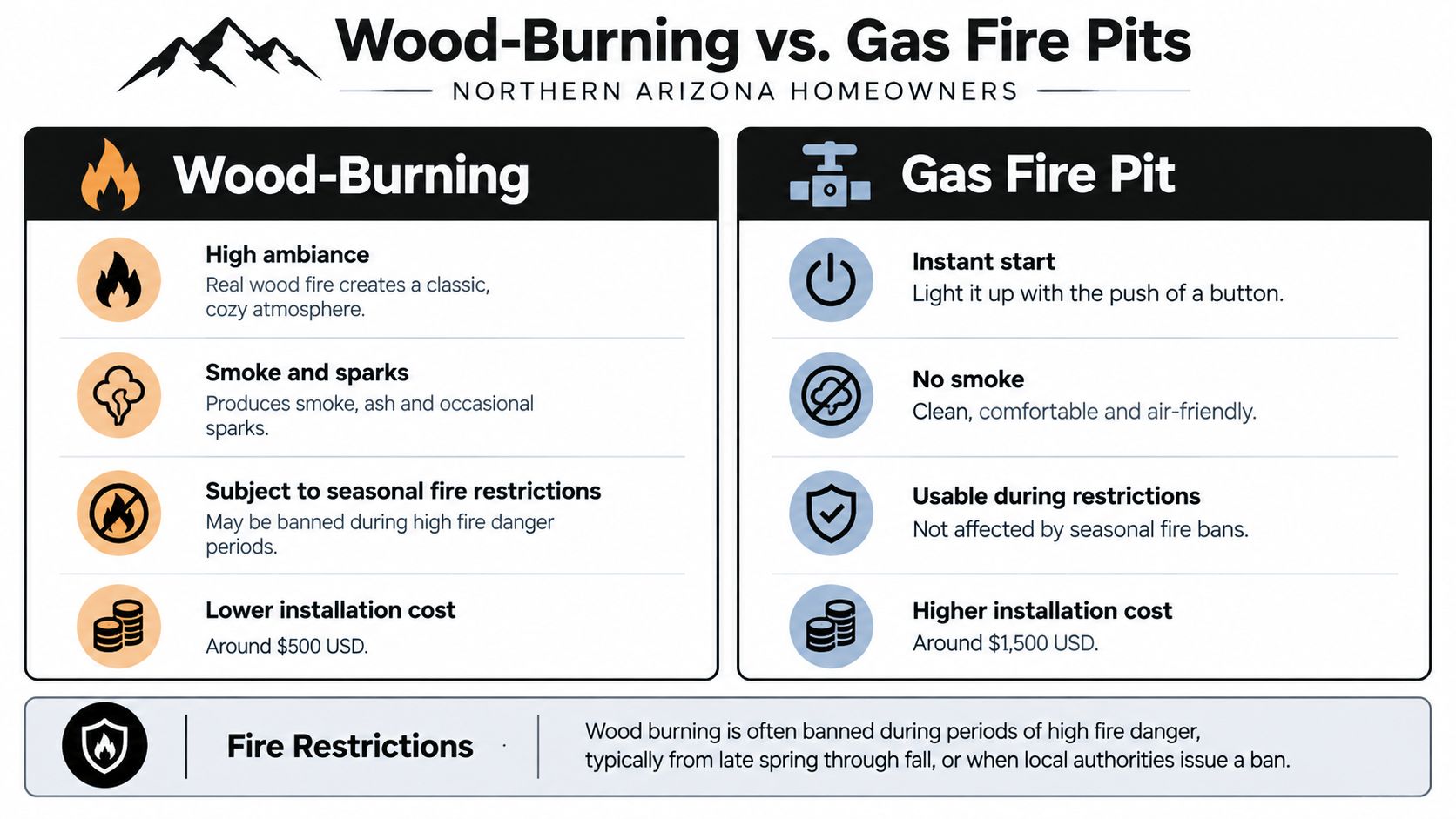
Match the system to your habits
Wood-burning | Gas |
|---|---|
Traditional crackle, aroma, and ember glow | Instant start and controllable flame |
Requires clean, dry seasoned hardwood | Requires a properly installed fuel supply |
Produces smoke, sparks, and ash | Produces no wood smoke or ash |
May be limited by seasonal fire restrictions | May remain available under specified restriction conditions |
Needs a spark screen and ash-handling area | Needs an accessible shutoff and protected controls |
Wood construction needs a heat-tolerant liner, a stable grate arrangement where appropriate, spark control, and enough room to remove cooled ash safely. Gas construction needs burner placement, noncombustible supports, weather-protected controls, ventilation, and either a correctly installed natural-gas line or a compliant propane setup. Gas work should be handled by the appropriate licensed trade, and homeowners planning future service should understand the basics of gas line maintenance for your property.
Fuel choice also affects smoke exposure. The U.S. Environmental Protection Agency's wood-burning guidance explains that incomplete wood combustion produces PM2.5, carbon monoxide, benzene, formaldehyde, acrolein, and polycyclic aromatic hydrocarbons. Outdoor fire pits are among the residential wood-burning sources identified by the EPA. In King County, Washington, residential wood smoke contributed nearly one-third of annual direct PM2.5 emissions in the county's 2014 National Emissions Inventory, and an EPA recreational-fire-pit emissions study estimated that replacing one pit could reduce particulate matter emissions by approximately 7 pounds per year.
That doesn't make an in-ground wood pit automatically unsuitable. Use clean, dry wood, avoid oversized chambers, provide adequate combustion air, and consider a low-smoke insert where local rules permit. EPA testing found that wetter wood reduced radiant heat yield, increased fuel consumption, and raised emissions. It also found that low-smoke or barrel-style designs had particulate emission factors about 80% lower than the AP-42 benchmark, while each percentage-point increase in low-smoke design prevalence was associated with a 1.24% emissions reduction. These figures support better design and operation, not a claim that any fire pit is smokeless.
A useful middle path is a dual-fuel concept, but it must be designed carefully. Wood and gas components can't be casually improvised in the same chamber. The layout needs safe separation, approved components, accessible controls, and a clear plan for disabling one fuel system before using the other. For detailed installation considerations, see gas fire pit construction by R.E. and Sons Landscaping.
Masonry, Liners, and Finishing Touches
Once the fuel system and base are settled, the visible construction can take shape. The retaining ring must be level, mechanically stable, and built from materials that tolerate repeated heating and cooling. Ordinary decorative stone may look appropriate but can crack or spall when trapped moisture expands under high heat.
A prefabricated steel ring is usually the straightforward choice for a wood-burning pit. It gives the masonry a defined inner edge and helps protect the surrounding wall from direct flame. Custom masonry can create a stronger visual connection to a patio or seat wall, but it requires more careful detailing around the liner, cap, mortar, drainage, and heat exposure.
Select materials for heat and movement
Use heat-tolerant masonry or fire-rated concrete products for the combustion zone. Natural stone, brick, manufactured stone, and concrete blocks can all have a place in the design, but they shouldn't be selected only by color. Ask how each material handles thermal cycling, absorbed water, and contact with the liner.
The ring should be assembled in controlled courses, with each course checked for level and alignment. Where the design calls for mortar, adhesive, or a structural support system, use products approved for the exposure rather than general-purpose materials placed close to direct flame. The cap should be stable, comfortable to the touch when the fire is not operating, and shaped so water doesn't drain into the wall or seating area.
Gas pits need a different interior. Burner pans, media, supports, access panels, and controls must follow the selected manufacturer's requirements. Keep shutoff access clear of traffic and heat, and provide ventilation where the enclosure requires it. A sealed cavity without appropriate air movement can create a dangerous condition.
Finish the surrounding zone
The area immediately outside the ring should be noncombustible and easy to sweep. Pavers, concrete, brick, or patio blocks create a cleaner transition than loose mulch or dry groundcover. Seating can be built into a curved wall, placed on movable chairs, or integrated with a larger patio, but leave enough room for people to move without brushing against hot masonry.
A spark screen is functional equipment, not decoration. For a wood-burning design, it helps contain embers and ash, while a suitable cover helps keep rain and debris out between uses. R.E. and Sons Landscaping designs fire features as part of broader outdoor living spaces, including patios, outdoor kitchens, and bar areas. That makes it possible to coordinate the pit's elevation, paving pattern, lighting, and seating instead of treating each feature as a separate afterthought.
Maintenance, Safety, Costs, and When to Hire a Pro
A permanent fire pit still needs routine attention. Inspect the ring and liner for cracks, check that the screen remains sound, clear leaves and pine debris from the surrounding area, and keep drainage paths open. A fitted cover can reduce water and debris accumulation, but it shouldn't trap heat or be placed over an active fire.
Wood-burning operation requires clean, dry, seasoned hardwood. Never use construction waste, treated lumber, gasoline, lighter fluid, or other accelerants. NFPA guidance also calls for fully extinguishing the fire before removing cooled ashes, placing those ashes in a metal container with a tight-fitting lid away from combustible materials, and keeping a spark screen in use. For gas systems, shut off the fuel source after every use and keep the control area accessible.
Where professional work earns its place
A homeowner may handle simple layout and planting work, but professional installation becomes the safer choice when the project involves:
Gas connections: Fuel lines, burner assemblies, controls, testing, and inspection need qualified installation.
Complex masonry: Curved walls, integrated seating, retaining structures, and custom liners require accurate base and structural work.
Difficult sites: Slopes, drainage problems, utility conflicts, and tight access can turn excavation into a larger project.
Changing restrictions: A local contractor can help you design around current requirements, but you still need to confirm rules before each burn.
Exact project cost depends on excavation, access, masonry, liner selection, gas-line complexity, drainage, paving, seating, and permitting. A simple DIY ring may be less expensive than a professionally installed feature, while a custom fire pit integrated with a patio and outdoor kitchen requires a broader design and construction allowance. The most useful estimate comes from a site review rather than a generic online range.
Use a written fire safety inspection checklist to review the area before the first burn and after seasonal changes. If a crack, loose cap, damaged screen, exposed control, or drainage problem appears, stop using the pit until the condition is corrected.
R.E. and Sons Landscaping designs and builds in-ground wood, gas, and related outdoor living features for homeowners in Prescott, Prescott Valley, Chino Valley, and surrounding Northern Arizona communities. Visit R.E. and Sons Landscaping to schedule a consultation, review your fuel and restriction options, and plan a fire pit that fits your property and the way you'll use it.
Comments