
Outdoor Kitchen Countertop Ideas for Northern Arizona
Granite and quartzite are the countertop materials that hold up best through Northern Arizona's intense UV, freeze-thaw nights, and wide day-to-night temperature swings. Porcelain slabs sit close behind for anyone who would rather skip sealing. Those three resist ultraviolet light, shed water, and barely move when the temperature drops below freezing after a warm afternoon.
This guide is for homeowners in Prescott, Prescott Valley, Chino Valley, and the surrounding high country who want a counter that still looks right after five summers. R.E. and Sons Landscaping designs and builds complete outdoor kitchens in this climate, with custom countertops in granite, concrete, tile, or composite. Every layout is drawn around the exact dimensions of your yard, not a catalog template. For a broader look at how counter choices affect a kitchen's long-term durability, see this guide to choosing durable counters in Portage kitchens.
Demand for these spaces is real. 34% of surveyed homeowners ranked their outdoor living space as the area they most wanted to renovate, according to System Pavers' Outdoor Living Trends Index. 12% of U.S. homeowners who took on an outdoor renovation in 2024 added or upgraded an outdoor kitchen, per Houzz's 2024 U.S. Outdoor Trends Study.
What follows are eight outdoor kitchen countertop ideas, each judged against the same local test: how it handles UV, how it behaves when water gets in and freezes, and what it asks of you every year.
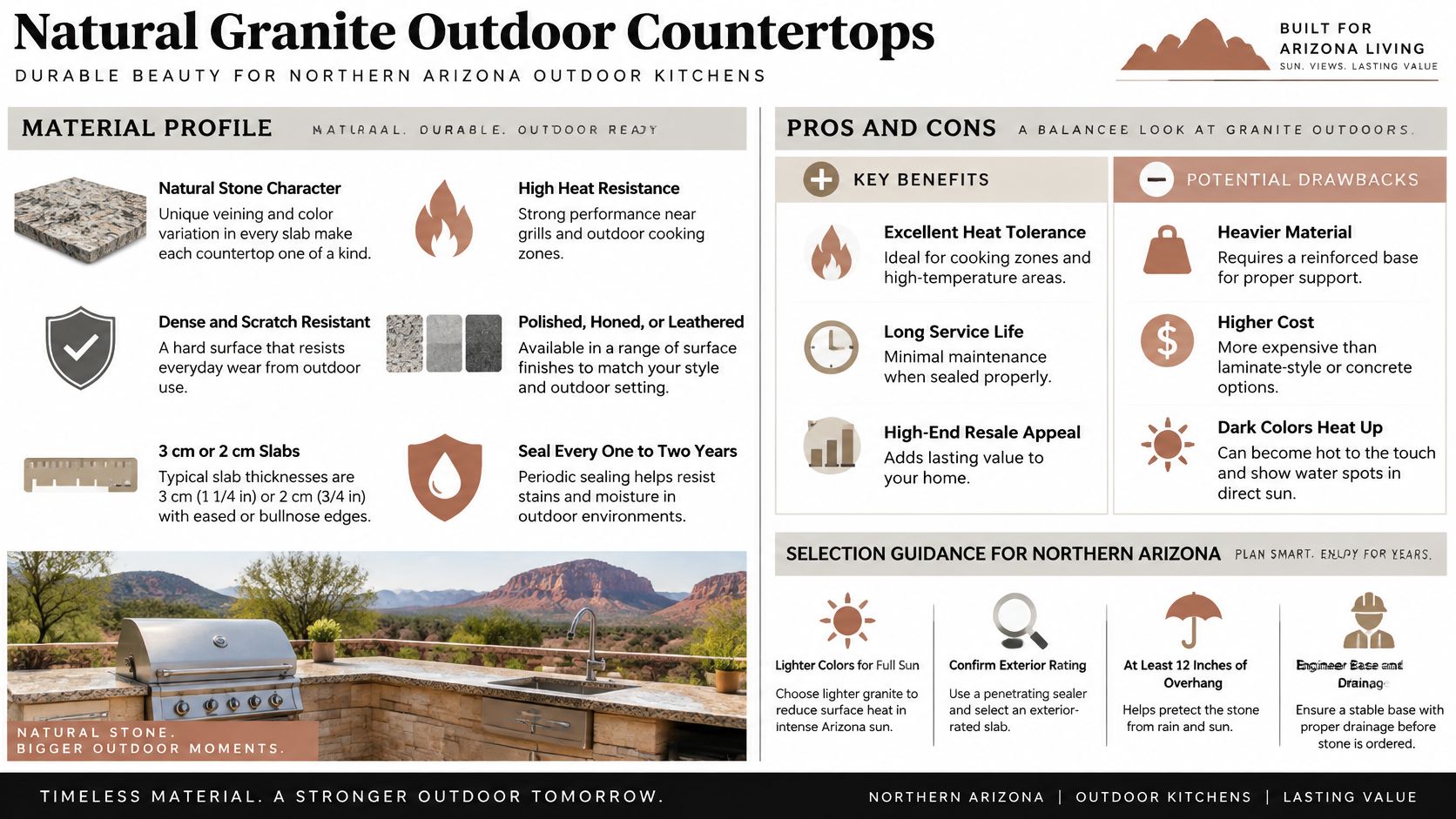
1. Natural Granite Outdoor Countertops
Granite stays granite after Prescott's freeze-thaw nights, hard UV, and wide day-to-night temperature swings. It is igneous stone, cut in large slabs, then polished or honed. Grill heat and monsoon rain do not bleach it the way a resin-bound surface can.
Natural stone leads outdoor-kitchen countertop selections at 41.1%, ahead of engineered stone at 24.8% and porcelain or ceramic at 17.1%, according to a professional outdoor-space survey. That share only tells you what buyers pick. For the slab itself, ask the fabricator for documented water absorption test results on that exact piece, and compare those results across the slabs you are considering.
Is granite good for outdoor kitchens in Northern Arizona?
Yes, when it is sealed and the base drains. At this elevation granite handles direct sun and repeated freeze-thaw better than resin-based quartz, which can discolor under sustained UV. What fails is a slab set over a substrate that traps water, or a cutout with sharp square inside corners. Water held under the stone expands when the night drops below freezing, and stress collects in those corners.
Two layouts make the climate trade-off concrete. In Prescott, a 12-foot granite bar top runs beside a built-in grill on a poured concrete base under a pergola, so the stone stays shaded through the worst afternoon sun. In Prescott Valley, honed granite prep counters sit with a matching fire pit seating wall, tying the cooking zone to the seating area without a second material fighting the light.
Practical rule: lighter granite colors run cooler in full sun, and a honed finish hides water spots better than a high polish.
Confirm exterior rating: ask the fabricator for a slab documented for outdoor use, not a remnant left over from an indoor job.
Specify a penetrating sealer: expect to reseal periodically and test with a water bead before assuming the sealer is still working.
Plan a 12-inch overhang: it shades the cabinet face, keeps rain off the stone edge, and gives bar seating somewhere to land.
Build the base first: site preparation and the foundation go in before the slab is ordered. A settling or wet base is the failure granite will not hide, and that foundation work is part of a full outdoor kitchen install.
2. Quartzite Outdoor Countertops
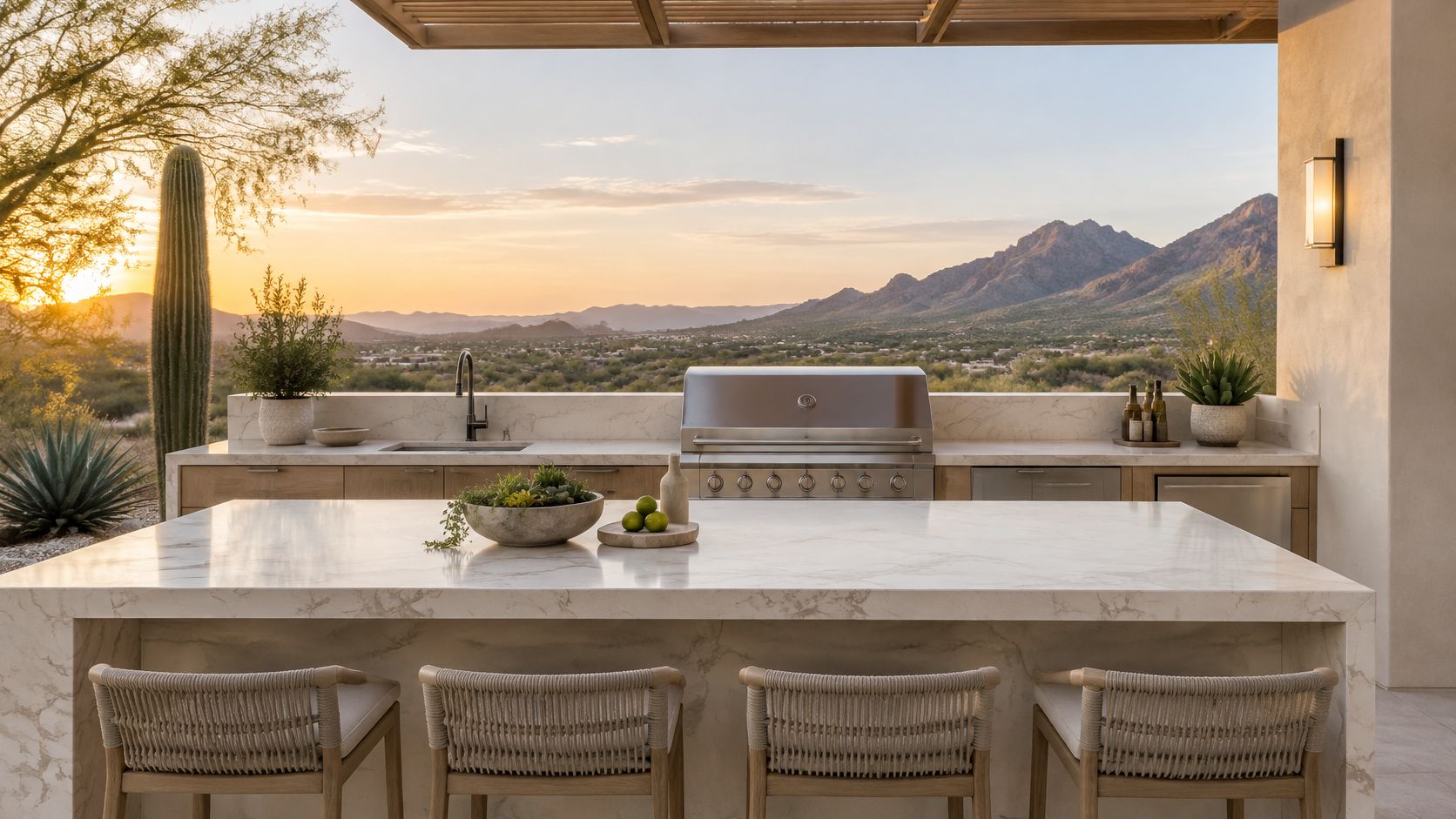
Quartzite suits homeowners who want marble's movement without marble's upkeep. Heat and pressure turn sandstone into this metamorphic stone. It is harder than granite, more heat resistant, and it does not etch the way marble does when a lemon wedge sits on it overnight.
Northern Arizona is the harder test. Freeze-thaw nights, intense UV, and wide swings from a cold morning to a hot afternoon expose soft stone and a weak sealer. Quartzite rides that cycle better than marble when the slab is specified for exterior use and the base sheds water instead of holding it against the underside.
Quartzite usually costs more than granite. Spend the premium on a slab worth looking at in full sun, not on a name from a sample board.
How do you choose a quartzite slab for an outdoor bar?
Look at the full slab in daylight, outdoors, at the time of day the bar gets the most sun. A six-inch sample will not show where a vein crosses a sink cutout, or how the color shifts under UV. On west-facing patios in Chino Valley and Prescott Valley, slabs that stay light tend to read better than ones that darken toward gray-green.
A Prescott Valley bar can use a quartzite waterfall edge next to a stacked-stone fireplace, where guests see the face of the stone. In a Prescott backyard, quartzite prep counters can wrap a built-in smoker so the cooking surface and the bar share one pattern. Either way, keep cabinetry and masonry quiet so the slab stays the focal point.
A waterfall edge on a bar is worth the extra slab. A waterfall edge on a 12-foot back run usually is not.
Order the mitered edge early: waterfall and mitered edges need extra slab, and that changes the price before the pattern is chosen.
Use a stone-specific exterior sealer: a general-purpose sealer will not hold through monsoon cycles and freeze-thaw nights.
Build for the weight: thicker slabs need a base designed for them, not an interior cabinet box.
Ask about seam placement: wide veining looks broken if a seam lands mid-pattern.
3. Travertine Outdoor Countertops and Bar Tops
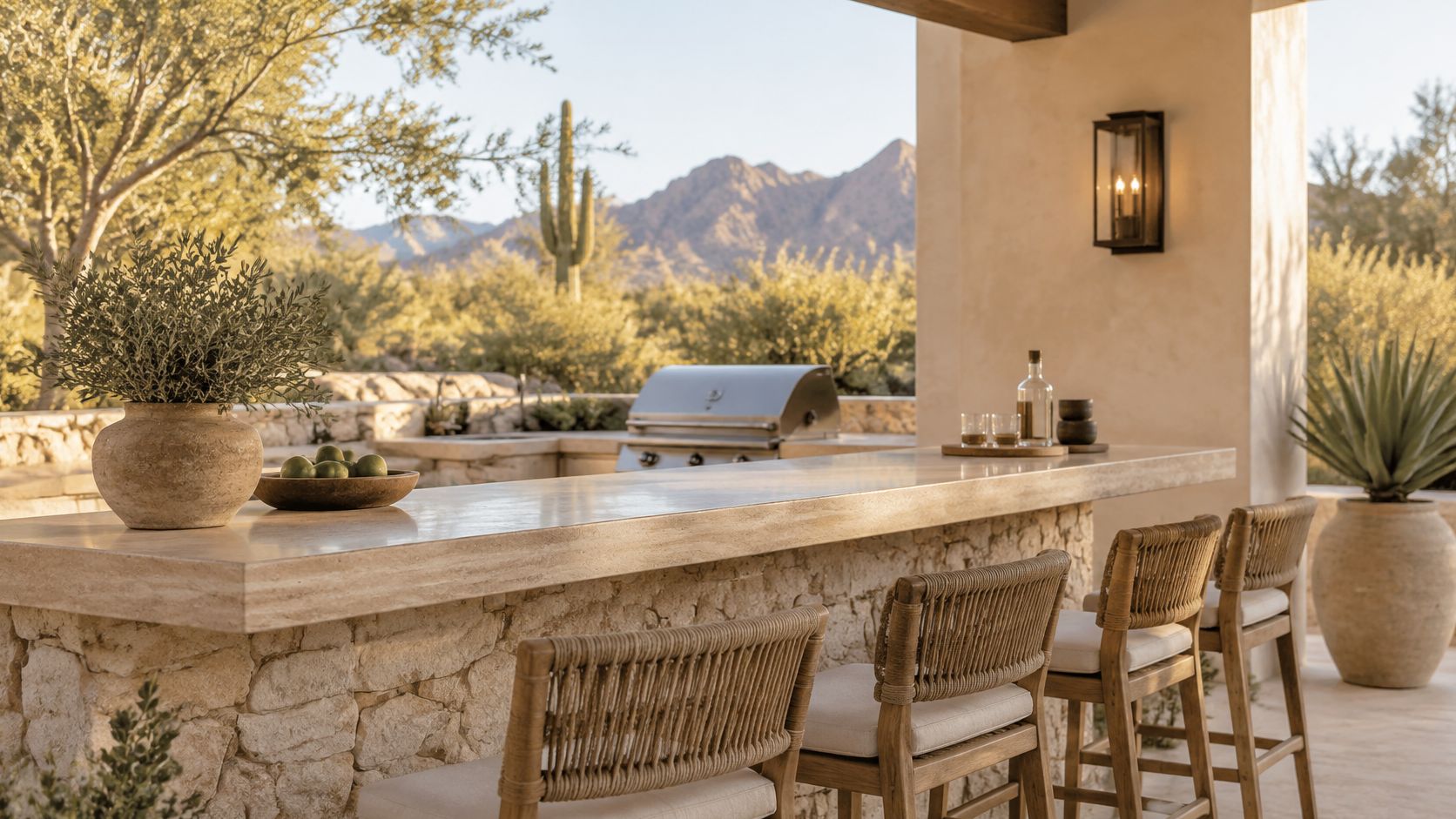
Travertine is the warmest-looking option on this list and the one that punishes shortcuts fastest. It's a sedimentary limestone with a naturally porous texture, which is exactly why it matches Prescott's stone palette and exactly why it stains if you treat it like granite.
The physics are simple. Water expands by roughly 9% when it freezes, so moisture sitting in pores or hairline fissures pushes the surface apart during repeated freeze-thaw cycles, as this technical comparison of outdoor countertop materials explains. Travertine can be filled and sealed to reduce that risk, but the plan has to include drainage and a resealing schedule from day one, not after the first hard winter.
Where travertine makes sense and where it doesn't
Use it on bar tops under a ramada, on seating walls, and on serving surfaces that see drinks and plates rather than knives and hot pans. Keep it away from the grill zone and the sink if the layout allows, because grease and standing water are the two things that age travertine fastest.
A Prescott backyard with a travertine bar top set into matching patio pavers reads as one continuous material, which is the look most homeowners are after. A Prescott Valley kitchen pairing travertine counters with a stacked stone fire pit gets the same effect across the whole living space.
Filling the pores before the first use matters more than which brand of sealer goes on top.
Seal before first use, then annually: twice a year if the counter is fully exposed to sky.
Pick honed over polished: a honed finish grips better when the surface is wet.
Use coasters and boards: citrus, wine, and tomato are the three stains that show.
Match the geology: travertine sits naturally beside flagstone and stacked stone, and this travertine installation guide from Melbourne Tiling Services covers the filling and grouting details that keep porous stone sound.
4. Poured or Cast Concrete Outdoor Countertops
Concrete is the only option here that can be any shape you can build a form for. That's its real advantage: an integrated sink, a curved bar front, a color matched to the house trim, a single continuous surface with no seams. It's poured on site or cast in a mold, then polished, stained, or textured.
Its weakness is climate-specific. An industry materials guide covering outdoor counter options benchmarks installed sealed concrete at roughly $65 to $100 per square foot, cautions that sealed concrete can develop microfractures in freeze-thaw regions, and recommends stone or porcelain slabs for hard-freeze conditions. Prescott sits squarely in that freeze-thaw zone. Concrete still works here, but only with the right mix design, reinforcement, control joints, and a sealer schedule you follow consistently.
How do you keep a concrete countertop from cracking in Prescott?
You plan for movement instead of pretending it won't happen. That means a reinforced, control-jointed base, a slab thickness that suits the span, and joints that give the slab somewhere to crack that isn't the middle of your bar top. Around Chino Valley and Prescott Valley, where afternoon sun hits hard and nights cool fast, thermal cycling does the damage, not the load.
A Prescott Valley backyard with a poured concrete bar top beside a built-in pizza oven, color-matched to a broom-finished patio, is the version that holds up. A Chino Valley kitchen with a cast counter and integrated stainless sink works the same way, provided the sink cutout has radiused corners and the sealer gets refreshed on schedule.
Watch how the pour, the finish, and the cure get handled:
Choose a penetrating sealer: and reapply on the manufacturer's schedule, not once and never again.
Approve a mockup: pour a sample in your actual color and finish before the final pour.
Detail the drainage: a slight fall keeps water from pooling at the grill opening and the sink.
Count repairability as a plus: small chips can be patched in a way granite can't match.
For a deeper look at how we build and seal these counters, read Concrete Countertops for Outdoor Kitchens.
5. Porcelain Slab Outdoor Countertops
Porcelain slabs are fired clay and minerals pressed into large, thin panels, and they're the lowest-maintenance surface on this list. They don't absorb water, they don't care about UV, and they don't need sealing. If you want a countertop you can hose off after a party and forget about, this is it.
The trade-off is edges and installation. Published guidance on choosing countertops for an outdoor kitchen notes that porcelain delivers very low absorption along with strong UV, heat, and stain resistance, while its edges stay vulnerable to impact. A chipped corner on a porcelain slab is a visible repair, not a patina.
Do porcelain slabs look like real stone outdoors?
From two feet away, yes. Large-format slabs with marble or concrete-look graphics read convincingly, and matte finishes handle glare better than polished granite in bright sun. The giveaway is usually the edge detail and the seam layout, which is why the fabricator matters more than the brand on the crate.
Two finished examples. In Prescott, a large-format porcelain island anchors an outdoor kitchen with a built-in gas grill, and the pattern runs the long direction so seams disappear from the main viewing angle. In Prescott Valley, a marble-look porcelain bar ties visually to the indoor kitchen visible through the slider, which is the trick that makes an addition feel original to the house.
Insist on seeing your installer's previous porcelain work, including a finished edge, before you sign.
Use a matte or textured finish: near a pool or spa, polish gets slick when wet.
Specify a substrate rated for large panels: adhesive set or mechanically fastened, not a standard tile bed.
Protect exposed edges: a radius on the corners costs little and prevents the chip that ruins the run.
Coordinate with the indoor kitchen: sharing a finish across the threshold makes the outdoor room feel intentional.
Cleaning is simple enough that it rarely becomes a complaint, and this guide to cleaning commercial porcelain floors covers the same principles that keep an exterior slab looking new.
6. Tile Outdoor Countertops with Mosaic and Decorative Accents
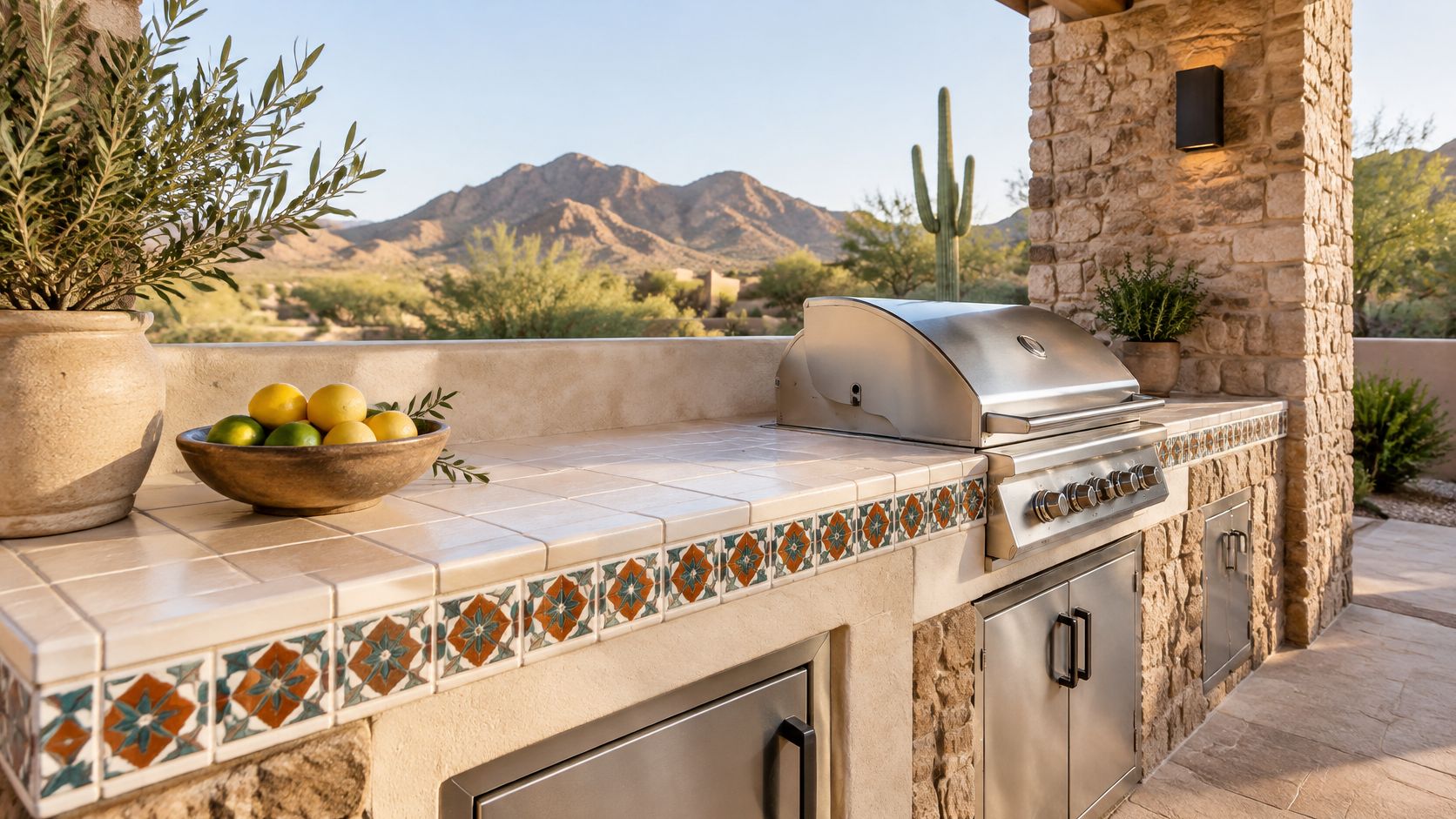
Tile is the material that gives you color for the least money, and the one that causes the most long-term grief when it's the whole counter. Individual ceramic, porcelain, or glass tiles set over backer board and grouted into place create the pattern, and every one of those grout lines is a small reservoir for water, grease, and dust.
That's not a style opinion, it's a hygiene issue. NSF's food equipment standards require countertop materials to be free of cracks and crevices because irregular surfaces retain moisture, grease, and food debris, and unfinished wood or laminate-style tops don't pass in food and beverage areas. An outdoor kitchen isn't a commercial kitchen, but the logic holds: the more seams and joints a surface has, the harder it is to clean completely after rain, dust, and a rack of ribs.
Where tile belongs in a Prescott outdoor kitchen
Put it on vertical faces and accents, not the entire work surface. A Prescott backyard bar with Talavera-style accent tile across the front and a plain porcelain tile top reads as handmade without turning the prep zone into a grout project. A Chino Valley kitchen with glass mosaic detailing along the countertop edge puts the sparkle where guests look.
Use frost-rated tile: Northern Arizona's freezing nights rule out anything rated for interior walls only.
Switch to epoxy grout: it resists staining far better than cementitious grout and needs resealing less often.
Keep joints narrow: wide grout lines collect debris and fail first.
Cap heavy prep areas with stone or concrete: tile belongs around them, not under the cutting board.
7. Stainless Steel Outdoor Countertops
Stainless is the right answer for one specific zone and a questionable one for the whole kitchen. Fabricated from grade 304 or 316 sheet, it's hygienic, heat-proof, and easy to wipe down, which makes it ideal for a prep counter next to a grill. It's also loud, hot in direct sun, and it shows every fingerprint and water spot.
Why the grill zone matters so much comes down to how people build. Among renovating homeowners who added or upgraded an outdoor kitchen, 58% of those projects involved plumbing, electrical, or heating work, 55% included appliances, and 50% included countertops, with grills appearing in 88% of reported outdoor kitchens, according to reporting on outdoor project trends. The grill is the center of the build, so the surface beside it takes more abuse than any other inch of the counter.
Is stainless steel too hot to use in Arizona sun?
In full afternoon sun, yes, a brushed stainless top can be uncomfortable to touch, and it will radiate heat onto anything sitting on it. Under a ramada or pergola, or on a north-facing run, it's fine. If your layout puts the prep counter in open sun, granite or porcelain will treat you better.
A Prescott Valley build with a stainless prep counter set beside a stone grill island gets the best of both: a sanitary landing zone for tongs and trays, and stone where guests sit. A Prescott backyard bar with a stainless top on a concrete base goes full industrial, which suits a modern house and looks deliberate rather than accidental.
Specify 304 for nearly every Northern Arizona yard: 316 is worth the upcharge mainly near salt or heavy chemical exposure.
Choose brushed over mirror: it hides scratches and dries without streaks.
Ask about a sound-dampening core: it kills the drum effect of a thin metal top.
Wipe dry after cleaning: water spots are cosmetic but stubborn once they set.
Our outdoor kitchen metal frame work explains how the framing and substrate under a metal or stone top get built to carry the load.
8. Flagstone and Stacked Stone Outdoor Countertops
Flagstone and stacked stone belong on a Prescott kitchen when the counter has to read as part of the yard. Freeze-thaw nights, intense UV, and wide temperature swings punish a surface that holds water or locks the wall joint rigid. Flagstone is sedimentary rock split into flat, irregular slabs. Stacked stone is usually a manufactured veneer that mimics natural rock. Used together, they tie the house, the patio, and a fire feature into one material family.
The build is heavier than a single slab. Pieces vary in thickness, so the base, the overhang, and the joints carry the load. Outdoor-construction guidance recommends additional support for overhangs beyond 250 millimeters, per this outdoor countertop pricing and installation guide. Give the top a slight, deliberate fall toward the drain side so rainwater runs off instead of pooling. Radius inside corners at cutouts instead of leaving them square, and run flexible sealant where the counter meets a wall. Stone and the house move at different rates through a Northern Arizona temperature swing, and a hard joint there cracks.
Where flagstone works and where it doesn't
Smooth flagstone is the prep and serving surface. Rough, cleft pieces go on bar fronts, grill surrounds, and walls. A Prescott yard with a flagstone top, a stacked stone bar, and a matching fire pit reads as one structure. A Prescott Valley grill surround in stacked stone, with flagstone on the counter, gives the same unity and more flat workspace.
Seal the counter, not only the wall. Food, wine, and grease stain unsealed flagstone, and strong sun sets the mark. Bed the top in mortar over a solid base. Spot-bonded pieces rock, and low spots hold water that freezes overnight. Keep thickness even on the work surface for that reason. Carry the same stone onto the fire pit, a fireplace, or a low wall so the material looks deliberate.
Those layout choices are covered in these stone patio design ideas.
Outdoor Countertop Materials Compared
Prescott nights freeze, midday UV is harsh, and the temperature swing between them stresses a counter more than heat alone. Use that cycle to read the table.
Material | Heat & UV Resistance | Maintenance Level | Best For |
|---|---|---|---|
Natural Granite Outdoor Countertops | Very high heat resistance; stable under Arizona UV when color is chosen carefully | Moderate; seal every one to two years | High-end outdoor kitchens and grill areas |
Quartzite Outdoor Countertops | Excellent heat resistance. Good UV tolerance; color and sealer choice matter | Moderate; periodic sealing and gentle cleaning | Upscale cooking surfaces with a marble-like look |
Travertine Outdoor Countertops and Bar Tops | Stays relatively cool in direct sun. Moderate heat tolerance; porous, so UV-stable colors and sealing are key | High; seal regularly and protect against stains | Desert-inspired bars and seating areas |
Poured or Cast Concrete Outdoor Countertops | Stable heat tolerance; surface can craze with thermal cycling if not reinforced or sealed. Good UV tolerance when sealed and colored for sun | Moderate; seal and maintain periodically | Custom shapes, colors, and integrated features |
Porcelain Slab Outdoor Countertops | Strong heat and UV resistance | Low; easy to clean | Sunny outdoor kitchens needing a low-maintenance surface |
Tile Outdoor Countertops with Mosaic and Decorative Accents | Less heat-resistant than stone near open flames; choose outdoor-rated tile | Moderate to high; maintain and seal grout regularly | Decorative accents and budget-friendly designs |
Stainless Steel Outdoor Countertops | Excellent heat resistance; can become very hot in direct sun | Low; clean and dry to prevent water spots | Food prep zones and contemporary outdoor kitchens |
Flagstone and Stacked Stone Outdoor Countertops | Stone is naturally heat-tolerant; UV performance depends on the specific stone | Moderate; some stone types need sealing | Rustic or Southwest designs and casual bar tops |
Plan Your Countertop With a Free Local Consultation
Match the material to three things and the decision gets simple. First, sun exposure: a fully exposed island in Prescott Valley asks more of any surface than a covered bar under a ramada, so quartzite, granite, or porcelain earn their cost there, while travertine and concrete need more attention. Second, how you cook and entertain: a grill-heavy layout wants a dense stone landing zone plus a stainless prep panel, while a drinks-and-appetizers bar can justify a dramatic slab or a warm travertine top. Third, your maintenance appetite: if you won't reseal concrete every year, don't buy concrete.
Then accept that the slab is maybe half the job. The base, the drainage fall, the joint where the counter meets masonry, the overhang support, and the utility rough-in decide whether the counter is still flat and tight in five years. A premium slab on a settling base fails. A modest material on an engineered base with proper slope and a drip edge performs. That's why the plan should start with the yard, not the showroom.
Interest in these projects is still climbing. 22% of surveyed homeowners said they envisioned adding an outdoor kitchen, according to System Pavers' Outdoor Living Trends Index as reported by Gifts & Decorative Accessories, which means your material decisions will be compared against plenty of neighbors' builds.
R.E. and Sons Landscaping is a licensed, bonded, and insured design-build firm (Arizona ROC #300642) serving Prescott, Prescott Valley, and Northern Arizona. One crew handles consultation, custom design, permitting, masonry, countertop installation, and appliance connection, and most builds finish in two to four weeks. Permanent kitchens with gas, plumbing, or electrical connections typically require permits, and we manage that process as part of project management. Consultations are free and followed by detailed, itemized quotes, so you can compare materials on real numbers instead of showroom guesses.
Schedule a complimentary consultation online or by phone during Monday through Friday office hours, 8am to 4pm, and we'll put together countertop recommendations for your yard, your sun exposure, and the way your family cooks.
A Northern Arizona countertop only performs as well as the assembly under it, which is why R.E. and Sons Landscaping evaluates the base, drainage, cutouts, and utility connections before recommending a material for your outdoor kitchen. From granite and quartzite bars to concrete, porcelain, tile, and stone surrounds, the team designs and builds the whole space, permits included, and handles the appliance connections at the finish. Visit R.E. and Sons Landscaping to schedule a free consultation and get a detailed, itemized quote for your Prescott or Prescott Valley project.
Comments