
What Is Hardscape in Landscaping: A Prescott Guide
Hardscape is the non-living, built framework of an outdoor space, including patios, walkways, retaining walls, driveways, and rock features made from stone, concrete, brick, or pavers. Unlike softscape, which includes plants and other living materials, hardscape provides the permanent structure that organizes movement and outdoor living.
You may be looking at a bare Prescott backyard right now, with decomposed granite underfoot, a juniper near the fence, and water that cuts a muddy channel across the lot during monsoon storms. R.E. and Sons Landscaping helps homeowners, builders, property managers, and HOA boards in Prescott, Prescott Valley, Chino Valley, and nearby Northern Arizona turn those difficult spaces into usable patios, paths, walls, drainage features, and complete outdoor living areas. The key question isn't only what hardscape means. It's how to build it so it works with Prescott's rocky soil, high-desert sun, elevation, and weather.
What Hardscape Means in a Real Prescott Yard
Take a typical backyard off Willow Creek Road. The lot may have a juniper, scattered granite, a sloping grade, and little obvious separation between the back door, seating area, and planting beds. Once a contractor adds a patio, a walkway, a retaining wall, steps, edging, or a fire pit, those built features become the yard's hardscape. They create the durable framework that people walk on, sit beside, and use throughout the year.
The distinction is straightforward:
Hardscape: Patios, walkways, driveways, retaining walls, stairs, fire pits, decks, edging, drainage structures, and rock features.
Softscape: Trees, shrubs, native plants, lawns, xeriscape groundcovers, and pollinator gardens.
Hardscape commonly uses stone, concrete, wood, brick, and metal, and its purpose extends beyond appearance. It establishes circulation, supports seating and outdoor kitchens, creates level areas on sloped ground, and helps manage water. Outdoor Brite's hardscape definition describes the category as the non-living, built elements that form a yard's permanent framework.
Why Prescott changes the definition
A patio in a mild coastal climate doesn't face the same job as a patio above 5,000 feet. Prescott's freeze-thaw cycles can expose weak paving, poor joints, and inadequate bases. Summer monsoon runoff can move quickly across sloped lots, while caliche-heavy or rocky soil makes excavation, grading, and drainage more demanding. Strong ultraviolet exposure also affects color, sealers, wood, and exposed surfaces.
That means the bones of a Prescott yard have to fight the ground and weather before they can look finished. A beautiful flagstone layout with a shallow, poorly compacted base may shift. A retaining wall without a drainage plan may collect pressure behind it. A smooth patio that traps water near a foundation creates a problem rather than solving one.
Practical rule: In Prescott, hardscape design starts with slope, soil, drainage, and intended use. Material appearance comes after those decisions.
The rest of the project follows from that order. You need to understand how hardscape and softscape support each other, which elements solve common yard problems, how materials behave here, and what to ask before hiring an installer.
Hardscape vs Softscape and Why Both Matter
Hardscape is the skeleton of an outdoor space. Softscape is the living layer that gives that structure shade, color, habitat, and seasonal change. A successful Prescott outdoor design needs both because a yard made entirely of built surfaces can feel harsh and hot, while plants without paths, walls, or usable grades often become difficult to access and maintain.
A flagstone patio, for example, becomes more comfortable when Apache plume and penstemon soften its edge. A boulder retaining wall looks more settled when planting fills the joints and connects it to the surrounding terrain. Decomposed granite pathways can guide movement between manzanita, native grasses, and a small seating court without requiring a lawn to carry the whole design.
Feature | Hardscape | Softscape |
|---|---|---|
Main role | Structure, circulation, level changes, and outdoor use | Shade, color, habitat, screening, and visual softness |
Typical materials | Stone, concrete, brick, pavers, gravel, wood, and metal | Trees, shrubs, perennials, turf, groundcovers, and native plants |
Seasonal behavior | Provides relatively consistent use throughout the year | Changes with growth, dormancy, watering, and weather |
Prescott application | Patios, walls, paths, stairs, drainage, and fire features | Xeriscape beds, native planting, pollinator areas, and shade trees |
The partnership matters most in the high desert. Hardscape carries the traffic, furniture, cooking, and gathering, while softscape helps reduce visual heat and connects the installation to Northern Arizona's natural character. Planting can also help define zones, but it shouldn't be expected to correct a failed grade or a badly built wall.
Use hardscape where the yard needs strength, access, or shape. Use softscape where it needs life, shade, texture, or ecological value. The strongest designs let each component do the work it's suited for instead of asking plants to stabilize construction or asking concrete to provide all the character.
The Main Hardscape Elements Homeowners Use
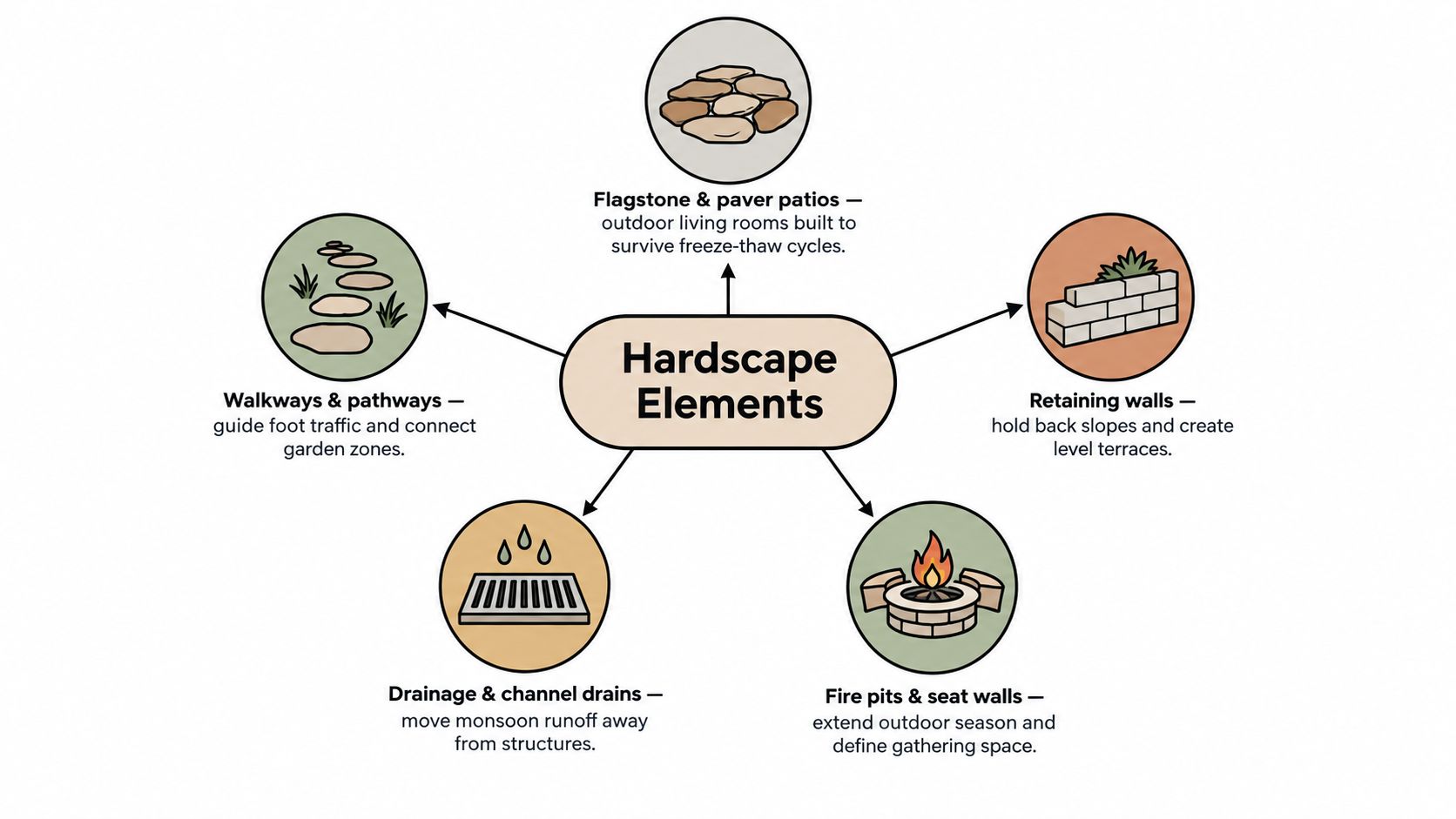
Prescott homeowners rarely need hardscape for decoration alone. Each feature usually answers a practical need, such as creating a level place to sit, controlling runoff, connecting parts of the property, or making a difficult slope usable.
Patios create the main outdoor room
A patio extends the living area beyond the back door. Flagstone, concrete pavers, and other stable surfaces can support dining tables, lounge chairs, grills, and shade structures. In Prescott, the subgrade and base matter as much as the surface, because freeze-thaw movement can turn a poorly prepared patio into a collection of uneven edges.
Paver layouts offer repair flexibility because individual units can be lifted and reset. Homeowners comparing paver patterns can review interlocking pavers and their applications before choosing a layout.
Walkways connect the property
A path should lead somewhere useful. Decomposed granite works well for informal routes and garden connections, while steppers or mortared flagstone create a more defined passage between the front entry, side yard, and backyard. Edges are important because loose material migrates into planting beds when foot traffic and runoff have no restraint.
Retaining walls create stable terraces
Boulder, block, and dry-stacked stone walls can hold back a slope, form planting terraces, and slow water moving down a lot. A wall isn't just a vertical decorative feature. It needs a suitable footing or base, stable construction, and a way to relieve water pressure behind it.
Fire features extend outdoor use
Gas fire pits, seat walls, and flagstone fireplaces create a gathering point when evenings turn cool. Their placement should account for clearances, fuel or utility work, seating circulation, and local requirements. A fire feature that blocks the main path or sits too close to a roofline may look attractive in a drawing but function poorly in real use.
Water features need restraint
Small recirculating fountains and pondless waterfalls can add sound and movement without demanding the footprint of a large pond. In a low-rainfall region, a contained system with accessible equipment is usually easier to manage than a feature that relies on complex planting or difficult-to-reach pumps.
Edging and driveways solve movement problems
Steel, stone, and concrete edging keep decomposed granite from spreading into planting beds. Driveways use larger structural surfaces, such as reinforced concrete or pavers, and must handle vehicle loads, runoff, and winter movement. Homeowners reviewing driveway construction options can also see this resource on replacing an Atlanta driveway, although Prescott soil and weather still require local design decisions.
In Northern Arizona, every element pulls double duty. A patio is an outdoor room and a drainage surface. A wall is a visual boundary and a slope-control structure. A path is a design line and a safe route across uneven ground.
Common Hardscape Materials Compared
Material selection should begin with the job, not a showroom sample. Natural stone can fit a Prescott property beautifully, but installation depends heavily on stone thickness, base preparation, joint treatment, and the skill of the crew. Concrete pavers offer consistent dimensions and repairability. Poured concrete can cover large areas efficiently, but cracks are difficult to hide or replace once they appear.
Wood and composite decking belong in a different decision category from masonry surfaces. If a raised platform or deck is part of the plan, comparing products such as TimberTech decking can help clarify how decking differs from patios and paving.
Material | Installed Cost (per sq ft) | Durability in Prescott Climate | Best Uses | Maintenance Level |
|---|---|---|---|---|
Natural stone, including flagstone and sandstone | Varies by stone, access, thickness, and labor | Strong when properly selected and based; joints and placement require care through freeze-thaw cycles | Patios, steps, accent walls, and regional designs | Moderate |
Concrete pavers | Varies by pattern, product, base work, and labor | Good when the base, edge restraint, and drainage are correct; individual units can be reset | Patios, walkways, driveways, and courtyards | Low to moderate |
Clay brick | Varies by brick type, pattern, and installation | Can perform well with a stable base, though color and surface character depend on the product | Entries, borders, walks, and traditional details | Moderate |
Poured concrete | Varies by thickness, reinforcement, access, and finish | Efficient for slabs and driveways, but cracking can follow movement in expansive or poorly prepared soils | Driveways, slabs, service areas, and simple patios | Low at first, higher if cracking requires repair |
Decorative gravel and river rock | Varies by rock type, depth, access, and edging | Well suited to high-desert beds, swales, and paths when contained and graded correctly | Xeriscape beds, drainage areas, pathways, and accents | Low to moderate |
Natural flagstone and Arizona moss rock often look at home beside juniper, manzanita, and native planting. Their irregular shapes can produce a more natural composition, but fitting and setting the pieces takes skilled labor. Concrete pavers provide more predictable patterns and color choices, which helps when a homeowner wants a clean courtyard or a surface that can be repaired in sections.
Decorative gravel is the high-desert workhorse. It supports xeriscape beds, drainage swales, and informal pathways, but it isn't maintenance-free. Without proper edging and a prepared base, it spreads, collects in low spots, and mixes with soil and plant debris. Decomposed granite's common landscape uses can help homeowners distinguish a compactable pathway material from larger decorative rock.
Design Principles That Make Hardscape Last
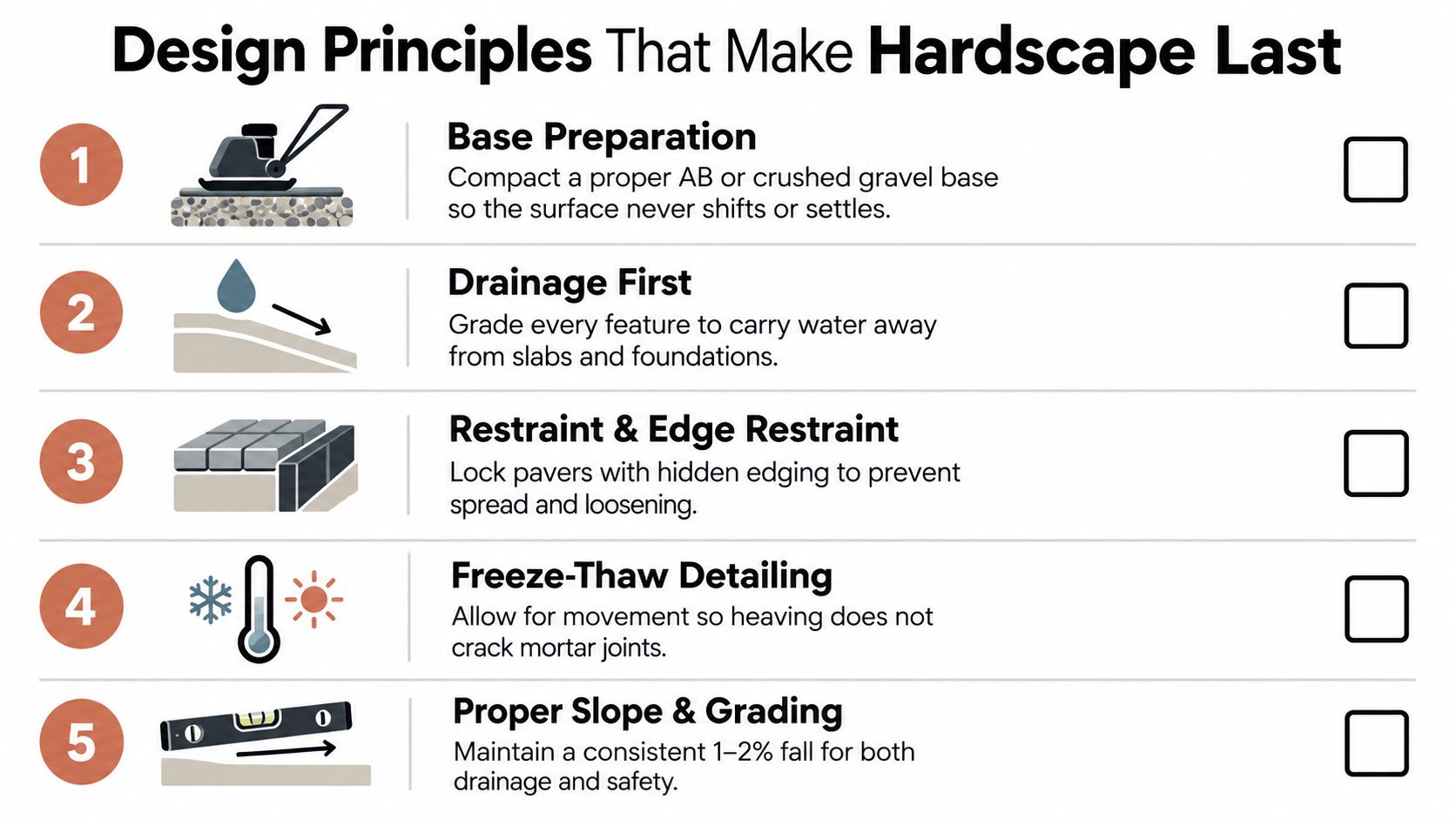
A durable installation comes from construction decisions that aren't visible after the job is complete. The surface may be the part you notice, but the base, grade, restraints, and transitions determine whether it stays where it belongs.
Start below the surface
Excavation removes unstable material and creates room for a properly compacted AB, crushed gravel, or decomposed granite base. In rocky Northern Arizona soils, crews still need to establish a consistent construction profile rather than just place material on top of whatever the shovel encounters. A weak or uneven base is a common reason surfaces settle, separate, or heave.
Drainage and grading come next. Hardscape should move water away from foundations, doors, walls, and low points, while channel drains or other collection features may be needed where runoff concentrates. The University of Nebraska–Lincoln hardscape guidance distinguishes permeable, pervious, and porous paving systems, all of which address water movement in different ways.
A permeable paver system drains through joints between units. Pervious paving allows water through the paving material itself, while porous systems use a cellular structure that may contain gravel or vegetation. These approaches can reduce surface runoff by allowing infiltration near where rain lands, but they still require correct excavation, aggregate layers, grading, and maintenance.
Make the layout serve the house
A patio should connect logically to the back door, kitchen, grill, or seating area. A walkway should follow the route people naturally take, not force them around a decorative shape. On compact Prescott lots, fewer larger elements often create a calmer and more usable plan than several small features competing for space.
Keep transitions deliberate. Steel edging, concrete bands, step-downs, and restrained joints prevent gravel, pavers, and planting soil from migrating into each other. Allow movement where the material and climate require it, especially around mortar joints and rigid structures.
A good design therefore answers five questions before installation begins:
What carries the load? The base must suit the surface and expected traffic.
Where does water go? Grades and collection points should be clear.
How will people move? Paths should connect actual destinations.
Is the scale right? Large features need room to function and breathe.
How do materials meet? Edges and transitions need restraint.
Maintenance, Cost, and Contractor Considerations
Low-maintenance doesn't mean no maintenance. Pavers and natural stone may need joint sand replenished, sealers may need renewal every three to five years depending on product and exposure, and drainage channels should be cleared before monsoon season. Gravel beds need occasional raking and top-up work where runoff or foot traffic displaces rock.
Some project prices are available as practical planning figures. A basic paver patio in Prescott may run $18 to $28 per square foot installed, while natural flagstone may run $25 to $40 per square foot. Engineered retaining walls may run $40 to $70 per square foot, depending on wall height and soil conditions. These figures are local planning ranges, not guaranteed bids, because access, excavation, demolition, drainage, material selection, and engineering can change the scope.
What a responsible bid includes
A low quote deserves questions, not automatic approval. Ask every contractor for:
A written base specification: The scope should identify base material and installation details.
A drainage plan: The contractor should explain where runoff will go during storms.
A complete material list: Confirm surface products, jointing materials, edging, and drainage components.
Proof of insurance: Request current documentation before work begins.
Local references: Look for projects with comparable slope, soil, and materials.
A workmanship warranty: Get the coverage and exclusions in writing.
You can also use this guide on how to verify a contractor license when checking a prospective installer. For larger outdoor kitchens, fire features, lighting systems, or walls, ask how the contractor handles utilities, approvals, inspections, and sequencing.
A bid that leaves out base preparation and drainage isn't cheaper. It may simply move those costs into repairs.
The cheapest installation can become the most expensive after settling, heaving, joint failure, or drainage damage appears. A clear scope protects both the homeowner and the contractor because it makes the hidden work visible before construction starts.
How R.E. and Sons Landscaping Brings Hardscape to Life
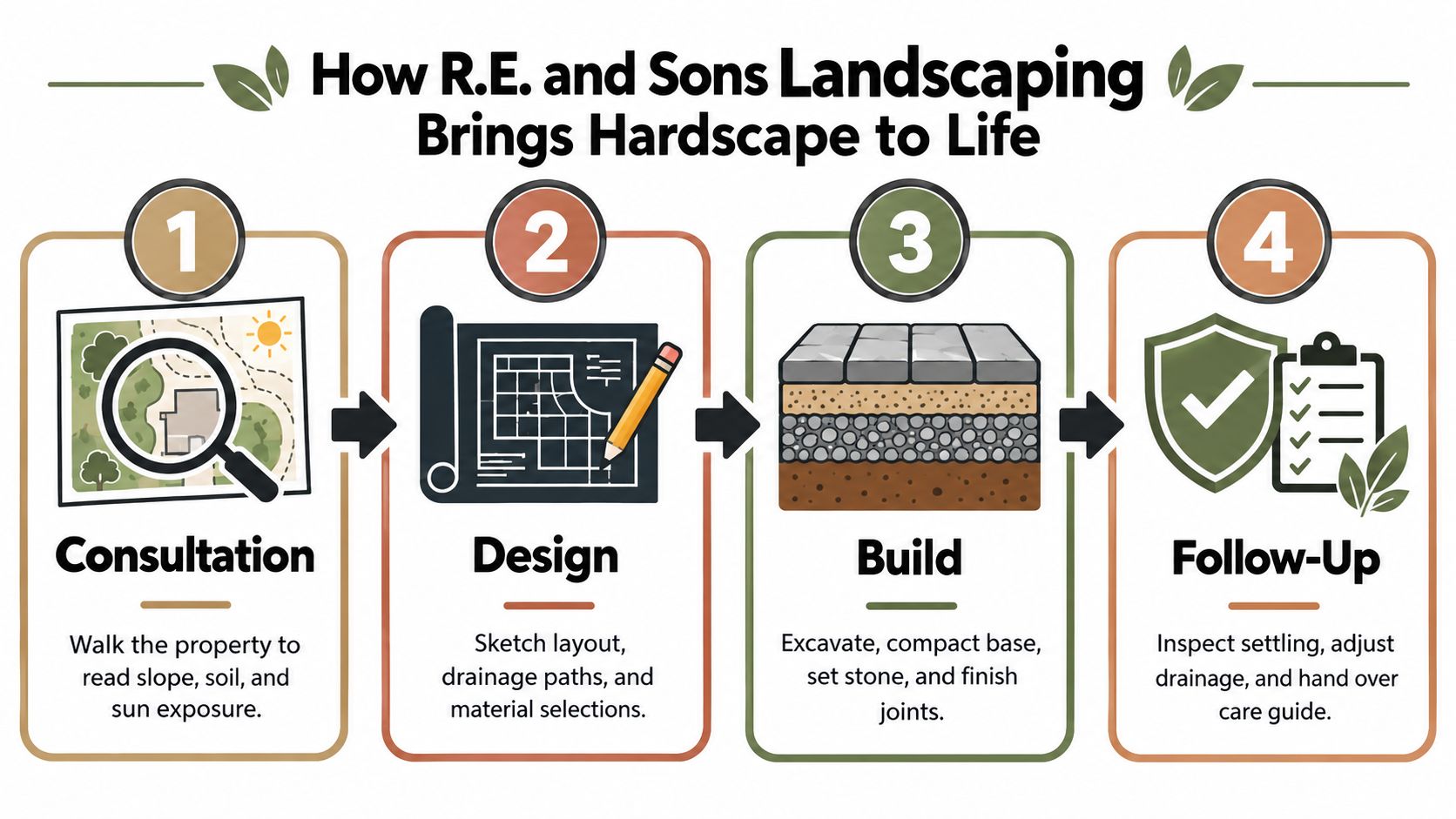
R.E. and Sons Landscaping uses a four-step process for Prescott-area exterior construction, beginning with an on-site consultation. The team reads the slope, soil, sun exposure, existing drainage, access, and how the household wants to use the property. That review matters in the Prescott area, where granite subsoil, rocky excavation, elevation, and intense sun influence both the design and the construction method.
Consultation
The project starts with the site rather than a catalog. The team identifies slopes, runoff paths, existing features, and the relationship between the house and proposed outdoor rooms.
Design
The layout then brings together patios, walls, paths, planting, drainage, and material choices. A good plan accounts for freeze-thaw movement, monsoon runoff, UV exposure, access, and maintenance before any surface is installed.
Build
Construction focuses on excavation, geotextile where appropriate, compacted base, accurate grading, stone or paver placement, edge restraint, and correct jointing. Those details determine whether the finished work stays stable after weather and everyday use.
Follow-up
The final walkthrough covers cleaning, sealing, drainage care, planting coordination, and warranty information. R.E. and Sons Landscaping is licensed, bonded, and insured, and operates under Arizona ROC #300642. Its work includes paver patios, rock and stone features, retaining walls, fireplaces, fire pits, water features, outdoor kitchens, and related outdoor installations for Prescott and surrounding Northern Arizona communities.
Hardscape Questions Prescott Homeowners Ask Most
How long does a well-built paver patio last at Prescott elevation?
A well-built paver patio can provide long service when the base, drainage, edge restraint, joints, and surface product match the site. Longevity depends more on installation quality and maintenance than on elevation alone.
Do retaining walls need permits in Yavapai County?
Requirements can vary by wall design, height, location, drainage, and jurisdiction. Ask the local building department or have your contractor confirm the applicable Yavapai County and municipal requirements before construction.
What materials pair well with low-water native plants?
Natural stone, Arizona moss rock, concrete pavers, decomposed granite, and decorative gravel pair well with juniper, manzanita, Apache plume, penstemon, and other regional planting. Use a restrained palette so the hardscape supports rather than overwhelms the plants.
Why do pavers heave after the first winter?
Common causes include inadequate base preparation, trapped water, poor grading, weak edge restraint, or soil movement beneath the installation. Resetting the surface without correcting the underlying drainage or base problem usually won't last.
Is decomposed granite a smart substitute for lawn?
It can be a practical low-water surface for paths, sitting areas, and xeriscape zones, especially when the base, grading, and edging are correct. It isn't a universal lawn replacement because it doesn't provide the same cushioning, cooling, or play surface.
R.E. and Sons Landscaping designs and builds Prescott-area patios, walkways, retaining walls, rock features, fire pits, water features, outdoor kitchens, and complete low-maintenance outdoor spaces. Visit R.E. and Sons Landscaping to schedule a consultation and discuss a hardscape plan suited to your property, soil, drainage, and the way you want to use your yard.
Comments