
Backyard Putting Green Turf Guide for Prescott Homeowners
What good is a perfectly green putting surface if it's too hot to use or the ball wanders across a settled base? Backyard putting green turf works best when you choose the surface, foundation, drainage and sun exposure together, not when you buy the carpet first and figure out the yard afterward.
R.E. and Sons Landscaping helps homeowners in Prescott, Prescott Valley, Chino Valley and nearby Northern Arizona communities turn that planning problem into a workable yard design. We design and install custom putting greens, with a process that connects your practice goals to the yard's grade, existing hardscape and everyday use.
The right starting point isn't the fastest turf or the biggest layout. It's a clear specification for how the green should play, where water will go and when your family will use it.
Backyard Putting Green Turf Specs at a Glance
Pile height, stimp speed, infill and backing decide much of how a backyard green plays and feels. Compare those specifications before judging a sample by its color.
Residential putting green turf specs
Spec | Typical residential range | Why it matters |
|---|---|---|
Pile height | 3/8 to 5/8 inch, approximately 9 to 16 mm | Shorter pile gives truer ball roll; taller pile feels softer underfoot |
Stimp speed | 6 to 10 feet | Higher numbers mean faster greens; 6 to 8 suits beginners and kids |
Infill | Silica sand, sand-free or none | Adds weight and stability and affects drainage and firmness |
Backing | Perforated or open backing | Lets water pass through to the base below |
Warranty | Manufacturer-specific written coverage | Read exclusions for UV fading, pet damage and seams |
Pile height describes the exposed fiber length, but it doesn't tell you everything about roll because fiber construction and the installed surface also matter. A soft turf sample isn't automatically suitable for putting.
Stimp speed describes how far a ball rolls during a standardized test. Faster isn't necessarily better, especially when a compact yard needs forgiving breaks rather than balls that repeatedly run off the edge.
How should you compare turf samples?
Infill must match the turf system, not just the installer's preferred bag of material. Sand adds ballast and affects firmness, while products designed without conventional infill need their own installation specifications.
Backing needs a clear path into a draining foundation; holes in the carpet won't fix a blocked base. Warranty coverage deserves the same attention as appearance because product coverage and installation workmanship may have different exclusions.
During your consultation, we can walk through these specifications and connect them to your intended use. Bring questions about putting practice, children, pets and whether you expect to chip onto the surface.
For surrounding beds, The Cactus Outlet's desert garden inspiration for contractors offers useful ideas for integrating drought-tolerant planting rather than treating the green as an isolated rectangle.
Before signing: Get the product specification sheet and intended installed stimp rating in writing. Compare samples side by side in daylight, then roll a ball on an installed example if possible.
What a Backyard Putting Green Costs in Northern Arizona
Professional backyard putting-green installation typically costs $15 to $40 per square foot, according to HomeAdvisor's 2025 cost guide, which provides the rates used for the illustrative calculations below. A separate Homes.com national estimate puts artificial backyard installations at $1,500 to $16,000 in 2025, depending on size, labor and added features.
Estimated cost by putting green size
Green size | Low estimate at $15 per sq ft | High estimate at $40 per sq ft |
|---|---|---|
200 sq ft | $3,000 | $8,000 |
400 sq ft | $6,000 | $16,000 |
600 sq ft | $9,000 | $24,000 |
These are budgeting calculations, not Prescott quotes. The national total-project range isn't a ceiling, and multiplying a larger footprint by an installed rate can produce a higher total.
What pushes a quote toward the upper end?
Excavation and access can matter as much as turf selection. A yard with rocky ground, a narrow equipment entrance or material that must be hauled through a side passage takes more work than an accessible, prepared area.
Compare these scope items before deciding whether a proposal is expensive:
Earthwork and drainage: Grade correction, unsuitable-soil removal and a dependable outlet.
Borders and transitions: Edging, fringe and connections to patios or stone beds.
Playing features: Contouring, multiple cups, chipping areas and bunkers.
Finish work: Seams, infill placement and cleanup.
In Prescott, rocky soils and preparation for freeze-thaw conditions can push a project toward the upper end. Removing essential base work to preserve extra putting area is usually the wrong trade.
Artificial turf installation timelines depend on the space's size and condition. Most projects move faster than a full traditional lawn installation because there's no ongoing grow-in period, but excavation and drainage still need adequate time.
Ask for separate line items for excavation, base, turf, infill and seam work. Compare written quotes using the same footprint and base specification, not merely matching turf names.
Base, Drainage and Layers Under the Turf
The turf is only the visible finish. The foundation determines whether your intended contours stay put and whether rainfall leaves the surface usable.
The USGA's backyard putting-green guide describes a common synthetic assembly with approximately 2 to 4 inches of gravel beneath 6 to 8 inches of compacted aggregate, shaped slightly like a turtle back to shed water. Those are reference dimensions for an assembly, not a substitute for evaluating your particular yard.
The diagram shows how the materials fit together.
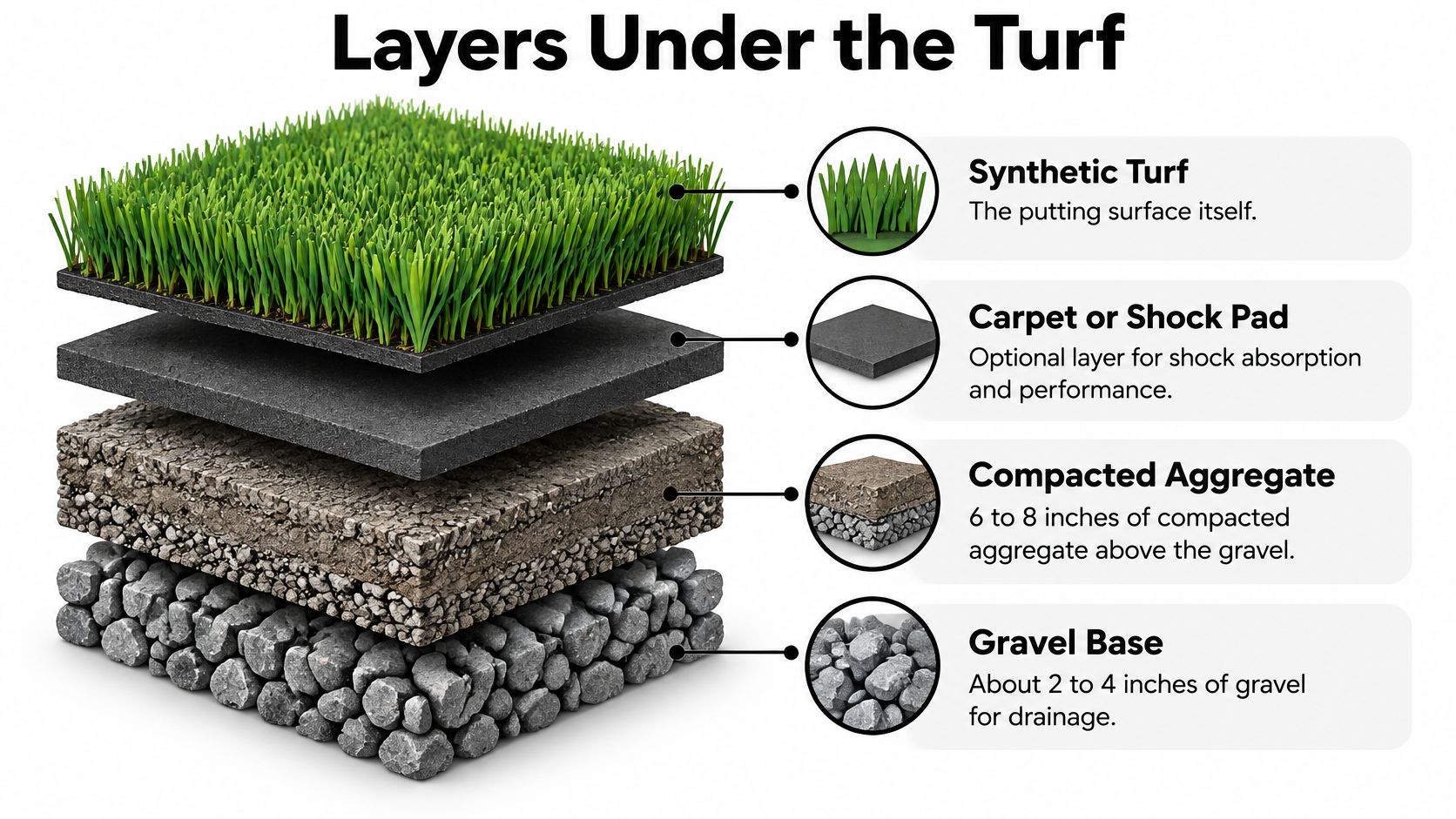
Gravel provides a drainage layer. Compacted aggregate above it supports the finished contours, while an optional pad must suit the intended putting and chipping response rather than making the surface softer.
Installing directly over native soil leaves too much to chance. Trapped moisture can encourage algae, weaken support and create depressions that send a ball somewhere the original design never intended.
Does every green need drainage pipes?
No. Surface drainage is often sufficient for residential greens, but clay soils, heavy incoming runoff or a constrained outlet can justify subsurface drainage. The important question is whether water has a continuous route away from the assembly.
A true USGA-style natural green is a different construction: the same USGA guide describes about 12 inches of sand-based root zone over at least 4 inches of gravel and drainage pipes. A sales label using USGA-style language doesn't establish that a synthetic residential green follows that specification.
Before covering the foundation, verify:
Soil conditions: Remove unstable or organic material rather than burying it.
Positive grades: Establish intentional falls without accidental low pockets.
Controlled compaction: Compact aggregate in lifts instead of attempting the entire depth at once.
Discharge route: Identify where water exits without creating a problem at the house or neighboring property.
Our artificial turf drainage guide gives homeowners more context for evaluating that water path.
Use the installation video as a visual companion when discussing construction sequencing.
Ask to see the base depth and water exit before the turf goes down. A clean finished carpet can hide an incomplete foundation.
Will Turf Be Too Hot to Putt On in Summer?
Yes, artificial turf can become much hotter than living grass in direct sun. In Prescott and Northern Arizona, that affects when the green is comfortable, particularly for children, pets and anyone using it barefoot.
A 2025 backyard experiment available through the University of Melbourne monitored surfaces over 51 summer days and recorded the daytime averages below; the accompanying findings also identify the separate report's peak readings.
Summer surface temperatures by ground cover
Surface | Average daytime temperature | Peak reported |
|---|---|---|
Artificial turf | 49.9°C (121.8°F) | 72°C (161.6°F), separate report |
Irrigated natural turf | 29.9°C (85.8°F) | Not specified |
Unirrigated natural turf | 31.7°C (89.1°F) | Not specified |
Natural turf, separate report | Not specified | 39°C (102.2°F) |
In that experiment, the synthetic surface exceeded the 48°C skin-burn threshold for almost four hours per day on average. These findings aren't a forecast for every Prescott installation, and the average and peak columns come from different observations.
Air temperatures differed only modestly. The larger difference was at the surface, exactly where a hand, paw or bare foot makes contact.
How can you make the green more usable?
Start with a sun-exposure plan, not a cooling claim on a brochure. Look at the proposed location during the hours you expect to practice, including afternoon sun reflected from nearby walls.
Place shade deliberately: A pergola or nearby tree can protect a useful portion of the green, though trees also bring leaves and roots to consider.
Compare actual materials: Ask how lighter infill or a different surface color affects both heat and playing performance.
Choose practice hours: Early morning or evening use may suit the site better than midday play.
Check before contact: Use an infrared thermometer as a screening tool and keep children and pets off an uncomfortably hot surface.
Our guidance on keeping artificial turf cool can help you evaluate those options during planning.
Wetting the surface can provide temporary cooling, but it uses water and requires a suitable drainage path. Low irrigation demand doesn't automatically mean comfortable summer use, so decide whether shade, scheduling or occasional cooling fits your household before installation.
Keeping a Backyard Putting Green True Through the Seasons
Low maintenance doesn't mean no maintenance. Keep fibers upright, remove debris before it breaks down into the infill and rinse after heavy pet use.
Use a synthetic-turf brush with nonmetal bristles and follow the product's brushing direction. Start with mild, turf-approved cleaners rather than bleach, solvents or aggressive pressure washing, and confirm compatibility before applying anything broadly.
What should you check each season?
Spring: Inspect seams, edges and the drainage outlet, then brush and rinse. Look for lifting or gaps after freeze-thaw weather, and arrange a repair before foot traffic enlarges the opening.
Summer: Rinse after heavy use and adjust play around hot spells. Keep shade arrangements secure and remove objects that could concentrate reflected sunlight onto the turf.
Monsoon: Clear outlets within a day of major storms when it's safe to do so, and check for pooling. Photograph persistent wet areas so the installer can distinguish a blocked exit from a localized base problem.
Fall and winter: Remove leaves before they settle into the surface. Check exposed edges through freeze-thaw periods, and don't pry ice away with a metal shovel.
For a practical routine, use our putting-green maintenance guide alongside your product's care instructions.
Why has the ball started rolling differently?
Check for debris and flattened fibers before assuming the foundation has moved. Brush the area, clear the cup rim and compare the roll from different directions.
If the system uses infill, concentrated traffic near cups and entry points may require redistribution or a product-matched top-up. Don't add an unfamiliar sand just because the surface feels slow.
Maintenance rule: Restore the specified surface condition before changing the green's speed. Extra infill isn't a cure for a depression or loose seam.
Call the installer if a dip remains after cleaning and brushing. A foundation repair and a surface adjustment solve different problems.
Runoff, Materials and Removal at End of Life
Synthetic turf needs no irrigation for biological growth, but that doesn't make every installation environmentally equivalent. The University of Florida IFAS guidance cites a 2021 study in which synthetic-turf lawns produced more runoff and retained less water than living turf lawns.
For a Northern Arizona yard, evaluate the whole property: permeability, stormwater routing, surrounding planting and where cleaning water goes. Replacing a thirsty lawn is a different decision from covering an already permeable, low-water planting area.
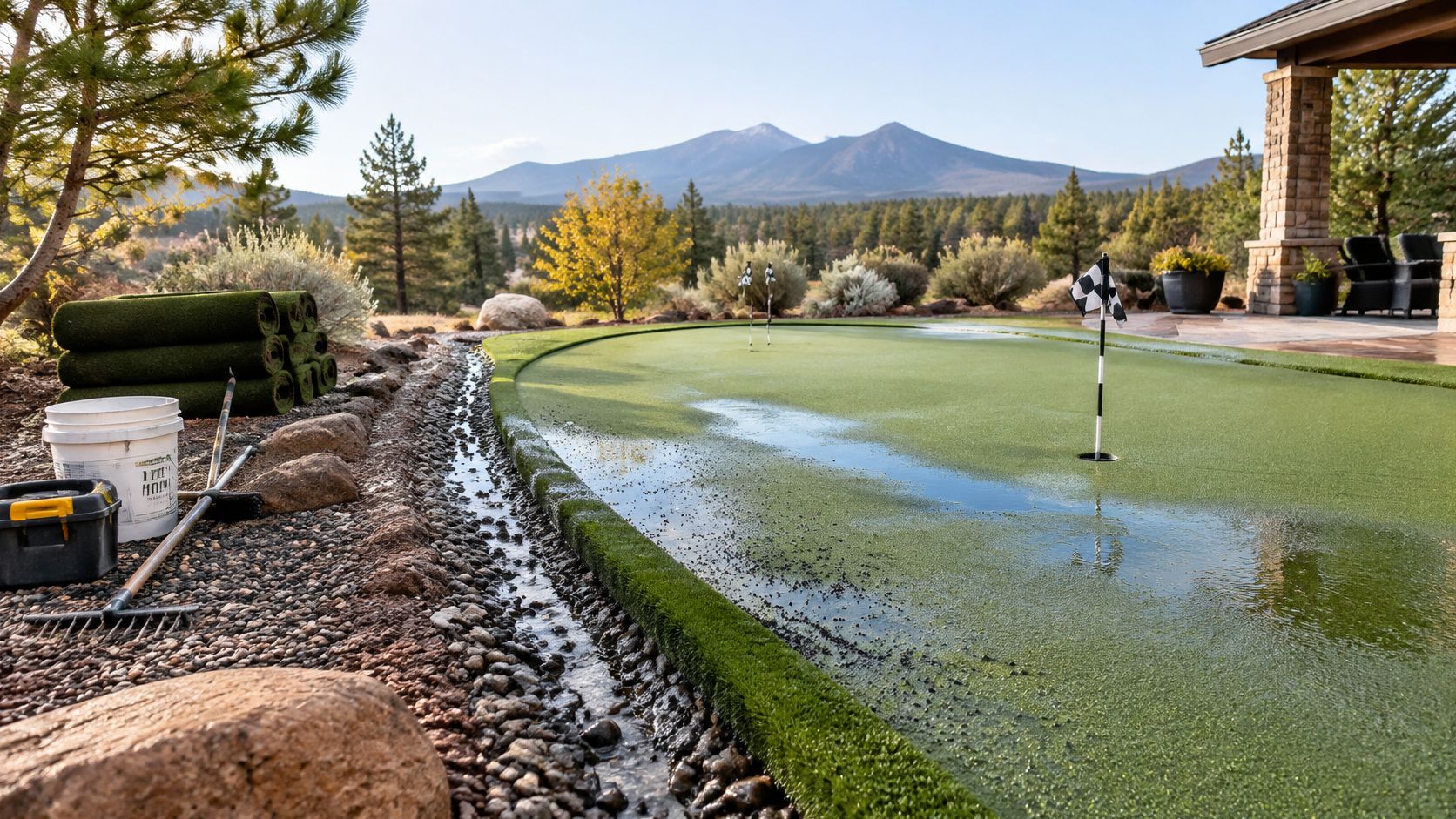
This installation image highlights the materials that deserve attention beyond the finished surface.
What should you know about infill and disposal?
Phys.org's 2025 coverage of artificial grass discusses runoff, recycling difficulties and microplastic pollution, alongside the EPA tire-crumb study's limitations: it did not specifically test for PFAS target analytes, although non-targeted analyses identified no PFAS in tire crumb rubber. That distinction doesn't establish that every turf, backing or infill product is PFAS-free or risk-free.
Request documentation for the actual proposed materials. Rubber infill, recycled content, adhesives and cleaning products shouldn't be treated as interchangeable, and findings about tire crumb shouldn't be casually applied to an entirely different infill.
Ask these questions before approving the material schedule:
What's in the infill? Get the product name, composition and relevant safety documentation.
How will this assembly handle heavy rain? Confirm the drainage path, edge restraint and how permeability will be checked.
What happens at replacement? Request the removal plan, likely disposal route and any recycling arrangements that accept the material.
Is a recycling promise enough?
No. Ask who accepts the removed product and whether infill separation, transport and disposal are included in the replacement scope.
Read warranty exclusions for pet use, weather-related movement and cleaning chemicals. A durable installation still needs a realistic removal plan, and a firm surface that rolls well can limit infiltration when the underlying assembly is poorly built.
How to Vet a Putting Green Contractor in Prescott
Screen the contractor before comparing turf brands. A proposal should establish who's responsible for the buried construction, not merely identify the roll of material.
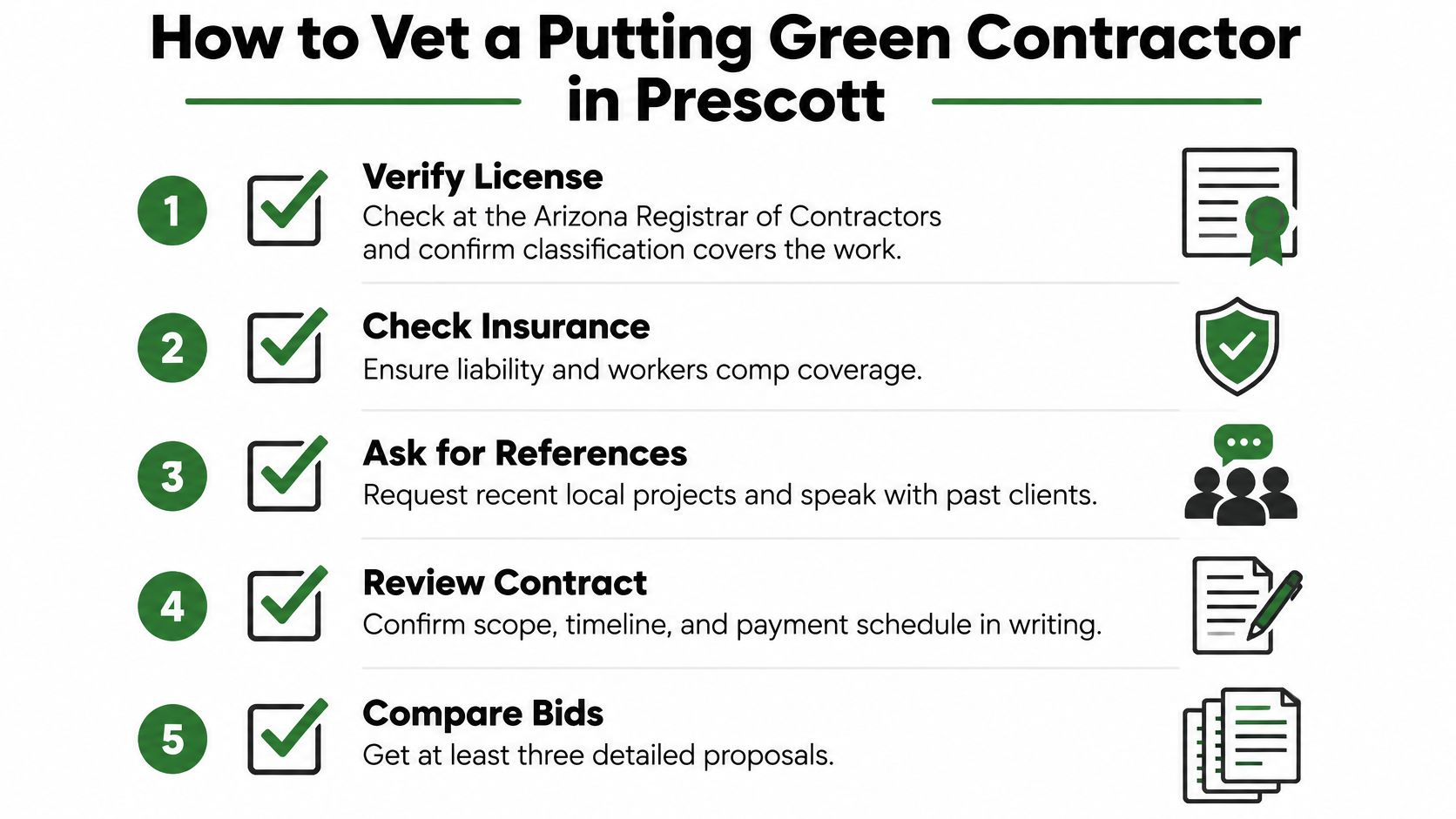
Verify the license and classification. Arizona generally requires a contractor's license when labor and materials exceed $1,000, or when a permit is required regardless of price, according to the Arizona Registrar of Contractors' classification guidance. Confirm that the classification covers the proposed work.
Compare detailed written estimates. The ROC's before-you-hire guidance recommends estimates from at least three contractors, license checks, references and a written contract identifying the project, price, permit responsibility, license number, and start and completion dates. Compare construction scope rather than the lowest total.
Request relevant local references. Ask about recent putting-green work in Prescott, Prescott Valley or Chino Valley and whether you can view a completed installation. Ask owners about communication, drainage and follow-up, not just appearance.
Review the contract and insurance. Require excavation, base depth, edging, drainage, seams and removal responsibilities in writing. Request current evidence of applicable liability and workers' compensation coverage.
Use this checklist when reviewing proposals.
What protections come with licensed contracting?
The Arizona ROC's consumer-protection overview states that residential contractors must provide $200,000 of protection through a surety bond, cash deposit or Recovery Fund participation, and qualifying Recovery Fund claims can reach $30,000. Eligibility and claim requirements apply; this isn't a blanket guarantee for every dispute.
R.E. and Sons Landscaping is licensed, bonded and insured in Prescott and lists Arizona ROC #300642. Verify that credential yourself before signing.
A proposal that names only the turf leaves the most consequential work undefined. Clear construction responsibilities make both price comparisons and later inspections more useful.
Book a Consultation and Get Answers
Book a consultation when you're ready to connect a practice idea to the actual yard, even if you haven't chosen turf yet. A useful consultation should resolve layout questions before you commit to materials.
Our process begins with a guided consultation based on your vision. During design, you approve a custom layout that fits the yard's grade and integrates with existing hardscape, followed by transformation and enjoyment.
Use the consultation to explain whether you want quiet putting practice, family recreation or a green that connects to a larger patio renovation. Those priorities affect how much space should remain open around the playing surface.
The website provides a starting point for exploring the company and arranging the conversation.
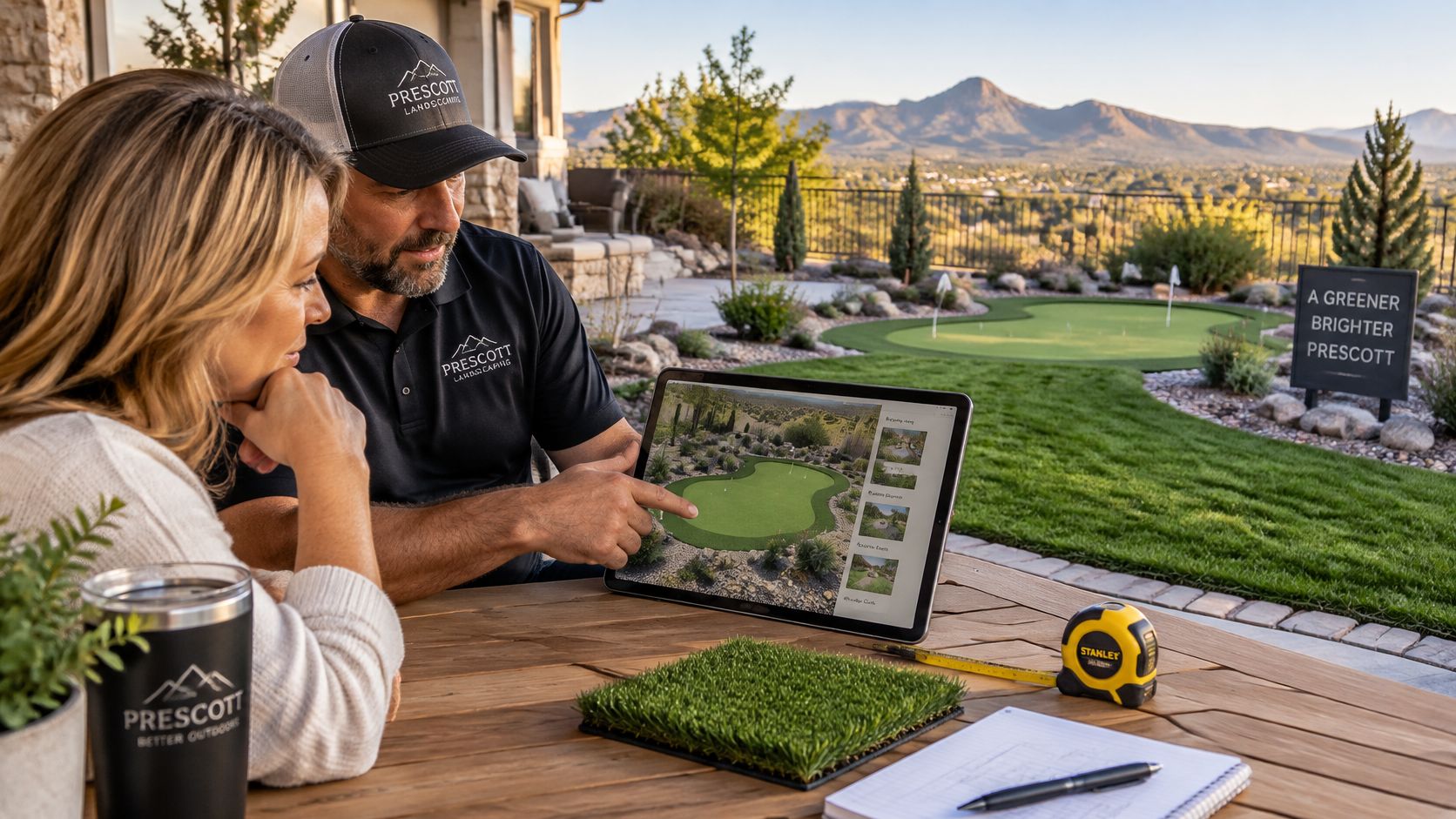
What should you bring to the consultation?
Contact the team to schedule. Explain your location and whether the putting green is a standalone project or part of a broader yard.
Bring useful site information. Rough measurements, photos showing sun exposure and pictures of existing patio edges help make the discussion specific.
Approve the construction decisions. Confirm the layout, base depth, drainage route and infill, then make sure the written scope reflects those decisions.
Keep your specification questions with the design documents. It's easier to resolve an unclear transition or cup location on a drawing than after the materials arrive.
How long does a backyard putting green take to install?
Timing depends on the size and condition of the space, including access and preparation needs. Turf projects skip the grow-in period, so they usually finish faster than a full traditional lawn installation.
Can a small yard fit a putting green?
Yes, smaller greens and short putting runs can fit around patios and planting beds. Preserve room for a comfortable stance and safe walking access rather than filling every available corner with putting surface.
Do I need a permit?
Permit requirements depend on the project's scope, particularly when related grading, drainage or structural work is involved. Have the contractor confirm permit responsibility in writing before work begins.
R.E. and Sons Landscaping offers a free turf consultation to help you plan a backyard putting green suited to your practice goals and Northern Arizona yard. Visit R.E. and Sons Landscaping to schedule a conversation, and bring your rough measurements, sun-exposure photos and questions about the foundation beneath the turf.
Comments